Blind Curves on a Desert Mountain Road
There's a specific kind of knot that forms in your stomach when you're navigating an Arizona desert mountain road on your ATV or UTV, and you know there's a blind curve coming up. You can't see what's on the other side – is it a giant pickup truck, another side-by-side, a washed-out section of road, or even a herd of cattle? This guide is all about helping you conquer that anxiety and master the art of safely taking on those tricky blind corners, ensuring your desert adventures stay thrilling, not terrifying.
The Unique Dangers of Desert Blind Curves for OHVs
Riding off-highway vehicles (OHVs) in Arizona means embracing some of the most stunning, rugged landscapes out there. But with that beauty comes a certain level of unpredictability, especially when you're traversing mountain roads with their notorious blind curves. It's not the same as driving your car on a paved highway; the stakes feel different, and the potential hazards are amplified.
Limited Visibility and Unexpected Obstacles
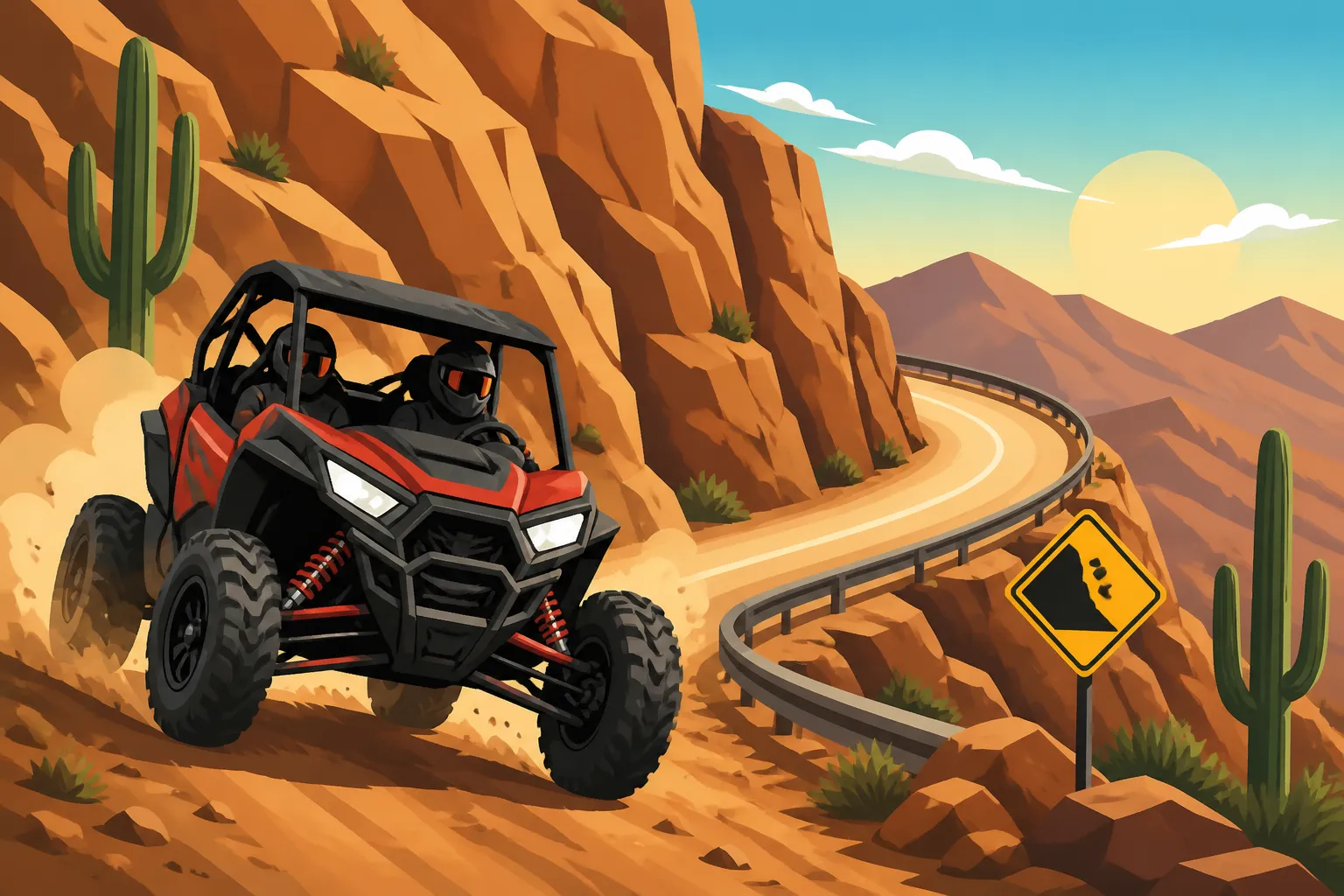
Imagine you're cresting a hill, and the road immediately drops into a sharp, tight turn around a rock outcropping. The desert terrain, with its steep canyons, dense saguaro forests, and sudden changes in elevation, acts like a natural curtain, hiding whatever lies beyond the bend. You might be riding along, feeling the sun on your face, only to suddenly encounter a wash-out from a recent monsoon storm that has carved a deep rut across the road. Or perhaps a large boulder has tumbled down, blocking half the path.
Then there’s the traffic. While you might expect other OHVs, these roads are often shared by full-size trucks heading to a remote cabin, ranchers on their daily rounds, or even construction vehicles. The size disparity between your side-by-side and a lifted Ford F-350 coming around a blind corner is a jarring thought. And let's not forget the wildlife – a deer, javelina, or even a cow can appear out of nowhere, especially at dawn or dusk, creating an immediate, urgent need to react. The limited sightlines on these desert mountain roads mean you have far less time to process and respond to these sudden appearances, making proper technique absolutely crucial.
The Weight and Momentum of Your Machine
Your UTV or ATV isn't a sportscar built for nimble cornering on asphalt. These machines are designed for rugged terrain, but that also means they handle very differently under sudden stress. When you're carrying speed into a blind curve, the momentum of your machine – especially a heavier side-by-side loaded with gear and passengers – can quickly become your enemy. A sudden slam on the brakes might cause your machine to skid, or worse, to lock up and lose control. If you swerve too sharply to avoid an unforeseen obstacle, you risk a rollover, particularly with machines that have a higher center of gravity.
Modifications also play a role. If you've installed a lift kit or larger tires, your machine's handling characteristics have changed. While a lift kit from a company like SuperATV might be great for clearing obstacles, it can also raise your center of gravity, making roll-overs a greater risk if you take a blind curve too fast. Understanding how your specific machine responds to braking, steering, and throttle input is paramount. Practice in a safe, open area to get a feel for its limits before you tackle those challenging mountain roads. The last thing you want is to discover your machine's breaking point while hugging the edge of a sheer drop-off around a curve.
Essential Pre-Ride Planning and Machine Prep
Safety on blind curves starts long before your tires hit the dirt. It begins with meticulous planning and making sure your machine is in peak condition to handle whatever the desert throws at it. A little foresight can prevent a lot of heartache and potential danger out on the trails.
Scouting Your Route and Understanding Conditions
Never underestimate the power of good old-fashioned research. Before you even load your machine, take some time to scout your intended route. Modern technology makes this easier than ever. Utilize digital mapping apps, but don't forget a physical map as a backup, especially since [Cell Service in the Arizona Backcountry] can be spotty. Look for sections marked with switchbacks, steep grades, or tight turns. These are your red flags for potential blind curves. Pay attention to contour lines on topographical maps; tight lines indicate steep terrain, often leading to more challenging, view-obstructing corners. You can learn a lot from [Reading an Arizona Motor Vehicle Use Map] about designated routes and potential hazards.
Beyond the map, check recent weather forecasts. Heavy rains, even days before your ride, can create washouts, mudslides, and loose gravel on mountain roads, making curves even more treacherous. Conversely, prolonged dry spells contribute to massive dust clouds, severely limiting visibility for you and oncoming traffic. Talking to local riders or checking online forums for recent trail reports can give you invaluable, real-time insights into specific conditions, such as recent rockfalls or newly formed ruts. Understanding these conditions beforehand helps you anticipate difficulties and adjust your riding style accordingly.
Equipping Your OHV for Maximum Safety
Visibility isn't just about what you can see; it's also about what others can see of you. On twisty mountain roads, standing out is a matter of safety. Ensure all your lights are in perfect working order. This means bright headlights that illuminate the path ahead, taillights that clearly mark your presence from behind, and brake lights that signal your intentions immediately. Arizona has specific rules, like [Arizona's 500 Foot Headlight Rule], that are worth knowing. Consider adding auxiliary lights, especially if you anticipate riding at dawn, dusk, or through particularly shaded canyon sections. A light bar or cube lights from a brand like SuperATV can dramatically improve your forward visibility and help you spot obstacles sooner.
Furthermore, a whip flag is not just for sand dunes; it’s a critical safety device for mountain roads. A tall flag mounted on your machine, visible above brush and terrain, can be the first warning sign to an oncoming driver that something is around the bend. Reviewing guidelines for [Whip Flags on a Road Section of a Ride] can clarify proper usage. Reflective tape on your machine or helmet also adds a layer of passive visibility. Finally, don't overlook your braking system. Regular maintenance is key; ensure your brake pads aren't worn thin and your fluid levels are good. Your life might depend on your ability to stop quickly and controllably. Check your tire pressure for the terrain too – typically lower pressure for softer ground, but consult your owner's manual for recommended ranges for rocky, uneven roads to ensure optimal grip without risking a flat.
Navigating Blind Curves with Skill and Caution
Once you're out on the trail, armed with your well-prepped machine and a good understanding of the route, the real work begins: applying smart riding techniques to safely navigate those daunting blind curves. This isn't about speed; it's about control, anticipation, and respect for the unknown.
The "Slow In, Fast Out" Approach
This classic riding technique is your best friend when approaching a blind curve. Here's how it works: As you approach a curve, significantly reduce your speed before you enter the turn. This gives you maximum time to react if you encounter an unexpected obstacle or vehicle. As you enter the curve, try to position your machine to see as far through the turn as possible. On a left-hand curve, you'd hug the right side of the road (assuming you're driving on the right). On a right-hand curve, you'd stay towards the left side of your lane if it's safe to do so, maximizing your line of sight around the bend without crossing into oncoming traffic.
Maintain a steady, controlled speed through the curve, constantly scanning ahead. The moment you can see the exit of the curve and confirm the path is clear, you can smoothly and gradually accelerate out of the turn. This "slow in, fast out" method ensures that if something is waiting for you on the other side, you have the maximum amount of time and space to react, brake, or steer safely. Remember, these aren't race tracks, and the [Arizona Speed Limits for Street-Legal Machines] are there for a reason, especially on unpaved roads. Don't be afraid to take it easy.
Communication and Awareness for Group Rides
Riding with a group adds another layer of fun, but also another layer of responsibility, especially on blind curves. Effective communication is non-negotiable. Before you head out, establish a clear set of hand signals for common scenarios: "stopping," "hazard ahead," "slow down," "oncoming traffic," and "turn ahead." Make sure everyone in your group knows and understands these signals. For even better communication, consider investing in two-way radios or helmet-mounted intercom systems. These allow for real-time alerts about conditions around the bend.
When riding in a group, a staggered formation is often recommended. This isn't just for dust reduction; it gives each rider a slightly different visual line around curves and helps prevent "accordion" effects where everyone bunches up. The lead rider has the critical job of calling out potential hazards or approaching vehicles before they're visible to those behind. For example, a simple "truck coming!" or "washout left!" can give the rest of the group precious seconds to adjust. Always ensure that the rider behind you sees your signals before you proceed, and if you lose sight of someone, slow down or stop until they catch up.
Honking and Hazard Signals
Sometimes, even the most careful "slow in" approach isn't enough on truly obscured curves. On exceptionally tight, narrow, and blind mountain roads, especially those where the terrain rises steeply on both sides, a quick honk of your horn can be a lifesaver. Before entering a completely blind curve, especially one where you suspect other traffic, give a couple of short, sharp blasts of your horn. This alerts any oncoming vehicles to your presence. Arizona has specific requirements for the sound a horn makes, wanting it [The Horn Arizona Wants Audible at 200 Feet], so make sure yours is up to snuff. This small action can give an approaching vehicle a heads-up, prompting them to slow down and prepare.
Hazard lights are another underutilized safety tool. If you encounter an unexpected problem on a blind curve – perhaps you need to stop to clear a fallen branch, or you're moving exceptionally slowly due to severe washouts – turning on your hazard lights immediately can warn both oncoming and trailing traffic. This is particularly important on roads where you might be temporarily blocking the path or creating a bottleneck. Remember, the goal is to be as predictable and visible as possible, giving everyone on the road maximum time to react to your presence and actions.
What to Do When the Unexpected Happens
Despite all your careful planning and cautious riding, the desert has a way of throwing curveballs. When the unexpected happens on a blind curve, knowing how to react calmly and effectively can prevent a minor incident from escalating into something far more serious.
Encountering Oncoming Traffic
You've done everything right: slowed down, hugged your line, perhaps even honked. But then, there it is – a full-size pickup truck or another OHV, bearing down on you from around the blind corner. Your immediate priority is controlled braking. Avoid slamming the brakes, which can cause a skid, but apply firm, steady pressure. Steer straight or gently towards the widest part of the road that is safely on your side. If there's a small pull-off or wider section of the shoulder available, aim for it.
On narrow mountain roads, sometimes one vehicle has to yield more than the other. Generally, larger vehicles have less maneuverability, but as an OHV, you can often find a safe spot off to the side more easily. Be prepared to yield the right of way, even if you feel you have it. A quick wave can sometimes communicate "I see you, I'm slowing down." If you're in a group, the lead rider should immediately alert those behind, who should then also slow and prepare to pull over. Common courtesy and a willingness to share the road safely go a long way in these situations.
Dealing with Obstacles or Hazards
It’s not always other vehicles; sometimes it’s the trail itself. A surprise rockfall, a deep erosion gully, or a section of the road that has become extremely soft and sandy after a storm can appear without warning. Your primary goal is to maintain control of your machine. If you can stop safely before reaching the obstacle, do so. Assess the situation: can you navigate around it safely, or is it too wide or too deep? If it’s something you can move, like a smaller rock or branch, and it’s safe to do so, clear it.
If the obstacle is significant and impassable, you might need to back up, turn around, or find an alternative route. This is where having a spotter in your group can be invaluable. They can guide you through tricky maneuvers, ensuring you don't inadvertently put yourself or your machine in a more precarious position. If the hazard is serious and could endanger other riders, consider reporting it to the appropriate land management agency. [Arizona State Trust Land Recreational Permits] often come with information on who to contact for trail issues.
Accident Protocol
No one wants to think about it, but accidents can happen, especially on challenging terrain like blind curves. If you're involved in a collision or a rollover, your first priority is the safety of everyone involved. Check for injuries. If anyone is hurt, provide immediate first aid if you're trained, and call for emergency help. Keep in mind that [Cell Service in the Arizona Backcountry] can be unreliable, so having a satellite messenger or knowing where the nearest ranger station is crucial.
If other parties are involved, safely move vehicles off the active roadway if possible and exchange information. Take photos of the scene, damage, and any relevant road conditions. Even if it's a single-vehicle incident, documenting what happened can be important for insurance or just for learning from the experience. Remember that Arizona has specific [Arizona OHV Crash Reporting] requirements, so be sure to understand what's expected of you after an incident. Staying calm, prioritizing safety, and documenting the situation will help navigate a difficult moment.
Disclaimer
This article is for general informational purposes only and does not constitute professional advice. Laws, prices and regulations vary by location and change over time. Consult a qualified professional for guidance on your specific situation.