DOT Helmet Ratings Arizona Accepts
You are loading the kids and the side-by-side for a weekend near Florence or the Mogollon Rim, and someone asks whether that bargain helmet from a swap meet is actually legal. The sticker on the back says DOT, but so do plenty of novelty lids. This guide explains which helmet ratings Arizona accepts, who must wear one, and how to spot a helmet that only pretends to qualify.
What Arizona Law Actually Requires
Arizona has a reputation as a “no helmet” state, and for adult riders that reputation is mostly accurate. The picture changes quickly once a rider under 18 is involved, and the specific standard the law refers to is the one that trips people up.
The Under 18 Rule for Off-Highway Vehicles
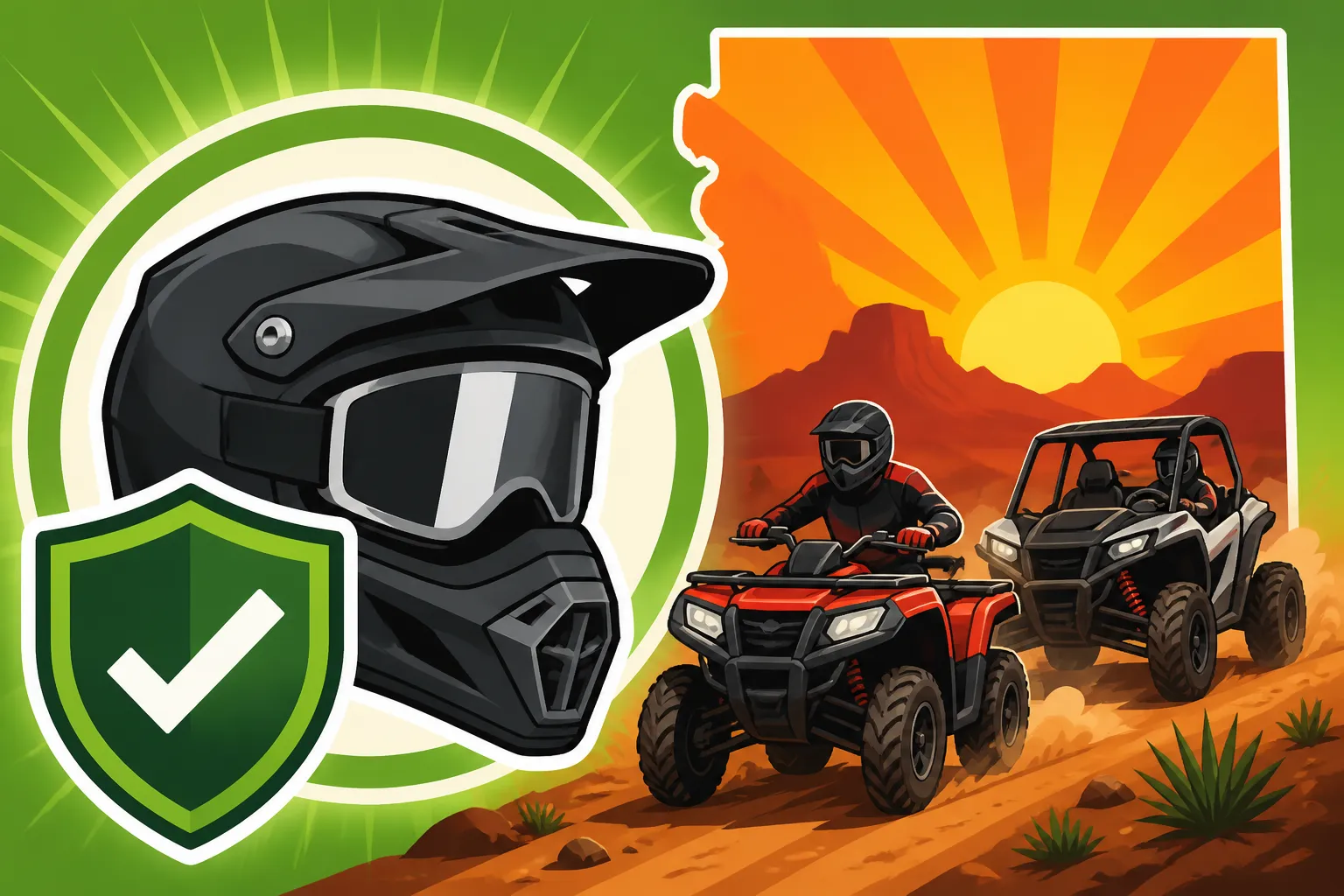
Arizona’s off-highway vehicle statute requires anyone under 18 who operates or rides on an OHV on public or state land to wear protective headgear that is properly fitted, fastened, and designed for motorized vehicle use, with a minimum US Department of Transportation safety rating. That covers ATVs, UTVs, side-by-sides and dirt bikes used off-highway on public and state trust land.
Notice the words “operates or rides on.” The rule is not just for the young driver. A 12-year-old passenger in a side-by-side, or a teen riding two-up on an ATV designed for it, falls under the same requirement. If you want the full breakdown of how the under 18 rule plays out on the trail, see Arizona Helmet Rules for Riders Under 18.
Adults and the Helmet Question
Arizona does not require riders aged 18 and older to wear a helmet on an OHV by state law, and the same is true for adult motorcycle riders on the road. That is a legal floor, not a recommendation. Certain private riding areas, organized events, races, and some managed recreation sites set their own rules and may require helmets for everyone regardless of age. If you are riding in a group event or at a staging area run by a club, check the event rules before you assume adults can ride bareheaded.
Public Land, State Land and Roads
The OHV helmet requirement is written around riding on public and state land, which covers the bulk of Arizona’s riding: Bureau of Land Management areas, national forest roads and trails, and state trust land. On private land with the owner’s permission, state helmet law generally does not apply, although the landowner can set conditions.
Once a street-legal machine with a motorcycle plate is on a public road, motor vehicle rules come into play as well. Arizona’s motorcycle equipment law also requires riders under 18 to wear a helmet on the road, so a teen in a plated UTV crossing between trail systems is covered either way. How different land types are treated is explained in Arizona Helmet Standards on Public and State Land.
| Rider and Location | Helmet Required by Arizona Law? | Standard Referenced |
|---|---|---|
| Under 18 operating an OHV on public or state land | Yes | Minimum DOT rating |
| Under 18 riding as a passenger on public or state land | Yes | Minimum DOT rating |
| Under 18 on a public road on a plated machine | Yes | Minimum DOT rating |
| 18 and older on public or state land | No, by state law | Not specified |
| 18 and older on a public road | No, by state law | Not specified |
| Any age at an event or private facility | Depends on the organizer or owner | Set by the organizer |
Understanding the DOT Rating
When Arizona law refers to a helmet with a DOT rating, it means a helmet certified as meeting Federal Motor Vehicle Safety Standard No. 218, the US standard for motorcycle helmets. It is worth understanding what that rating covers, because it explains why some helmets qualify and others only appear to.
What FMVSS 218 Tests For
The DOT standard sets minimum performance requirements in a few key areas. Impact attenuation measures how much of a blow the helmet absorbs before force reaches the head. Penetration resistance checks that a pointed object cannot push through the shell. The retention test makes sure the chin strap and buckle hold the helmet on under load. There are also requirements for peripheral vision, so the helmet does not block too much of the rider’s side view, and for labeling, so the rider knows what they are wearing.
A helmet that passes these tests is not indestructible, but it has been built to a defined minimum. A novelty helmet, the thin shell with little or no liner sometimes sold as a “beanie,” usually fails badly on impact and penetration and therefore does not meet the standard.
How Certification Works
DOT certification in the United States is a self-certification system. The manufacturer is responsible for ensuring its helmets meet FMVSS 218 and for affixing the label. The federal government does not pre-approve each model before it goes on sale, but it does buy helmets from the market and test them for compliance. Models that fail can be the subject of recalls or enforcement.
In practice, helmets from established manufacturers sold through reputable dealers reliably meet the standard. The risk comes from unknown brands, auction listings, and secondhand helmets whose history you cannot verify.
Reading a Genuine DOT Label
A compliant helmet carries a permanent label on the outside rear of the shell. It should show the letters DOT, the words FMVSS No. 218, and the word CERTIFIED, along with the manufacturer’s name or brand and the precise model designation. Inside the helmet, there should be another permanent label showing the manufacturer, model, size, and month and year of manufacture, plus care instructions.
Warning signs of a questionable helmet include a DOT sticker that looks like a loose decal rather than a permanent label, a label without the manufacturer and model on it, a very light shell with a thin foam liner, or a helmet sold with the label “in the box” for the buyer to apply. Removable DOT stickers exist precisely so novelty helmets can look compliant. They do not make the helmet compliant.
Other Standards and How Arizona Treats Them
Riders who shop online or buy from overseas sellers will see other ratings, and many good helmets carry more than one.
| Rating | Where It Comes From | Does It Satisfy Arizona’s Requirement on Its Own? |
|---|---|---|
| DOT FMVSS 218 | United States federal standard | Yes, this is the standard the statute names |
| Snell M-series | Private US foundation, voluntary | Not on its own; most Snell helmets also carry DOT |
| ECE 22.06 | European standard | Not on its own unless the helmet is also DOT certified |
| FIM racing homologation | International racing standard | Not on its own; many are also DOT or ECE |
| No rating or novelty label | None | No |
| Bicycle helmet standards | Designed for pedaling speeds | No, not designed for motorized use |
The practical takeaway is simple. When you buy for an Arizona rider under 18, make sure the helmet carries a genuine DOT label, whatever else it has. A Snell or ECE rating on top of DOT is a bonus, not a substitute. A bicycle or skate helmet, however sturdy it looks, does not count, because the law requires headgear designed for motorized vehicle use.
Choosing the Right Helmet for Arizona Riding
Meeting the legal minimum is the starting point. Arizona’s dust, heat, rocks and long desert miles make some helmet styles much better choices than others, especially for kids.
Helmet Styles Compared
Several styles of helmet can carry DOT certification. They protect very differently.
| Helmet Style | Coverage | Strengths in Arizona | Weaknesses |
|---|---|---|---|
| Full-face motocross | Full head and chin, open eye port | Strong protection, good airflow, works with goggles | Needs separate goggles; hotter at low speed |
| Dual-sport | Full face with visor and peak | Versatile for trail and road sections | Heavier than motocross |
| Modular | Full face with flip-up chin bar | Convenient for stops | Heavier; chin bar is a mechanical part |
| Open-face | Head coverage, no chin bar | Cooler and lighter | Leaves the face and jaw exposed |
| Half helmet | Top of head only | Lightest and coolest | Least protection; poor in rollovers |
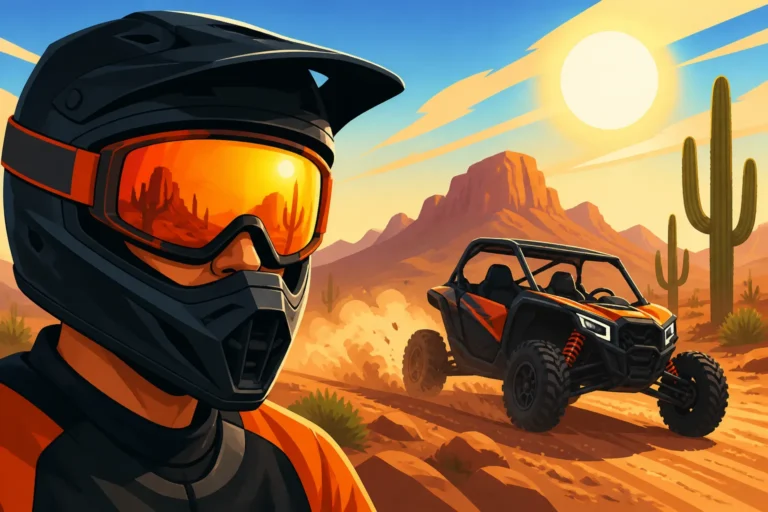
For riders under 18 on ATVs and dirt bikes, a full-face motocross helmet with goggles is the most common choice on Arizona trails, and for good reason. Desert falls often involve the face and chin hitting rocks or the ground. In enclosed UTVs with a roll cage, some families choose open-face or lighter full-face helmets for comfort, but a rollover can still bring the head into contact with the cage or terrain.
Fit Matters as Much as the Rating
The statute says “properly fitted and fastened,” and that is not just legal language. A DOT helmet that is two sizes too big provides far less protection, because it can shift or come off in a crash. Children are especially prone to wearing hand-me-down helmets that do not fit.
To check fit:
- Measure the head circumference about an inch above the eyebrows and compare it to the manufacturer’s size chart.
- Put the helmet on and fasten the strap snugly, with room for no more than one or two fingers under the chin.
- Try to rotate the helmet side to side; the skin of the forehead should move with it.
- Try to roll the helmet forward off the head from the back; it should not come off.
- Wear it for several minutes indoors to check for pressure points before a long ride.
- Recheck fit at the start of each season, since kids grow quickly.
Heat, Dust and Eye Protection
Arizona summers push riders toward the lightest, coolest option, and that is when helmets come off. Plan around it. Ride early in the morning, choose helmets with good ventilation, and carry plenty of water. The bigger risk in summer is heat illness, which is discussed in Summer Heat and Arizona Road Riding.
Dust is the other constant. Goggles or a face shield make a huge difference on dirt roads and wash crossings. If a machine will travel on public roads, Arizona also has eye protection requirements for motorcycle-style operation unless the vehicle has a suitable windshield; Eye Protection on an Arizona Road explains when that applies. Many UTV owners add a windshield or a half windshield, and aftermarket suppliers such as SuperATV offer windshields, roofs and mirrors for popular side-by-side models. A windshield can help with roost and dust but does not replace a helmet for a minor.
Youth Helmets and Growing Riders
Youth helmets are built on smaller shells and lighter liners, and the good ones carry the same DOT certification as adult models. The challenge is that children outgrow them. A seven-year-old who fits a youth medium in spring may need a youth large by the next riding season. Parents often try to stretch a helmet’s life by buying a size up and adding thicker padding, but that tends to produce a helmet that sits loosely in a crash.
A better approach is to buy the size that fits now and plan to replace it as the child grows. Some families keep a small rotation of helmets that pass down from older to younger children, which is perfectly sensible as long as each helmet is crash-free, within its useful life, and fits the rider wearing it that day. Write the size and purchase date on a piece of tape inside the helmet bag so you know at a glance which one belongs to whom.
Weight matters for younger riders too. A heavy adult helmet on a small child puts extra strain on the neck, especially over long, bumpy desert miles. Choose a helmet designed for youth riders rather than the smallest adult size you can find.
Cameras, Communicators and Modifications
Helmet cameras and Bluetooth communicators are popular for group rides, and they make it easier to keep track of kids spread out along a trail. Mount them with care. Adhesive mounts designed for helmets are generally preferred over anything that requires drilling, because drilling into a shell can weaken it and may void the manufacturer’s certification. Avoid painting a helmet with solvent-based products, cutting the liner to fit speakers, or removing parts of the shell, since all of these can change how the helmet performs in an impact.
If a modification changes the structure of the helmet, it is no longer the helmet that was certified. For a rider under 18, that could raise questions about whether it still meets the DOT requirement, and more importantly, it may not protect as designed.
When to Replace a Helmet
Helmets are designed to absorb one significant impact. After a hard crash, the foam liner may be compressed even if the shell looks fine, and the helmet should be replaced. Most manufacturers also suggest replacing helmets after several years of regular use, since liners and padding degrade with sweat, UV exposure and heat. Arizona’s sun is particularly hard on gear stored in the back of a truck, so keep helmets out of direct sun when you can.
Avoid buying used helmets unless you know their full history. A helmet that has been dropped hard onto pavement or worn in a crash may look perfect and still be compromised.
Practical Compliance on Arizona Trails and Roads
Knowing the rules is only useful if you can apply them on a busy weekend with several kids, multiple machines, and changing terrain.
A Pre-Ride Helmet Checklist
Before leaving the staging area, run through a quick check for every rider under 18:
- Confirm the helmet carries a permanent DOT label with the manufacturer and model.
- Confirm the size is right for the rider, not for an older sibling.
- Fasten the strap and check it is snug.
- Inspect the shell for cracks and the liner for compression or damage.
- Make sure goggles or a visor are on hand for dusty sections.
- Check that every passenger under 18 also has a helmet, not just the driver.
Passengers and Shared Machines
Families often run into trouble with passengers. A parent driving a side-by-side may be legally exempt as an adult, but the teenager in the passenger seat is not. The same applies to the back row of a four-seat UTV. Make sure there are enough helmets for every minor who will ride, including friends and cousins who come along. Passenger rules on road sections are covered in Passengers on an Arizona Road Section.
Seat belts or harnesses add another layer of safety in a UTV. Many owners upgrade from factory belts to harnesses from suppliers like SuperATV, and that can be a worthwhile addition, but harnesses complement a helmet; they do not satisfy the helmet requirement.
Who Is Responsible if a Minor Rides Without a Helmet
When a young rider is stopped without proper headgear, the question of responsibility comes up quickly. Depending on the circumstances, the operator, the minor, or the parent or guardian who allowed the minor to ride may face consequences. The details, and why officers on public land take this seriously, are in Who Gets the Ticket When an Arizona Child Rides.
Road Sections and Street-Legal Machines
Many Arizona rides link trail systems with short stretches of county or forest roads, and some families plate their side-by-sides so they can use public roads legally. If your machine is street legal, the under 18 helmet rule still applies on the road, along with other equipment and licensing rules. The process of plating a UTV is explained in Making a UTV Street Legal in Arizona, and Getting an MC Plate for a Side-by-Side covers the registration step.
Before heading out, check which roads are actually open to OHVs, since the answer varies by jurisdiction. Which Arizona Roads Allow OHVs is a good starting point, and national forest roads have their own designations that are explained in Arizona Rules on Forest Service Roads.
Shopping Smart for DOT Helmets
When buying helmets for a family, especially several youth sizes at once, it is tempting to go for the cheapest option online. A few habits keep you on the right side of the law and safety:
- Buy from established dealers or reputable retailers that list the certification clearly.
- Avoid listings that describe the helmet as “novelty,” “for display,” or “not for highway use.”
- Look for photos of the permanent rear DOT label showing the brand and model.
- Try helmets on in person when you can, especially for children.
- Keep receipts and the inside label intact in case you ever need to show the helmet’s certification.
Some riders also buy helmets alongside other gear from UTV accessory suppliers such as SuperATV, while others prefer dedicated motorsports dealers where they can try sizes. Either way, check that the specific helmet model carries DOT certification, and check the seller’s own page for current pricing and availability.
Disclaimer
This article is for general informational purposes only and does not constitute professional advice. Laws, prices and regulations vary by location and change over time. Consult a qualified professional for guidance on your specific situation.