Arizona MVD OHV Registration Explained
Navigating the Arizona Motor Vehicle Division (MVD) can feel like deciphering an ancient scroll, especially when you're just trying to get your beloved ATV or UTV registered for some desert adventures. The process isn't always straightforward, and it's easy to get bogged down in paperwork and confusing instructions. This comprehensive guide is here to untangle the Arizona MVD OHV registration process, walking you through everything you need to know to get your machine legal and ready for the trails.
What Even Is OHV Registration in Arizona?
When we talk about OHV registration in Arizona, it's often a source of confusion for new and even experienced riders. People tend to lump together titling, registration, and the annual OHV decal, thinking they're all the same thing or that one automatically includes the others. The reality is that these are distinct but interconnected steps that ensure your off-highway vehicle is legally recognized and authorized for use on public lands. Understanding these differences from the outset will save you a lot of headaches and ensure you're compliant with Arizona law.
Distinguishing Registration, Titling, and Decal
Let's break down the components. Titling is about establishing legal ownership of your OHV. It's similar to owning a house – the title is the deed. The Arizona Department of Transportation (ADOT), through its MVD, issues a Certificate of Title, which serves as the official record of who owns the vehicle. This document is crucial for proving you are the rightful owner, especially if you ever decide to sell your machine or if it's stolen. Without a title, proving ownership can become a tangled mess, so securing your [Arizona Certificate of Title for an Off-Highway Vehicle] is paramount.
Registration, on the other hand, is the process of recording your vehicle with the MVD for identification and taxation purposes. For most OHVs that weigh 1,800 pounds or less, you will receive an "RV" (Recreational Vehicle) license plate. This is a perpetual registration, meaning it doesn't expire annually like a car's registration. However, simply having this plate isn't enough to ride off-highway on public lands. That's where the OHV Decal comes in. The decal is an annual permit managed by the Arizona Game and Fish Department (AZGFD) that grants you access to designated OHV trails and areas. It's a user fee, essentially, that funds trail maintenance, law enforcement, and other OHV-related programs. Many people ask, [Arizona's Annual OHV Decal Explained], and it's vital to understand its unique role.
Why OHV Registration Matters for Arizona Riders
Beyond simply following the law, properly registering and decaling your OHV in Arizona carries significant benefits. First and foremost, it keeps you legal. Riding an undecaled or unregistered machine on public lands can lead to hefty fines and citations from law enforcement agencies like the Game and Fish Department, Forest Service, or Bureau of Land Management (BLM). Nobody wants a day of fun cut short by a ranger handing out a ticket because you missed a step in the process. You can learn more about [What an Arizona Ranger Asks a Rider For] to understand the common checks.
Secondly, the system ensures that the OHV community is contributing to the very trails and facilities we enjoy. The funds generated by the annual OHV decal go directly into the Arizona OHV Fund, which is used for important initiatives such as trail construction and maintenance, signage, law enforcement patrols, and educational programs. So, when you pay for that decal, you're directly investing in the future of OHV recreation in our beautiful state. It's a way for riders to give back and ensure these incredible outdoor opportunities remain accessible and well-maintained for generations to come.
The Essential Documents You'll Need to Gather
Before you even think about stepping foot into an MVD office or heading online, the absolute first step is to gather all your necessary documentation. This is where most people get tripped up, facing delays because they've forgotten a crucial piece of paper. The MVD is pretty strict about its requirements, and rightly so, as these documents prove ownership, identity, and ensure your machine meets all legal standards. Think of it as building your case for your OHV's legal existence – every piece matters.
Proving Ownership: Titles, Bills of Sale, and Affidavits
The cornerstone of OHV registration is proving you own the machine. For a brand-new OHV purchased from an Arizona dealer, this is usually straightforward. The dealer will provide you with a Manufacturer's Certificate of Origin (MCO), which is basically the OHV's birth certificate. They often handle much of the initial titling and registration paperwork on your behalf, which is a huge convenience. However, if you're buying from a private seller, the game changes. You'll need the seller's properly signed-off Certificate of Title. This title must be clear of any liens and the seller's signature needs to be present, along with the odometer reading (if applicable, though less common for true OHVs) and the date of sale. You might find it helpful to look into [What an Arizona Bill of Sale Should Carry] to ensure all the details are covered in your private transaction.
Sometimes, things aren't so simple. What if the seller never got a title in their name, or the title is lost? Arizona offers options for these scenarios, but they typically involve additional steps, such as obtaining a bonded title or using an MVD affidavit for a [Titling an Arizona Quad With No Ownership History] or if the seller couldn't provide a proper title. For a secure private sale, it's always wise to draft a comprehensive bill of sale, even if you have the title. Online resources like LawDepot offer customizable bill of sale templates that can help you document all the necessary information, protecting both the buyer and the seller. This ensures you have a clear record of the transaction, which can be invaluable down the line.
Identity, Residency, and Machine Information
Beyond ownership, you'll need to prove who you are and where you live. This means bringing a valid form of identification, such as an Arizona driver's license or ID card. If you're a new resident, you'll need to establish your Arizona residency. For the machine itself, you'll absolutely need the Vehicle Identification Number (VIN). This 17-character code is unique to your OHV and is used to track its history, ownership, and specifications. Make sure you know [Finding the VIN on a Desert-Worn Machine] before you head to the MVD, as they will need to verify it. Sometimes, MVD staff may even physically inspect the VIN on your machine to ensure it matches the paperwork, especially for out-of-state transfers or older vehicles where the paperwork might be less clear.
Additionally, you'll need details about the OHV itself, such as its make, model, year, and engine size. For OHVs brought in from out of state, there might be additional requirements or inspections. For instance, if you're looking into [Registering a California Quad After Moving to Arizona], expect a slightly more involved process. The MVD also collects information regarding sales tax on the purchase, which is separate from the registration fees. If you purchased your OHV privately or brought it from another state, you might be liable for Arizona's use tax, so be prepared to provide information on the purchase price. Having all these details readily available will streamline your visit and prevent frustrating back-and-forth trips.
The Step-by-Step Registration Process at the MVD
Once you've meticulously gathered all your documents, you're ready to tackle the actual registration process. While it can feel daunting, approaching it systematically makes it much more manageable. Arizona offers a couple of avenues for getting your OHV registered, each with its own advantages, so understanding your options is a good starting point. Remember, patience is a virtue when dealing with government processes, but being prepared is your best defense against delays.
Visiting the MVD or a Third-Party Office
The most traditional route is to visit an Arizona MVD office in person. This can be beneficial if you have complex questions, unusual circumstances, or simply prefer face-to-face interaction. However, MVD offices can sometimes have long wait times, so it's always a good idea to check their website for current wait times or even make an appointment if possible. Bring all your original documents, as copies are often not accepted for critical paperwork like titles. The staff can guide you through the forms and ensure everything is filled out correctly.
Alternatively, Arizona has a network of authorized [Third-Party MVD Providers That Register OHVs]. These privately owned businesses are licensed by the state to perform many of the same services as a direct MVD office, including OHV registration and titling. For many riders, these third-party offices offer a more convenient and often quicker experience, with shorter lines and more personalized service. They might charge a small additional service fee, but for many, the time saved and improved convenience is well worth it. You can inquire about [Registering Through Arizona MVD or a Third Party] to see which option best suits your schedule and location. These providers are especially helpful if you're trying to get all your paperwork handled efficiently before hitting the trails.
Completing the Forms and Paying the Fees
Regardless of whether you choose a direct MVD office or a third-party provider, you'll need to complete specific forms. The primary form for titling and registration is typically the Title and Registration Application. This form asks for all the details about you (the owner) and your OHV (the vehicle). Be prepared to accurately fill in your personal information, the vehicle's VIN, make, model, year, and purchase information. Don't rush this part; errors on the form can cause further delays. If you're uncertain about any section, it's best to ask the MVD or third-party agent for clarification rather than guessing.
Once the forms are complete and your documents are verified, it's time to pay the necessary fees. This typically includes a title fee, a registration fee (which for OHVs is often a one-time perpetual fee, as mentioned), and any applicable sales or use tax if it hasn't already been paid. Remember, these fees are separate from the annual OHV decal fee, which is handled by the Arizona Game and Fish Department (AZGFD). Be sure to understand [Arizona OHV Title Fee] and other related costs. The MVD office or third-party provider will accept various forms of payment, usually cash, credit/debit cards, or checks. You'll receive a temporary registration and often your license plate on the spot, with your permanent title mailed to you later.
What Happens After You Register: Decals and Plates
So, you've navigated the MVD, submitted your paperwork, and paid your fees. Congratulations, your OHV is now officially registered in Arizona! But your journey to full trail legality isn't quite over yet. There are still a couple of key items you'll receive that are essential for riding on public lands: your OHV decal and your license plate. These aren't just decorative; they are your proof of compliance and your ticket to enjoying Arizona's vast network of off-highway trails.
Understanding Your OHV Decal
While your OHV might be registered with the MVD, the annual OHV decal is your critical permit for riding on state trust lands, federal lands (like Forest Service or BLM areas), and other designated public OHV routes. This decal is purchased separately from the registration and is administered by the Arizona Game and Fish Department (AZGFD). It's an annual fee that contributes directly to the Arizona OHV Fund, supporting trail maintenance, enforcement, and education efforts. You need to obtain this decal every year, regardless of your MVD registration status, which is perpetual for most OHVs. You can learn more about [What the OHV Decal Buys an Arizona Rider].
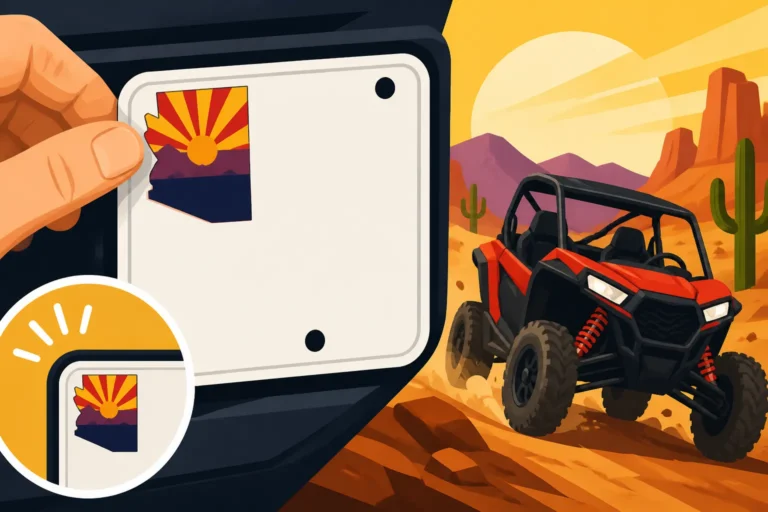
To get your decal, you'll typically do so through the AZGFD website via their online portal, or by mail. You'll need your OHV's VIN and your MVD registration information. The decal itself is a sticker that you affix to your OHV's license plate. It's crucial that you place it correctly, usually on the upper-left corner of the plate. Check out [Where the Arizona OHV Decal Goes on the Plate] for specific instructions. Riding without a current decal can result in fines, even if your machine is fully registered with the MVD. It's a common mistake, especially for those new to Arizona's unique two-part system. Don't forget, you can also sign up for email reminders from AZGFD to help you remember [Renewing an Arizona OHV Decal Each Year].
The Plate for Your Machine
Upon successful registration with the MVD, your OHV will be issued an Arizona license plate. For most off-highway vehicles, particularly ATVs, UTVs (side-by-sides), and dirt bikes that are not street-legal, this plate will carry the "RV" designation. This RV plate signifies that your vehicle is registered as a recreational vehicle and is generally not intended for street use, though some county and city ordinances may permit limited road travel. This is distinct from an "MC" (motorcycle) plate, which is issued to street-legal motorcycles and some street-legal OHVs.
Your OHV plate must be displayed clearly on the rear of your machine, typically in a dedicated plate holder. It needs to be visible and free from obstructions. This plate, combined with your annual OHV decal, serves as proof to law enforcement that your machine is compliant for off-highway use. Remember, the MVD registration (and thus the plate) is generally perpetual for OHVs, but the decal is annual. So, while your plate doesn't expire, the little sticker on it does! Always ensure both are current before heading out on your next adventure. If you're thinking about [Making a UTV Street Legal in Arizona], the process for getting an MC plate is entirely different and involves a whole other set of requirements.
Common Pitfalls and How to Avoid Them
Even with the best intentions, the OHV registration process can sometimes throw curveballs. It's easy to make a small mistake or overlook a critical detail that can lead to delays, frustration, or even fines. Knowing these common pitfalls ahead of time can help you navigate the system more smoothly and ensure your machine is legally ready for the desert. Forewarned is forearmed, as they say, and a little proactive planning goes a long way when dealing with official paperwork.
Missing Paperwork and Common Delays
The single most common reason for delays in OHV registration is incomplete or incorrect paperwork. People often show up to the MVD without a signed title, missing a bill of sale, or with an incorrect VIN. For example, if you bought a used machine, and the seller didn't properly sign and date the title, the MVD will likely send you packing until you get it sorted. This can be particularly frustrating if the seller is no longer easily reachable. It’s absolutely critical to ensure that when you purchase an OHV, all sections of the title transfer are completed accurately at the time of sale. This includes the seller's signature, your signature, the date of sale, and the purchase price.
Another frequent issue arises when there's a lien on the title. If the previous owner financed the OHV and hasn't fully paid off the loan, the lender will hold the title or have a lien recorded against it. You cannot transfer ownership or register the OHV until that lien is satisfied and a lien release is provided. Always check for [Liens on an Arizona OHV Title] before buying a used machine. If you're missing critical documents like the original title, you may need to pursue a bonded title or other special processes, which add time and complexity. Always double-check your checklist of required documents before you leave for the MVD. For private sales, using a template from a service like LawDepot for your bill of sale can help ensure you don't miss important details that might be overlooked in a casual transaction.
Understanding Fees and Taxes
Another area where confusion often reigns is fees and taxes. Many riders are caught off guard by the various costs associated with getting their OHV legal. As we've discussed, there's the MVD title fee, the perpetual OHV registration fee, and then the annual AZGFD OHV decal fee. These are distinct charges for different aspects of compliance. What often surprises people is the sales or use tax. If you buy a new OHV from a dealer, they'll collect sales tax at the point of sale. However, if you buy a used OHV from a private party, you are responsible for paying the [Arizona Sales Tax on a Machine Purchase] directly to the MVD when you title the machine.
Similarly, if you purchase an OHV out-of-state and bring it into Arizona, you'll likely be subject to Arizona's use tax, which is essentially the state's sales tax applied to items purchased outside the state for use within Arizona. Many riders think that if they paid sales tax in another state, they're exempt from Arizona's, but this is often not the case or only partially true. The MVD will assess any difference in tax. It’s important to budget for these taxes and fees when planning your OHV purchase. Don't assume the price you paid the seller is your final cost. Always factor in the additional government charges to avoid an unpleasant surprise at the MVD counter. You can find out more about the current [Arizona OHV Decal Price and Processing Fee] on the AZGFD website.
Special Circumstances: Buying Used, Out-of-State, or Through a Third Party
While the general registration process is fairly standard, the real world throws in some twists. Not every OHV purchase is a pristine new machine from a local dealer. Many riders find great deals on used machines, move to Arizona with their existing OHV, or prefer the convenience of third-party services. Each of these scenarios comes with its own set of considerations and specific steps you'll need to follow to ensure a smooth and legal registration.
Buying a Used OHV in Arizona
Purchasing a used ATV or UTV can be a fantastic way to get into the sport, but it carries a unique set of challenges regarding paperwork. The biggest hurdle is almost always the title transfer. You must get the original Certificate of Title from the seller, and it absolutely must be properly signed off by all listed owners on the front and back (if applicable). Pay close attention to the VIN on the title and ensure it matches the VIN on the machine itself. A discrepancy here is a red flag and will halt your registration. Take a look at [Buying a Used Side-by-Side in Arizona: The Paperwork] for a deeper dive.
Beyond the title, it's highly recommended to use a detailed bill of sale for any private transaction. This document should clearly state the buyer and seller's names, the purchase price, the date of sale, the OHV's make, model, year, and VIN, and both parties' signatures. This helps protect both parties and provides invaluable proof of purchase, especially if there are any questions about sales tax or the transaction later on. While not strictly required by the MVD if you have a properly signed title, it's a smart piece of documentation to have. Services like LawDepot provide excellent templates for these private sale agreements, helping you ensure all bases are covered and you have a clear record of the transaction. You're also responsible for paying the sales tax on the purchase price directly to the MVD when you title the used OHV.
Registering an Out-of-State Machine
Moving to Arizona with your existing OHV from another state, or purchasing one across state lines, brings its own set of rules. The good news is that Arizona welcomes OHV enthusiasts. The challenge is converting your previous state's documentation to Arizona's system. You'll need your out-of-state title and registration, along with proof of identity and residency. The MVD will perform a VIN inspection to verify the machine's identity and ensure it matches the title. This is a crucial step for [Registering an Out-of-State Machine in Arizona].
Be prepared to pay Arizona's use tax if you haven't paid an equivalent sales tax amount in your previous state. Even if you did, Arizona might collect the difference if its tax rate is higher. It’s always best to contact the MVD or a third-party provider beforehand to understand the specific requirements for your situation, especially if your previous state had unusual titling or registration procedures for OHVs. The process might involve a little more legwork than a standard Arizona sale, but it's entirely doable with the right preparation.
Working with Third-Party MVD Providers
For many riders, especially those with busy schedules or a dislike for long lines, working with a third-party MVD provider is a godsend. These authorized businesses can handle most OHV titling and registration services, often with significantly shorter wait times and more personalized customer service than a direct MVD office. They are especially useful for ensuring all your paperwork is correct before submission, catching potential errors that could lead to delays. While they do charge a service fee on top of the state's official fees, many find the convenience well worth the cost. You can learn more about how they operate by looking up [Registering Through Arizona MVD or a Third Party].
When choosing a third-party provider, look for one with good reviews and a clear understanding of OHV-specific regulations. They should be able to answer your questions about titles, registration, and the annual OHV decal. Remember, while they handle the MVD registration, you'll still typically need to acquire your annual OHV decal directly through the Arizona Game and Fish Department, though some third-party services might offer guidance on that process as well. Using these providers can significantly streamline your experience, allowing you to spend less time in an office and more time on the trails.
Required Documents for OHV Registration in Arizona
To make your registration process as smooth as possible, here's a quick overview of the essential documents you'll typically need. Remember, specific situations (like a bonded title or out-of-state transfer) may require additional paperwork, so always verify with the MVD or your chosen third-party provider.
| Document Type | Scenario: New Purchase (Dealer) | Scenario: Used Purchase (Private) | Scenario: Out-of-State Transfer |
|---|---|---|---|
| Proof of Ownership | Manufacturer's Certificate of Origin (MCO) | Properly Signed Arizona Title | Out-of-State Title |
| Bill of Sale | Dealer Invoice | Recommended (especially if using LawDepot template) | Proof of Purchase (e.g., prior bill of sale) |
| Identification | Arizona Driver's License/ID | Arizona Driver's License/ID | Arizona Driver's License/ID |
| Proof of Residency | N/A (implied by AZ ID) | N/A (implied by AZ ID) | Required (e.g., utility bill) |
| Vehicle Information | VIN, Make, Model, Year, Engine Size | VIN, Make, Model, Year, Engine Size | VIN, Make, Model, Year, Engine Size |
| Emissions Test | N/A (unless street legal) | N/A (unless street legal) | N/A (unless street legal) |
| Lien Release | N/A | If applicable | If applicable |
| Arizona Title & Registration App | Will be completed at MVD/Dealer | Will be completed at MVD/Third-Party | Will be completed at MVD/Third-Party |
Disclaimer
This article is for general informational purposes only and does not constitute professional advice. Laws, prices and regulations vary by location and change over time. Consult a qualified professional for guidance on your specific situation.