Arizona Emissions Testing in the Two Metros
It can be incredibly frustrating to discover that your beloved off-highway vehicle, which you've poured time and passion into, might need to jump through yet another hoop just to hit the trails or ride legally on certain roads. Many Arizona ATV and UTV owners, especially those living in or near Phoenix and Tucson, are often caught off guard by the state's emissions testing requirements. This guide is here to untangle the complexities of OHV emissions testing specifically within these two major metropolitan areas, helping you understand if your machine needs testing, how to prepare, and what to do if it doesn't pass.
Understanding Arizona's Emissions Requirements for OHVs
Arizona's approach to emissions testing can feel a bit like navigating a maze, especially when it comes to OHVs. It's not a blanket rule across the entire state, which is where the confusion often begins. Instead, the requirements are very specific, focusing primarily on a combination of where you live and how your machine is registered and used. If you're riding a quad or a side-by-side, you're likely thinking about registration and decals, but emissions are a separate, crucial step for some.
Which Machines Need Testing in Phoenix and Tucson?
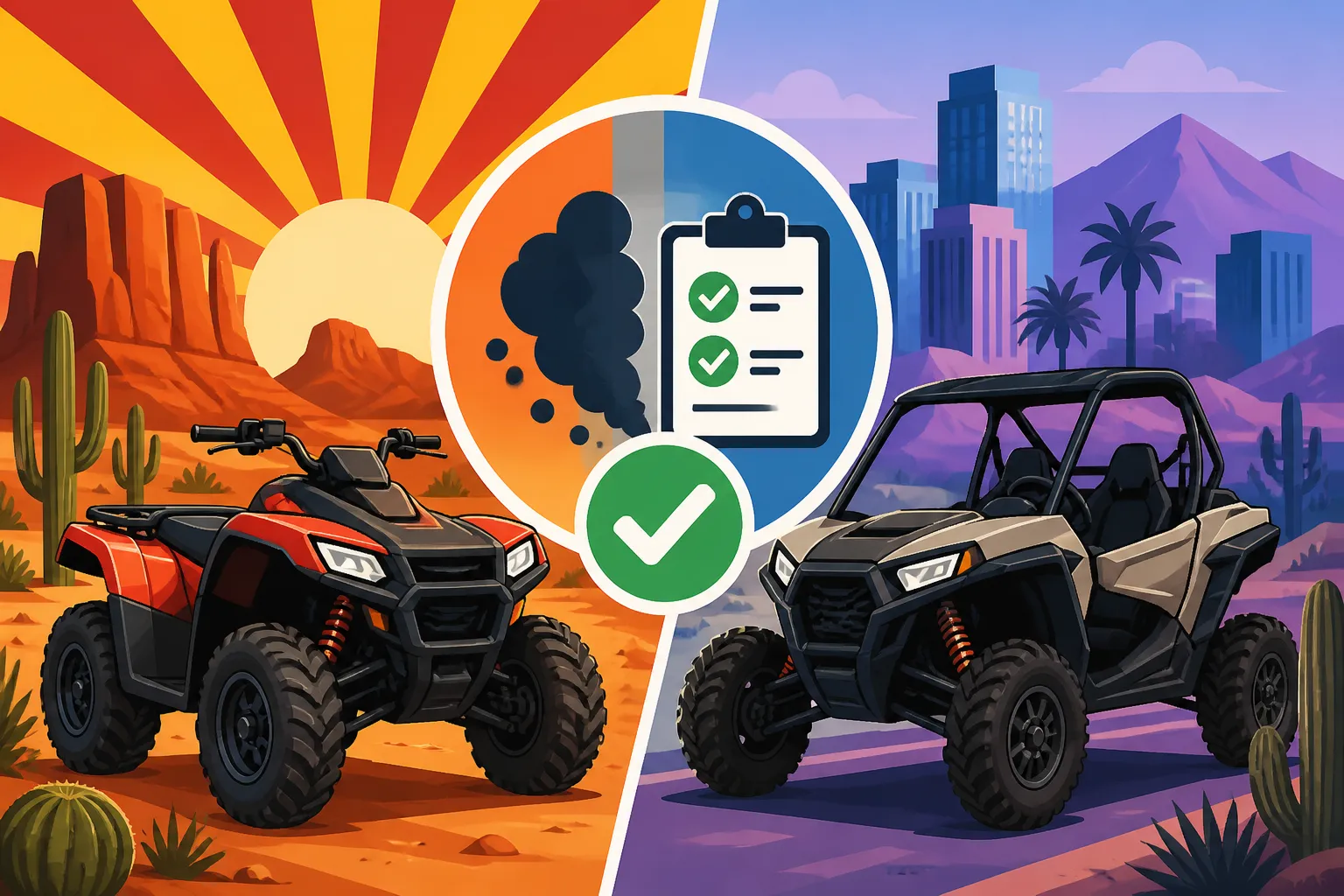
The critical distinction for OHVs needing emissions testing in Arizona hinges on one main factor: whether your machine is registered as street-legal and resides within the designated testing areas of Phoenix or Tucson. If your ATV or UTV is purely an off-highway machine, only ever ridden on trails, designated OHV areas, or private land, then you generally won't need to worry about emissions testing. The requirement kicks in when you want to make that side-by-side or quad legally eligible to drive on public roads, such as cruising through a trail town or connecting from a trailhead to an off-road route. When you go through the process of [Making a UTV Street Legal in Arizona], you're effectively putting it into a category that may trigger emissions compliance. This includes obtaining "MC" plates for your machine, which signal its street-legal status. Without a passing emissions test certificate, the Arizona Motor Vehicle Division (MVD) will not issue or renew your street-legal registration in these specific metropolitan areas.
For example, imagine you've invested in a brand new Polaris RZR and you're eager to make it street-legal so you can ride it from your home in Peoria, Arizona, directly to the desert trails north of town. Because Peoria falls within the Phoenix metropolitan area, and you intend to register your RZR with an MC plate for street use, your machine will be subject to emissions testing. This holds true for ATVs, UTVs, and any other OHV type that fits the description of a street-legal vehicle, regardless of its primary off-road purpose. It's the act of requesting that street-legal registration, which allows you to mingle with regular traffic, that brings it under the emissions umbrella.
The "Two Metros" Rule: Why It Matters
The reason for this geographical split lies in Arizona's efforts to maintain air quality in its most populous regions. The Phoenix and Tucson metropolitan areas are designated as "non-attainment areas" for certain air pollutants by the Environmental Protection Agency (EPA). To comply with federal clean air standards and improve local air quality, the state implemented mandatory vehicle emissions inspections in these specific regions. This means that if you live in places like Mesa, Glendale, Surprise, or Scottsdale within the greater Phoenix area, or Marana, Oro Valley, or Sahuarita within the greater Tucson area, and you want to ride your OHV on the street, you're in the emissions testing club.
Riders in other parts of Arizona, say Flagstaff, Prescott, or Lake Havasu City, generally don't face these same requirements for their street-legal OHVs. Their counties are not considered non-attainment areas. This distinction can be a real point of frustration for new residents or snowbirds who are used to different rules. For instance, someone moving to Arizona from California, where emissions testing is widespread, might initially assume their purely off-road machine needs testing, only to find out it depends on their registration intent and specific Arizona location. Conversely, a snowbird who spends winters in Yuma might be surprised when they move their street-legal UTV to their summer home in Phoenix and suddenly need to get it tested for renewal. Understanding these boundaries is key to avoiding unnecessary stress or unexpected delays in getting your machine legally on the road.
Navigating the Emissions Testing Process
Once you've determined your street-legal OHV needs to be tested, the thought of actually going through the process can feel a bit daunting. You might be picturing long lines, confusing paperwork, or strict technicians. However, with a little preparation, it can be a relatively smooth experience. The goal is to make sure your machine is not only running well but also meets the specific environmental standards set for the Phoenix and Tucson areas.
Preparing Your OHV for the Test
Preparation is half the battle when it comes to emissions testing. Think of it like getting ready for a big ride: you wouldn't just jump on and go without checking your fluids and tires, right? The same goes for an emissions test, but with a focus on your engine's efficiency and your street-legal equipment. First and foremost, a well-maintained engine is more likely to pass. Consider a recent tune-up, including fresh spark plugs, a clean air filter, and an oil change if it's due. These simple steps can make a significant difference in your machine's exhaust output. Also, ensure your tires are properly inflated, as this can affect the engine load during certain types of tests. A crucial, often overlooked, step is to make sure your engine is fully warmed up before you arrive at the testing station. A cold engine runs "richer" and produces more pollutants, increasing the chances of a failed test. Take a short, easy drive to the station to get everything up to operating temperature.
Beyond engine performance, remember that your machine is being tested because it's street-legal. This means all the required street-legal modifications must be in place and fully functional. Think about your [Arizona's 500 Foot Headlight Rule], taillights, turn signals, mirrors, horn, and especially your [Arizona's Spark Arrestor Requirement]. A missing or non-compliant spark arrestor can lead to an immediate failure, not to mention a fire hazard in the desert. You'll also need to bring your current vehicle registration and proof of ownership, like your title or a bill of sale. If you're a new resident, you might need additional documents, so it's always a good idea to check the Arizona Department of Environmental Quality (ADEQ) website for the most current list of required paperwork before you head out. Being prepared means less stress and a higher chance of passing on your first visit.
What Happens at the Testing Station
When you pull into the emissions testing station with your street-legal ATV or UTV, the process generally involves two main components: a visual inspection and the actual emissions measurement. First, a technician will perform a visual check to ensure your vehicle is equipped with the required emissions control devices, such as a catalytic converter (if applicable for your model) and, as mentioned, a compliant spark arrestor. They'll also verify your VIN (Vehicle Identification Number) against your paperwork to ensure everything matches up. This is a quick but important step, confirming your machine is what it claims to be.
After the visual inspection, your OHV will be subjected to the emissions measurement. For many street-legal OHVs, this involves a "two-speed idle" test, where the technician will measure exhaust gases at both idle and a higher RPM. They'll insert a probe into your exhaust pipe, and the testing equipment will analyze the levels of various pollutants, including hydrocarbons (HC), carbon monoxide (CO), and nitrogen oxides (NOx). The results are then compared against state-mandated limits for your vehicle's specific model year and type. Unlike some passenger vehicles, OHVs usually don't go on a rolling dynamometer for emissions testing; the focus is more on the exhaust output itself. If your machine passes, you'll receive a certificate that allows you to complete or renew your street-legal registration with the MVD. If it doesn't pass, the technician will provide you with a detailed report outlining the reasons for failure, which is crucial for understanding what needs to be fixed.
When an OHV Fails Emissions Testing
A failed emissions test can feel like a punch to the gut, especially when you're just trying to get your machine legal for the street. It's easy to get frustrated, but it's important to remember that a failure isn't the end of the road. It simply means something isn't quite right with your OHV's engine or exhaust system, and it needs a little attention to meet Arizona's clean air standards. The key is to understand why it failed and then take systematic steps to rectify the issue.
Understanding Emissions Test Results
When your OHV fails an emissions test, you'll be given a report that details the readings for specific pollutants: hydrocarbons (HC), carbon monoxide (CO), and potentially nitrogen oxides (NOx). High levels of hydrocarbons often indicate unburned fuel, suggesting issues like misfires, faulty spark plugs, or an engine running too rich. Elevated carbon monoxide usually points to incomplete combustion, which could be caused by a clogged air filter, a problem with the fuel delivery system, or an issue with the catalytic converter if your machine has one. Nitrogen oxides, while less common for OHV-specific failures, can indicate high combustion temperatures. The technician might also note visual inspection failures, such as a missing or damaged catalytic converter, or a non-compliant [USDA-Approved Spark Arrestors in Arizona].
It's tempting to just glance at the "failed" stamp and get annoyed, but taking the time to truly understand these readings is crucial for effective repairs. For instance, if your HC levels are through the roof, you know your focus needs to be on ignition and fuel mixture. If CO is high, it's more about combustion efficiency. Don't hesitate to ask the testing technician for clarification on the report. They often have insights into common failure points for different types of vehicles, including street-legal OHVs. Taking this report to a trusted mechanic will give them a clear roadmap for diagnosing and fixing the underlying problem, rather than just guessing.
Steps to Take After a Failed Test
After receiving a failed emissions report, your next step is to address the issues identified. The most straightforward approach is to take your OHV to a qualified powersports mechanic who understands emissions systems. Share the detailed emissions report with them, as it provides invaluable data for their diagnosis. They can perform necessary repairs or adjustments, such as replacing faulty sensors, cleaning fuel injectors, or tuning the carburetor or fuel injection system. Sometimes, simply replacing old spark plugs or a dirty air filter can bring the numbers back into compliance. If the failure was due to a missing or non-compliant component, like a catalytic converter or spark arrestor, you'll need to install the correct part.
Once repairs are complete, you'll need to return to an emissions testing station for a retest. Arizona typically allows a grace period for repairs and retesting, but it's important not to delay, especially if your registration is about to expire. Keep all your repair receipts and documentation. In rare cases, if you've spent a significant amount on repairs and your vehicle still fails, you might be eligible for a repair waiver. However, these waivers usually have strict cost thresholds and specific requirements, and they are less common for OHVs than for passenger vehicles. For documenting significant repairs, particularly if you're working with a private mechanic or making custom modifications to ensure compliance, having a written agreement or detailed record can be helpful. Services like LawDepot can provide templates for personal agreements or checklists to ensure you cover all bases when detailing the work done on your machine, protecting both you and your mechanic. This detailed record-keeping can be especially valuable if you encounter further issues or need to demonstrate due diligence for a waiver.
Exemptions and Special Circumstances
While emissions testing is a firm requirement for street-legal OHVs in Phoenix and Tucson, it's important to know that not every machine falls under this mandate. Understanding the exemptions can save you time, money, and unnecessary stress. Arizona's rules are designed to target specific types of vehicles in specific areas, leaving a significant number of OHV users unaffected.
Machines Not Required to Undergo Testing
The primary exemption for OHVs from emissions testing in Arizona's metro areas is tied directly to their registration status and intended use. If your ATV or UTV is registered for off-highway use only – meaning it carries an "RV" plate and an [Arizona's Annual OHV Decal Explained] but is not plated for street legality – then it does not require an emissions test. These machines are understood to be used exclusively on trails, designated OHV parks, or [Do You Need a Decal on Private Arizona Land?], and therefore do not contribute to the on-road air quality issues the testing program aims to address. This distinction is vital for a huge portion of the Arizona riding community.
Furthermore, there are age-based exemptions. Generally, vehicles older than a certain model year are exempt from testing, regardless of their street-legal status. For example, specific regulations might exempt vehicles manufactured before a particular year, recognizing that older machines were built to different standards and may not have the same emissions control technology. It's always a good idea to check the current ADEQ guidelines for the exact cutoff year. So, if you have a vintage quad that you've lovingly restored and made street-legal, it might still be exempt purely based on its age. The intent here is to focus on newer vehicles where emissions control technologies are expected to be present and functioning, rather than penalizing owners of classic machines that predate modern environmental standards.
Moving to Arizona or Out-of-State Machines
New residents bringing their OHVs to Arizona face specific considerations regarding emissions testing. If you're moving into the Phoenix or Tucson metro areas and plan to register your OHV as street-legal, it will likely need to pass an Arizona emissions test, even if it passed in your previous state. This is because Arizona's program has its own standards and verification processes. However, there might be temporary permits or grace periods available to allow you to get your registration and testing done without immediate penalties. For example, if you're [Registering a California Quad After Moving to Arizona] and plan to ride it on the street, you'll need to comply with Arizona's testing rules.
For [Winter Residents and the Arizona Decal] or those who only visit Arizona for part of the year, the rules can be a bit more nuanced. If your OHV is registered and plated in another state and you're not seeking Arizona street-legal registration, you generally won't need to get an Arizona emissions test. The Arizona OHV Decal covers off-highway use for both residents and non-residents, and it doesn't trigger emissions requirements. However, if you decide to fully transfer your street-legal registration to Arizona while residing in one of the two metro areas, then the emissions test becomes a necessary step. Always confirm the latest regulations with the MVD or ADEQ to ensure you're in compliance, as rules can sometimes change or have specific interpretations based on residency status and vehicle type.
The Link Between Emissions, Registration, and Street Legality
For many OHV owners, the journey to street legality involves a series of steps: adding the necessary safety equipment, applying for specific plates, and, if you're in the right place, undergoing emissions testing. These elements aren't isolated; they're interconnected pieces of a puzzle that ultimately determine whether your ATV or UTV can legally share the asphalt with cars and trucks. Understanding this connection is vital for smooth sailing through the registration process.
How Emissions Affect Your Registration and Plates
In the Phoenix and Tucson metropolitan areas, passing an emissions test is a non-negotiable prerequisite for obtaining or renewing [Street-Legal Registration Instead of a Decal] for your OHV. The Arizona MVD will simply not process your application for an "MC" plate – the designation for motorcycles and street-legal OHVs – without a valid emissions certificate on file. This means that if your current street-legal registration is due for renewal, and you're within one of these testing zones, you'll first need to take your machine to an emissions station. Without that passing certificate, your registration will be held up, and you won't be able to renew your [MC Plates and Street-Legal Machines].
The consequence of not passing, or simply not getting your machine tested, is direct and impactful: you cannot legally operate your OHV on public roads in Arizona with a street-legal registration that is expired or incomplete. This could lead to citations, fines, or even having your machine impounded if you're caught riding on the street without proper documentation. It's not just about avoiding trouble; it's about being a responsible rider. The emissions program is in place to reduce air pollution, and by ensuring your street-legal OHV passes, you're contributing to cleaner air in your community while also maintaining your riding privileges. Therefore, integrating emissions testing into your annual vehicle maintenance and registration renewal schedule is crucial if you want to keep your OHV street legal in these areas.
Keeping Your Street-Legal OHV Compliant
Once you've cleared the emissions hurdle and have your street-legal plates, the goal is to stay compliant for future testing cycles. Regular maintenance is your best friend here. Sticking to your manufacturer's recommended service schedule, including oil changes, spark plug replacements, and air filter checks, will go a long way in ensuring your engine runs efficiently and cleanly. Pay particular attention to fuel system components and exhaust systems, as these directly impact emissions. Using quality fuel and avoiding excessive idling can also help maintain your machine's emissions performance over time.
Be mindful of aftermarket parts and modifications, especially those related to the engine or exhaust. While many riders enjoy customizing their OHVs, some modifications can negatively impact emissions control systems or even render your machine non-compliant. If you're considering an aftermarket exhaust system, for instance, ensure it's designed to meet emissions standards and retains a compliant [Arizona's Spark Arrestor Requirement]. Attempting to [Passing Emissions With a Modified Engine] can be challenging if the modifications aren't carefully chosen. If you're having custom work done, it's a good idea to discuss emissions compliance with your mechanic. Documenting any significant modifications, especially those that touch on engine performance or exhaust, can be helpful. Using a service like LawDepot to create a clear record of modifications or agreements with custom shops can provide you with essential documentation should any questions arise during future emissions tests or registration renewals. This kind of careful record-keeping ensures you always have a clear history of your machine's build and maintenance, simplifying future compliance checks.
Here’s a quick overview of Arizona’s OHV emissions testing requirements:
| Feature | Street-Legal OHV (MC Plate) in Phoenix/Tucson Metro | Off-Highway Only OHV (RV Plate/Decal) | Out-of-State OHV Visiting AZ |
|---|---|---|---|
| Emissions Test Required | YES | NO | NO (unless registering street-legal in AZ metro) |
| Purpose | On-road air quality compliance | N/A | N/A |
| Trigger | Obtaining/Renewing Street-Legal Registration | N/A | Transferring street-legal registration to AZ metro |
| Key Documents Needed | Registration, Proof of Ownership, Emissions Cert. | Registration, Proof of Ownership | Out-of-state registration (for visitors) |
| Common Failure Points | Engine running rich, worn spark plugs, exhaust issues | N/A | N/A |
| Remedial Action | Repairs, retest | N/A | N/A |
Disclaimer
This article is for general informational purposes only and does not constitute professional advice. Laws, prices and regulations vary by location and change over time. Consult a qualified professional for guidance on your specific situation.