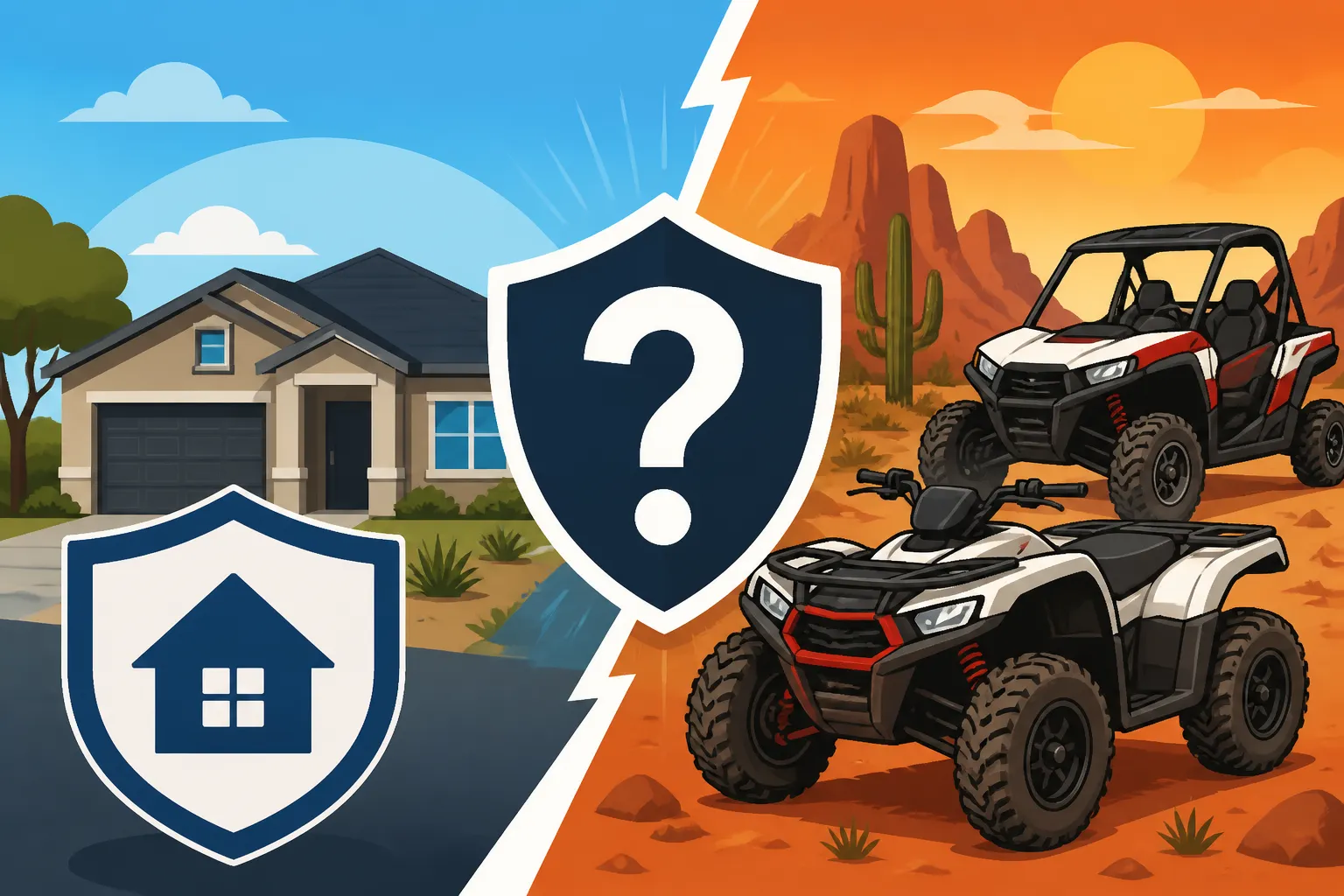
Does a Homeowners Policy Reach Your Quad?
It's a common, gut-wrenching moment for many Arizona off-highway vehicle (OHV) owners: you're sitting down to sort out your insurance, probably assuming your trusty homeowner's policy has your quad or side-by-side covered for, well, something. Then you hit a wall of confusing jargon and suddenly realize you might be completely exposed. This guide is here to untangle that knot, walking you through why most homeowner's policies fall short when it comes to your desert-conquering machine and what you really need to do to protect your investment and yourself.
The Common Misconception: Your Homeowners Policy and Your Quad
Let's be real, when you've invested in a fantastic ATV or UTV, it feels like an extension of your personal property, right? It sits in your garage or on your property, so it makes sense that your homeowner's insurance, which covers so much of your other stuff, would naturally extend to your off-road pride and joy. Unfortunately, this is one of the biggest and most costly misconceptions many riders encounter.
What a Homeowners Policy Is Really Designed For
A homeowner's insurance policy is fundamentally designed to protect your primary residence and the personal belongings within it, as well as providing liability coverage for incidents that occur on your property or are otherwise directly related to your household. Think fire, theft of household goods, burst pipes, or someone tripping on your front walkway. These policies are crafted around the risks associated with a dwelling and its immediate surroundings. They're excellent at what they do, providing a critical safety net for your home life.
However, the world of off-road vehicles introduces an entirely different set of risks and scenarios that simply aren't factored into the core design of a typical homeowner's policy. The speeds, the terrain, the specific types of accidents, and the public land use inherent to OHV riding are outside the scope of home-based coverage. It’s easy to assume your expensive toys are protected, but many riders only get a rude awakening after an incident occurs and their claim is denied.
Why Off-Highway Vehicles Often Fall Outside the Scope
The reason OHVs often fall outside the typical homeowner's policy is straightforward: they're motorized vehicles primarily designed and used for recreation or transport away from your home. Insurance companies categorize risk, and the risk associated with driving a 700-pound quad through the desert is vastly different from the risk of a lawnmower, even if both are "motorized." OHVs are often ridden on public lands, state trust lands, or designated trail systems, bringing with them unique liability concerns for accidents, property damage, and injuries that can occur far from your insured property.
Consider the potential for serious bodily injury to yourself or others, or significant property damage to another vehicle or public land features. These scenarios can quickly rack up costs far beyond what a homeowner's policy would ever anticipate or be designed to cover. The financial exposure is simply too great, and the nature of the activity too distinct, for a blanket homeowner's policy to effectively manage.
Digging Into the Fine Print: Standard Exclusions to Watch For
When you first purchase your homeowner's policy, you probably skimmed over a lot of the dense legal language, focusing on the big picture. But when it comes to OHVs, the devil truly is in the details, specifically in the exclusion clauses. These are the sections that clearly state what the policy doesn't cover, and they often contain explicit language regarding motorized vehicles.
The "Motorized Vehicle" Exclusion Clause
This is perhaps the most significant hurdle for OHV owners. Almost all standard homeowner's policies contain a "motorized vehicle" exclusion. This clause typically states that the policy will not cover liability or property damage arising from the ownership, maintenance, use, loading, or unloading of motorized vehicles. While there might be exceptions for things like lawnmowers or motorized wheelchairs used on your property, larger, recreational machines like ATVs and UTVs are almost universally excluded.
What this means in plain English is that if you get into an accident while riding your quad, even if it's on your own property, your homeowner's policy will likely offer no protection for the damage to your machine, injuries to yourself or passengers, or any damage or injury you inflict upon others. It's a broad exclusion designed to channel those risks into specialized policies that are priced and structured to handle them. So, if you hit a fence post on your back forty, your homeowner's policy probably won't be writing a check for repairs.
Understanding Liability and Property Damage Limits
Even if, by some rare chance, your homeowner's policy did offer some incredibly limited form of coverage for your OHV (which, again, is highly unlikely for recreational use), the limits would almost certainly be inadequate. Homeowner's liability limits are set with typical household accidents in mind. If someone slips on your icy driveway, that's one thing. If you accidentally collide with another rider on a trail, causing them severe injury and totaling their machine, the costs can escalate into hundreds of thousands, if not millions, of dollars.
A standard homeowner's policy simply isn't equipped to handle that level of financial exposure. The bodily injury and property damage minimums for OHVs, especially if you're ever considering making your machine street-legal in Arizona, are usually specified for motor vehicles and are significantly higher than anything your homeowner's policy would offer. For real peace of mind and adequate protection, you need coverage that is specifically designed for the unique risks associated with operating an OHV.
Theft and Damage: Is Your Quad Protected While Parked?
This is where things can get a tiny bit murkier, but still often fall short. If your OHV is stolen from your garage or shed on your property, some homeowner's policies might cover it under the "personal property" section. However, this coverage is almost always limited to the actual cash value, not replacement cost, and is subject to your policy's deductible. If your quad is worth $15,000 and you have a $1,000 deductible, you'd only get $14,000, assuming no depreciation or other limits.
Crucially, this is typically only for theft while stored on your insured property. If your quad is damaged in a fire in your garage, it might be covered. But if it's damaged while you're riding it, or if it's stolen from a trailhead parking lot away from your home, your homeowner's policy is very unlikely to provide any coverage. The distinction is key: storage vs. operation, and on-property vs. off-property. Most insurance companies draw a very clear line here.
Limited Exceptions: When Homeowners Insurance Might Help (A Little)
While the general rule is "no coverage," there are a few highly specific and limited scenarios where a homeowner's policy might offer some minimal protection related to an OHV. These are typically not for recreational use and come with significant caveats. It's vital to understand these are exceptions, not the rule, and they rarely provide the comprehensive coverage an OHV owner truly needs.
Machines Used Solely for Property Maintenance
One common exception sometimes found in homeowner's policies is for motorized vehicles used solely for the maintenance of the insured premises. This is usually aimed at things like riding lawnmowers or small utility tractors. On larger properties, like ranches or farms, a UTV might theoretically fall into this category if its use is strictly limited to tasks such as hauling feed, checking fences, or spraying weeds on that specific property. [Arizona OHV Rules for Ranch and Farm Machines]
However, the moment that utility machine leaves your property for recreational use, or if you ever take it to a local trail, this exception typically vanishes. Insurance companies are very clear about the "solely for maintenance" and "on the insured premises" clauses. Don't assume that just because your UTV can haul firewood, it's covered for a weekend joyride in the desert. Always check with your insurance provider directly and get it in writing if you believe your specific utility use case qualifies.
Coverage for Stored Vehicles (Theft Only, Sometimes)
As mentioned earlier, if your quad or UTV is stolen from your garage, shed, or another secured structure on your insured property, your homeowner's policy may offer some coverage under the personal property section. This is typically limited to the actual cash value of the machine, subject to your deductible and any internal limits your policy might have for specific types of personal property. For example, some policies have lower limits for recreational vehicles or watercraft.
It’s important to reiterate that this potential coverage is almost always for theft or perhaps damage from a covered peril (like a fire) while the vehicle is stored and not in use. It absolutely does not extend to damage incurred during operation, nor does it provide any liability coverage for accidents you might cause. If you're looking for protection beyond simple storage theft, you'll need a different solution.
Very Low-Powered or Toy Vehicles
Occasionally, very low-powered, small electric vehicles or children's ride-on toys might be considered "personal property" and fall under limited homeowner's coverage. Think miniature electric cars or small battery-powered quads designed for toddlers. These are typically not considered "motorized vehicles" in the same vein as a powerful gasoline-driven ATV or UTV.
However, this exception almost never applies to actual ATVs, UTVs, or dirt bikes, even smaller displacement youth models. These machines, regardless of engine size, are generally designed for speeds and activities that put them squarely into the "motorized vehicle" exclusion. If your child's machine requires a title or registration in Arizona, it's highly unlikely to be covered by a homeowner's policy. For any machine with a combustion engine, or even powerful electric OHVs, assume you need dedicated coverage.
The Smarter Solution: Dedicated OHV Insurance in Arizona
Given the significant gaps in homeowner's policy coverage, the most realistic, comprehensive, and ultimately responsible approach for any Arizona OHV owner is to secure a dedicated off-highway vehicle insurance policy. This specialized coverage is designed specifically for the unique risks and requirements of quads, UTVs, dirt bikes, and other recreational machines.
Comprehensive Coverage for Your Arizona Adventures
A dedicated OHV insurance policy offers a suite of coverages tailored to your off-road life. This often includes:
- Collision Coverage: This pays for damages to your own OHV if it collides with another vehicle, an object, or if it rolls over. Whether you ding a saguaro on a tight turn or get tangled up with another machine, this coverage helps with repairs or replacement.
- Comprehensive Coverage: This protects your OHV from non-collision incidents such as theft, vandalism, fire, flood, or damage from falling objects (like a tree branch in a monsoon). If your machine goes missing from a trailhead or is damaged while parked overnight, this is your safety net. [What an Insurer Wants After a Desert Theft]
- Liability Coverage: This is perhaps the most crucial. It covers bodily injury and property damage you might cause to others while operating your OHV. This includes medical expenses for injured parties, legal fees if you're sued, and repairs to someone else's property (e.g., another rider's machine, a fence, or even an unintended impact with a parked car).
- Uninsured/Underinsured Motorist Coverage: This protects you if you're in an accident with another rider who doesn't have insurance or whose insurance isn't enough to cover your damages.
Many policies also offer coverage for custom parts and accessories, roadside assistance, and even protection for your gear. When you're cruising through the [Arizona's 40,000 Miles of OHV Trail], knowing you're fully covered is invaluable.
Meeting Arizona's Legal Requirements (Especially for Street-Legal Machines)
While Arizona does not generally require liability insurance for OHVs ridden exclusively on designated off-road trails and private land, the rules change significantly if you ever intend to make your machine street-legal or operate it on public roads. [Insuring an ATV in Arizona] If you're converting your UTV to be street-legal, it must meet specific requirements and carry minimum liability insurance, just like any other motor vehicle. [Arizona Liability Minimums for Street-Legal Machines]
These minimums often involve [Arizona Bodily Injury Minimums of 25 and 50] (which means $25,000 per person and $50,000 per accident) and a [Arizona Property Damage Minimum of 15] ($15,000 for property damage). Many riders opt for higher limits than these minimums to ensure greater financial protection. Understanding these requirements is critical, especially if you plan on riding from a trail town to the trailhead, or using your machine for short trips on paved county roads. [Arizona Insurance Limits of 25/50/15] It's another clear reason why a homeowner's policy simply won't cut it.
Finding the Right Policy and Provider
Shopping for dedicated OHV insurance involves a few key steps. Start by getting quotes from multiple providers who specialize in powersports vehicles. Don't just go with your current auto or home insurer; while they might offer a bundle, comparing rates from different companies can save you money and ensure you get the best coverage. Consider your riding habits: Do you ride aggressively? Do you participate in races or organized events? Do you have expensive modifications? These factors can influence your policy needs and premiums.
When you're dealing with such a valuable asset, having all your ducks in a row with ownership documents is just as crucial as having the right insurance. Services like LawDepot can be incredibly helpful for creating solid bills of sale or other legal agreements when you buy, sell, or even lend your machine, ensuring you have clear proof of ownership should a claim ever arise. This due diligence, both in paperwork and insurance, protects you comprehensively. Always read the policy documents thoroughly, understanding what is covered, what is excluded, and your deductibles. Don't be afraid to ask questions until you're absolutely clear on your coverage.
| Feature | Homeowners Insurance (Typical) | Dedicated OHV Insurance |
|---|---|---|
| Liability Coverage | Highly unlikely for OHV use | Yes, comprehensive |
| Property Damage (to others) | Highly unlikely for OHV use | Yes, comprehensive |
| Damage to Your OHV (Collision) | No | Yes |
| Damage to Your OHV (Comprehensive) | Theft only, if stored on-property | Yes, for various perils |
| Medical Payments (for you) | No | Often available |
| Custom Parts/Accessories | No | Often available |
| Roadside Assistance | No | Often available |
| Theft from Trailhead | No | Yes |
| Meets AZ Street-Legal Requirements | No | Yes |
| Covers Off-Property Use | No | Yes |
Disclaimer
This article is for general informational purposes only and does not constitute professional advice. Laws, prices and regulations vary by location and change over time. Consult a qualified professional for guidance on your specific situation.