OHV Access on Arizona State Park Roads
It can be incredibly confusing to figure out where you can and cannot take your off-highway vehicle (OHV) in Arizona, especially when it comes to places like our beautiful state parks. You might be planning a family outing, towing your side-by-side to a trailhead, or simply want to drive through a scenic area, only to find yourself wondering, "Are OHVs even allowed on these paved roads?" This guide is here to clear up that confusion, explaining the nuances of OHV access on Arizona State Park roads, what you need to know before you go, and how to stay on the right side of the rules.
The Basics of OHV Access on Arizona State Park Roads
Arizona's State Parks are fantastic places to visit, offering everything from stunning red rock vistas to serene lake experiences. But when you arrive with your ATV, UTV, or dirt bike, you quickly realize these aren't your typical open desert trails. The rules for OHVs within state parks are generally much stricter than on Bureau of Land Management (BLM) land or Forest Service roads. It’s not just about having your [Arizona's Annual OHV Decal Explained]; it’s about understanding the specific regulations that apply to these managed recreational areas.
Most Arizona State Parks have paved roads, and sometimes unpaved access roads, that lead to campgrounds, picnic areas, trailheads, or scenic overlooks. The key distinction here is that these are typically considered "designated roads" for general vehicle traffic, not necessarily "OHV trails." This means that while your OHV might be permitted on these roads, it's usually under the same conditions as any other street-legal vehicle, or for the purpose of accessing specific areas, rather than recreational riding within the park boundaries.
Decal and Registration Requirements for State Park Riding
Before your wheels even touch a state park road, your OHV needs to be properly registered and decaled. There's no getting around this. Every OHV operating in Arizona, whether on public lands or within state parks (if allowed), must have a valid Arizona OHV Decal. This isn't just a suggestion; it's a legal requirement. The decal fee helps fund OHV recreation, safety, and enforcement efforts across the state, including some trail maintenance, so it's vital to have.
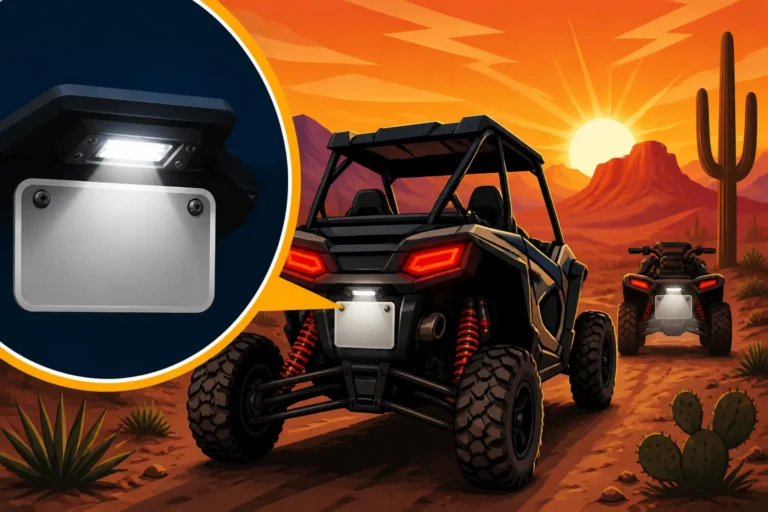
In addition to the decal, your machine must be registered with the Arizona MVD. For many, this means a standard off-highway registration. However, if you plan to operate your OHV on paved state park roads that are also open to street-legal vehicles, your machine will need to meet street-legal requirements, which involves much more than just a decal. This often includes things like working headlights, taillights, turn signals, mirrors, and appropriate tires. If your machine is not fully street legal and plated, its use on state park roads will be very limited, typically only for ingress and egress to designated OHV-friendly zones if they exist. You can learn more about general registration requirements by looking into [Arizona MVD OHV Registration Explained].
Understanding "Designated Roads" within State Parks
The term "designated roads" is crucial when discussing OHV access in Arizona State Parks. These are the specific routes that have been officially identified and signed for vehicle use. For most state parks, these are paved or well-maintained gravel roads that lead to various park amenities. Your OHV might be allowed on these designated roads only if it is fully street-legal and plated, much like you would drive your truck or car. If your OHV is not street-legal, its presence on these roads is generally restricted to the absolute minimum necessary, such as driving directly from your campsite to a specified staging area if the park has one for OHVs.
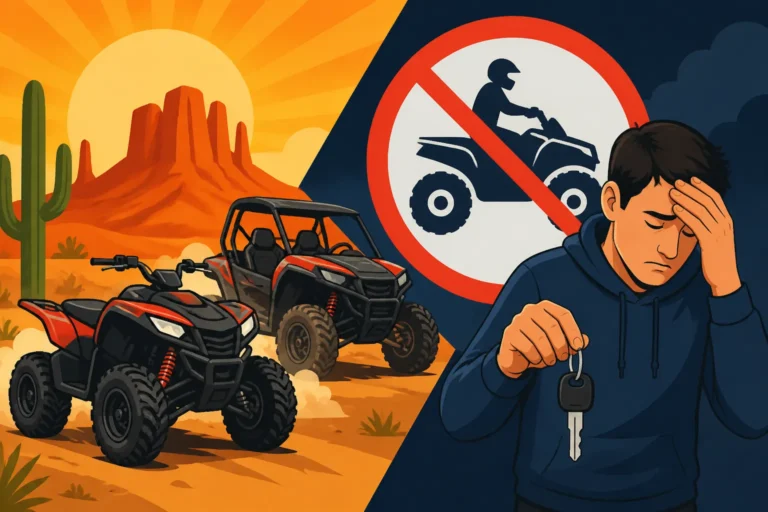
What you cannot do, however, is simply ride your non-street-legal OHV recreationally on these roads. They are not considered open OHV riding areas. Think of it this way: a state park road is like a regular public road that happens to be inside the park. Just as you wouldn't drive your non-street-legal dirt bike on a city street outside the park, you generally can't do so inside the park either. Always look for signage, and when in doubt, assume it's restricted.
The Difference Between State Park Roads and OHV Trails
It's really important to distinguish between state park roads and actual OHV trails. Most Arizona State Parks do not have dedicated, marked OHV trails within their boundaries for recreational riding. Their focus is often on preserving natural resources, providing passive recreation like hiking, and offering camping or water-based activities. If an OHV trail does exist within or immediately adjacent to a state park, it will be clearly marked, often with specific access points and rules.
Conversely, the roads within state parks are primarily for vehicle transit to and from facilities. They are not intended for, nor typically permitted for, open recreational OHV use. For example, at Catalina State Park near Tucson, you'll find an extensive network of hiking, biking, and equestrian trails, but no designated OHV trails. You might drive your UTV on the paved park road to get to a specific trailhead or campground, but you wouldn't then just start riding it on the dirt trails meant for hikers. If you're looking for true OHV trails, you'll typically be heading to lands managed by the Forest Service or BLM, or dedicated OHV areas like Cinder Hills, not directly within most state parks.
Common Questions and Specific Scenarios for State Park Access
Navigating state park rules with an OHV can bring up a lot of specific questions. People often wonder if they can simply cruise through a park, or what the deal is if they're just passing through to another destination. It's easy to assume that if you have a decal, you're good to go everywhere, but that's just not the case. The park setting introduces a layer of regulation designed to protect both the environment and the experience of all visitors.
One of the common frustrations is the lack of uniformity. While the state decal is universal, the specific access rules can vary slightly from one state park to another, depending on their unique features and management plans. This is why always doing your homework before you head out is so crucial. A piece of advice that almost always rings true is to keep your paperwork handy and your machine in good working order, perhaps even considering some upgrades like reinforced A-arms or heavy-duty tie rods from a brand like SuperATV, especially if you plan on extended use on various terrains or when trailering your rig.
Can You Just Drive Through a State Park on Your OHV?
The answer to this question largely depends on whether your OHV is street-legal. If your ATV or UTV is properly licensed and equipped for street use (meaning it has a license plate, lights, horn, mirrors, etc., just like a car), then yes, you can generally drive it on the paved and designated unpaved roads within an Arizona State Park, as long as those roads are open to public vehicle traffic. You'd be treated like any other vehicle entering the park, subject to entrance fees and all standard traffic laws, like speed limits.
However, if your OHV is not street-legal (meaning it only has the annual OHV decal, but no license plate or street-legal modifications), then you cannot simply drive it through a state park on its own wheels. Your non-street-legal machine would need to be trailered or otherwise transported through the park on another street-legal vehicle. There are very few exceptions to this, and they typically involve directly accessing a specific, designated OHV staging area if the park explicitly allows it. Trying to cruise your non-street-legal machine through a park for fun is a surefire way to get a chat with a park ranger.
Trailering an OHV Through a State Park to Reach a Trailhead
This is a much more common scenario and generally perfectly acceptable. Many popular OHV riding areas are located near or require passage through state park lands. For instance, you might be heading to a trail network that's on BLM land, but the most convenient access road or staging area requires you to drive your truck and trailer through a portion of a state park. In this situation, you are using the state park roads as a means of transit, not as a riding area for your OHV.
When trailering, your OHV simply becomes cargo, and your tow vehicle (truck, SUV, etc.) is the one legally operating on the state park roads. You will still be subject to park entrance fees, and you must adhere to all traffic laws within the park. Once you reach the designated OHV staging area outside the state park boundary, or at a specific park-approved location, then you can unload your machine and begin your ride, provided you have all the necessary [Arizona State Trust Land Recreational Permits] or other permissions for the actual riding area. Always ensure your tow vehicle and trailer are in good repair; perhaps a heavy-duty hitch from SuperATV could be a useful upgrade for peace of mind when hauling your precious cargo.
Specific Park Examples and Their OHV Policies
While I can't give real-time, park-specific directives, let's consider a couple of hypothetical examples to illustrate the common approach.
Example 1: Lake Havasu State Park. This park is very popular for boating and camping. Its internal roads lead to boat ramps, campgrounds, and day-use areas. If you wanted to visit Lake Havasu State Park with your side-by-side, you'd typically need to have it street-legal to drive it on the park's paved roads. You could drive it to your campsite, or to the designated parking area, but you wouldn't be able to ride it off the paved roads or into non-motorized areas. If you're trailering your machine to the nearby Standard Wash OHV Area, you'd drive your truck and trailer through the park or around it on public roads to get there, then unload once you're on open OHV land.
Example 2: Lost Dutchman State Park. This park is all about hiking and enjoying the Superstition Mountains. Its roads lead to trailheads and campgrounds. Here, street-legal OHVs might be allowed on the paved roads for transit to a campsite or trailhead parking, but there are absolutely no OHV trails within the park itself. Trying to ride your non-street-legal machine anywhere off the paved roads, or even recreationally on the paved roads, would likely result in a citation. The rangers here are focused on preserving the quiet natural environment for hikers and campers.
In both cases, the common thread is that state park roads are for access, not for recreational OHV riding, unless your machine is fully street-legal and operating just like a car. Always check the official Arizona State Parks website for the specific park you plan to visit, or better yet, call them directly before you leave home to confirm their current OHV policies. Knowing [What an Arizona Ranger Asks a Rider For] can save you a lot of trouble.
Safety, Etiquette, and Regulations for OHVs in State Parks
Even when OHVs are permitted on state park roads, it's not a free-for-all. You're entering a shared space, often with families, children, pedestrians, and cyclists. Responsible behavior isn't just about avoiding a ticket; it's about ensuring everyone has a safe and enjoyable experience. This means being extra mindful of your speed, noise, and general presence. Park rangers are there to enforce these rules and protect the park's resources, so understanding their role and the regulations they uphold is key.
Remember, the goal is coexistence. While you might love the roar of your engine or kicking up a little dust on a trail, those behaviors are generally unwelcome, and often illegal, on state park roads. The focus shifts from high-adrenaline adventure to careful navigation and respect for the environment and other park visitors. Proper preparation also helps: ensuring your machine's exhaust system is in good order and possibly considering a quieter muffler can contribute to a better experience for everyone. Some riders even add enhanced lighting kits or side mirrors, which you can find through suppliers like SuperATV, for better visibility and safety on shared park roads.
Speed Limits and Traffic Laws on State Park Roads
This is non-negotiable: when operating your OHV on any designated state park road, you must obey all posted speed limits and traffic laws. These are generally the same rules that apply to cars and trucks. Speed limits in state parks are often lower than on open highways, sometimes as low as 15 or 25 mph, especially in campground areas or near visitor centers. These limits are in place for the safety of pedestrians, wildlife, and other park users.
Treat your OHV like any other vehicle: stop at stop signs, yield to pedestrians, use your turn signals, and maintain a safe following distance. Reckless driving, excessive speed, or operating under the influence will absolutely result in citations, just as it would for any other driver. Park rangers are fully authorized law enforcement officers within the park boundaries and will enforce these rules rigorously. Getting a ticket for speeding in a beautiful state park is not the memory you want to make.
Noise, Dust, and Respecting Other Visitors
One of the biggest concerns with OHVs in state parks is their potential impact on other visitors' experiences. The loud exhaust of a UTV can quickly shatter the peace and quiet that many people seek in a natural setting. Likewise, kicking up clouds of dust on an unpaved park road can be an annoyance and a health concern for those around you, especially near picnic areas or campgrounds.
When you're driving your OHV in a state park, be extra courteous. Keep your speed down to minimize dust. If your machine is particularly loud, try to be especially mindful when passing campgrounds, visitor centers, or areas where people are picnicking or enjoying the view. It's about being a good neighbor. Excessive noise or dust can be considered a disturbance and may lead to a warning or even a citation from a park ranger. The goal is to blend in, not to stand out for the wrong reasons. Think about the quiet enjoyment of others, whether they're birdwatching or simply relaxing by their campfire.
The Role of Park Rangers and Enforcement
Arizona State Park Rangers are sworn law enforcement officers. This means they have the authority to enforce all state laws, including those pertaining to OHV operation, traffic laws, and park-specific regulations. They are there to protect the park's natural and cultural resources, ensure visitor safety, and provide assistance.
When you're in a state park, assume you are under observation. Rangers regularly patrol roads, campgrounds, and day-use areas. They will check for proper registration and decals, look for street-legal compliance on paved roads, and observe general conduct. If you're approached by a ranger, be polite and cooperative. Have your [Keeping the Paperwork on the Machine] readily available, including your OHV decal information, registration, and driver's license. They are a valuable resource for information, but they are also responsible for upholding the rules. Ignoring their directives or violating park regulations can result in fines, ejection from the park, or even more serious legal consequences depending on the offense.
Planning Your State Park OHV Trip
Planning is half the battle when it comes to enjoying your OHV, especially when state parks are involved. You can't just throw your gear in the truck and hope for the best. Taking the time to understand the specific rules of your destination, what gear you might need, and how to manage your visit can turn a potential headache into a smooth and enjoyable outing. It's all about proactive thinking and setting yourself up for success.
The beauty of Arizona is its diverse landscapes, but that diversity also means varying rules. From the desert parks to those in higher elevations, understanding the nuances will enhance your experience. And don't forget the practicalities – even if you're just driving through, having the right setup, perhaps including robust storage solutions or a winch from SuperATV, can make the trip easier, preparing you for any eventuality on the road or once you reach your ultimate trail destination.
Checking Park-Specific Rules Before You Go
This cannot be stressed enough: always check the specific rules for the Arizona State Park you plan to visit before you leave home. A quick phone call to the park office or a thorough review of their official website can save you a lot of hassle and potential fines. Park websites often have dedicated sections for rules and regulations, and some even have specific information regarding OHVs.
Things to look for include:
- Are OHVs allowed on any park roads, and if so, under what conditions (e.g., street-legal only)?
- Are there any designated OHV staging areas within or immediately adjacent to the park?
- Are there any OHV trails within the park boundaries? (Highly unlikely for most parks, but worth asking).
- What are the park entrance fees?
- Are there any current fire restrictions or special closures that might affect your plans?
- What is the best way to [Find an Arizona City's OHV Ordinance] if you plan to pass through a community near the park?
Don't rely on hearsay or outdated information. Rules can change, and what applies to one park might not apply to another.
Essential Gear for State Park Riding
While the state park roads are often less rugged than open trails, it’s still wise to have essential gear, especially if your OHV is street-legal and you plan on driving it.
Here's a basic checklist:
- Proper Registration and Decals: As discussed, absolutely essential.
- Driver's License and Proof of Insurance: Required for street-legal operation.
- Helmets: Mandatory for all riders under 18, and highly recommended for adults. Some parks might have stricter rules.
- Eye Protection: Goggles or a windshield are important to protect against dust and debris.
- Basic Tool Kit: For minor repairs.
- First-Aid Kit: Accidents can happen anywhere.
- Water and Snacks: Staying hydrated is always critical in Arizona.
- Maps (Physical and Digital): Even on roads, it's good to know where you are.
- Communication Device: A fully charged cell phone, though service can be spotty.
- Fire Extinguisher: A good safety item to carry, especially in dry Arizona.
- Trash Bag: Pack it in, pack it out! Leave no trace.
For a more comprehensive overview of general safety, consider reviewing guides like [Arizona Safety Briefing Covers]. Remember, you're responsible for your own safety and preparedness.
Considerations for Overnight Stays or Camping
If your state park trip includes an overnight stay, special considerations come into play for your OHV. Most state parks have designated campgrounds with specific rules regarding vehicle parking and noise.
- Parking: Your OHV, if street-legal, can usually be parked at your campsite in the same manner as a car. If it's not street-legal and you trailered it in, the OHV must remain on the trailer or parked discreetly within your designated campsite, never blocking roads or other sites.
- Noise: Absolutely no operating your OHV (or any loud vehicle) during quiet hours, which are typically from 10 PM to 6 AM. Even during the day, excessive engine idling or revving is generally frowned upon in campgrounds.
- Campground Access: You generally cannot ride your non-street-legal OHV around the campground loops or on internal dirt roads unless explicitly allowed as direct access to a specific amenity, and even then, usually only at walking speed. Think of it as a residential neighborhood; you wouldn't be joyriding a dirt bike through it.
- Security: State parks, while generally safe, are still public places. Secure your OHV at night to prevent theft. Using a sturdy lock and chain is always a good idea.
Being a respectful camper with your OHV means ensuring your machine doesn't detract from the experience of your fellow park visitors. Keep it quiet, keep it parked, and keep it safe. If you're a new visitor, you might find some useful tips in [Arizona Rules for Visiting Riders] to help you prepare.
Disclaimer
This article is for general informational purposes only and does not constitute professional advice. Laws, prices and regulations vary by location and change over time. Consult a qualified professional for guidance on your specific situation.