Mechanics Near Arizona Trailheads
A broken belt, punctured tire, or overheating UTV can turn an Arizona trail day into a long wait—especially when you’re far from pavement and cell service. The closest repair shop may be miles from the trailhead, and not every mechanic works on ATVs or side-by-sides. This guide explains how to plan for repairs, find suitable help, and decide what to do when a machine fails.
How to plan for repairs before you ride
Match your riding area to a realistic service plan
Arizona’s riding areas are spread across a huge range of terrain. A route near Table Mesa north of Phoenix, a ride outside Sedona, and a trip into the Cinder Hills near Flagstaff each create different repair and recovery challenges. A shop in the nearest town may not be close to the trail itself, and the trailhead can be a considerable drive from the nearest paved road.
Before leaving, identify the town you would use as your service base and check what repair options are actually available there. Ask whether a shop works on your machine’s type and brand, whether it accepts walk-ins, and whether it can handle the likely problem. A shop that repairs motorcycles may not service a four-wheel ATV, while a general automotive garage may not have the parts or equipment for a side-by-side.
It’s also worth thinking beyond the nearest town. If you’re riding remote routes, your practical plan might involve getting the machine to a larger service center rather than finding a mechanic beside the trail. Use Planning an Arizona Riding Trip to build in travel time, and review Arizona Trailhead Parking and Staging so you know where a trailer or recovery vehicle can safely meet you.
Call ahead with useful details
A quick call before your trip can prevent a frustrating surprise after a breakdown. Have the machine’s make, model, year, engine size, and a description of the symptoms ready. Explain where you’re riding and whether the machine can be driven, loaded, or needs recovery. If you know the likely problem—such as a flat tire, damaged belt, starting issue, or overheating—say so, but don’t present a guess as a confirmed diagnosis.
Ask specific questions rather than simply asking, “Do you work on ATVs?” For example: Do you service side-by-sides? Can you inspect or replace a drive belt? Do you handle tire repairs? Do you have a way to transport a disabled machine, or should you arrange a separate tow? Does the shop require an appointment, and should you bring the machine in on a trailer?
Service availability, parts, and opening hours can change. Confirm details directly with the shop before you rely on them. For a remote ride, save the shop’s phone number and address before you lose reception. A screenshot of directions can be useful if your phone cannot load a map later.
Use a map, but don’t mistake it for a rescue plan
Mapping tools can help you understand the distance between a riding area, a town, and a paved road. onX Offroad can be useful for reviewing routes and saving map information before a ride, but a map app does not guarantee cell reception, pinpoint every access restriction, or arrange a recovery vehicle. Download the maps you expect to need and make sure your group knows how to use them offline.
Check route access and current conditions before setting out, particularly after storms, during fire restrictions, or when seasonal closures may apply. Checking Arizona Trail Status Before You Drive is a useful reminder to verify access before towing a machine to a distant staging area. Also plan for communication gaps: Cell Service in the Arizona Backcountry covers why a phone that works in town may be useless in a canyon or remote wash.
Where to look for ATV and UTV repair help
Use nearby towns as service bases, not guarantees
The most practical place to begin looking is often the nearest population center, not the trailhead itself. Riders heading toward Sedona may look for service options around Sedona or Cottonwood. Those going to Cinder Hills may use Flagstaff as a base. For rides around Table Mesa, Phoenix-area options may be more realistic, while rides near Oracle or the Catalina foothills may involve looking toward Tucson or nearby communities.
These are starting points for research, not a promise that a particular shop is open, accepts your machine, or can repair it immediately. A small town may have limited powersports service, and a busy regional shop may be booked or waiting on parts. Call before you drive across the region with a trailer. If a repair requires a part that is not in stock, ask whether the shop can order it and whether there is a safe place to store the machine while you wait.
Consider how the machine will reach the shop. A running machine with a minor issue may be driven carefully to a service point, if doing so is safe and lawful. A machine with a damaged wheel, steering problem, severe overheating, or suspected drivetrain failure should not be driven just to avoid arranging transport. Towing Off a Desert Trail can help you think through the recovery side of the problem before you’re stuck making decisions in the heat.
Confirm that the shop is a fit for your machine
Even experienced mechanics may specialize in certain types of vehicles. Before booking, confirm that the shop handles your machine’s category and model. Ask whether it works on ATVs, UTVs, dirt bikes, or only road vehicles. If you have a modified machine, mention non-stock tires, suspension, exhaust, engine components, or added accessories that could affect diagnosis.
Describe the problem as clearly as you can. “It makes a noise” is less useful than “the noise starts when I accelerate, seems to come from the rear, and began after a long climb.” If the machine has a warning light or diagnostic code, take a photo. Don’t keep restarting or driving a machine that is leaking fluids, producing smoke, making a harsh mechanical sound, or rapidly overheating. Continuing to operate it can turn a manageable repair into a much bigger one.
Before authorizing work, ask what the inspection will involve, whether the shop will contact you before replacing parts, and how it handles a machine that needs a repair beyond the original estimate. Those questions are practical, not pushy. When you’re traveling, a clear understanding of the next step helps you decide whether to wait, arrange a rental, or change the rest of your trip.
| Situation | What to do first | What to confirm with a repair or recovery provider |
|---|---|---|
| Flat tire | Stop somewhere stable and inspect the tire and wheel | Whether the tire can be repaired safely or needs replacement |
| Suspected belt problem | Stop if the machine loses drive or makes unusual noises | Whether the shop services your model and has the right parts |
| Overheating | Shut down safely and let the machine cool; do not open a hot cooling system | Whether it can be transported and inspected without being driven |
| Starting failure | Check simple, safe items such as the kill switch and battery connections | Whether the shop can diagnose electrical or starting problems |
| Steering, wheel, or brake damage | Do not continue riding | Whether a trailer or off-trail recovery is needed |
| Breakdown far from the road | Move people to a safe location and share your position with your group | Whether the recovery provider can reach the route and what access is required |
What to do when a machine breaks down on the trail
Make the people safe before troubleshooting
A disabled ATV or UTV can create a dangerous situation if it stops on a narrow track, blind corner, steep slope, or wash crossing. First, get everyone out of the path of other riders and vehicles. Keep the group together, use visible clothing or lights if conditions require it, and avoid standing below an unstable machine or on the edge of a drop.
If the machine is in a hazardous location and can be moved without risking injury or causing more damage, move it only as far as needed to reach a safer spot. Do not attempt a difficult recovery simply because the group wants to clear the trail quickly. On steep, loose, or uneven ground, an improvised pull can cause a rollover or injure someone. If there is immediate danger, prioritize people and contact emergency services when possible.
Once the group is safe, take stock of water, daylight, weather, and the distance to the nearest accessible road. Arizona desert conditions can become serious quickly, particularly in hot weather or when a storm threatens. Share your location with another person if communication is available. If you used onX Offroad or another mapping app, note the route name, nearby junctions, and a clear location description; a dropped pin alone may not be enough if the recipient cannot open the same map.
Decide whether to make a trail-side repair
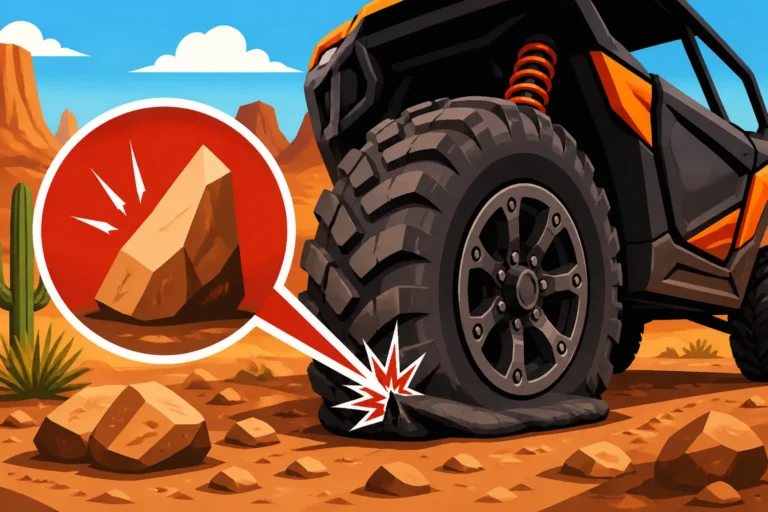
Some problems are manageable with basic tools and the right supplies. A tire plug may be appropriate for a small puncture in a repairable part of the tread, but a damaged sidewall or bent wheel is a different matter. Flat Tires From Sharp Desert Rock explains why carrying a plug kit, pump, and tire tools can make a difference, while also underscoring that not every tire can be safely patched on the trail.
A belt issue, serious coolant leak, damaged steering component, or electrical fault usually calls for a cautious decision rather than trial-and-error repairs. Trail-side troubleshooting should stop if the machine is unstable, hot, leaking, or difficult to secure. Don’t crawl under a machine held only by a jack, and don’t open a pressurized cooling system while it is hot. If the fix requires a specialized tool, replacement part, or a stable work area, arrange recovery instead.
Before the trip, practice using the tools you plan to carry. A tire repair kit is not much help if nobody knows how to use it, and a winch can create hazards if the group has never used one. Recovery Gear for Deep Sand offers a useful starting point for thinking about recovery equipment and safe preparation. For longer routes, agree on who will stay with the disabled machine, who will seek help, and how the group will avoid leaving someone alone without water or a way to communicate.
Reduce the chance of needing a trail-side mechanic
Inspect the machine and pack for common failures
A basic pre-ride inspection can catch problems that are much easier to handle at home or in town. Check tire condition and pressure, wheel hardware, brakes, steering, lights, battery connections, fluids, belts where accessible, and any leaks. Look for worn tires, cracked hoses, loose guards, or damaged wiring. Follow the machine manufacturer’s maintenance guidance, especially if the machine has seen heavy use, deep sand, dust, or long climbs.
Carry supplies suited to the machine and the route. Depending on the vehicle and trip, that might include a tire repair kit, portable pump, basic hand tools, spare fuses, a belt, fluids, gloves, and a first-aid kit. Carry water for the people, not just the machine. A vehicle problem can leave you waiting in the sun longer than planned, so bring more water and food than you expect to need.
Your riding area should influence what you pack. A short outing close to a staging area is different from a long route with limited access for a recovery vehicle. For wide, open routes, compare your machine and experience with Arizona Trails Rated for Full-Size Rigs. For narrow or rough routes, don’t assume that a trailer or tow rig can follow you to the point of failure.
Build a plan for delays, not just the ride
Tell someone outside the group where you plan to ride, when you expect to return, and what to do if they do not hear from you. Save local emergency contacts, repair-shop details, and directions before leaving reliable reception. If your group is spread across several machines, agree on a regrouping plan and avoid splitting up without a clear way to communicate.
Think through where you would wait if the machine cannot be moved. A trailhead may be an appropriate meeting point, but remote routes can have multiple access roads and confusing junctions. Write down a location description that includes the route, direction of travel, nearby landmarks, and the last junction you passed. This gives a recovery provider more useful information than “we’re somewhere near the mountain.”
Finally, allow room in your schedule for a delay. If you are visiting from out of town, plan lodging and transportation with some flexibility rather than assuming every repair can be completed the same day. Guides such as Staying in Flagstaff for Cinder Hills and Lodging in Sedona for Riders can help you think about a riding base, but confirm the practical details of any reservation directly. A little planning can make a breakdown an inconvenient part of the trip rather than a crisis.
Disclaimer
This article is for general informational purposes only and does not constitute professional advice. Laws, prices and regulations vary by location and change over time. Consult a qualified professional for guidance on your specific situation.