Arizona Trailhead Parking and Staging
A full-size truck, trailer, and UTV can turn a promising Arizona ride into a frustrating morning if the trailhead has limited space, a tight turn, or no safe place to unload. This guide explains how to choose a staging area, plan parking and trailer maneuvers, protect your gear, and avoid common access problems around Arizona’s deserts, forests, and riding areas.
Start With the Right Kind of Staging Area
Confirm what the trailhead is designed to accommodate
“Trailhead” can mean several different things in Arizona. It might be a developed staging area with marked spaces and room to unload, a dirt pullout beside a route, a forest-road parking area, or a public access point where space is shared with hikers and other visitors. The label alone does not tell you whether a long truck-and-trailer combination will fit.
Before driving out, look for information about vehicle access, parking limits, route restrictions, and whether trailers can be left at the site. A trail entrance that looks easy to reach on a map may involve a narrow, rutted road or a turn that is difficult to manage with a toy hauler. Check current land-manager information and route maps, especially when an approach crosses different types of land or connects to a popular recreation area.
Places such as Table Mesa north of Phoenix, Bulldog Canyon near Mesa, and Cinder Hills near Flagstaff attract different kinds of riders and have different approach roads and terrain. Do not assume that a large, familiar riding area has equally spacious parking at every access point. Use a map to identify the exact staging location, then check the route from the highway to that spot. [Arizona Trailhead Parking and Staging] is a useful companion when you are comparing where to unload and leave a tow vehicle.
Check access rules as carefully as route access
Parking on public land does not automatically mean every nearby activity is allowed. The staging spot might be on land managed by a different agency than the trail you plan to ride, or access could involve State Trust land, a private road, a seasonal closure, or a designated parking area with specific restrictions. Confirm that you can both reach and use the area for your intended purpose.
Permits and decals are separate questions from parking permission. A vehicle may be parked legally while the machine you plan to ride still needs the appropriate decal, registration, or other authorization. If your route touches State Trust land, check the applicable permit requirements before heading out; the rules for a recreational permit are not the same as the rules for riding on other public land. [Arizona State Trust Land Recreational Permits] explains why it is important to identify the land you are crossing rather than treating all open-looking desert as the same.
A practical check is to write down three details before the trip: the staging location, the land manager or owner, and the route’s access requirements. If any one of those is unclear, resolve it before towing a trailer into a remote area. [Finding the Right Travel Management Map] can help you understand why route lines and land boundaries matter, while [Checking Arizona Trail Status Before You Drive] is a reminder to confirm that the route is open before you leave home.
Match Your Parking Plan to Your Rig
Estimate the complete length, not just the trailer
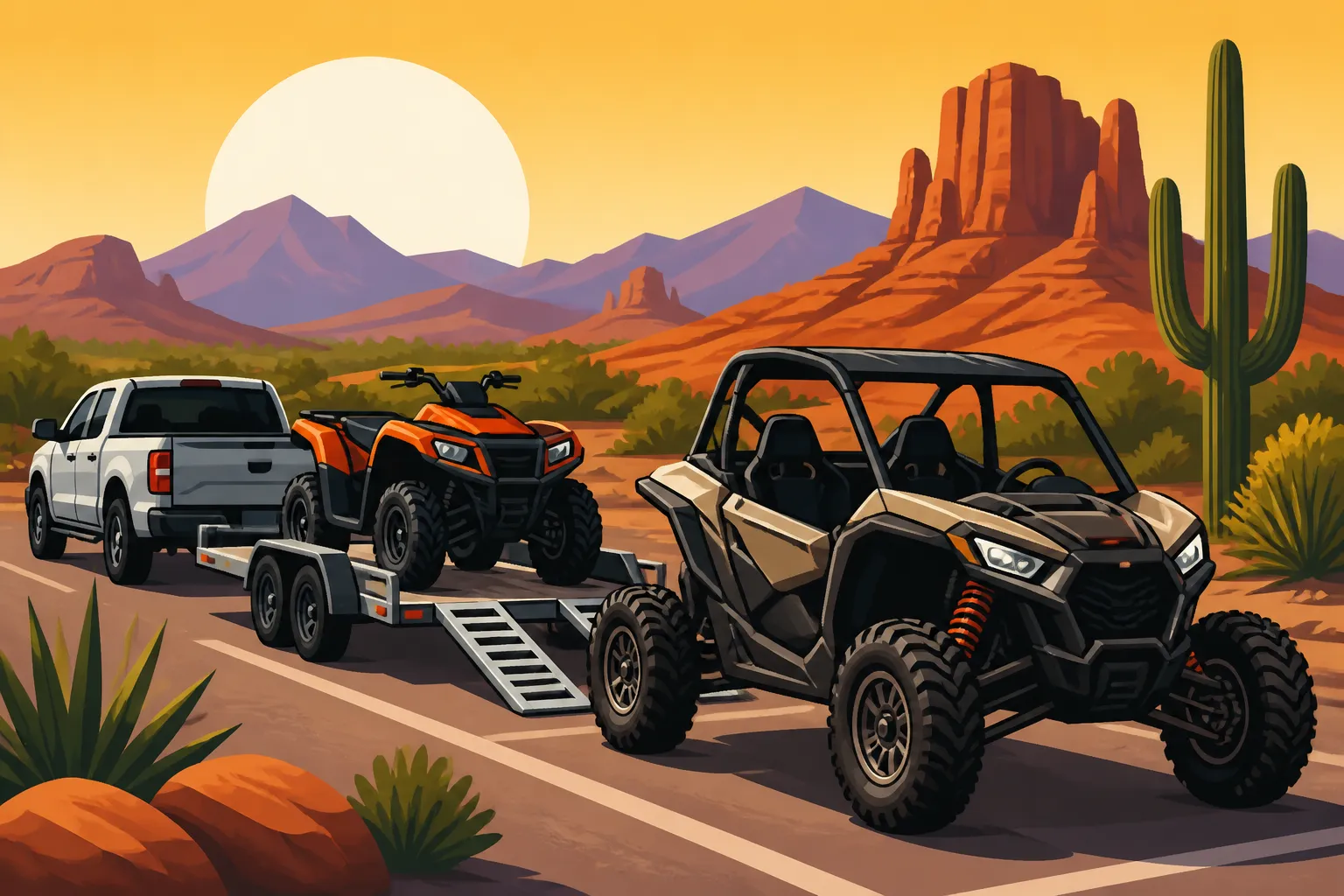
The space your setup needs includes the tow vehicle, trailer, and enough room to pull through, turn, unload, and get back onto the road. A trailer that fits in a marked parking bay may still leave the tow vehicle hanging into the access lane. At an informal desert pullout, the available area can be uneven or narrower than it appears from a quick glance.
Measure your full combination at home, including any hitch extension, spare tire, cargo rack, or rear attachment that changes the length. Think through the turning path, too. A long trailer needs more room to swing wide, and a tight entrance can become especially awkward if another vehicle arrives behind you. If you are traveling with friends, agree in advance on who will guide the trailer and where others should stand while it is backing.
The best approach is not always the closest one. A slightly longer walk from a larger, safer parking area can be preferable to squeezing into a small pullout or blocking a trail entrance. If you are planning a multi-machine trip, look for a location that can handle the entire group without forcing people to park in brush, on a road shoulder, or across the exit route. [Arizona Trailhead Parking and Staging] is especially relevant when the tow vehicle is larger than the vehicle you will ride.
Compare parking situations before committing
This table is a planning aid, not a guarantee about any specific site. Facilities, access conditions, and restrictions can differ between locations and may change, so confirm the details for your destination.
| Staging situation | What may work well | Common concern | Before you go |
|---|---|---|---|
| Developed staging area | Marked spaces and a clearer unloading area | Busy periods can fill spaces or complicate trailer movement | Check parking rules, access details, and space for your full setup |
| Informal desert pullout | Convenient access to a nearby route | Limited room, soft ground, dust, or no safe turnaround | Inspect the approach and identify a backup parking option |
| Forest-road access point | Useful for reaching higher-elevation routes | Narrow roads, uneven surfaces, or limited passing room | Check road conditions, vehicle suitability, and any seasonal restrictions |
| Trailhead shared with other visitors | Access may serve hikers, cyclists, and riders | Parking conflicts and blocked access if vehicles spread out | Park tightly and keep entrances, gates, and pedestrian paths clear |
| Remote staging point | A quieter start and fewer nearby distractions | Little help if a vehicle is stuck, damaged, or unable to turn around | Share your plan, carry recovery supplies, and avoid relying on cell service |
When you compare sites, look beyond the number of spaces. A small area with a safe entry and exit might be a better choice than a larger-looking pullout with deep sand or a sharp ditch at the entrance. If you cannot tell whether the surface will support a loaded trailer, consider leaving the trailer at a more suitable location and using a different plan for the ride—provided that parking there is allowed.
Unload Safely and Keep the Staging Area Clear
Choose a stable place before lowering ramps
Unloading on a slope or on loose, uneven ground can make ramps shift under the machine’s weight. Before backing down, inspect the ground behind the trailer, the space around the ramp ends, and the path the ATV or UTV will follow. Look for rocks, holes, wash channels, soft sand, and other obstacles that could catch a tire or make the machine lurch sideways.
Set the tow vehicle and trailer as level and stable as conditions allow. Follow the trailer and machine manufacturers’ instructions for loading and unloading, and use equipment rated for the job. Keep bystanders out of the travel path. One person should give clear directions from a place the driver can see, rather than several people calling instructions at once.
Desert ground can look firm and still give way under a heavy trailer or a spinning tire. Near places like Table Mesa, loose sand and rocky ground can make a short reverse maneuver more difficult than expected. If you are uncertain about traction or stability, stop and reassess rather than trying to power through. A few minutes spent adjusting the setup is better than a machine sliding off a ramp or a truck becoming stuck before the ride begins.
Keep access routes open for everyone
A staging area is shared space, not an extension of your campsite. Keep trucks and trailers inside the designated or clearly established parking area. Do not block gates, road entrances, turnaround zones, emergency access, or the path other riders need to reach the trail. Avoid spreading gear across adjoining spaces, even when the lot looks quiet when you arrive.
Unload efficiently, then move loose equipment out of the traffic lane. Secure ramps, straps, helmets, and tools so they cannot blow away or create a trip hazard. If several vehicles are traveling together, park as a group only when there is enough room to do so without forcing other visitors to squeeze past or wait for you to finish a long backing maneuver.
These habits matter at popular destinations such as Cinder Hills and the Sedona area, where riders may share access points with people who are hiking, sightseeing, or using other recreation facilities. Keep noise reasonable, yield space to arriving vehicles, and leave room for someone towing a trailer to turn around. [Arizona Trailhead Parking and Staging] pairs naturally with [Family-Friendly Arizona OHV Trails] for groups planning a ride where multiple vehicles and different experience levels may meet at the same starting point.
Prepare for Arizona Conditions Before You Park
Plan around heat, wind, dust, and changing weather
An exposed parking area can become uncomfortable quickly in Arizona’s low desert, especially when the tow vehicle is parked in direct sun for hours. Bring drinking water for the staging period as well as the ride, and consider where passengers will wait while machines are unloaded. Do not leave people or animals inside a parked vehicle without a safe way to manage the heat.
Wind and dust can complicate unloading. Secure paper maps, bags, helmets, and lightweight equipment before opening the trailer, and keep sensitive items protected from blowing grit. If a dust storm or strong gusts arrive while you are maneuvering, pause in a safe location rather than trying to rush a trailer turn with poor visibility. For rides during monsoon season, take the possibility of storms seriously even when the sky is clear at the trailhead; weather can differ across the surrounding terrain.
Elevation changes the plan, too. A cool morning near Flagstaff can feel very different from a summer afternoon near Phoenix or Lake Havasu City. The route may also climb from low desert into cooler country, so bring layers and check the conditions for the whole ride rather than only the parking lot. [Water Planning for an Arizona Trail Day] and [Arizona Monsoon Season and Flash Flooding] cover two conditions that can affect both your ride and the safety of getting back to your vehicle.
Have a backup for road and parking surprises
A mapped route does not guarantee an easy approach. A wash crossing may be rutted, a dirt road may be rougher than expected, or a closure may redirect traffic. Before the trip, identify another legal place to stage or a safe point where you can turn around if the approach is unsuitable for your rig. If a narrow road has no safe passing area, do not continue simply because the destination is close.
Navigation tools can help you understand the route, but they do not replace checking access rules or observing signs on the ground. Riders who use onX Offroad can consult it while planning a route and reviewing nearby map details, then cross-check important access and closure information with the responsible land manager. Save the route information before leaving reliable service, and bring a backup navigation option if the area is remote.
Tell someone who is not riding with you where you plan to stage, which route you expect to take, and when you expect to return. In remote areas, a small parking problem can become a larger one if the vehicle is disabled or the group is delayed without cell service. [Cell Service in the Arizona Backcountry] and [Getting Turned Around in the Sonoran Desert] offer useful planning context for trips where a wrong turn or failed phone signal could leave you far from help.
Finish the Trip Without Leaving a Problem Behind
Secure the tow vehicle and equipment before riding
Once machines are unloaded, take a final walk around the truck and trailer. Check that the trailer is parked securely, the hitch area is not obstructing another space, and ramps and tie-downs are stowed. Lock the vehicle if appropriate, keep valuables out of sight, and avoid leaving paperwork or electronics visible through the windows.
Carry the items you will need on the ride rather than assuming they can be safely retrieved from the truck later. That includes water, navigation, protective gear, and any required documents. Rules for carrying papers can depend on the machine and how it is registered, so learn what applies to your situation before leaving the vehicle. [Do You Carry Papers on an Arizona Trail?] and [What an Arizona Ranger Asks a Rider For] are useful references when you are sorting out what to keep accessible.
If you are leaving a trailer unattended, make sure you are allowed to park it there for the length of your ride. A spot that is fine for a short unload may not be suitable for long-term parking or overnight use. Do not block another visitor’s access just because you expect to return before they need the space.
Inspect the site again when you return
Before loading, check that the ground and ramps are still in safe condition. Other vehicles may have parked nearby, dust may have covered a small obstacle, or afternoon wind may have moved loose equipment. Give yourself enough room to line up the machine and trailer without backing into traffic or asking another rider to stand in a blind spot.
Then pack out everything you brought, including food scraps, zip ties, broken straps, and small bits of plastic. Look for items that can be easy to miss in desert gravel, such as a glove, a water bottle, or a loose tool. If you find damage or a new hazard in the parking area, report it through the appropriate land manager when practical, rather than trying to move a barrier or create a new access path yourself.
A good staging plan is part of a good ride. Choosing the right access point, checking the rules, giving your trailer enough room, and leaving the area clean all reduce avoidable stress for your group and the people arriving after you. For a broader trip plan, see [Planning an Arizona Riding Trip] and [Arizona Trailhead Parking and Staging].
Disclaimer
This article is for general informational purposes only and does not constitute professional advice. Laws, prices and regulations vary by location and change over time. Consult a qualified professional for guidance on your specific situation.