Forest Service Permits Arizona Riders Need
Forest Service Permits Arizona Riders Need
Trying to work out whether an Arizona ATV or UTV ride needs a permit can be confusing: the answer may change with the forest, route, activity, and vehicle. Most ordinary rides do not require one blanket Forest Service permit, but some areas and organized or commercial activities have extra rules. Here’s how to tell what applies before you load up.
Do Arizona Forest Service trails require a permit?
There is no single permit that covers every ride on every National Forest in Arizona. For a typical recreational ride, the main requirement is often to use a route open to your machine and follow the forest’s current rules. But a particular area may control access, and special activities may require advance approval.
Arizona’s National Forests have different route networks and local rules. A trail that is open to one type of vehicle may be closed to another, while a road may allow motor vehicles but have a width or seasonal restriction. Forest boundaries also do not always match the boundaries of the land beside a route. A ride can pass through National Forest, Bureau of Land Management, State Trust, private, or tribal land in a single trip, with different rules applying in each place.
The practical distinction is between permission to use a route and a permit or pass required for a specific activity or place. A route shown as open on the applicable motor vehicle use map may still be subject to a closure, an access permit, or a separate restriction. Conversely, the absence of a special permit for a route does not mean every vehicle can use it.
| Riding situation | What to check before you go |
|---|---|
| Ordinary ride on a National Forest route | Current motor vehicle use map, route closures, vehicle eligibility, and required Arizona OHV decal or registration |
| Controlled-access area | Whether an area-specific permit, reservation, or gate code is required |
| Organized group event | Whether the organizer needs a Forest Service special use permit |
| Commercial or guided ride | Whether the business or guide has the required authorization |
| Overnight stay | Whether camping is allowed there and whether a campground reservation, fee, or local restriction applies |
| Route crossing other land | The rules for each land manager, not just the National Forest |
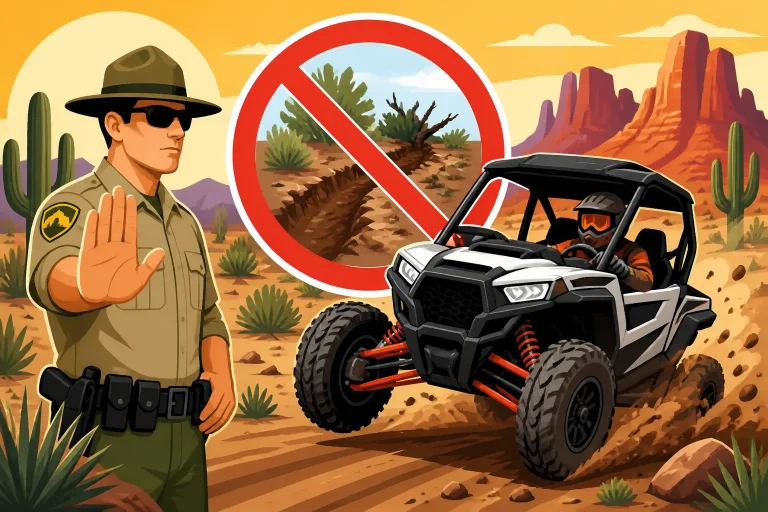
A ride on a National Forest is not automatically allowed just because it is public land. Forest managers designate where motor vehicles may travel. Riding off a designated route can damage soil and vegetation, create new tracks, and result in enforcement action. If a route is unclear on the map, do not treat uncertainty as permission.
A useful starting point is Reading an Arizona Motor Vehicle Use Map. These maps help identify routes open to motorized use, but riders should also check for updates and closures before leaving. A printed map can be handy where reception is poor; an offline digital map is useful too, but neither replaces the current official route information.
Which permit or approval might apply?
The phrase “Forest Service permit” can mean several different things. A rider may be asking about access to a particular area, a group event, a paid tour, or overnight use. Identifying the activity first makes it easier to ask the right question.
Area-specific access permits
Some locations have controlled access or local procedures that do not apply across an entire forest. Bulldog Canyon in the Tonto National Forest is a familiar example of an area where motorized access has been managed through a permit and gate-code process. The process and availability can change, so check current information for that specific area before planning around it.
An access permit may have conditions such as approved entry points, allowed dates, vehicle limits, or rules for closing gates. Do not assume that a permit for one area gives access to another nearby route. Read the terms for the location and keep any required proof available during the trip.
Organized rides and events
A club ride with several vehicles does not necessarily have the same permit requirements as a public event, race, fundraiser, or activity that uses Forest Service land in a way that needs special authorization. The details matter: group size, route, duration, commercial involvement, facilities, and expected impacts can all affect whether the organizer must seek approval.
If you are joining an event, ask the organizer whether the necessary land-manager approval has been obtained. Riders generally should not assume that an event is authorized simply because it is advertised or has taken place before. For the land-use side, see Arizona Permits for an Organized Ride and Special Use Permits on Arizona Forest Land.
Commercial tours and paid guiding
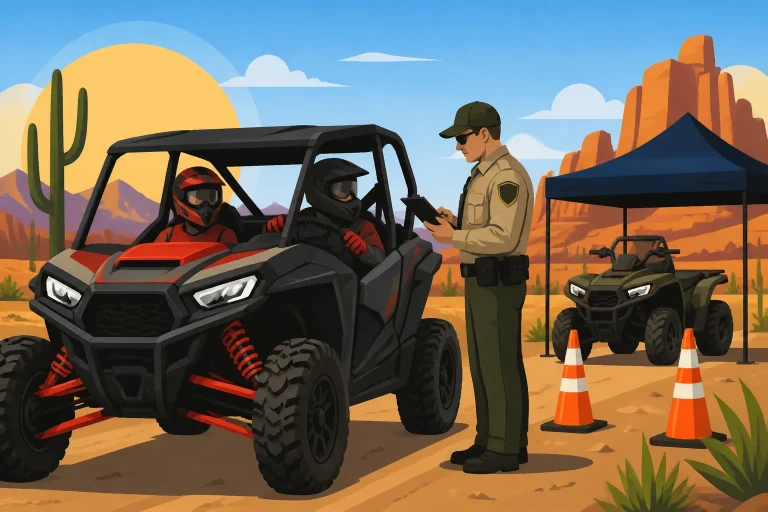
A business offering guided rides or another paid activity on National Forest land may need a special use authorization. That is usually the operator’s responsibility, not a permit each customer obtains for an ordinary ride. Still, a customer can ask whether the company is authorized for the route and activity being sold.
This is separate from the rules that apply to the customer’s machine. A guided tour does not automatically make a closed route open, excuse a rider from required vehicle documentation, or authorize travel across land that the operator does not control. Riders considering a paid trip can also review Forest Service Permits Arizona Riders Need only as a starting point for questions to ask; the controlling details come from the local land manager and the operator’s authorization.
Camping, parking, and staging
A ride plan may involve more than operating the machine. Developed campgrounds can require reservations or fees, while dispersed camping rules vary by location and can be affected by closures, fire restrictions, or limits on length of stay. Trailhead parking and staging can also have separate rules. A riding permit does not necessarily authorize camping, and a campground reservation does not authorize riding on a closed route.
Check where you plan to park the truck and trailer, whether overnight parking is allowed, and whether the staging area is open to your rig. For some routes, a site can be open to riding while nearby land is closed to camping or vehicle staging.
Permits from other land managers
A Forest Service permit applies only to the activity and area it covers. It does not replace a separate permit required by another agency or landowner. State Trust Land, for example, has its own recreational access rules; review Arizona State Trust Land Recreational Permits if your route crosses that land. BLM land also has its own route and permit requirements, covered in BLM Permit Rules in Arizona.
If a route crosses tribal land or private property, do not assume public access. Check the applicable access rules and obtain permission where required. When a ride spans multiple jurisdictions, make a simple list of each land manager and verify its rules separately.
How to check your route and permit requirements
A dependable pre-ride check is more than searching a trail name and looking at a route on a phone. Maps can be outdated, online descriptions may not reflect temporary closures, and the same place name can refer to multiple roads or trailheads.
Use this process before you commit to a route:
- Identify the land manager. Find out whether the trailhead and each planned segment are on National Forest, BLM, State Trust, tribal, private, or other land. A route may cross more than one kind of property.
- Find the official motor vehicle use map. Use the map for the relevant National Forest and check that the route is open to your vehicle type. Pay attention to route designations, width limits, seasonal dates, and notes.
- Check alerts and local orders. Look for closures, fire restrictions, construction notices, temporary access changes, or emergency orders. A route marked open on a map can still be temporarily closed.
- Search for area-specific access rules. Confirm whether the destination requires a permit, reservation, gate code, or other access step. Read the conditions rather than relying on an old trip report.
- Confirm the activity type. If the trip involves a guided business, race, fundraiser, organized event, filming, or another special use, ask the relevant land manager whether authorization is required.
- Check vehicle paperwork separately. Confirm whether your ATV or UTV needs an Arizona OHV decal, registration, or other documentation. A Forest Service permit does not replace vehicle requirements.
- Save proof and details offline. Keep permit confirmation, maps, route notes, and emergency information available without cellular service. Follow any rules about carrying or displaying a permit.
The official map is important because it answers a narrower question than many consumer trail apps: which motorized routes are designated for use under the land manager’s rules. A GPS track can show where someone drove, but it cannot establish that the route is legal for you to ride today. Compare any downloaded route with the applicable map and current notices.
When asking a Forest Service office about a trip, be specific. Give the forest or district, trail or road name, planned dates, vehicle type, group size, and whether the activity is commercial or organized. Ask whether a permit is required, who must obtain it, and whether it covers the entire route. If you only ask, “Do I need a permit in Arizona?” the answer may be too general to help.
If information conflicts, pause and verify with the responsible office before riding. This is especially important when a route crosses a land boundary, an access gate, or an area with seasonal restrictions. A map app, forum post, or old permit confirmation may not reflect the current rule.
The decal, registration, and route permission are separate
Riders often use “permit” to describe several unrelated requirements. Keeping them separate avoids a common mistake: having one piece of paperwork and assuming it covers everything.
An Arizona OHV decal or vehicle registration concerns the machine’s legal status and use under Arizona requirements. A Forest Service permit concerns a defined use of Forest Service land, where one is required. A route designation concerns where the machine may travel. A camping reservation concerns a campsite. One does not automatically replace another.
For example, a street-legal machine may have a plate and insurance, but those do not give it permission to use a closed trail. A rider with an OHV decal may still need an area-specific access permit. And a group’s event authorization does not necessarily take the place of the individual machine’s required decal or registration.
The rules can differ for Arizona residents and visiting riders. Check Resident Decals Versus Visitor Decals in Arizona and the related information on Arizona’s Non-Resident OHV Decal to determine what applies to your machine and situation. If you are riding a plated machine, review Street-Legal Plates in Place of an Arizona Decal rather than assuming that a plate automatically settles every decal question.
The land manager’s route rules apply regardless of whether your machine is registered. On the other hand, meeting land-access rules does not automatically satisfy state vehicle requirements. Treat these as separate checks:
- Is the route open to this type and size of machine?
- Is a permit or other access authorization required for this location?
- Does the machine need an Arizona decal, registration, or other documentation?
- Are there separate rules for the event, tour, camping, or parking?
- Does every landowner or agency along the route allow the planned use?
If you are riding only on a route managed by the Forest Service, you may not need a separate Forest Service permit for ordinary travel. That is not the same as having no requirements. The right route, current access conditions, and vehicle paperwork still matter.
Common mistakes that lead to trouble
Most permit problems come from relying on an assumption rather than checking the exact area and activity. These are the mistakes worth avoiding:
- Assuming every National Forest uses the same rules. Forests and districts can have different access procedures, restrictions, and route networks.
- Treating a map app as permission. A track or user-generated route can include closed or unauthorized roads.
- Using an old map or trip report. Seasonal closures and temporary orders can change access after a route was described.
- Confusing a vehicle decal with an area permit. They address different requirements.
- Assuming an event organizer has handled everything. Ask whether the necessary authorization is in place and what riders must do individually.
- Riding beyond a gate or boundary without checking. A route can continue physically while legal access ends.
- Assuming a permit follows the rider everywhere. Permits are often limited to a particular place, time, or activity.
- Ignoring parking and camping rules. Access to a trail does not necessarily include overnight parking, camping, or staging a trailer.
- Planning around cell service. Download the map and save confirmation details before you reach the backcountry.
If a gate is closed, a sign conflicts with a map, or the route appears to enter land with different access rules, do not bypass the barrier and hope the online information is right. Stop, confirm the status, and choose a route you can verify. A small detour is better than a citation, a damaged resource, or a vehicle stranded beyond its permitted access.
For riders planning across more than one jurisdiction, Arizona Wilderness Boundaries and Machines can help clarify a particularly important map issue: designated routes do not mean motorized access is allowed inside wilderness areas. Also check the route and land boundaries rather than relying on a trail’s name, since the named destination may be near land where vehicle use is prohibited.
Frequently Asked Questions
Is a Forest Service permit required for every ATV or UTV ride in Arizona?
No single permit covers every ride, and ordinary recreational travel on an open route does not automatically require a separate Forest Service permit. Specific areas, events, commercial activities, or other uses may require authorization. Check the local rules for the route and activity.
Does an Arizona OHV decal let me ride any National Forest trail?
No. A decal addresses a vehicle requirement; it does not make a closed or undesignated route legal. Follow the current motor vehicle use map, closures, and any area-specific permit conditions.
Do I need a permit for a guided ride?
The guide or business may need authorization for its commercial activity, while customers may have separate vehicle and access requirements. Ask the operator whether the trip is authorized and confirm any individual requirements for your machine.
What should I do if the map and a trail sign disagree?
Do not assume the route is open. Check current notices and contact the responsible Forest Service office or land manager. Temporary closures or updated local directions may not appear on every map or app.
Disclaimer
This article is for general informational purposes only and does not constitute professional advice. Laws, prices and regulations vary by location and change over time. Consult a qualified professional for guidance on your specific situation.