Arizona’s Non-Resident OHV Decal
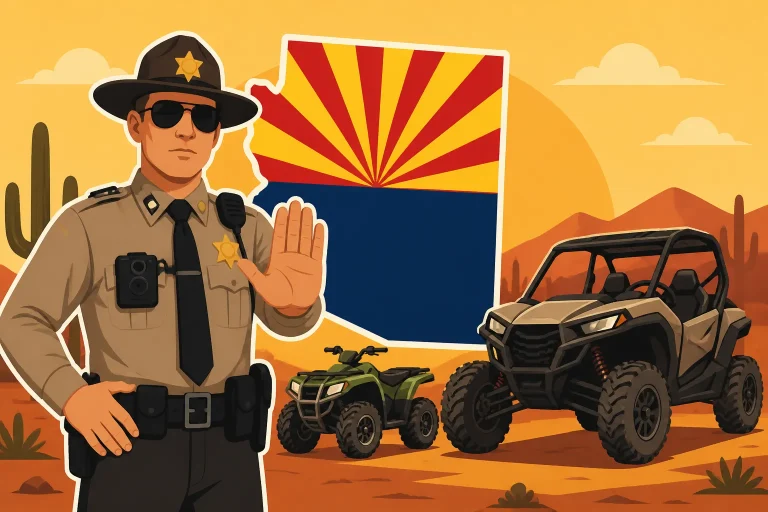
Arizona visitors often discover the decal question after loading a quad or side-by-side for a trip: an out-of-state registration may not be enough for every Arizona riding area. This guide explains when a non-resident OHV decal may be needed, how to prepare before leaving home, what the decal does not authorize, and how to avoid confusing it with other land-use permits.
What Arizona’s Non-Resident OHV Decal Is For
The decal is an Arizona riding requirement, not a replacement for registration
A non-resident OHV decal is an Arizona-specific requirement for certain off-highway vehicles from outside the state when they are operated in covered areas. It does not replace the machine’s home-state registration, title, or other required documents. Think of it as an additional Arizona requirement that can apply even when your ATV or UTV is properly registered where you live.
That distinction matters because visitors often assume their home-state plate settles every question. A plate may demonstrate that the machine is registered, but it does not necessarily satisfy Arizona’s separate OHV decal rules. Before a trip, identify how the vehicle is classified at home and check Arizona’s requirements for that kind of machine and the places you plan to ride.
The decal is also different from a recreational permit for Arizona State Trust Land. A decal does not automatically grant access to every public parcel, trail, or staging area. If your route crosses land with separate access rules, you may need another authorization as well. The useful first step is to treat vehicle compliance and land access as two separate checks.
The rule is tied to the machine and where it is operated
The key question is not simply, “Am I an Arizona resident?” It is also, “What type of vehicle am I bringing, and where will I operate it?” Rules can depend on whether the machine is an OHV, how it is registered, and whether the route includes public land or another area covered by Arizona requirements.
A visitor riding a quad on a public trail near Phoenix may face a different compliance question from someone driving a street-legal UTV only on paved roads. Likewise, a machine parked on a trailer is not in the same situation as one being operated on a trail. Avoid relying on a general statement from a friend or an old forum post when the details of your own vehicle and route matter.
For an overview of the broader Arizona registration system, see Arizona’s Non-Resident OHV Decal is not the only relevant topic; Arizona Rules for Visiting Riders and What Arizona Riders Need Before They Ride can help frame the practical questions visitors should ask. Before departure, confirm the current decal requirements through the official Arizona portal and compare them with your machine’s paperwork.
Who May Need a Non-Resident Decal
Visitors bringing an out-of-state ATV or UTV
If you are bringing a quad, side-by-side, or another qualifying OHV registered outside Arizona, do not assume that your home-state registration automatically exempts it. Arizona’s non-resident decal rules are intended to address out-of-state machines being operated in covered settings. The exact requirement can depend on the vehicle and its registration status, so check rather than guessing based on the plate alone.
This comes up often with visitors traveling from neighboring states. A California rider heading to the Sonoran Desert, a Utah family visiting northern Arizona, or a Nevada owner towing a side-by-side to Lake Havasu should each check the Arizona requirements before the trip. Routes near Sedona, Flagstaff, and the Colorado River can involve different land managers and access rules, so planning the riding area matters as much as identifying the machine.
If you are relocating rather than visiting, your situation may not fit the ordinary short-term visitor scenario. New residents should review Arizona registration and address requirements as well as decal rules. Moving to Arizona With an Out-of-State Quad and Arizona Registration Deadline for New Residents are useful companion topics for separating a visitor’s obligations from a resident’s.
Street-legal machines and possible exceptions
A machine with street-legal registration may be treated differently from an OHV that is registered only for off-highway use. But “street legal” is not a magic phrase that answers every land-access question. You need to know what the vehicle’s registration actually authorizes, where you plan to ride, and whether the applicable Arizona rule recognizes that status as an alternative to a decal.
For example, a UTV with road-use equipment and a plate may be driven on certain roads when it meets the relevant requirements. That does not necessarily mean it can be used on every trail, enter every recreation area, or skip every land permit. An operator can be fully compliant on the road and still need to verify access rules for a nearby trail or parcel.
Check the details at the point of use rather than relying on a broad claim such as “my machine has a plate, so I’m covered.” The articles Street-Legal Plates in Place of an Arizona Decal and Street-Legal Registration Instead of a Decal address that distinction. When the vehicle’s status is unclear, ask the relevant Arizona agency or land manager before setting out.
How to Get Ready Before Traveling
Start with the official portal and your machine information
Begin with the official Arizona Game and Fish portal and follow its instructions for non-resident OHV decals. Keep your machine’s identifying details and registration information nearby. The information requested may depend on the application process, so use the portal’s current prompts rather than relying on a saved checklist from someone else’s trip.
Make sure the details you enter match the machine’s documents. A typo in a vehicle identification number, an incorrect registration detail, or choosing the wrong vehicle category can create avoidable delays or confusion. If you are preparing paperwork for several family machines, work through them one at a time and keep each confirmation associated with the correct vehicle.
Do not wait until you are parked at a trailhead with weak cell service. A rider who arrives near a staging area outside Flagstaff or Lake Havasu only to discover that the account is incomplete has fewer easy options than someone who handled the process at home. For account setup and portal basics, see Setting Up an Arizona Portal Account and Creating an Arizona Game and Fish Portal Account.
Confirm delivery, display, and proof requirements
Follow the official instructions for how the decal is issued and displayed. If a physical decal is mailed, build enough time into your trip planning for it to arrive and be placed as directed. Do not assume that an order confirmation is interchangeable with the decal itself unless the official instructions specifically say so.
Keep a copy of the confirmation and relevant vehicle paperwork in a place where you can find them. A digital copy on your phone is useful, but it is sensible to have a backup if your battery dies or you lose coverage. A waterproof document sleeve can protect paper copies from dust and spilled drinks; some riders look for basic sleeves through stores such as Amazon, but the sleeve is only for organization and does not substitute for required vehicle documents.
Before loading the trailer, check that the displayed decal is attached to the correct machine and is readable. If your trip includes multiple vehicles, do not assume one decal or one application covers the whole group. Review Where to Buy an Arizona OHV Decal and Where an Arizona Non-Resident Decal Is Mailed for related planning questions, and use the official portal for current instructions.
| Trip question | What to check before departure |
|---|---|
| Is the machine an OHV under Arizona’s rules? | Confirm its classification and relevant vehicle details |
| Is it registered outside Arizona? | Review the non-resident decal instructions for that status |
| Is it street legal? | Check whether that registration is recognized for the planned use |
| Will you ride on State Trust Land? | Check whether a separate recreational permit is required |
| Is the decal physical or otherwise issued through the portal? | Follow the current application and display instructions |
| Are several machines traveling together? | Confirm requirements separately for each vehicle |
| Will the route cross land managed by different agencies? | Check access rules for every part of the route |
The Decal Course and Operator Preparation
Understand the course requirement separately from the decal
Arizona’s OHV education rules and its decal process are related but not identical questions. Riders should verify whether an operator must complete the applicable course, who is covered by the requirement, and how completion is recorded. Do not assume that buying or applying for a decal automatically completes every education obligation.
This distinction is especially important for families and groups. The machine owner may handle the decal application, while a different person operates the vehicle. An adult who purchased the machine’s decal should not assume that the operator’s training requirements have been met for every rider. Check the rule against the ages and roles of the people who will actually drive.
The course is intended to help riders understand responsible operation, safety, and Arizona-specific expectations. Treat it as part of trip preparation rather than a last-minute administrative hurdle. Arizona’s Free Mandatory OHV Decal Course and Who Must Take the Arizona Decal Course provide more detail about the course and who may need it.
Make sure every operator knows the rules that affect the trip
A decal does not make an inexperienced rider ready for desert terrain. Operators should understand the machine’s controls, passenger limits, protective equipment, and the difference between a legal route and an attractive-looking two-track. In Arizona, a trail can cross changing terrain quickly, and a route that looks straightforward on a screen may include deep sand, rocks, steep grades, or a wash that changes after rain.
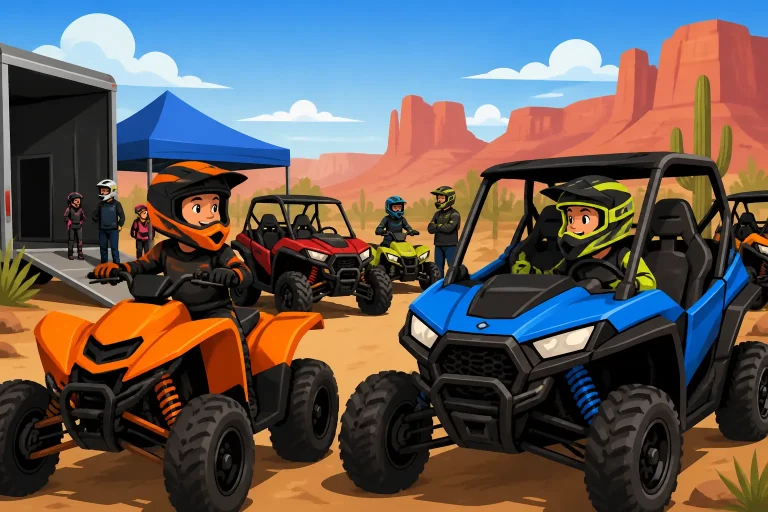
Before leaving a staging area, agree on a simple group plan: who leads, who follows, where you will stop, and what to do if a machine has a problem. A family ride near Table Mesa or a group outing outside Sedona can become stressful when riders assume everyone knows the route or has the same experience. A short briefing at the trailer is easier than sorting out confusion after the group has spread out.
Check age and supervision requirements for younger operators, too. Parents should not assume that rules for riding on private property carry over to public trails or roads. The relevant guidance includes Arizona Education Rules for Under-18 Riders and Supervising a Young Rider in the Desert. Keep the learning process age-appropriate, and do not put a child on a machine they cannot control safely.
Reciprocity, Registration, and What a Decal Does Not Cover
Home-state registration is not the same as Arizona authorization
Reciprocity is often misunderstood as a blanket agreement that one state’s paperwork automatically satisfies another state’s riding rules. In practice, your home-state registration can remain important while Arizona may still have a separate decal requirement for operating an out-of-state OHV in covered areas. The safest approach is to keep both obligations in view.
Carry the machine’s registration and ownership documents as required, and keep your Arizona decal information available as directed. A rider may be asked to show that the vehicle is properly identified and that applicable riding requirements have been met. The precise documents to carry can depend on the circumstances, so do not rely on a single decal as proof of ownership or registration.
If you are visiting from a particular state, look for guidance that addresses your situation directly. The articles Do Nevada Riders Need an Arizona Decal?, Do California Riders Need an Arizona Decal?, and Utah Riders Coming to Arizona Trails are useful starting points. They are not a substitute for checking current official requirements for your machine and itinerary.
A decal is not a trail pass, registration, insurance, or permission to ride
The decal’s purpose is limited. It does not give permission to ride across land that is closed to motorized use, authorize travel through private property, replace a street-legal plate, or make an unsafe machine lawful. It also does not automatically meet any separate insurance, registration, or equipment requirements that apply to the vehicle and route.
That limitation matters around Arizona’s mix of land ownership. A route can pass through public land, State Trust Land, private parcels, or areas managed under different rules. A trail shown on a map does not necessarily guarantee permission to enter every parcel it crosses. Before riding, identify the land manager and confirm that your intended route is open and accessible.
Arizona State Trust Land is a particularly common source of confusion. A rider may have the correct OHV decal and still need a recreational permit for the trust land portion of a trip. Arizona State Trust Land Recreational Permits explains that separate authorization, while Why a Decal Alone Will Not Let You Stage addresses the important difference between vehicle compliance and permission to use land.
Planning Routes and Land Access
Check every land manager along the route
A ride described as “near Sedona” or “outside Phoenix” can involve more than one access rule. Routes around the red rocks, desert trail systems, and northern Arizona forests may be managed by different agencies or include different land types. A decal does not tell you whether a specific road or trail is open, whether a gate is locked, or whether a permit is needed at the staging area.
Use a current travel management map and review notices from the relevant land manager before leaving. Pay attention to route designations, seasonal closures, fire restrictions, and temporary access changes. If a road is unsigned or the map is unclear, do not treat the uncertainty as permission to proceed. Turning back is frustrating, but it is better than creating a trespass or resource-damage problem.
For practical route planning, see Finding the Right Travel Management Map and Checking Arizona Trail Status Before You Drive. These checks are particularly useful if your trip combines trail riding with a highway crossing, forest road, or a route near private land. Plan a legal alternative in advance so one closure does not derail the whole day.
Treat State Trust Land as a separate permission question
Arizona State Trust Land is not simply another name for public recreation land. Access for recreation can require a separate permit, and the rules may apply to activities such as riding, parking, or staging. A non-resident OHV decal does not automatically provide that authorization. Before parking a trailer or unloading machines, confirm that the specific location permits your planned activity.
This is where otherwise careful riders can make a costly mistake. A group may see an open-looking area near a trail and assume it is a public staging area. If the parcel is Trust Land, the group may need a permit even if every machine has the appropriate decal. The same problem can arise when a route crosses a parcel boundary without an obvious fence or sign.
Check land status before the trip, not just when you reach a gate. Keep permit records accessible, and make sure the permit type matches the people and activities involved. The articles Which Arizona Land Is Trust Land, Telling Trust Land From BLM Ground, and Parking on Arizona Trust Land can help you understand why the distinction matters.
Practical Checks for the Trailhead
Keep documents organized and accessible
A few minutes of organization can prevent a frustrating search at a staging area. Keep the machine’s registration information, decal confirmation or related records, and any required land permit together. If you are traveling with more than one vehicle, label or group the records so you do not mix up the paperwork for the ATV and the side-by-side.
A paper copy is helpful when phones are damaged, batteries run low, or service disappears. A digital backup can also be useful, particularly if a document is misplaced. Some riders use a simple waterproof sleeve from a general retailer or Amazon to keep paper records clean in dusty conditions. The goal is not to carry every document you own; it is to make the relevant records easy to retrieve if asked.
Do not store important papers where they can blow away or get soaked in an open cargo bed. At the same time, avoid leaving original documents exposed to sun, dust, or theft. For more detail on what riders may be asked to show, read What an Arizona Officer Asks For and Do You Carry Papers on an Arizona Trail?.
Do a vehicle and equipment check before unloading
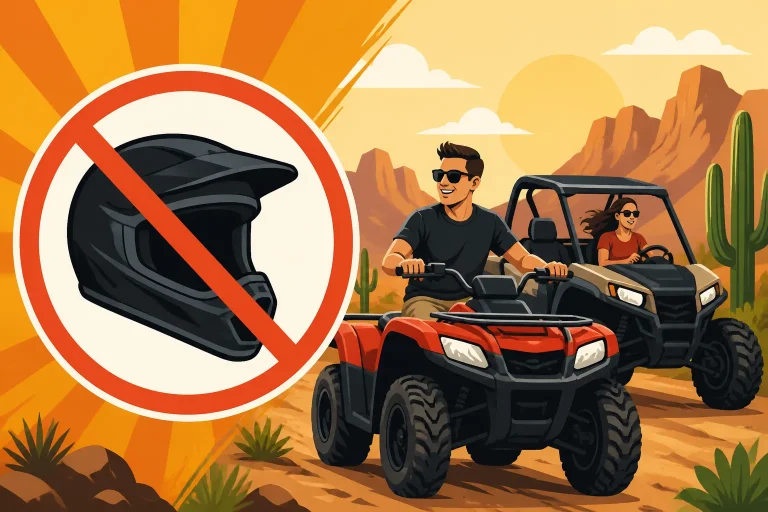
A decal does not make a machine mechanically safe. Before a ride, check tires, brakes, steering, lights where required, fuel, and any safety equipment appropriate for your vehicle and route. For a long desert loop, bring basic recovery and repair supplies suited to the terrain. A small issue at the trailer is easier to fix than a breakdown miles from pavement.
Think through the day’s conditions, too. Summer heat, monsoon weather, dust, and remote terrain can turn a short ride into a serious situation. Carry enough water, tell someone where you plan to ride, and check weather and closure information. If a route includes a wash, remember that rainfall elsewhere can create dangerous flooding even when the sky above you looks clear.
Finally, make sure the decal is visible and attached as instructed. Dust, damage, or an incorrect placement can make a valid decal difficult to identify. If your decal is lost or damaged, do not improvise a substitute. Review Replacing a Lost or Damaged Arizona Decal and follow the official replacement process.
Common Visitor Scenarios and Mistakes to Avoid
A weekend visitor with a registered quad
Suppose you live in Nevada and are towing a registered quad to Arizona for a weekend. Before departure, confirm whether your machine needs the non-resident decal, follow the portal’s current application steps, and make sure the decal is issued and displayed as directed. Keep your Nevada registration information with the Arizona decal records so you can answer questions about both the machine and its Arizona compliance.
Then check the actual route. If you plan to ride an area near Lake Havasu, verify trail access, staging rules, and whether any portion involves land requiring another permit. Do not assume the decal covers a trailer parking area or gives you permission to ride a route simply because it appears on a recreational map.
The common mistake in this scenario is stopping after purchase. Riders sometimes think, “I got the decal, so I can ride anywhere.” A better sequence is vehicle compliance, operator preparation, route verification, and land-permit checks. That order helps catch issues before the truck and trailer are already on the road.
A family bringing several machines
For a family trip with multiple ATVs or a UTV and a quad, treat each vehicle as its own compliance item. Confirm the requirements for each machine, match each record to the right VIN or registration, and follow the official display instructions separately. Do not assume one application or one decal covers several vehicles unless the portal expressly says that it does.
Next, check the operators. The adults may be familiar with riding, but a teenager or first-time rider may have separate age, education, supervision, or equipment requirements. Make sure everyone knows which machines they are allowed to operate and that passengers are permitted for the specific vehicle. A family plan should not put a young rider on a machine that is too large or difficult to control.
At the staging area, keep the group together long enough to review the route, identify the lead and sweep riders, and confirm that everyone has water and protective gear. Families often lose time not because the paperwork is complicated, but because one missing item is discovered only after unloading. A short pre-trip checklist saves that avoidable scramble.
A snowbird or seasonal visitor
A seasonal visitor who keeps a machine at a second home should not assume that last season’s arrangements still apply. Check the decal’s validity and current requirements before the first ride of the season. If the machine’s registration, ownership, or location has changed, review whether that affects the process.
Storage can also create practical problems. A decal left exposed to Arizona sun may fade or become hard to read, and paperwork stored in a hot garage can be misplaced among other seasonal items. Keep a record of the machine’s identifying information and check the physical decal before the first outing. If replacement is needed, use the official process rather than relying on a blurry photograph as a substitute.
Snowbirds also sometimes invite visiting friends or relatives to ride. A decal attached to your machine does not necessarily satisfy every requirement for a visitor operating it, and the visitor still needs to understand the rules and route. Review What a Snowbird Needs to Ride in Arizona and Lending Your Machine to a Visitor before lending the keys.
Frequently Asked Questions About the Non-Resident Decal
Does an out-of-state plate automatically exempt my machine?
Not necessarily. Home-state registration and Arizona OHV decal rules are separate questions. A street-legal registration may affect the answer, but you should verify how Arizona treats your specific vehicle and intended use. Do not rely on the presence of a plate alone without checking current official guidance.
Does the decal let me ride on State Trust Land?
No. The decal and State Trust Land access are separate matters. You may need an applicable recreational permit to ride, park, or stage on Trust Land. Check the parcel and planned activity before entering, and do not assume that a trail’s proximity to public land means the entire route is open.
Can I wait until I arrive in Arizona to sort it out?
That is a risky plan. The application process, account access, issuance, or delivery instructions may take time, and remote staging areas can have poor cell coverage. Complete the required steps before traveling whenever possible, and bring the records you are instructed to keep.
What if the decal is delayed, lost, or damaged?
Follow the official instructions for the relevant situation. Do not assume that an order confirmation, handwritten note, or photocopy replaces a required decal. If it has not arrived before your trip, check the official portal or contact the appropriate agency to learn what is allowed. If it is lost or damaged, use the established replacement process.
Is a decal all I need for a safe and legal ride?
No. You still need to follow the rules that apply to the operator, machine, route, land, and conditions. That may include registration, equipment, education, insurance, land permits, age requirements, and road-use restrictions. The decal is one part of trip preparation—not a universal riding pass.
Disclaimer
This article is for general informational purposes only and does not constitute professional advice. Laws, prices and regulations vary by location and change over time. Consult a qualified professional for guidance on your specific situation.