Where Arizona Decal Revenue Is Spent
Arizona’s OHV decal is more than a sticker required for many off-highway vehicles: its revenue helps support the systems that make riding possible. But the money does not simply go straight to the trail closest to you. Here’s how decal funding works, what it can support, and how to follow the money to projects in Arizona.
How Arizona OHV decal revenue is handled
Arizona’s OHV decal program collects money from riders and directs it toward off-highway vehicle recreation through the state’s OHV funding system. The Arizona Game and Fish Department administers OHV programs and grants, including funding for projects that support riding opportunities and responsible use.
The important distinction is that a decal purchase is not a direct payment to a particular trail, land manager, or riding area. Revenue is handled through a broader program, and eligible projects may receive funding through grant processes. That lets the state support work in different places and across different types of needs, rather than tying each rider’s payment to a single route.
The term “decal revenue” can also be used loosely. The OHV program may involve more than one funding source, and a published project budget may combine funds from different sources. So a project that receives OHV grant support is not necessarily funded solely by the decal fees collected from riders.
The amount paid at the time of purchase may also include charges associated with processing or issuing the decal. Don’t assume that every dollar charged at checkout becomes grant money for trail work. For the current amount, what the fee covers, and the rules that apply to your machine, check the official program information before purchasing. Arizona’s Annual OHV Decal Explained
A useful way to think about the flow is:
| Stage | What happens |
|---|---|
| Decal purchase | A rider obtains the decal required for their machine and use. |
| Program funding | Revenue supports the state’s OHV funding system, alongside other applicable funding sources. |
| Grant or program decision | Eligible agencies and organizations may seek support for approved OHV-related work. |
| Project delivery | Awarded funds help pay for work such as maintenance, signs, education, or enforcement, depending on the project. |
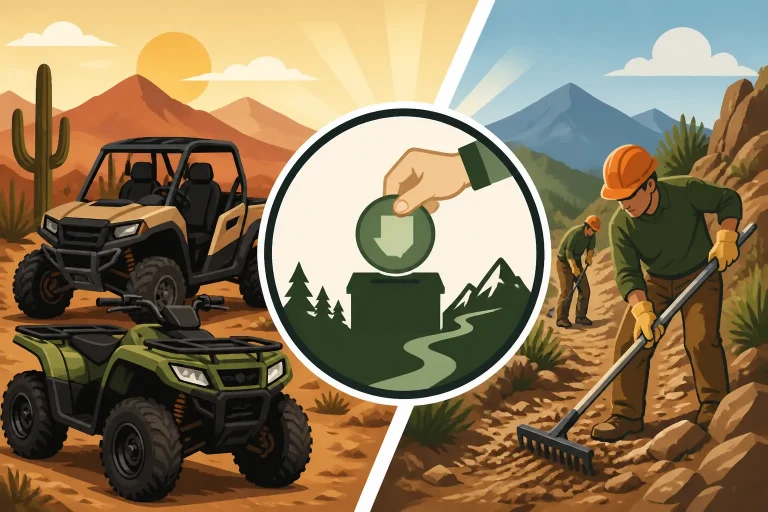
This structure means decal revenue can benefit riders beyond the person who bought the decal. It may help keep routes usable, improve information at a staging area, or support education and enforcement that encourage safer, more responsible riding. The specific work depends on which projects qualify and receive funding.
For more background on how the funding program and trail work connect, see Arizona OHV Fund and Trail Projects and Arizona OHV Grants for Trails.
What funded work can support
OHV funding can support more than construction of a new trail. Existing routes need upkeep, public information, and management, too. A grant or program investment may help address a practical problem that affects riders, land managers, or nearby communities.
Trail maintenance and route improvements
Maintenance may include work that keeps an established route in usable condition, helps reduce erosion, or addresses damage caused by weather and heavy use. Projects can also improve access or make a route easier to follow. The precise work depends on the land, the project proposal, and the approvals required from the land manager.
A route does not become open simply because it receives funding. Riders still need to follow current access rules, closures, and route designations. A funded project may maintain a permitted route, but it does not authorize riders to travel beyond it or create access across land that is closed to motorized use.
Signs and rider information
Signs can help riders identify routes, understand where motorized travel is allowed, and avoid sensitive or closed areas. Clear information at a trailhead or on a route can also reduce confusion for visitors who are unfamiliar with the area.
Signs are only useful if riders can see and follow them. Before heading out, check current maps and land-manager notices rather than relying on an old sign, a track downloaded from another rider, or a route shown in an app. Finding the Right Travel Management Map and Checking Arizona Trail Status Before You Drive can help with that planning.
Education and responsible riding
Funding may also support rider education and outreach. Those efforts can help explain rules, safety practices, and the reasons behind restrictions. Education is especially useful in areas where different types of recreation share space or where inexperienced visitors may not recognize route boundaries.
Education funding does not replace a rider’s responsibility to know the rules. A decal by itself does not grant permission to ride on every public or private parcel. Land ownership, local restrictions, permits, and closures still matter. See What the OHV Decal Buys an Arizona Rider for a closer look at what the decal does—and does not—authorize.
Enforcement and management
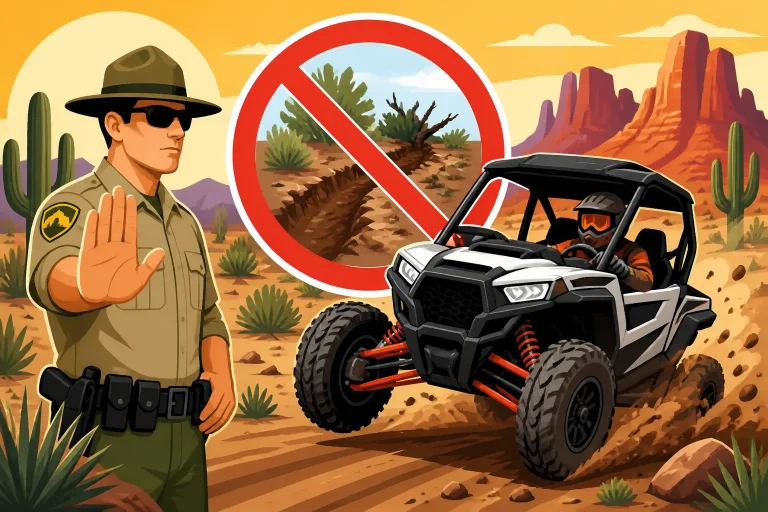
OHV-related funding may support work that helps land managers address illegal riding, resource damage, or other problems affecting public access. Enforcement and management can help protect routes that are open to riding by discouraging behavior that leads to closures or damage.
That does not mean every enforcement activity is paid for exclusively by decal revenue. Agencies may draw on several budgets and funding sources. When a project or agency report describes OHV support, look for the stated funding source and scope before concluding that decal fees paid for the entire effort.
How projects differ
The needs of a desert route, a forest trail, and a busy staging area are not identical. One project may focus on maintaining a route after weather damage, while another may improve signs or provide education. Funding decisions depend on the proposal and the program’s eligibility rules, so riders should not expect the same types of improvements in every area.
A project can also take time to plan and complete. Land approvals, environmental review, coordination among agencies, contractor availability, and seasonal conditions can all affect the schedule. A grant award is not necessarily a promise that work will begin immediately or that every proposed element will be completed.
How to follow the money to a local project
If you want to know whether OHV funds have supported a particular trail or area, start with the agencies and organizations responsible for managing it. A local land manager may have information about recent work, planned maintenance, or signs installed through a grant. The Arizona Game and Fish Department’s OHV program is another place to look for grant and program information.
When reviewing a project description, separate four questions:
- Who received the funding? The recipient may be a public agency or another eligible organization.
- What work was approved? Look for the specific tasks, location, and intended result.
- Which funding sources were involved? A project may combine OHV program money with other contributions.
- What was completed? An award or proposal does not always mean every planned task is finished.
This distinction is useful when a project is described broadly as “trail funding.” The money could be supporting signs, planning, maintenance, education, or another eligible activity rather than building a new route. If a report does not identify the funding source or completed work clearly, ask the managing agency for clarification instead of assuming that all costs came from decal revenue.
Local clubs and other organizations may take part in trail work or help develop proposals, but participation does not automatically mean a club controls public land or determines which routes are open. For details on how clubs can be involved, see Arizona OHV Grants to Local Clubs and How Arizona Clubs Apply for Trail Money.
Riders can also help identify needs. If a sign is missing, a route is damaged, or an area appears to be receiving repeated resource damage, report it to the land manager responsible for that property. Include the location as precisely as you can and describe what you observed. A report does not guarantee that a project will receive OHV funding, but it can help the responsible agency assess the problem. Reporting a Blocked Desert Trail
What decal revenue does not guarantee
Paying for a decal does not give you a personal claim on a specific trail, and it does not guarantee that a favorite riding area will receive funding. Funding decisions depend on program rules, eligible proposals, available resources, agency priorities, and the work that can be carried out responsibly.
It also does not mean that every OHV-related cost is covered. Land managers may need other funds for broader operations, and a project may require contributions or approvals beyond an OHV grant. Similarly, the decal does not replace other requirements that apply to your trip, such as a separate land-use permit, a registration requirement, or restrictions on where your machine may travel.
Keep these points in mind:
- A decal is not an access pass for all land. Confirm whether the area is open and whether you need an additional permit.
- A funded route is not necessarily open year-round. Closures and seasonal conditions can change access.
- A grant does not ensure a particular project will be completed on a specific schedule. Planning and field conditions affect delivery.
- A project’s OHV connection does not prove it was funded entirely by decal money. Check the project’s funding description.
- The fee and purchase process can change. Confirm current details with the official program before you buy.
For visiting riders, the key task is still to check the rules that apply to their situation. Arizona decal requirements can differ depending on the machine, its registration, and the rider’s circumstances. Start with Arizona Rules for First-Time Visitors and confirm current requirements through the relevant official channels before traveling.
Understanding where decal revenue goes can make the program feel less abstract: it supports a statewide system intended to maintain and manage OHV recreation, not a guaranteed upgrade to any one trail. Checking grant information and contacting the local land manager are the best ways to connect that broad purpose with work near your riding area.
Disclaimer
This article is for general informational purposes only and does not constitute professional advice. Laws, prices and regulations vary by location and change over time. Consult a qualified professional for guidance on your specific situation.