Enforcement and Checkpoints in Arizona
Arizona OHV checkpoints can interrupt a ride, especially when you’re visiting from another state and aren’t sure which decal, permit, or papers apply. Knowing what officers may check—and what each document actually proves—helps you prepare, respond calmly, and avoid treating one requirement as a substitute for another.
What Arizona OHV enforcement may check
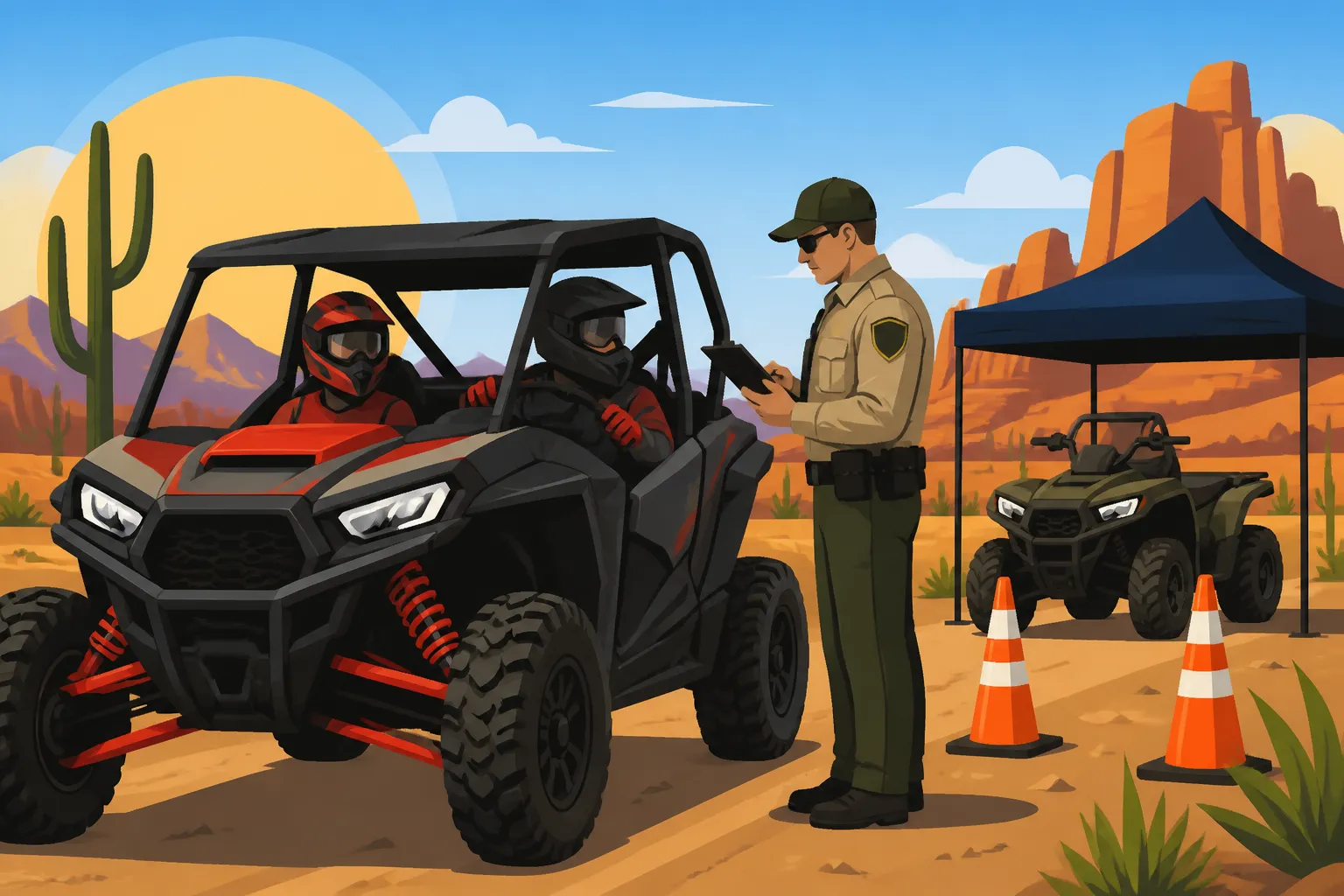
Enforcement can happen at a staging area, trail access point, road crossing, or during a patrol. An officer or land manager may check whether the machine and rider meet the rules for that particular road or parcel of land. A checkpoint is not only about decals: registration, required equipment, rider age, and land access can all matter.
The officials you encounter may have different roles. State or local law enforcement can enforce applicable motor-vehicle and safety rules. Arizona Game and Fish Department officers and land-management personnel may also check compliance with rules within their authority. Who is present and what they can inspect depends on the location and circumstances. For more detail on the types of encounters riders may see, read Arizona Ranger and Deputy Checkpoints.
A check may involve some or all of the following:
- The machine’s decal or plate. The officer may look for the required Arizona OHV decal, a valid registration plate, or another applicable form of identification. What counts depends on the machine and how it is being operated.
- The operator and passengers. Age-related requirements, helmet rules, and passenger safety can be relevant. Rules may differ for a road section, public land, private land, or a particular type of machine.
- The route and the land. A machine can meet registration requirements and still be somewhere it is not allowed to ride. Officers may ask where you entered the route or whether you have permission or a required land-use permit.
- Street equipment and road use. If you are using a public road, the machine and operator may need to meet the rules for that road. An OHV decal alone does not make an off-highway machine street legal.
- The machine’s identity. An officer may inspect the visible vehicle identification number (VIN), registration details, or plate to confirm that they match the machine.
- Conduct and condition. Speed, impairment, unsafe riding, resource damage, or riding beyond a signed closure can be more important than paperwork alone.
A decal or plate helps identify whether a machine meets a particular registration or use requirement. It does not grant unrestricted access to every trail, road, or parcel. Similarly, a permit for one kind of land does not necessarily satisfy the machine’s decal requirement. Keeping those distinctions clear is one of the simplest ways to prevent a paperwork problem from becoming a larger one.
What to have ready before you ride
Prepare for the land and route you plan to use, not just for the possibility of a checkpoint. Before leaving home or camp, confirm that the machine is properly identified and that any required decal is displayed as directed. Make sure a plate is secure and readable if the machine is registered for road use.
A useful pre-ride check is:
- Confirm what kind of machine you have. A dirt bike, ATV, side-by-side, and street-legal machine may not be treated identically. Weight, registration status, and intended use can affect what is required.
- Check the land status along the route. A route can cross land managed by different agencies or owners. Check current maps, signs, and access rules rather than assuming the same permit covers the whole ride.
- Confirm your decal or registration status. Residents and visiting riders may have different requirements. If you rely on an out-of-state registration or street-legal plate, verify that it applies to the use and land in question.
- Check for separate land permits. Arizona State Trust Land access, for example, can require a recreational permit separate from an OHV decal. See Arizona State Trust Land Recreational Permits.
- Review age and safety requirements for everyone riding. Do not assume an adult’s documents or training cover a younger operator.
- Carry essential records where you can reach them. Have the relevant registration, proof of ownership if appropriate, and permit or course information available in a way that does not require unloading gear at the roadside.
A phone may be convenient for digital records, but do not count on having service at a remote trailhead or checkpoint. Download any available documents before leaving coverage, and keep the phone charged and protected. Paper copies can be a practical backup. A small waterproof document pouch, including one bought through Amazon, can keep paper records together; it should not replace the original documents when an original is required.
For a checkpoint-specific rundown of the questions and records that may come up, see What an Arizona Officer Asks For. The safest approach is to have documents ready without presenting unrelated personal material. If you are unsure whether a document is required, ask what information the officer needs and respond to that request directly.
Keep proof separate from access permission
A common point of confusion is assuming that one document proves everything. Registration can identify a machine, while a decal may address an OHV-use requirement. A land permit can address permission to use a particular parcel, and a street-legal registration may address road operation. These documents solve different problems.
| Item | What it may help establish | What it does not automatically establish |
|---|---|---|
| OHV decal | That a machine meets an applicable decal requirement | Permission to ride every road or parcel |
| Registration plate | The machine’s registration status and identity | Access to closed routes or restricted land |
| State Trust Land permit | Authorization for covered recreational use on Trust Land | An OHV decal or street-legal status |
| Street-legal registration | Registration for qualifying road use | Permission to ride trails that prohibit the machine |
| Safety-course record | Completion of a course when the rule applies | Registration, land access, or permission to ignore age rules |
The exact requirements depend on the machine, rider, route, and land. Check them before the trip, especially if the route crosses private property, State Trust Land, federal land, or a road open only under specific conditions.
What to do at a checkpoint
An enforcement stop can feel tense, particularly if you are unfamiliar with the area or unsure which rule applies. A calm, orderly response makes the interaction easier and gives you a chance to understand what is being checked.
Stop safely and follow instructions
Slow down when directed, move to a safe place if instructed, and stop where the officer can see you. Avoid sudden movements or reaching into a bag before explaining what you are doing. Turn off the engine if asked. Keep passengers seated or gathered safely unless the officer directs otherwise.
If the stop is on a narrow trail, road crossing, or blind section, prioritize safety and follow instructions about where to park. Do not block other riders or traffic while searching through storage compartments.
Answer clearly and stay on the question
Listen to the question before responding. If an officer asks for a specific document, provide that document or explain where it is stored. If you do not understand the request, ask for clarification in a neutral way.
You do not need to guess at a rule or argue from something you heard in a parking lot. If you believe your machine is properly registered or your permit applies, calmly explain the basis for that belief and show the relevant record. Avoid escalating the conversation by debating the rule beside the trail.
If you do not have a required document with you, be truthful. Do not claim that a phone file exists if it does not, or present a document for a different machine as though it applies. A mistaken statement can make a simple check harder to resolve.
Ask what the concern is
If the officer says something is wrong, ask what requirement or location is at issue. A useful response is to clarify whether the concern is the machine’s decal, registration, rider eligibility, road equipment, or access to the land. That helps you understand whether you can correct the problem immediately or need to stop riding.
A checkpoint may also reveal a route problem you did not know about, such as a closure or a boundary you crossed. Do not continue along a route after being told it is closed or that your permit does not cover it. Ask where you may legally turn around or exit.
Do not treat a warning as permission to continue
A warning or verbal explanation is not necessarily proof that the rest of the route is open or that other requirements are waived. If the officer tells you to correct a condition, follow the instruction before riding again. If you are told to leave a location, do so as directed.
For a group ride, the lead rider should relay instructions to everyone. Do not let riders behind the group assume they can pass through a checkpoint or continue on a route because the lead rider has already spoken with an officer.
Decals, permits, and visitors from other states
Visiting riders often arrive with a valid plate from home and assume that it settles the Arizona requirements. Sometimes an out-of-state registration or street-legal status is relevant; it should not be treated as a universal exemption from Arizona rules. Requirements can depend on whether the machine is operated off-highway or on a public road, what type of registration it carries, and where it is being ridden.
Start with the visitor-specific rules in Arizona Rules for Visiting Riders. If you are relying on a plate instead of an Arizona decal, review Street-Legal Plates in Place of an Arizona Decal and confirm that your particular machine and use qualify. Rules for resident and visitor decals are not interchangeable by assumption; Resident Decals Versus Visitor Decals in Arizona explains why checking the correct category matters.
The decal requirement is also separate from access permission. A rider may have the right decal and still need to stay off a closed route or obtain permission for private land. A State Trust Land permit is another separate issue. Do not assume an OHV decal gives you permission to stage, park, camp, or ride on Trust Land. Confirm both the machine requirements and the land requirements for your planned route.
Before a trip, make a short checklist for each machine rather than one checklist for the whole group:
- Is the machine’s decal or registration valid for its intended use?
- Is the decal or plate displayed in the required location and easy to read?
- Does the operator meet the applicable age, training, and safety rules?
- Is the route open to this type of machine?
- Does any part of the trip cross land that requires separate permission?
- Are road sections on the route open to this machine, and does it meet road-use requirements?
- Does each visitor have the correct records for their own machine?
This is especially important when one group includes Arizona residents, visitors, rented machines, or both street-legal and off-highway-only machines. A document that applies to one rider or vehicle may not cover the others. For decal-specific details, see Arizona Non-Resident Decal.
If an officer says there is a violation
A citation, warning, or instruction to leave an area should be taken seriously, even if you believe you were riding legally. First, make sure you understand what the officer says the issue is. It may concern the decal, a road rule, a permit, a closed route, an age requirement, or another condition. Those issues call for different next steps.
If you receive a citation, read the information on it before leaving. Note the alleged violation, the location, and any response deadline or instructions printed on the document. Deadlines and procedures can vary, so follow the instructions provided and confirm uncertain details with the appropriate court or agency. Do not assume that a verbal discussion at the checkpoint changes what the citation requires.
Write down what happened while the details are fresh. Useful notes include:
- The date, approximate time, and location of the stop
- The route or access point you were using
- The officer’s stated concern and any instructions given
- The machine’s plate, decal, and registration status
- The permit or documents you showed
- The names and contact information of witnesses, if appropriate
- Any signs, closure notices, or map information you relied on
Keep copies of the citation and relevant records together. If a photograph might help explain the location or display of a decal, take it only when it is safe and lawful to do so. Do not alter a decal or move the machine after an officer has given instructions.
A citation does not mean you should argue the case at roadside. If you disagree, use the response process described on the citation or confirm the proper process with the issuing agency or court. You can read Appealing a Desert Citation for a closer look at that issue. For possible consequences tied specifically to a missing decal, see Fines for Riding Arizona Without a Decal.
If you discover that a decal, permit, or registration is missing or does not apply, stop riding until you know what is required. Buying a document after a stop may not resolve an alleged violation that already occurred. Check the correct rule and follow the official instructions before returning to the route.
Preventing avoidable problems
A little preparation can prevent many checkpoint delays:
- Check route status and land boundaries shortly before departure.
- Keep documents organized by machine and rider.
- Make sure decals and plates are visible, secure, and legible.
- Do not ride around a gate, sign, or checkpoint to avoid inspection.
- Tell every person in the group which route is planned and where the group may need separate access permission.
- Leave time to address a problem rather than pressing on because the group is behind schedule.
Rules and agency practices can change. If a requirement seems unclear, verify it with the agency responsible for the land or the registration before riding. Arizona OHV Rules That Changed Recently can help identify why relying on old advice may be risky.
Frequently Asked Questions
Can an Arizona officer stop an OHV at a trailhead?
A rider may encounter an enforcement stop at a trailhead, staging area, road crossing, or on a route. The location and the official’s authority affect what may be checked. Follow instructions, ask what requirement is being reviewed, and avoid assuming that a stop is only about decals.
Does an out-of-state plate mean I do not need an Arizona OHV decal?
Not automatically. Whether a plate or other registration affects the decal requirement depends on the machine and how and where it is operated. Check the Arizona rules for your specific visitor status and use before riding.
Does an OHV decal give me permission to ride on State Trust Land?
No. A decal and a land-use permit address different requirements. Confirm whether the route crosses State Trust Land and whether you need a separate permit for the activity.
What should I do if I disagree with a citation?
Stay calm during the stop, make a note of the officer’s explanation, and follow the response instructions on the citation. Confirm any deadline or procedure with the issuing court or agency rather than relying on assumptions.
Disclaimer
This article is for general informational purposes only and does not constitute professional advice. Laws, prices and regulations vary by location and change over time. Consult a qualified professional for guidance on your specific situation.