Arizona Rules for Visiting Riders
Visiting Arizona with an ATV or UTV takes more than loading the machine and picking a trail. The decal rules, land permissions, road access and rider requirements can depend on where you ride and how your machine is registered. This guide explains what to sort out before you leave home, so you can avoid a wasted trip or an unpleasant surprise at a trailhead.
Start by checking your machine’s registration and decal status
Arizona treats vehicle registration, an off-highway vehicle decal and permission to use particular land as separate things. One document does not automatically replace the others.
For a visitor, the first question is whether the machine will be operated as an off-highway vehicle on Arizona public land. If so, you may need Arizona’s nonresident OHV decal unless your machine qualifies for an exception, such as having current street-legal registration. The details can depend on the machine’s classification and registration status, so verify the current rule before traveling rather than assuming a decal from your home state will work.
An out-of-state registration card or OHV sticker can be useful proof of your machine’s status, but it does not necessarily substitute for Arizona’s decal. Reciprocity is not a safe assumption. Check the requirements for your specific machine and intended use through the official Arizona Game and Fish Department portal. The article Arizona’s Non-Resident OHV Decal covers that decal in more detail.
| Your situation | What to check before riding |
|---|---|
| Your machine is an off-highway vehicle with out-of-state registration | Whether Arizona requires a nonresident decal for your planned public-land use |
| Your machine has current street-legal registration and a plate | Whether it qualifies for an Arizona decal exception, and whether it is legal on each road you plan to use |
| You are borrowing a machine | Whether its registration and decal status cover the machine and whether you have the owner’s permission |
| You are renting | What the rental company has already handled and which routes the contract allows |
| Your route crosses state trust land | Whether you need a separate recreational permit in addition to any OHV decal |
| Your route uses a public road | Whether the machine is street legal and the road is open to that kind of vehicle |
A decal is not the same as registration
An OHV decal is not a license plate, proof of ownership or blanket street-use permission. It is tied to off-highway use under Arizona’s rules. A plated machine, by contrast, must meet the conditions for its registration class and applicable road-use rules.
If your machine is not registered for street use, do not treat an OHV decal as permission to ride on any paved road. Some legal routes include designated road segments or crossings, but the route and the vehicle still have to meet the applicable requirements.
If you are uncertain which category your machine fits, start with What Arizona Riders Need Before They Ride and confirm any machine-specific questions before you travel.
Do not rely on another state’s sticker alone
Rules and decal programs differ among states. A valid sticker where you live may not satisfy Arizona’s requirements, and Arizona’s decal does not automatically authorize riding in another state. If your group is coming from several states, check each machine separately. One rider’s paperwork does not cover the whole group.
Also check the decal’s display instructions. A decal that is required but hidden, damaged or placed incorrectly can be hard to verify during a stop. Keep your registration documents accessible, and follow Arizona’s current placement guidance.
Street-legal registration may change the decal question
A machine with current street-legal registration may be treated differently from an off-highway-only machine for decal purposes. That does not mean every road is open to it, or that the registration is valid for every part of a planned ride. Confirm both questions: whether the machine needs the decal, and whether it may use the particular road or route.
For the distinction, see Street-Legal Plates in Place of an Arizona Decal. If your goal is to convert an off-highway machine for road use, that is a separate project with equipment, insurance and registration requirements.
Check for permits beyond the OHV decal
Arizona’s land is a patchwork of federal, state, tribal, local and private ownership. A decal addresses only one part of the paperwork. It does not open every trail, authorize every activity or let you stage wherever you find a wide spot.
Before setting out, identify the land crossed by your route. A map may show a continuous road even though it crosses several land-management boundaries. That can mean different access rules along a single ride.
State trust land requires special attention
Arizona State Trust Land is not the same as BLM land or National Forest land. Recreational access may require a separate permit from the Arizona State Land Department. That permit is distinct from an OHV decal and may have its own terms for activities, access, parking and camping.
Start with Arizona State Trust Land Recreational Permits. Check the current permit conditions and confirm that the type of riding you plan to do is allowed. Do not assume that having a permit means every road or parcel is open to motorized use.
A route can also cross trust land briefly without making the land boundary obvious from the seat. Use current land-status and travel maps rather than relying only on a trail app’s line. If you plan to leave the route, park, camp or unload on trust land, confirm that the permit covers that activity. Why a Decal Alone Will Not Let You Stage explains why a decal and permission to stage are separate issues.
Federal land is not one uniform trail system
BLM land and National Forest land each have designated routes, seasonal closures and local restrictions. Some roads are open to motorized use, while nearby tracks may be closed or intended for another type of vehicle. A visible tire track does not prove that the route is legal.
Use the appropriate current travel-management information for the area. For a ride in National Forest land, review Arizona Rules on Forest Service Roads. For a BLM route, check Arizona Rules on BLM Roads. Pay attention to route identifiers, gates, seasonal notices and restrictions on vehicle width or type.
National parks, wilderness areas and other protected places have their own boundaries and access rules. Motorized vehicles are generally prohibited in designated wilderness, but routes near a wilderness boundary can make it easy to wander onto closed ground. Study the boundary before the ride; Arizona Wilderness Boundaries and Machines offers more detail.
Private and tribal land require permission
A public road or trail can pass close to private property, ranch land or tribal land. Do not assume that a gate left open, an old track or a route shown on an informal map gives you permission to cross. On private land, get the owner’s permission. On tribal land, follow the relevant tribal rules and obtain any required authorization.
If a ride depends on crossing a particular parcel, verify access before the group leaves home. Finding out at a locked gate can leave you with a long detour, and riding around the gate can turn a planning mistake into a trespass problem.
Confirm the whole route, not just the destination
A legal destination does not make every approach legal. Check:
- Whether each road or trail is currently open to motorized vehicles
- Whether the route is suitable for your machine’s width and type
- Whether a permit is needed for any land crossed
- Whether you may park, unload or camp at the proposed staging area
- Whether a closure or seasonal restriction changes the route
- Whether the trail connects to a public road that your machine can legally use
For a practical route-checking routine, see Checking Arizona Trail Status Before You Drive. It is worth doing again shortly before departure, since conditions and closures can change.
Know when your machine can use a road
A trail ride may include a public-road segment, but “the road is public” does not by itself mean an ATV or UTV can use it. The vehicle’s registration class, equipment, insurance and the road’s restrictions all matter.
A nonresident decal is not a substitute for street-legal registration. Likewise, a street-legal plate does not guarantee access to every road, trail or highway crossing. Local restrictions may apply, and a county road, city street, forest road and state highway can have different rules.
Plan road sections before you reach them
Some routes require a short connection on a road or a designated crossing. Find out in advance whether the machine is allowed there and what the operator must carry or have fitted. If the route depends on using a road that is not open to your machine, choose another route rather than improvising at the junction.
A useful planning step is to mark road segments separately from off-highway trails. For each one, confirm:
- The road is open to OHV use.
- Your machine’s registration class is permitted there.
- Required equipment and insurance are in place.
- The route does not require an unlawful highway crossing or shoulder ride.
- The group can complete the segment safely in the expected traffic and visibility conditions.
If you want to ride on public roads regularly, review Which Arizona Roads Are Open to OHVs and the road-equipment rules before building your trip around that plan.
Equipment and insurance are not afterthoughts
A street-legal machine may need required lighting, reflectors, mirrors, a horn, seats or footrests, depending on its classification and the current rules. Operators should also confirm the applicable insurance requirements. Do not assume that an ATV or UTV is covered by an ordinary auto policy, or that a policy from home automatically applies to every kind of riding.
Carry proof of coverage when the machine will be used on roads where insurance is required. Contact your insurer before the trip and describe the machine, where you plan to operate it and whether it will be used off road, on roads or both. For further background, see Arizona Insurance Minimums for Road Riding.
Road access can differ from trail access
A machine might be allowed on a designated off-highway route but not on a nearby paved road. The reverse can also happen: a street-legal vehicle may use a road that is not open to off-highway machines. Treat the road and the trail as separate parts of the ride, and follow signs and closures even when a route-planning app suggests a connection.
If you are traveling with a mixed group of plated and unplated machines, plan around the most restricted vehicle. Do not split up and expect riders to meet later unless everyone has a safe, legal route and reliable communications.
Check rider requirements, especially for young operators
Arizona’s requirements can depend on the rider’s age, the type of land and whether the machine is being used off road or on a public road. A child who is permitted to ride on private property may not be allowed to operate the same machine on a public route under the same conditions.
Before traveling with a young rider, confirm the current education, supervision, helmet and equipment rules that apply to the child and the planned ride. Do not rely on a rule remembered from a previous trip or another state.
Education rules and decals are separate checks
Arizona has OHV education requirements that can apply based on the rider’s age or other circumstances. Completing a course does not replace a required decal, and having a decal does not necessarily satisfy a rider’s education requirement.
Review Arizona Education Rules for Under-18 Riders before bringing a young operator. If the current process directs a rider to take an online safety course, complete it early and keep any completion information available. Do not wait until the group reaches the staging area to discover that a rider needs to finish a requirement.
Match the machine to the rider
A young rider needs a machine that fits their size, experience and control. Being able to reach the controls while parked is not enough; the rider must be able to manage starts, stops, turns and uneven ground without being overwhelmed by the machine’s weight or power.
Set group rules before the ride:
- Choose a route that matches the least experienced rider.
- Put a responsible adult where they can supervise, not merely somewhere in the group.
- Keep riders within sight and agree on a regrouping plan.
- Do not let a child operate a machine designed for a passenger or larger rider if they cannot control it safely.
- Make sure each machine carries only the number of occupants it was designed and authorized to carry.
Passenger rules also need attention. A child passenger must fit the seat and restraints, and the machine must be designed to carry a passenger. A lap, cargo area or improvised seat is not a safe substitute.
Helmets and protective equipment
Helmet requirements can vary with age and location, and road-use rules may not match off-highway rules. Even where a helmet is not legally required for a particular adult rider, wearing one is a sensible choice on desert terrain, where loose rock, branches, rollovers and dust are real hazards.
Bring eye protection that fits securely and works with the helmet. A windshield can reduce some wind and debris, but it does not replace eye protection if the rules or conditions call for it. Wear gloves, sturdy clothing and footwear suited to the machine and terrain.
For a family trip, set the expectation that protective gear is worn before the engine starts. It is harder to enforce once the group is already moving.
Prepare for Arizona conditions and trail realities
Arizona rides can change dramatically with elevation, season and weather. A cool morning in the high country does not predict afternoon conditions in the low desert. A route that looks short on a map may take much longer when it includes sand, rock, steep grades or frequent stops.
Check the forecast and local notices for the actual route, not only the nearest town. In hot conditions, schedule the ride conservatively, carry more water than the group expects to use and have a turnaround plan. During monsoon weather, avoid washes and low crossings when rain is possible upstream. Do not drive into moving or rising water.
Carry navigation that works without cell service
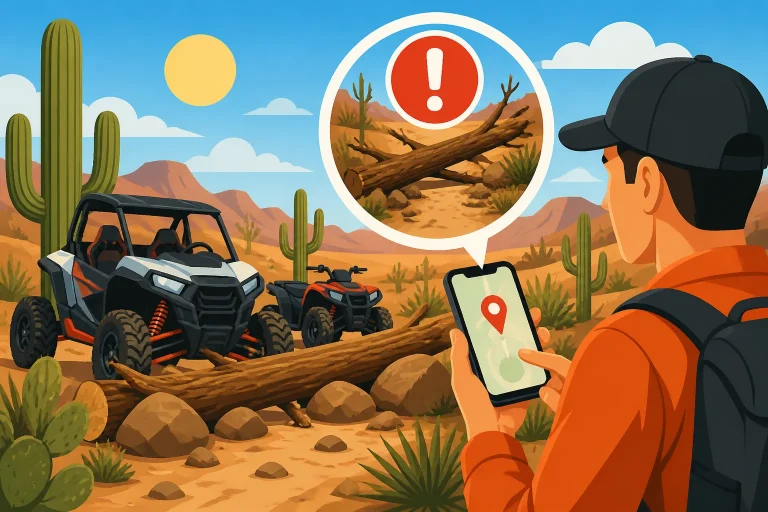
Cell coverage is unreliable in many backcountry areas. Download maps for offline use, charge devices, and bring a backup navigation method. Tell someone where you are going and when you expect to return. A paper map or a separate GPS can help if a phone battery fails or an app loses its data.
Amazon can be one place to find a waterproof document pouch for keeping printed maps and vehicle papers dry, but choose one that fits your documents and can be secured in the machine. A pouch will not protect papers if it is left loose in a cargo bed.
If you use a power bank bought through Amazon or another retailer, test it with your navigation device before departure and store it where it will not be crushed, soaked or overheated. A battery that has never been tested is not much of a backup. Bring suitable cables, and keep the phone itself protected from dust and heat.
Pack for a breakdown, not just a normal ride
At minimum, consider carrying water, basic first aid supplies, a tire repair kit appropriate to your machine, a way to contact help and the tools needed for simple roadside fixes. Your exact kit depends on how remote the route is and how many people are riding.
A compact first-aid kit from Amazon may be convenient to assemble, but check its contents rather than assuming every kit is complete. Add any personal medication and supplies your group needs. Know how to use the items you carry, and do not treat a small kit as a substitute for getting professional help when someone is seriously injured.
Before loading, inspect tires, belts, brakes, lights and fuel. Confirm that your trailer is properly secured and that the machine is tied down using suitable points. A mechanical issue that is minor at home can become a serious problem when the group is far from pavement.
Respect closures, fire restrictions and local conditions
A route can close because of fire danger, storm damage, maintenance, wildlife concerns or another management decision. Check for notices from the land manager and follow posted signs on site. Do not ride around a closure to “just look” at a section.
Keep noise and dust in mind near homes, campgrounds, wildlife and other trail users. Stay on designated routes instead of making a new line around an obstacle. A shortcut can damage fragile ground, create erosion or lead riders into a closed area.
Renting, borrowing or bringing your own machine
The paperwork and responsibilities differ depending on who owns the machine. A rental shop may handle some registration or decal requirements, but that does not mean every route is permitted under the rental agreement. A borrowed machine may have the right documents but still require the owner’s permission and a careful check of insurance.
If you are renting
Ask the rental company, before booking, what it provides and what you must arrange. Confirm:
- Whether the machine has the required registration and decal for the intended use
- Which trails and roads are allowed under the rental agreement
- Whether the route must stay within a particular area
- What safety gear is supplied and what you should bring
- How the shop handles breakdowns, damage and recovery
- Whether passengers and children are allowed on the specific machine
Do not assume the rental company’s route suggestions are current access authority. Use them as a starting point, then check land-manager information and posted restrictions. The general guide [Renting a Side-by-Side in Arizona] can help you prepare questions for a shop.
If you are borrowing a machine
Ask the owner for the registration information, decal details, insurance information and any restrictions on use. Get clear permission to operate it, and make sure the machine is appropriate for your experience and the planned terrain. Do not rely on a photo of an old sticker or registration card if the machine’s status may have changed.
If the owner’s machine is street legal, ask what equipment or operating conditions apply. If it is off-highway-only, do not plan a road segment on the assumption that the owner’s plate or decal will make it legal.
If you are hauling your own machine
Check the trailer, tie-downs and load before the long drive. Make sure your paperwork is easy to access and that the VIN on the documents matches the machine. If the vehicle has been modified, rebuilt or bought recently, resolve any registration questions before crossing state lines.
A machine that has not been ridden for months should get a proper mechanical inspection. Verify tire condition, battery, fluids, cooling, brakes and steering. Carry the tools and spare parts that make sense for your model, but avoid overloading the machine or trailer with gear you do not know how to use.
A practical pre-trip checklist for visiting riders
Use this checklist for each machine, not just once for the group. A group leader can keep copies of the plan, but every operator should know the key rules and route.
- Identify the machine’s legal status. Confirm whether it is registered off-highway, street legal, rented or borrowed.
- Check the Arizona decal requirement. Verify whether the machine needs a nonresident OHV decal and how to obtain and display it.
- Check rider education requirements. Pay special attention to young operators and finish any required course before traveling.
- Map the land boundaries. Identify BLM, National Forest, state trust, private and tribal land along the route.
- Arrange separate permits. Obtain any required State Trust Land or other land-specific permit; do not assume an OHV decal covers it.
- Confirm the route is open. Check current travel maps, closures, seasonal restrictions and vehicle-width rules.
- Review road sections. Confirm the machine is allowed on every road or crossing and meets applicable equipment and insurance requirements.
- Plan staging and parking. Verify that the unloading area is open and that parking or camping is allowed.
- Prepare the group. Match route difficulty to the least experienced rider, agree on spacing and regrouping, and make sure passengers fit the machine.
- Pack for conditions. Bring navigation, water, protective gear, first aid supplies, communications and basic repair equipment.
- Tell someone your plan. Share the route and return time with a person who is not on the ride.
- Recheck just before departure. Weather, closures and access notices can change after the trip is first planned.
If any part of the plan depends on a doubtful road connection, a missing permit or a route shown only in an informal app, change the plan before unloading. Arizona has plenty of riding opportunities, but legal access is specific to the route and the land.
The simplest way to avoid confusion is to treat each requirement as its own check: vehicle status, decal, rider eligibility, land permission and route access. Confirm all five before you leave home. That preparation is much easier than trying to sort out a boundary, closure or paperwork question in the desert.
Disclaimer
This article is for general informational purposes only and does not constitute professional advice. Laws, prices and regulations vary by location and change over time. Consult a qualified professional for guidance on your specific situation.