Flash Flooding in a Desert Wash
A dry wash can look like the easiest line across an Arizona trail, right up until rain miles away sends water rushing into it. That danger is easy to underestimate from an ATV or UTV, where a low route may seem harmless and the weather overhead may look clear. This guide explains how to spot flood risk, plan around washes, and respond if water starts moving.
Why desert washes can flood so quickly
Rain can reach you from far away
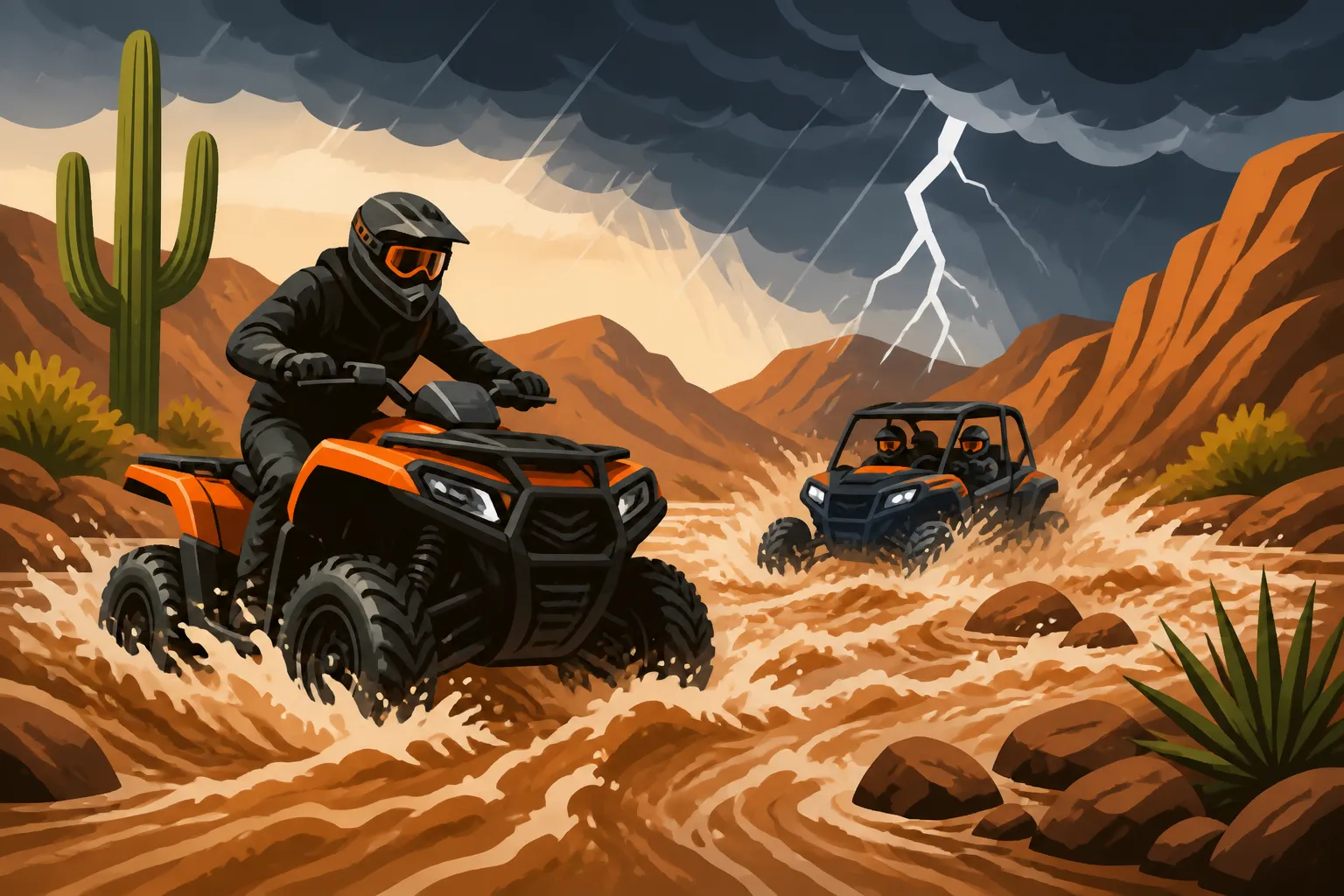
Arizona’s washes and canyons collect runoff from broad areas. A storm does not have to be directly overhead to send water toward your route: rain falling miles upstream can travel downhill and arrive later, sometimes as a fast surge carrying mud, branches, or rocks. In narrow canyons, the water may arrive with little warning.
That delay can create a false sense of safety. You might see blue sky, cross a dry stretch, and assume the risk has passed. Meanwhile, a storm beyond the ridge can be feeding the drainage you are following. This is why Rain 20 Miles Away and a Flooded Canyon is a useful safety topic to consider before heading into remote terrain.
The Arizona monsoon season brings a familiar version of this problem, but flash flooding is not limited to one season. Conditions can change quickly, so check the forecast and local advisories for the whole area you plan to ride—not just the trailhead. For seasonal planning, see Arizona Monsoon Season and Flash Flooding.
A dry wash is not a safe crossing
A wash can look like firm, ordinary ground when it is dry. During or after rain, however, its surface may become slick, muddy, or deeply rutted. Water can also conceal holes, loose rocks, damaged banks, and debris. A crossing that looked simple on the way in may be very different on the way back.
The danger is not limited to deep water. Moving water can push a machine off balance, sweep it downstream, or trap it against debris. The current may also undermine the edges of a wash, making a bank collapse beneath a tire. Because water depth, speed, and bottom conditions are difficult to judge from the seat, trying to estimate whether a crossing is “shallow enough” is not a reliable safety test.
Treat a wash as a potential flood channel, even when it is dry. When route planning, notice whether your track follows a drainage, crosses one, or descends into a low spot where runoff may collect. If you are unsure how a route changes in rain, choose a route that avoids the drainage rather than depending on a quick crossing.
The route can become a trap on the return trip
Out-and-back rides create a specific risk: a wash may be dry when you cross it, then flood while you are farther along the route. If the wash is the only way back, you may find yourself on the wrong side of rising water. A short crossing near the start can therefore affect the safety of the entire ride.
Before setting out, identify alternate routes and places where you could turn around without entering a drainage. This matters especially on remote routes around areas such as the Sonoran Desert, Table Mesa, or the backcountry near Lake Havasu, where the nearest paved road or staffed facility may be a long way off. Do not assume that a track shown on a map will remain passable after weather changes.
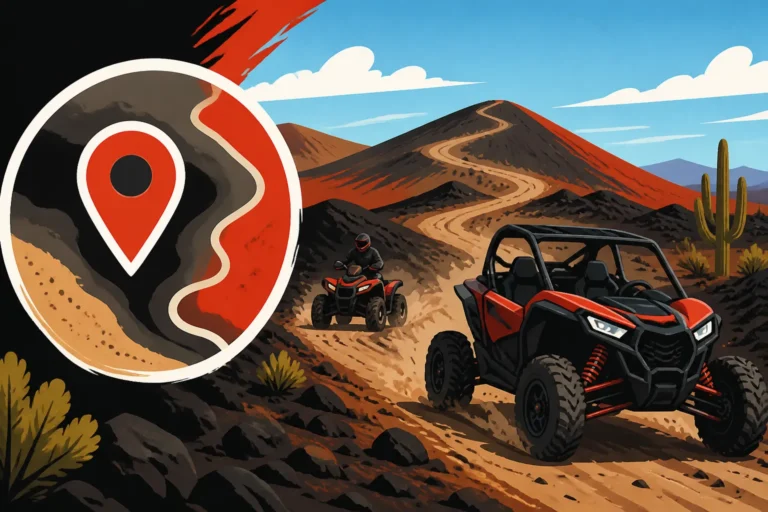
A GPS map can help you understand the terrain, but it cannot tell you that a wash is safe to cross in the moment. Use a tool such as onX Offroad to review route options and terrain before the ride, then pair that planning with weather awareness and a willingness to change plans. A route line is not a guarantee of safe conditions.
How to plan an Arizona ATV or UTV ride around flood risk
Check the full route and the surrounding forecast
Look beyond the forecast for your starting point. Consider weather across the wider drainage area and along the route, particularly if the ride passes through a canyon or follows a wash. Check for storm warnings, flood advisories, road closures, and trail-status information before loading up. Recheck conditions if weather changes during the day.
A printed or downloaded map can help if cell service disappears, but make sure you know how to read it before you leave. Reviewing Checking Arizona Trail Status Before You Drive can help you build a pre-trip routine that includes access and closure checks, not just directions. Keep in mind that a trail-status check cannot predict every fast-changing storm cell.
In onX Offroad, review the route in advance and look for alternatives that avoid low drainage sections. Save the information you need for offline use where available, and do not wait until you are standing beside a swollen wash to figure out your options. A map app can support a decision; it cannot replace local judgment or an official closure.
Identify places to turn around
As you plan, mark likely decision points: a signed junction, a broad area on higher ground, or a route split where you can return without crossing the same wash. Think about what you will do if a storm builds before you reach the most remote section. Agree on that plan with everyone in the group.
Turning around early can feel frustrating, especially after a long drive to the trailhead or when the group has been looking forward to a particular destination. But reaching the planned endpoint is not worth getting boxed in by water. Set a clear rule before departure: if rain begins upstream, thunder builds, or water starts moving, the group stops advancing toward the drainage and reassesses from safe ground.
Keep enough daylight and fuel in reserve for a slower return or a changed route. A hurried exit can lead to poor decisions, particularly if visibility drops or the trail becomes muddy. A conservative turnaround is a successful ride if it gets everyone home safely.
Carry essentials for a delayed return
Pack for the possibility that a route takes longer than expected. Bring more water than you think you will need, along with food, a first-aid kit, a charged phone, and a way to contact help when cellular service is unavailable. A satellite messenger can be useful in remote terrain, but carry it where you can reach it and know how to use it.
Water planning matters even when the concern is flooding. You may have to wait on high ground or take a longer way around. Use Water Planning for an Arizona Trail Day to think through hydration for the whole group, including passengers and young riders. Keep essential supplies secured so they do not become inaccessible if the machine is stuck or damaged.
Before leaving, tell someone who is not on the ride where you are going and when you expect to check in. Share the route and a plan for what that person should do if you do not return or make contact. In places with dead zones, [Cell Dead Zones in the Arizona Backcountry] offers another reminder to avoid relying on a phone as your only emergency plan.
| Situation | Safer choice | Avoid |
|---|---|---|
| Wash is dry and weather looks clear | Check the broader forecast and note an alternate route | Assuming dry conditions will last |
| Rain is falling upstream or storms are building | Stay out of drainages and turn toward higher, safer ground | Continuing deeper into a canyon |
| Water is moving across a trail | Stop well back and reassess from stable ground | Riding through or walking into the flow |
| A route back crosses a flooded wash | Wait in a safe location, seek help if needed, and follow official guidance | Testing the crossing because it was passable earlier |
| The group is separated or a rider is stranded | Account for everyone and contact emergency services if there is immediate danger | Sending someone into floodwater to retrieve a person or machine |
What to do when water starts moving
Stop before reaching the water
If you see water flowing across a trail or hear a sudden increase in water noise, stop well before the edge. Do not ride down to the bank to inspect it. The bank may be unstable, and moving closer can leave little room to retreat if the water rises.
Turn away from the drainage if you can do so without entering another low area. Move to higher ground that is not exposed to falling rocks, unstable slopes, or additional runoff channels. Do not park in the wash, on a narrow bank, or at the bottom of a canyon while deciding what to do.
Let the group know what you have seen, and keep riders together where it is safe. If someone is ahead, contact them by radio or phone if possible and tell them not to enter the drainage. Do not send a rider across to warn someone if doing so would require crossing floodwater.
Do not drive through a flooded wash
A flooded wash is not a place to test the machine, the tires, or the driver’s skill. Water can hide the bottom and move faster than it appears. Even a powerful UTV may be swept sideways, rolled, or pinned by debris. A quad may be especially difficult to control if its tires lose traction or the current catches its frame.
Do not follow another rider into the water just because they made it across. Conditions can change within minutes, and a vehicle’s successful crossing does not establish that the next one is safe. The same caution applies to walking: never wade through moving floodwater to retrieve a machine, reach another person, or check the depth.
For more on this specific decision, read Driving Through a Flooded Wash. If a road or trail is barricaded, do not go around the barrier. The risks of ignoring a closure can extend beyond vehicle damage; Arizona’s Stupid Motorist Law and Riders explains why Arizona riders should take flood-related restrictions seriously.
If you are caught near rising water
Move away from the channel and toward higher ground if a safe route is available. Avoid trying to drive through the flow or down a different wash that may also be carrying runoff. If you are unsure whether a route is safe, stop and contact emergency services rather than making a risky attempt.
If water is rising around your machine, prioritize people over equipment. Do not stay beside a vehicle to protect it or attempt a recovery in moving water. If you can reach higher ground safely, do so. If you are trapped or someone is in immediate danger, call 911 when possible, share your location as clearly as you can, and follow the dispatcher’s instructions.
Keep the group together if doing so does not put anyone closer to the water. Account for every rider and passenger, including children, before leaving a safe area or making a plan. Do not split up to search for a machine or take a shortcut through a drainage. A damaged ATV or UTV can be replaced; a person caught in a flash flood may have very little time to escape.
After the water recedes
Reassess before continuing
A wash that looks calm after a surge may still be dangerous. More water can follow, and the channel may have changed shape. Mud can cover deep holes, rocks, and debris, while the banks may be unstable. Do not assume that a route is safe because the water level has dropped.
Wait in a safe place and check for updated warnings or closures. If you have a clear alternative that stays out of the drainage, consider taking it. If you do not, delaying the ride or asking for assistance may be the safest option. Avoid pressure from the group to “just get across” because the vehicles are already there.
If you encounter a closure, keep out and follow posted instructions. Be cautious about routes that appear open but pass through freshly flooded ground. If you are uncertain whether the trail has been damaged, do not use your machine to probe it. Monsoon Flooding Across an Arizona Road is also relevant when your ride involves paved access roads or crossings on the way back.
Do not attempt a risky vehicle recovery
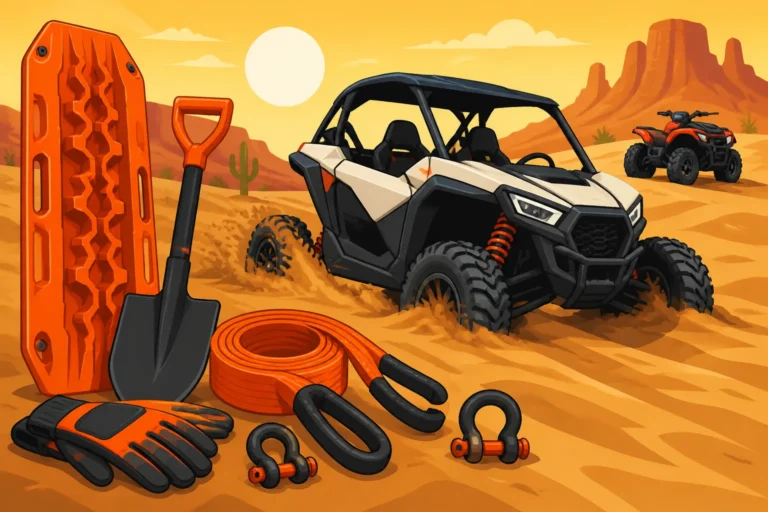
A machine stuck in mud or lodged against debris can tempt riders to try a quick tow. Resist that urge if the machine is near moving water, an unstable bank, or a channel that may flood again. Recovery straps, winches, and other gear do not make floodwater safe to approach.
If you have to wait, choose stable high ground away from the wash and keep the group visible to one another. Contact emergency services if anyone is injured, stranded, or in immediate danger. Explain your location using a trail name, route marker, GPS coordinates, or another clear reference; a vague description such as “somewhere in the desert” can slow a response.
Once conditions are safe, inspect the machine before riding again. Mud and water can hide damage, and the surface beneath the tires may be much less stable than it looks. If the machine has been submerged or is behaving unusually, do not assume it is ready for the ride home.
Make a better plan for the next ride
After returning, note where rain or runoff affected your route and what warning signs appeared. Share the information with your riding group, but distinguish firsthand observations from assumptions. A single trip does not establish that a route is usually safe or unsafe; it does show where your group needs better alternatives and decision points.
Use the experience to improve your next route plan. Review Getting Turned Around in the Sonoran Desert for practical preparation around navigation and changing plans. Keep offline maps and emergency supplies ready, and agree on a turnaround rule before the next ride rather than negotiating it during a storm.
Flash flooding is one of those hazards that can make a familiar trail feel completely different in a short time. The safest approach is simple, even if it means missing a destination: stay out of moving water, avoid low drainages when storms threaten, and never let the cost of a long drive or a stuck machine decide for you.
Disclaimer
This article is for general informational purposes only and does not constitute professional advice. Laws, prices and regulations vary by location and change over time. Consult a qualified professional for guidance on your specific situation.