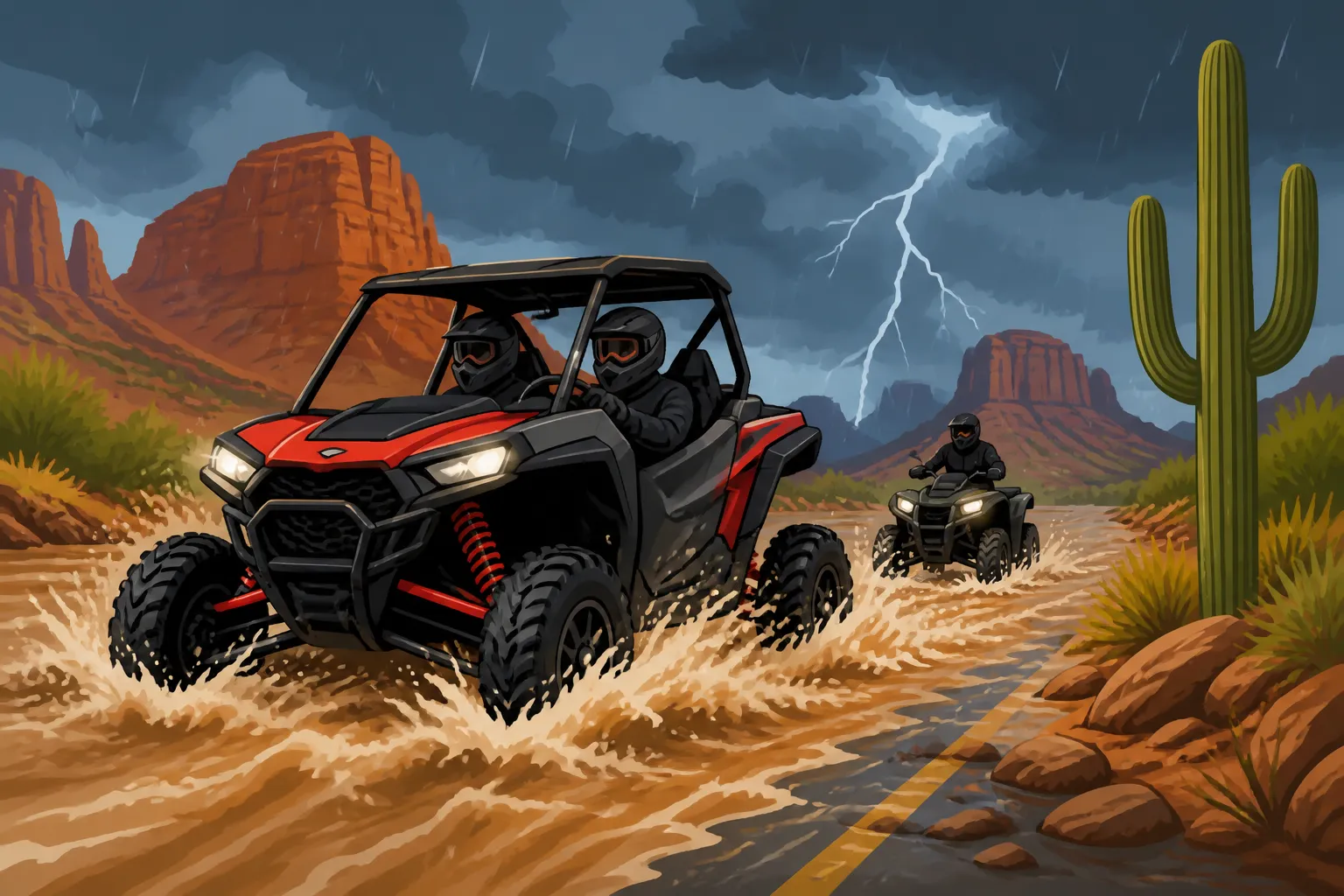
Monsoon Flooding Across an Arizona Road
Arizona's summer monsoon season brings a spectacular display of lightning and sudden downpours, but for those of us who love to explore the desert on our ATVs and UTVs, it also introduces a significant and often underestimated danger: flash flooding across roads. It's incredibly easy to be caught off guard, heading home on a seemingly dry county road only to find a raging torrent where a small wash usually crosses. This guide will help you understand the very real risks of monsoon flooding, what the law says about driving into floodwaters, and how to safely navigate or, more importantly, avoid these hazardous situations when you're out riding in the Arizona backcountry.
The Sudden Reality of Arizona Monsoon Flooding on Roads
Anyone who's spent a summer in Arizona knows the afternoon sky can transform from clear blue to an ominous anvil cloud in what feels like minutes. What many don't realize is just how quickly and dramatically this can impact the roads we rely on, especially when we're deep in the desert on our off-highway vehicles. These aren't just puddles; they're often powerful, destructive forces that can turn a familiar route into a death trap.
Why Monsoon Storms Are So Dangerous for Drivers
The desert landscape, with its hard-baked soil and sparse vegetation, isn't designed to absorb large amounts of sudden rainfall. Instead, water tends to run off rapidly, collecting in washes and canyons, and swelling them into violent rivers in moments. A storm twenty miles upstream in the mountains can send a wall of water roaring down a dry wash, completely unbeknownst to someone driving on a road below. These flash floods can hit without any direct rain at your location, making them incredibly deceptive. Imagine you're riding your UTV on a county road, perhaps heading back to camp after a long day. The sun is shining, but in the distance, you see some dark clouds. Suddenly, you approach a dip in the road where a small culvert usually handles a trickle of water, and it's now a churning, debris-filled river. That's the reality of monsoon danger – it's often not about the rain falling on you, but the rain that fell miles away. It's a phenomenon that demands respect, not bravado, from every rider who enjoys [Summer Heat and Arizona Road Riding].
The Unseen Power of Flash Floods and Washes
What makes a flash flood so dangerous isn't just the depth of the water, but its immense power and the hidden dangers it carries. Even shallow water, moving swiftly, can sweep an ATV or UTV downstream. The National Weather Service often warns that "turn around, don't drown" applies to just six inches of moving water for a passenger car, and an OHV, while perhaps more capable off-road, is far from immune to this force. Beyond the sheer push of the water, flash floods carry all sorts of debris – rocks, logs, mud, and even abandoned vehicles – that can collide with your machine, causing damage or even overturning it. The roadbed itself can be undermined or completely washed away, creating hidden drop-offs and sinkholes that you simply cannot see beneath the muddy surface. The visibility is often terrible, and the current can make steering impossible. Trying to cross a flooded wash is not only foolish but also often illegal, as we'll discuss next. For more on this, check out [Flash Flooding in a Desert Wash].
Arizona's "Stupid Motorist Law" and OHV Riders
Arizona takes monsoon flooding very seriously, and for good reason. Too many lives have been lost, and too many resources have been expended on preventable rescues. This led to the enactment of a specific law designed to deter drivers from making dangerous choices.
What the Law Says and Why It Matters to OHV Operators
Arizona's "Stupid Motorist Law" (officially ARS 28-910) is simple in its intent: if you drive or attempt to drive a vehicle on any highway or public roadway where there is a clearly visible sign warning that the road is closed or flooded, and you become stranded, entrapped, or involved in an accident, you may be held liable for the cost of your rescue. This isn't just about cars or trucks; it explicitly applies to any vehicle, which certainly includes your ATV or UTV. The law serves as a powerful deterrent, not just because of the risk to life, but because it hits directly at your wallet. Imagine being swept into a canyon and needing a helicopter rescue – the cost could easily run into the tens of thousands of dollars. This law isn't about punishment for its own sake, but about encouraging personal responsibility and preventing reckless behavior that endangers both the driver and the first responders. It's a stark reminder that even in the vast freedom of the desert, there are rules that protect everyone, including those riding a [Registering an OHV in Arizona].
The Financial and Legal Repercussions of Disregarding Floodwaters
The financial hit from a rescue operation is just one aspect of the potential fallout. Beyond the direct costs, there's the damage to your machine, which your insurance might not cover if you were acting negligently by violating the law. Furthermore, you could face citations for reckless driving or other traffic offenses. Your vehicle might be impounded, leading to towing and storage fees. If anyone else is with you or if your actions cause harm to others, the legal ramifications can escalate dramatically. This isn't just about a bad day in the desert; it can turn into a long-term financial and legal nightmare. Consider the stress, the potential loss of your prized OHV, and the guilt of endangering rescue personnel. It simply isn't worth the risk to challenge floodwaters, regardless of how capable you think your machine is. For more context on potential legal issues, you can refer to [Deputy Enforcement on Arizona Back Roads] and [Arizona OHV Crash Reporting]. While [Arizona Insurance Minimums for Road Riding] helps cover some situations, it won't necessarily cover willful negligence under the Stupid Motorist Law.
Practical Steps for OHV Riders Navigating Monsoon Season Roads
Preparation and good judgment are your best allies when riding during Arizona's monsoon season. Being informed and making smart choices can mean the difference between an epic ride and a dangerous ordeal.
Pre-Ride Planning and Weather Awareness
Before you even load up your rig, make checking the weather an absolute priority. This means not just looking at the forecast for your immediate staging area, but also for areas upstream in the mountain ranges that feed the washes you'll be crossing. Local news, weather apps, and the National Weather Service website often have detailed radar and flood advisories. If there's a significant chance of rain, or if warnings for flash floods are active in your intended riding area or its watershed, it's simply smarter to postpone your trip or choose a different, higher-elevation route.
Beyond weather, always have a detailed map and a GPS with you. Know where the major washes and low-lying road crossings are. [Water Planning for an Arizona Trail Day] isn't just about hydration; it's about all forms of preparation. Inform someone of your route and your expected return time. This "float plan" is crucial, especially when [Cell Service in the Arizona Backcountry] can be notoriously spotty. Even better, invest in a satellite messenger like a Garmin InReach or a Spot device. These can literally be lifesavers if you get into trouble in an area without cell signal, allowing you to call for help even if you're stranded. Knowing the terrain and potential hazards before you go is just as important as knowing the weather. If you're riding near known flood-prone areas, especially those designated with warning signs, make an informed decision about whether the ride is worth the potential danger. [Checking Arizona Trail Status Before You Drive] is a good habit to get into.
On-Trail Decisions When Encountering Flooded Crossings
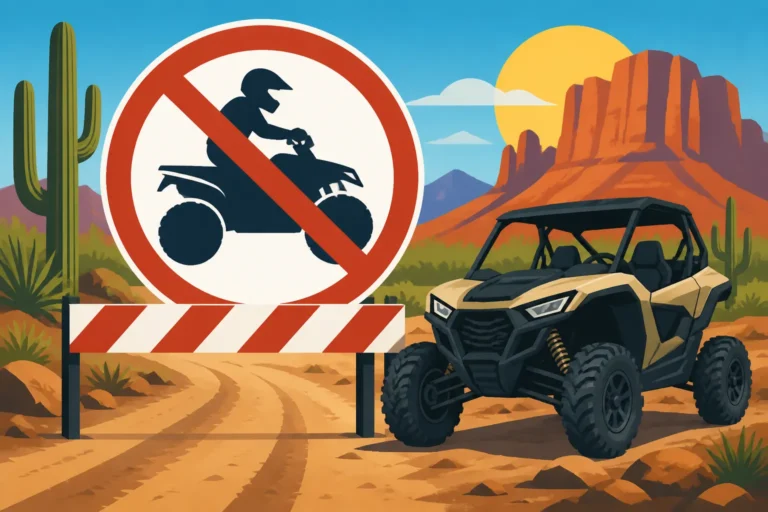
So, you're out riding, and you come across a flooded road or wash crossing. What do you do? The answer is almost always: turn around. Do not attempt to cross. Even if it looks shallow, the current can be deceptive, and the bottom could be washed out or filled with hidden debris. Remember the "Stupid Motorist Law." If there are "Road Closed" or "Do Not Enter When Flooded" signs, the decision is made for you. Disregarding them puts you at risk of hefty fines and rescue costs.
If you find yourself near a rising wash, head for higher ground immediately. Don't wait to see how high the water will get. Flash floods can surge incredibly fast. If you're on a trail and a storm rolls in, consider taking shelter until the worst passes, but always be mindful of where the water will naturally flow. Avoid parking in washes or low-lying areas, even if they appear dry. When in doubt, err on the side of caution. No ride is worth risking your life or the lives of rescuers. Patience is a virtue, and sometimes waiting out a storm or finding an alternate route is the smartest decision you can make. This is especially true when considering the advice in [Driving Through a Flooded Wash].
Post-Flood Precautions and Machine Maintenance
After a monsoon storm, even if you avoided the worst of the flooding, the landscape can be changed. Roads might be damaged, trails could be washed out, and new obstacles might have appeared. Always approach post-storm riding with extra caution, especially on unfamiliar routes. Be aware of soft shoulders, new ruts, and slippery mud.
Your machine might also need some attention if it encountered any water, even if it wasn't submerged. Check air filters for moisture or debris, inspect your brakes for reduced performance due to water, and ensure all electrical connections are dry. Water can get into axles, differentials, and other critical components, leading to corrosion and premature wear. Consider a thorough wash to remove any mud, sand, or grit that can cause abrasion. If your machine took on significant water, it's wise to have a professional inspect it. Water damage can be insidious and lead to costly repairs down the road if not addressed promptly. Taking care of your OHV ensures it's ready for your next adventure, safely.
Gear and Modifications to Consider for Monsoon Conditions
While avoiding floodwaters is paramount, some gear and modifications can help protect your machine and enhance safety if you find yourself in unexpectedly wet conditions, or if you simply enjoy riding through shallower water crossings that are clearly safe and legal.
Essential Equipment for Riding in Wet Conditions
When riding during monsoon season, even if you plan to avoid rain, it's wise to be prepared for the unexpected. Waterproof gear for yourself is essential: a good rain jacket, pants, and waterproof boots can keep you comfortable and focused. For your machine, consider a sturdy set of fender flares to minimize mud and water spray, keeping your vision clear and reducing the mess. Having a winch on your UTV or ATV is always a good idea in the desert, and it becomes even more critical if you get stuck in soft, muddy conditions. A recovery strap and shovel are also must-haves.
Ensure your lights are in top working order and consider adding auxiliary lighting for improved visibility, especially if you get caught in a downpour where ambient light is poor. Waterproof storage for your phone, first aid kit, and important documents is also non-negotiable. Even a small, unexpected splash can ruin electronics. Think about where your air intake and exhaust are located. If they're low, even minor water can become a major problem.
Protecting Your Machine from Water Damage
For those who ride frequently in areas where deeper, but safe, water crossings are common (and always within legal limits), specific modifications can offer a layer of protection. Snorkel kits, which raise your engine's air intake and exhaust vents to a higher position, are a popular upgrade. Brands like SuperATV offer robust snorkel systems designed for various ATV and UTV models, significantly reducing the risk of water entering your engine and causing catastrophic damage. This allows you to navigate deeper water with greater confidence, assuming the crossing is otherwise safe and permissible.
Another key area to protect is your drivetrain. Investing in sealed bearings and greaseable components can help keep water and mud out of critical areas like wheel bearings and universal joints, extending their lifespan. Consider upgrading to a high-mount exhaust system if available for your model, further keeping it out of the water. For electrical components, dielectric grease on connections can help prevent corrosion. While these modifications from companies like SuperATV can enhance your machine's capability, they are never an invitation to ignore the "Stupid Motorist Law" or attempt to cross dangerous floodwaters. They are for responsible riders who encounter permissible water and want to protect their investment.
Here's a quick comparison of safe versus unsafe actions during monsoon season:
| Action Category | Safe Practice | Unsafe Practice |
|---|---|---|
| Pre-Ride Planning | Check upstream and local weather forecasts. Share your float plan. | Head out without checking weather. Rely solely on visual conditions at home. |
| Route Selection | Stick to known, higher-ground routes. Identify alternate routes. | Choose routes with multiple low-lying wash crossings during storm season. |
| Encountering Water | Turn around; head for higher ground immediately. Wait it out if safe. | Attempt to cross any visible water on a road, regardless of depth/speed. |
| Signage | Obey all "Road Closed" or "Do Not Enter When Flooded" signs. | Drive around or ignore posted warnings. |
| Emergency Prep | Carry a map, GPS, satellite messenger. Have waterproof storage. | Rely solely on cell service. Store electronics unprotected. |
| Vehicle Prep | Inspect air filter, brakes, and electricals. Consider SuperATV snorkels. | Neglect pre-ride checks. Assume all components are sealed against water. |
Monsoon season in Arizona offers some truly incredible experiences, from dramatic skies to vibrant desert blooms, but it also demands an elevated level of respect and caution from OHV riders. By understanding the risks, adhering to the law, and preparing both yourself and your machine, you can safely enjoy the desert, even when the clouds roll in.
Disclaimer
This article is for general informational purposes only and does not constitute professional advice. Laws, prices and regulations vary by location and change over time. Consult a qualified professional for guidance on your specific situation.