Do Licensed Trucks Need an Arizona Decal?
It's a common sight in Arizona: a beefy Ford F-150 or a trusty Ram 2500, maybe even a Jeep Gladiator, rolling down the highway with a shiny side-by-side or a couple of ATVs strapped firmly in the bed or on a trailer. You might see these trucks heading to a favorite spot in the Sonoran Desert or up to the high country near Flagstaff, and it can leave you wondering about all the different rules. Specifically, a lot of folks get caught up on whether their licensed pickup truck, the one they drive to work every day, also needs an Arizona Off-Highway Vehicle (OHV) decal if they're taking it off the pavement. This confusion is totally understandable because so many vehicles are hitting the dirt these days, but this guide is here to clear up that very specific question, ensuring you're not wasting money or worrying unnecessarily.
Understanding the Arizona OHV Decal's Purpose
Let's cut right to the chase: no, your regularly licensed pickup truck, SUV, or passenger car does not need an Arizona OHV decal. That decal is specifically for off-highway vehicles that operate off paved roads. It's a fund-raising mechanism for the state to maintain trails, manage resources, and provide critical search and rescue services in the vast expanses of Arizona's public lands. The confusion often stems from the fact that many of us do take our trucks off-road, whether for camping, hunting, or just exploring, which feels like an "off-highway" activity. But the state's definition is very precise.
What the Decal Actually Covers
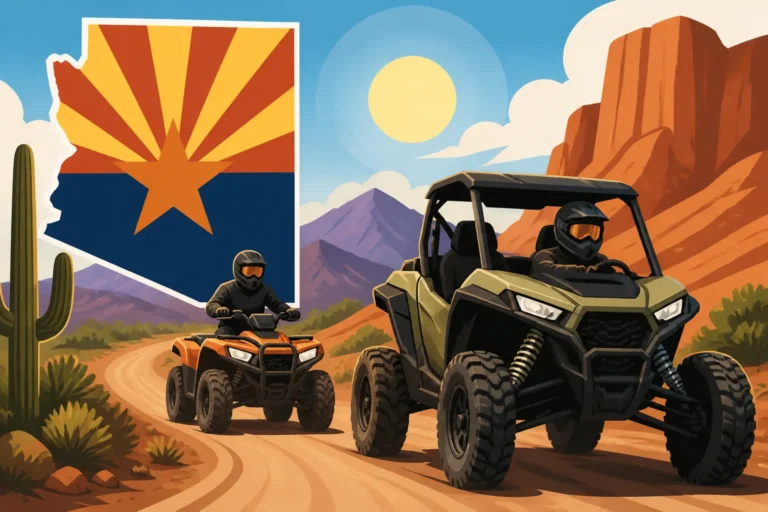
The Arizona OHV decal is designed for vehicles that are primarily intended for off-road use. Think of your quads, side-by-sides (UTVs), dirt bikes, sand rails, and even specialized 4x4s like rock crawlers that might not be street-legal. These are the machines that put the "off-highway" in OHV. The revenue generated from these decals directly benefits the trails and lands where these vehicles are ridden, funding things like signage, erosion control, and safety education. So, when you see a [What the OHV Decal Buys an Arizona Rider], it's really the side-by-side or ATV on the trailer, or the dirt bike in the truck bed, that’s benefiting from that little sticker.
The Arizona Game and Fish Department (AZGFD), which manages the OHV decal program, defines an OHV as a motor vehicle operated off-highway, subject to specific weight limits. Generally, any motor vehicle designed for or capable of travel over unimproved terrain and weighing 1,800 pounds or less is considered an OHV. However, the definition also includes side-by-sides and certain other vehicles over 1,800 pounds that are clearly designed for off-highway recreation. Your everyday pickup truck, even if it has four-wheel drive and rugged tires, simply doesn't fit this primary definition. It's built for the road, registered for the road, and if you take it off the road, it's still operating as a truck, not an OHV in the eyes of the law regarding decal requirements.
Why the Confusion Exists for Truck Owners
The line between a heavy-duty 4×4 pickup and an OHV can feel a little blurry sometimes, especially when you consider how many truck owners use their vehicles to access remote areas. You might be driving your truck down a dirt road to reach a fantastic dispersed camping spot, or you might be navigating some rough two-track to get to a fishing hole. These are undeniably "off-highway" activities in a colloquial sense. This practical use often leads truck owners to wonder if they, too, need to display an OHV decal.
Another source of confusion might be the increasing popularity of highly modified trucks designed for "overlanding" or extreme off-roading. These vehicles often feature heavy-duty suspension, massive tires, winches, and sophisticated SuperATV accessories that blur the lines with purpose-built OHVs. While these trucks are incredibly capable off-road, they are still fundamentally registered as motor vehicles for highway use with the Arizona Motor Vehicle Division (MVD). Their primary registration with the MVD covers their legality on public roads, and this primary registration does not mandate an OHV decal, regardless of how extreme your off-road adventures get in that truck. The OHV decal is a separate requirement for a different category of vehicle.
Differentiating OHVs from Licensed Trucks in Arizona
To truly understand why your licensed truck doesn't need an OHV decal, it helps to clearly define what Arizona considers an OHV versus a standard licensed motor vehicle, like a truck. These distinctions are critical for understanding registration requirements and where your hard-earned money for tags and decals actually goes.
Defining an Off-Highway Vehicle (OHV) in Arizona
In Arizona, an Off-Highway Vehicle (OHV) is generally defined as any motor vehicle operated off-highway, primarily designed for recreational travel over unimproved terrain, and weighing 1,800 pounds or less. This category includes common machines like ATVs, dirt bikes, and even smaller UTVs. However, the definition also broadens to include any "motor vehicle designed for or capable of travel over unimproved terrain that is a recreation vehicle." This is where side-by-sides typically fit in, regardless of their weight, as they are clearly designed for off-highway recreation.
Crucially, an OHV doesn't carry a traditional "RV" or "MC" plate for street-legal operation unless it has gone through the process of [Making a UTV Street Legal in Arizona]. Even then, if a street-legal OHV is going to be operated off-highway, it still needs the OHV decal. This dual requirement for street-legal OHVs can sometimes add to the confusion, but it highlights that the decal is tied to the off-highway use capability and intent of the vehicle itself, not just whether it has a license plate. If you own an ATV, a [Polaris RZR], or a dirt bike, it's almost certainly going to need that annual decal if you plan to ride it on public land.
Defining a Licensed Truck (Motor Vehicle) in Arizona
A licensed truck, on the other hand, is considered a standard "motor vehicle" in Arizona, registered primarily for use on public roads and highways. This includes everything from a compact pickup to a heavy-duty commercial truck. These vehicles receive a standard license plate (often an "RV" plate, but sometimes an "MC" if it's a very light truck or SUV that qualifies for that class) and pay registration fees that contribute to road maintenance and other state funds, but not directly to the OHV program's specific initiatives.
When you [Registering Through Arizona MVD or a Third Party] for your truck, you're fulfilling requirements for highway travel, including emissions testing in certain areas like Phoenix and Tucson (which OHVs typically don't require). Your truck's Vehicle Identification Number (VIN) identifies it as a highway vehicle, and its title and registration reflect its classification as such. Even if you've added an aggressive lift kit, oversized tires, or a robust front bumper from a company like SuperATV to your truck, it remains a licensed motor vehicle, distinct from an OHV in the eyes of the decal requirement. The decal is about the type of vehicle and its primary design for off-highway recreation, not just its capability.
The "Street-Legal" Exception for OHVs
It’s worth touching on the "street-legal" exception for OHVs, as this is where some of the biggest misunderstandings crop up. An OHV can be made street-legal in Arizona, allowing it to drive on certain public roads. This involves adding specific equipment like turn signals, a horn, mirrors, and obtaining an "MC" license plate. However, even once it's street-legal, if that same machine is going to be operated off-highway on designated trails or public lands, it still needs an OHV decal.
Why the double requirement? Because the OHV decal funds the off-highway infrastructure. A street-legal OHV benefits from those trails and services, just like an OHV that never touches pavement. Your licensed pickup truck, however, is considered a "motor vehicle" from the get-go. Its registration fees contribute to general transportation funds, not the specific OHV trail fund. So, while a street-legal [Honda Talon] needs both a license plate and an OHV decal, your street-legal pickup truck only needs its license plate. The distinction is about the vehicle's fundamental classification and intended use as defined by state law.
Scenarios Where a Truck Might Encounter OHV Rules (But Not Need a Decal)
Many truck owners naturally find themselves in situations where they interact with the OHV world. They might drive to remote trailheads, use their truck to haul supplies to a hunting camp on public land, or even drive on unpaved roads that feel very much like OHV trails. These scenarios often lead to the question of the OHV decal, but understanding the context helps clarify the rules.
Driving a Truck to an OHV Staging Area
Picture this: it's a crisp Saturday morning, and you've loaded your [Can-Am Commander] onto a trailer behind your Ford F-250. You're heading out to the Table Mesa OHV Area north of Phoenix, or maybe [Standard Wash Near Lake Havasu City]. When you pull into the staging area, you'll see dozens of trucks, SUVs, and toy haulers. The OHVs are unloaded, the riders get geared up, and then the fun begins.
In this scenario, your pickup truck is simply a tow vehicle or a means of transport. It's performing the same function as a car pulling a boat to a lake or an RV heading to a campground. The truck itself is not considered an OHV in this context, even though it's on unpaved ground at the staging area. Its role is to get your actual OHVs—the side-by-side, the ATV, or the dirt bike—to the riding area. Therefore, your truck does not require an OHV decal. The decal belongs squarely on the machine that will be leaving the staging area and hitting the trails. This is a common situation, and it's helpful to remember that the decal follows the recreational off-highway machine, not the vehicle that transports it.
Using a Truck on Designated OHV Routes
Arizona has thousands of miles of roads and trails, and sometimes the distinction between a graded dirt road, a county road, and a designated OHV route can feel a bit arbitrary, especially in rural areas. Many 4×4 trucks are perfectly capable of traversing designated OHV routes, particularly those rated as "easy" or "moderate." You might be driving your truck on a [Forest Service Road] that's also open to OHVs, or on a less-maintained BLM road that could easily be considered an OHV trail.
Even if your rugged truck, perhaps outfitted with lift kits and heavy-duty components from SuperATV, is capable of tackling these routes, it doesn't automatically become an OHV for decal purposes. Your truck retains its classification as a street-legal motor vehicle. The rules for OHV routes are about what vehicles are permitted on them, not about magically transforming a licensed truck into an OHV. As long as the route is legally open to full-size vehicles (which many OHV routes are, especially fire roads and two-tracks), you are fine to drive your truck there without an OHV decal. The decal is specifically for those vehicles whose primary purpose and registration are tied to off-highway recreation. Always remember to check [Arizona Motor Vehicle Use Map] before venturing out to confirm vehicle restrictions.
Agricultural and Work Exemptions for Trucks
Arizona also has specific exemptions for certain vehicles, including trucks, used for agricultural purposes or on private land. For example, a pickup truck used exclusively on a farm or ranch for work-related tasks typically doesn't need an OHV decal, nor would it need a standard MVD registration if it never touches public roads. These vehicles fall under different regulatory frameworks because their primary purpose is not recreational off-highway use.
However, even if you’re using your truck for work that takes you off-road, say, for hauling fencing materials across a large property or accessing a remote job site, as long as that truck also has a standard Arizona license plate and is capable of street travel, it doesn't need an OHV decal. The decal is explicitly for recreational OHVs. The distinction is key: if your vehicle is registered for street use, it's covered by those fees; if it's an OHV, it requires the decal for its off-highway recreational access. If your ranch truck is occasionally driven on a county road to get from one pasture to another, the rules for [Driving a Ranch UTV on an Arizona County Road] might apply to the UTV, but your truck remains a truck.
What Happens if You Accidentally Put a Decal on Your Truck?
In the vast landscape of Arizona's regulations, it's easy to make an honest mistake. What if, out of an abundance of caution or simply misunderstanding the rules, you ended up buying an Arizona OHV decal and sticking it on your licensed pickup truck? Don't worry, it's generally not a big deal, but it's important to understand why it's unnecessary.
The Harmlessness (Mostly) of a Misplaced Decal
Let's say you've got your OHV decal proudly displayed on your truck's license plate, right there in the upper-left corner. An Arizona Game and Fish Department officer or a sheriff's deputy spots it. Are you going to get a ticket for having an OHV decal on a truck that doesn't need one? Highly unlikely. In fact, it's more likely they'll simply chuckle good-naturedly and gently inform you that it's not required for your truck. There's no law against putting an unnecessary sticker on your vehicle, especially one issued by the state.
The biggest "harm" in this scenario is that you've spent money on something your truck doesn't need. The annual fee for the OHV decal, while modest, is still a cost you could avoid. It’s not illegal, and it won't cause any major issues with your vehicle's registration or operation. You just simply haven't directed that particular fee towards its intended purpose for your truck, which is already covered by its standard MVD registration.
The Real Vehicle That Needs the Decal
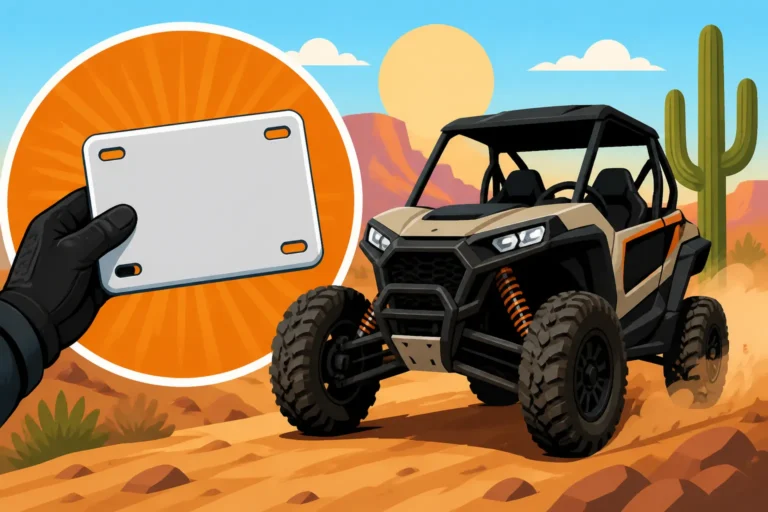
The core takeaway here is that the OHV decal belongs on the actual off-highway vehicle that will be used for recreation off paved roads. If you're hauling a side-by-side, an ATV, or a dirt bike, that's the machine that needs the decal. Your truck is merely the transport. The decal should be applied correctly to the OHV's license plate, if it has one (for street-legal OHVs), or directly to the OHV itself, as specified by AZGFD. You can find specific guidance on [Where the Arizona OHV Decal Goes on the Plate] or on the machine itself.
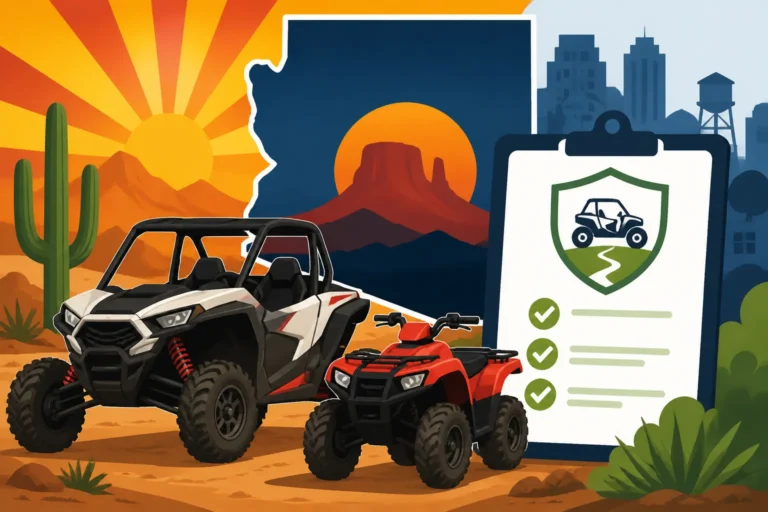
If you mistakenly put the decal on your truck, make sure you also have the correct decal on your OHV. Otherwise, your OHV will be considered undecaled, and you could face [Penalties for an Undecaled Machine in Arizona] when you're out on the trails. So, double-check that your recreational off-highway machines are properly decaled before you head out. The easiest way to remember is: if it's registered with MVD for the road as a car or truck, it doesn't need an OHV decal. If it's a recreational off-road machine, it does.
Here's a quick reference table to help clarify:
| Vehicle Type | Primary Use | Needs Arizona OHV Decal? | Needs Arizona MVD Registration/Plate? | Emissions Testing Required (in specific areas)? |
|---|---|---|---|---|
| Licensed Truck | On-highway transportation, general utility | NO | YES | YES (Phoenix, Tucson metros) |
| ATV / Dirt Bike | Off-highway recreation | YES | NO (unless street-legal conversion) | NO |
| Side-by-Side | Off-highway recreation | YES | NO (unless street-legal conversion) | NO |
| Street-Legal UTV | On-highway and off-highway recreation | YES | YES (MC plate) | YES (if meets criteria for street-legal) |
| Sand Rail | Off-highway recreation | YES | NO | NO |
Disclaimer
This article is for general informational purposes only and does not constitute professional advice. Laws, prices and regulations vary by location and change over time. Consult a qualified professional for guidance on your specific situation.