Riding to Breakfast in a Trail Town
There’s nothing quite like the feeling of pulling off a dusty Arizona trail, sun on your face, and knowing you’re just a short cruise away from a hearty breakfast in a charming trail town. Many of us dream of connecting those incredible off-road adventures directly with the comforts of civilization, skipping the whole trailer-and-truck shuffle. This guide will walk you through the practicalities and legalities of making that dream a reality, explaining how you can legally ride your ATV or UTV straight into an Arizona trail town to grab a bite.
The Dream of Riding Straight to Breakfast
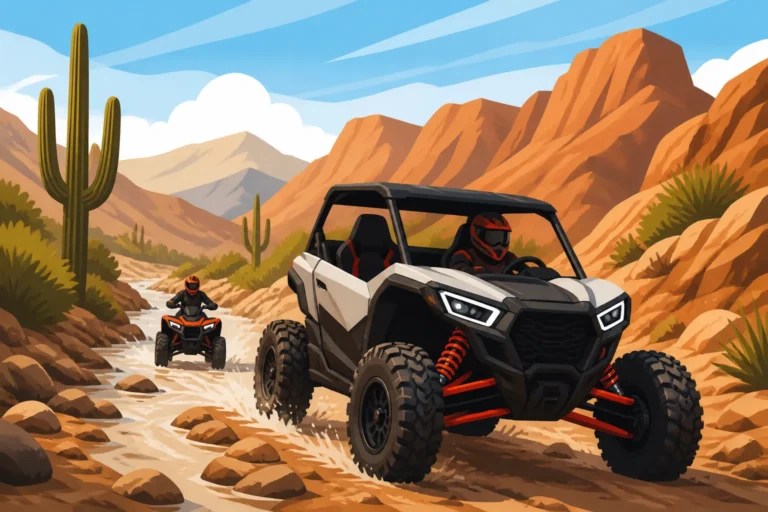
Imagine a perfect Arizona morning. You've been out since dawn, exploring winding desert washes or climbing rocky mountain trails, your machine humming beneath you. Now, the stomach rumbles, and the thought of a warm plate of huevos rancheros or a stack of fluffy pancakes sounds absolutely heavenly. The nearest town is just a few miles down the road, and wouldn't it be incredible to just keep riding, pull right up to a cafe, and enjoy the fruits of your morning adventure?
Why the Trail-to-Table Idea is So Appealing
The appeal of riding directly from the trail to the breakfast table is undeniable. For starters, it’s about pure convenience. No one enjoys the hassle of loading a dusty machine back onto a trailer, driving to a hotel or staging area, unloading, and then getting into another vehicle just to go eat. When you’re able to transition seamlessly from trail to town, it keeps the adventure flowing. It’s an immersive experience, allowing you to stay in the moment, savoring the sights and sounds of your ride right up to the cafe door. Think of it: you’ve just come off a beautiful section of trail near Sedona, the red rocks still vivid in your mind, and you roll directly into town, the dust still clinging to your tires, ready for that well-deserved meal. It makes the entire outing feel more connected and authentic.
The Legal Realities That Ground the Dream
As appealing as the idea is, it’s important to understand that Arizona isn't a free-for-all when it comes to riding your off-highway vehicle (OHV) on paved roads. Many riders get frustrated when they realize that simply having an OHV decal doesn't automatically grant them access to city streets. The reality is, for an ATV or UTV to be legally operated on most public roads, including those in trail towns, it needs to be "street-legal." This involves specific modifications and compliance with Arizona motor vehicle laws, which transform your off-road beast into something that can share the pavement with cars and trucks. Without these steps, that dream ride to breakfast could quickly turn into a costly citation and a major buzzkill for your morning.
What Makes an OHV Street-Legal in Arizona?
If you want to ditch the trailer and ride into town, your OHV needs to meet a specific set of requirements to be considered street-legal in Arizona. This isn't just about slapping on a license plate; it involves equipping your machine with safety features and registering it appropriately. Many riders invest in kits from brands like SuperATV that bundle most of these necessary components, making the conversion process a lot smoother.
Essential Equipment Arizona Demands
Making your OHV street-legal means adding components that often come standard on traditional road vehicles. Each item serves a critical safety function and is mandated by law to ensure your machine is visible and controllable on paved surfaces.
First and foremost, you need proper headlights, taillights, and brake lights. Your headlights must be able to illuminate the road ahead for a specified distance, typically 500 feet, making sure you can see and be seen, especially at dawn or dusk. Similarly, taillights need to be visible from 500 feet to alert drivers behind you. Brake lights, which activate when you apply the brakes, are crucial for signaling your intentions. All these lights need to be in good working order, and having high-quality, durable lights is key for desert riding where vibrations can be tough on electronics. You’ll also need a license plate light to ensure your plate is illuminated after dark, making it visible to law enforcement.
Next up is an audible warning device – a horn. This isn't just a courtesy; Arizona law requires a horn that can be heard from at least 200 feet away. A quick, sharp blast can prevent accidents by alerting pedestrians or other drivers to your presence. Along with the horn, rearview mirrors are non-negotiable. You'll need at least one mirror that provides a clear view of the road behind you. Many riders opt for two, one on each side, for maximum visibility, especially when navigating busy streets or merging into traffic.
For UTVs, seatbelts or safety restraints are critical. While most modern UTVs come with factory seatbelts, ensuring they are properly functioning and used by all occupants is essential for road safety. The tires on your OHV also matter. While knobby off-road tires are great for traction in the dirt, they need to be DOT-approved if they're going to see significant pavement use. This ensures they can handle the stresses of road driving and maintain proper grip. You might even consider a windshield for protection from road debris and wind, though it's often not a legal requirement for street-legal conversion. Finally, don't forget the spark arrestor. This device, often integrated into your muffler system, prevents hot carbon particles from escaping your exhaust and potentially starting wildfires. It's a requirement for all OHVs operating on public and state lands in Arizona, and that includes when you're crossing those lands to get to town. [Arizona's 500 Foot Headlight Rule] provides more detail on lighting requirements, and [The Horn Arizona Wants Audible at 200 Feet] offers specifics on that. For general requirements, see [Mirrors, Seats and Footrests on an Arizona Build] and [USDA-Approved Spark Arrestors in Arizona].
Registration, Plates, and Insurance
Beyond the physical equipment, your street-legal OHV needs to be properly registered and insured. This is where many riders get tripped up, thinking their standard OHV decal is sufficient for road use. It’s not.
To legally operate your OHV on paved roads, you must register it with the Arizona Motor Vehicle Division (MVD) as a street-legal vehicle, which typically means obtaining an MC (motorcycle) plate. This is distinct from the standard OHV decal that allows off-road use. The MC plate signifies that your vehicle has met the requirements to be driven on public roads. When you get an MC plate, you’ll also receive a standard vehicle title, similar to a car or motorcycle. This process often involves proving your machine has the required safety equipment discussed above. You can find more information about this at [Getting an MC Plate for a Side-by-Side].
Along with proper registration, insurance is absolutely mandatory for any vehicle operating on Arizona's public roads. You'll need to carry minimum liability coverage, which helps cover costs if you cause an accident resulting in injury or property damage to others. Arizona's minimums are typically expressed as 25/50/15, meaning $25,000 for bodily injury per person, $50,000 for bodily injury per accident, and $15,000 for property damage. It’s always a good idea to consider higher coverage limits for added peace of mind, especially with the unique risks associated with OHV operation. You'll need to carry proof of this insurance, along with your driver's license and registration, whenever you're on the road. [Arizona Insurance Minimums for Road Riding] and [Arizona Liability Minimums for Street-Legal Machines] go into more detail about what's required for road-going machines. You can learn more about how to prove coverage on the trail at [Proving Coverage on an Arizona Road].
Navigating Arizona's Trail Towns
Once your OHV is street-legal, registered, and insured, you're ready for the pavement, right? Well, almost. While state law lays the groundwork for street-legal OHV use, the real world also involves local regulations. This can be a source of frustration for riders, as what's legal in one town might be restricted in another.
Understanding Local Ordinances and Open Roads
Arizona's approach to OHV use on public roads is a bit of a patchwork. State law allows street-legal OHVs on most public roads where cars are permitted, unless specifically prohibited by a county or municipal ordinance. This "unless" clause is critical. Many smaller, OHV-friendly towns, often referred to as "trail towns" like those found near Payson, Lake Havasu City, or areas around Sedona, have embraced OHV tourism and explicitly allow street-legal machines on many of their local streets. They see the economic benefit and welcome riders.
However, other cities, particularly larger metropolitan areas or those less accustomed to OHV traffic, might have ordinances that restrict or completely prohibit OHVs on their streets, even if they're street-legal. They might cite concerns about noise, traffic flow, or safety. Imagine finishing a ride near Prescott, where county roads might be open to your UTV, but then hitting the city limits and finding that most urban streets are off-limits. It's a jarring experience and something you absolutely need to research beforehand. Before planning your breakfast run, always check the specific city or county ordinances for your destination. A quick search on the town's official website or a call to their police department or city hall can save you a lot of grief. [Finding an Arizona City's OHV Ordinance] is a great resource for this, as is [Which Arizona Roads Are Open to OHVs] and [Arizona City Streets Open to OHVs].
Parking and Etiquette in Town
Once you've confirmed that the local roads are open to your street-legal OHV, the next consideration is where to park and how to act in town. Most street-legal OHVs can utilize standard parking spaces, just like any other vehicle. When you pull into that cafe in Old Town Cottonwood or a popular diner in downtown Payson, you'll simply find an available parking spot and park your machine.
However, there's an element of etiquette that goes beyond mere legality. Remember, while you might be thrilled to be riding your UTV into town, not everyone shares the same enthusiasm. Be mindful of noise, especially in residential areas or near businesses. OHVs, particularly those with aftermarket exhausts, can be significantly louder than passenger cars. Keep your speed down, drive defensively, and be extra courteous to pedestrians and other drivers. Dust is another consideration; try to minimize kicking up dust, especially if you've just come off a particularly dry trail. Parking your machine responsibly, not blocking sidewalks or storefronts, and generally being a good ambassador for the OHV community will go a long way in ensuring these trail-to-town privileges continue. Respect for the community helps ensure that towns remain welcoming to riders. For general parking considerations, check out [Parking a Side-by-Side at a Trailhead].
The Ride to Breakfast: Practical Considerations
So, you've got your street-legal machine, you've checked the local ordinances, and you're ready to roll. The actual journey from trail to town still requires a bit of planning and a focus on safety, as riding an OHV on pavement is a different experience than kicking up dust in the desert.
Planning Your Route Beyond the Dirt
Even with a street-legal OHV, you can't just take any road. Planning your route is essential to ensure you stay on legal paths and avoid unnecessary risks. The first step is often to identify the exact point where your chosen trail system meets a public road. From there, you'll want to consult maps – whether it's a dedicated OHV map, a standard road atlas, or a GPS app on your phone. Look for county roads, local streets, and state highways that are clearly marked as open to OHVs.
Crucially, avoid major interstates and controlled-access highways. While Arizona allows street-legal OHVs on many state highways, interstates (like I-10 or I-17) are generally off-limits for safety reasons and can lead to serious citations. These roads are designed for high-speed traffic, and an OHV, even a street-legal one, is not built for sustained highway speeds. Stick to secondary roads, scenic routes, and local street grids. Many GPS apps now offer OHV-specific routing, or you can use tools like onX Offroad to plan your journey, identifying legal road segments that connect your trail with your breakfast spot. Remember, part of the adventure is finding those unique back roads that lead you to your destination. You'll find more information on this at [Can You Ride an OHV on an Arizona Highway?].
Safety, Speed, and Sharing the Road
Riding an OHV on pavement presents a different set of challenges than off-road riding. Your machine will handle differently; tires designed for dirt might feel squirrely on asphalt, and the suspension, tuned for bumps and jumps, might feel softer on smooth roads. Always remember to adjust your driving style.
Maintain appropriate speeds. While your OHV might feel fast, it's generally lighter and has a higher center of gravity than a typical car, making it more prone to rollovers if you take turns too quickly. Adhere strictly to posted speed limits, which will often be significantly lower than what your machine can achieve. Many OHVs are not designed for sustained high-speed operation on pavement, and excessive speed increases stopping distances and reduces control. [Speed Limits for Arizona Machines on Roads] provides good guidelines here.
Drive defensively and be highly visible. OHVs are smaller than most cars and trucks, making them less noticeable to other drivers. Always assume other drivers don't see you. Use your turn signals, maintain a safe following distance, and be extra cautious at intersections. When equipping your machine with street-legal components, consider adding bright reflective tape to the sides and rear, especially if you plan on riding in low light conditions. The goal is to make yourself as conspicuous as possible to minimize risk. Ignoring these safety precautions can lead to not only accidents but also fines for unsafe operation. [Arizona Fines for Illegal Road Riding] details some of the penalties for non-compliance.
Keeping Your Paperwork Handy
Just like with any other registered vehicle, when you're operating your street-legal OHV on Arizona roads, you need to have your important documents readily accessible. This means carrying your driver's license, vehicle registration (with your MC plate information), and proof of insurance.
Law enforcement officers, whether it's a city police officer or an Arizona State Trooper, can and will pull over OHVs that appear to be operating illegally or unsafely on public roads. If stopped, they will ask for these documents. Having them easily available, perhaps in a waterproof pouch on your machine or in a secure pocket, will make the interaction much smoother. Trying to explain you "just forgot" or "it's at home" won't fly and can lead to delays, tickets, or even your machine being impounded. Being prepared with your paperwork is a simple step that reinforces your compliance with the law and ensures your breakfast run stays pleasant. For more on what officers might ask for, review [What an Arizona Ranger Asks a Rider For] and [Do You Carry Papers on an Arizona Trail?].
| Feature / Aspect | Trail-Ready OHV (OHV Decal Only) | Street-Legal OHV (MC Plate) |
|---|---|---|
| Primary Use | Off-road trails, private land | Public roads, trails |
| Required Decal/Plate | Annual Arizona OHV Decal | MC (Motorcycle) License Plate |
| Headlights/Taillights | May be basic, for visibility on trail | DOT-compliant, specific visibility range, brake lights, license plate light |
| Mirrors | Not typically required | At least one rearview mirror |
| Horn | Not typically required | Audible horn (200 ft visibility) |
| Turn Signals | Not required | Often required (though state law can vary, good practice for safety) |
| Insurance | Not required by state for off-road use | Mandatory liability insurance |
| Tires | Off-road specific | DOT-approved for road use |
| Spark Arrestor | Required on public land | Required on public land |
| Speed Limits | No specific limit off-road, follows land manager rules | Posted road speed limits |
| Road Access | Limited to designated crossings or very specific exemptions | General access to most public roads (check local ordinances) |
Disclaimer
This article is for general informational purposes only and does not constitute professional advice. Laws, prices and regulations vary by location and change over time. Consult a qualified professional for guidance on your specific situation.