Decals for Ranch Work Machines
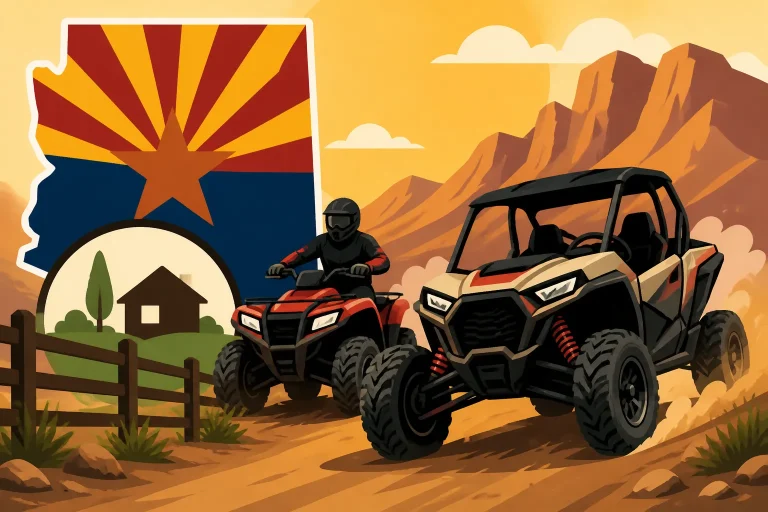
A ranch UTV or ATV can be a work tool on private ground one day and a machine on public land the next. That change in use can affect whether Arizona’s OHV decal rules apply. The key is not the “ranch” label: it is the machine’s classification, where it is operated, and whether a specific agricultural exemption covers that use.
Why “ranch machine” does not settle the decal question
Arizona does not treat every ATV or UTV used for work as automatically exempt from OHV decal requirements. A machine’s purpose, its features and its weight can affect how it is classified, but calling it a ranch vehicle is not enough by itself. Nor does hauling feed or checking fences turn every trip into exempt agricultural use.
Start by identifying the machine. Check its title or registration documents and the manufacturer’s specifications, including its intended use and weight. Arizona’s OHV rules apply to qualifying vehicles, and the rules for a machine that does not meet the OHV definition may be different. Weight is one part of that determination; it does not, by itself, establish that a machine may use a particular road or piece of land. See Machines Under 1,800 Pounds for more on why weight matters.
Next, look at where the machine will actually travel. A qualifying machine used only on private ranch property presents a different question from one ridden onto a public road, state land or other public ground. The general rules for private property are covered in Do You Need a Decal on Private Arizona Land?, but private ownership alone does not give a rider permission to cross neighboring property or enter public land.
| Situation | What to check |
|---|---|
| Work stays on private ranch property | Whether the land is privately controlled and whether the owner has authorized the use |
| Machine leaves the ranch for public or state land | Whether the machine needs an OHV decal and whether the rider needs a separate land permit |
| Machine travels on a public road | Whether it is properly registered and equipped for that road, and whether OHV access is allowed there |
| Machine is used for both work and recreation | Whether recreational trips fall outside any agricultural exemption |
| Machine is owned or operated by an out-of-state visitor | Whether Arizona’s visitor decal rules apply; another state’s registration may not answer that question |
A machine can also have more than one regulatory issue at once. An OHV decal is not a road registration, and neither one automatically grants access to land that has separate permit requirements. The broad overview in Arizona’s Annual OHV Decal Explained can help distinguish the decal from other paperwork.
When agricultural use may qualify for an exemption
Arizona has specific exemptions that may apply to some machines used for agricultural purposes. The important point is that an exemption is not a general pass for all ranch-owned machines or every trip connected to ranch work. The facts of the use matter, and the boundaries of an exemption can be narrower than an owner expects.
For example, a machine used exclusively for qualifying ranch operations may be treated differently from the same machine used for recreational trail riding. If a ranch UTV is used to carry tools during a workday and then taken out for a weekend ride, do not assume the work use exempts both activities. Ask whether the exemption applies to the particular operation and location, rather than relying on the machine’s primary purpose or the owner’s occupation. For a closer look at the issue, see Arizona Exemptions for Ranch Machines.
A useful way to evaluate the situation is to write down the machine’s actual uses:
- List the places it travels, including private ranch roads, public roads, state land and other public areas.
- Separate work trips from recreation, hunting, errands or trips to reach a trail.
- Note who owns or controls each parcel and whether permission or a permit is required.
- Check whether the machine is registered for road use, carries an OHV decal, or has neither.
- Ask the Arizona agency responsible for the relevant rule whether the agricultural exemption covers those specific facts.
That last step matters when the answer affects a machine regularly used near public land or on a route that crosses property boundaries. Keep a record of the guidance you receive and identify the machine and use clearly when asking. A vague question such as “Are ranch UTVs exempt?” may not produce an answer that fits your situation.
Do not treat a tax, farm-use or business classification as proof of an OHV decal exemption. Those classifications may serve a different legal or administrative purpose. Likewise, a machine’s commercial appearance, cargo bed, winch or work attachments do not necessarily establish that every trip is agricultural.
If the machine is used on ranch property owned by someone else, get clear permission from the owner or manager. Permission to do ranch work is not automatically permission to ride recreationally, cross onto adjacent land or use a nearby public route. Riding a Ranch by Permission explains why the landowner’s authorization and the applicable land rules are separate questions.
Public land, roads and permits are separate questions
The most common complication is a work route that leaves private ground. A rancher may need to reach a fence line, water source or grazing area by crossing land that is not privately owned. In that case, the work purpose does not necessarily remove other requirements. Confirm both the machine’s decal status and whether the route allows motorized use.
Arizona State Trust Land is a particularly important distinction. A state land recreation permit may be required for activities on Trust Land, and an OHV decal does not substitute for that permit. Conversely, holding a land permit does not necessarily replace a decal required for the machine. Check Arizona State Trust Land Recreational Permits before assuming a ranch-use exemption covers access or staging.
The same principle applies to roads. A decal is not permission to ride on a road closed to OHVs, and a ranch work exemption should not be treated as road registration. If a machine needs to travel on a public road, verify whether it must have street-legal registration and equipment, and confirm that the particular road permits OHV use. Rules for Work and Utility Machines and Which Arizona Roads Allow OHVs address those separate issues.
Be especially cautious when a ranch route crosses federal, tribal or other managed land. Different managers may have different access rules, closures or permit requirements. A route used for years does not necessarily remain open, and a landowner’s permission cannot authorize travel across land the owner does not control. Check current maps and rules for the land manager before setting out.
Out-of-state owners should not assume that a home-state plate or registration automatically satisfies Arizona’s requirements for riding off-road. Arizona has rules for visiting riders, and the relevant requirement may depend on the machine and where it will be operated. Arizona Rules for Visiting Riders and Resident Decals Versus Visitor Decals in Arizona can help clarify the distinction. A street-legal registration may affect whether a separate OHV decal is needed, but it does not grant access to every route; see Street-Legal Registration Instead of a Decal.
A practical way to keep a ranch machine compliant
Treat decal and permit checks as part of planning the route, not as a decision based only on the machine’s usual job. If a machine stays on private property, the questions may be straightforward. If it travels between parcels or onto public ground, check each part of the trip separately.
A simple operating record can help make the situation clear. Note the machine’s identifying details, where it is kept, who owns the land it uses and whether it is used for work, recreation or both. If an agency confirms an exemption applies, keep that information with the machine’s paperwork. If the exemption does not apply, find out what decal or registration is required before the next trip.
Keep paperwork protected from dust, moisture and heat. A weather-resistant document pouch, available through outdoor retailers or Amazon, can help protect copies of registration and permit documents; it does not replace any required decal or original document. Do not rely on a phone photo as a substitute when a rule requires a physical decal or document.
Before using the machine, work through this checklist:
- Identify the machine: Confirm its classification and relevant specifications rather than relying on a sales description or ranch nickname.
- Map the full route: Include crossings, staging areas and short connector roads, not just the ranch destination.
- Separate work from recreation: Do not assume that an exemption for agricultural use also covers a recreational ride.
- Check every land manager: Private property, State Trust Land and other public lands can have different access and permit rules.
- Confirm road status: Registration and equipment requirements are distinct from whether a road is open to OHVs.
- Get a specific answer: When uncertain, describe the machine, its use and the land involved to the appropriate Arizona agency.
- Recheck when use changes: A machine that starts taking recreational trips or visiting public land may need a fresh review of its decal and permit status.
When the answer is unclear, the safest approach is not to infer an exemption from the machine’s work role. Verify the current rule for the exact use and route, then keep the required decal, registration or land permit in order. That helps avoid confusing an agricultural exemption with permission to ride wherever a ranch route happens to lead.
Disclaimer
This article is for general informational purposes only and does not constitute professional advice. Laws, prices and regulations vary by location and change over time. Consult a qualified professional for guidance on your specific situation.