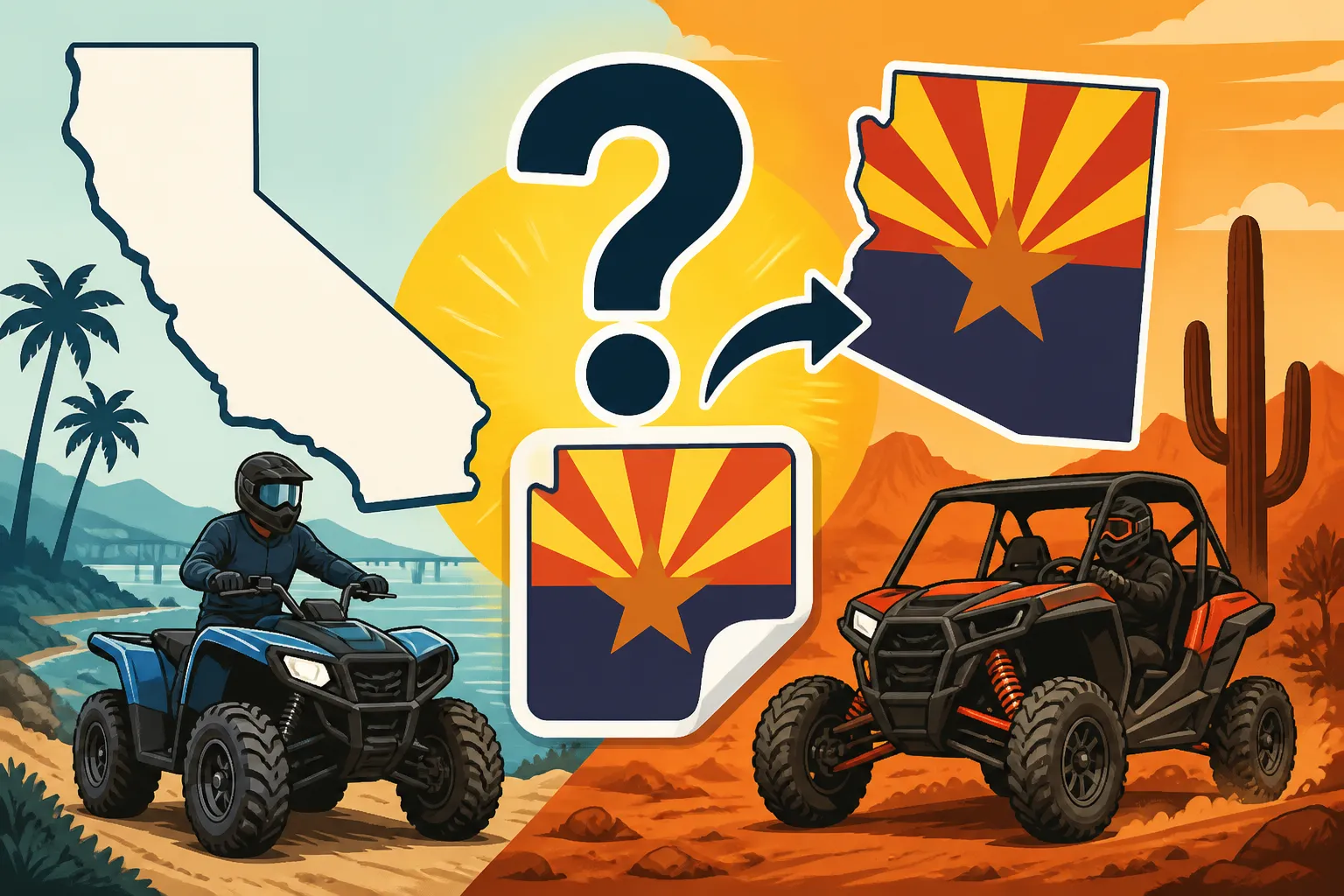
Do California Riders Need an Arizona Decal?
California riders generally need an Arizona non-resident OHV decal before riding an off-highway machine on covered Arizona lands. A California registration or OHV sticker is not the same as Arizona’s decal, and neither automatically grants access to every trail or parcel. The key is to check your machine’s status, get the right authorization and confirm the route’s land rules.
The short answer for California riders
If you bring an ATV, dirt bike or side-by-side from California and plan to ride it off-road in Arizona, don’t assume its California paperwork is enough. Arizona has a non-resident OHV decal for qualifying out-of-state machines used in the state. A California registration or OHV sticker does not, by itself, stand in for that Arizona decal.
The requirement is about where and how the machine is being used, not simply where it was bought or stored. If you’re planning to ride on public or State Trust land, check whether your vehicle needs the Arizona decal before leaving home. The rules can differ for a machine that is properly registered and equipped for street use, and the route’s land manager may impose separate restrictions.
| Your situation | What to check before riding |
|---|---|
| California-registered OHV used off-road | Whether it needs Arizona’s non-resident OHV decal |
| Machine with a California OHV sticker | Do not treat the California sticker as an Arizona decal |
| Street-legal machine with a plate | Confirm that its registration and street equipment qualify for the applicable exemption |
| Ride crosses State Trust land | Check whether a separate recreational permit is required |
| Ride stays on private property | Confirm that you have permission and whether any rules still apply |
| Machine is rented or borrowed | Ask who is responsible for the decal and verify it is covered |
A decal is authorization for a machine under Arizona’s OHV rules; it is not a general trail pass. It does not make a closed route legal, provide permission to cross private or tribal land, or replace a permit required for State Trust land. See Arizona Rules for Visiting Riders for the broader visitor checklist, and Arizona’s Non-Resident OHV Decal for details about the visitor decal.
Does California registration or a red or green sticker count?
A California OHV sticker and an Arizona non-resident decal serve different purposes. California paperwork may establish that your machine is registered or otherwise documented under California rules, but it does not automatically satisfy Arizona’s decal requirement. Plan on checking Arizona’s requirement separately rather than relying on the sticker’s color, expiration date or California registration category.
This distinction matters because people use the word “registered” to mean several different things. A machine may have California OHV registration but no street-legal plate. Another may be registered for road use and carry a plate. A third may have paperwork that is expired, incomplete or in a prior owner’s name. Those situations should not be treated as interchangeable.
If your machine is an off-highway vehicle
For a machine that is not street legal and will be ridden off-road, check the non-resident decal rules before your trip. Do not assume that a California registration certificate, OHV sticker or bill of sale is enough. Keep the Arizona decal and any required supporting records accessible while riding.
If you’re uncertain how Arizona classifies your machine, start with Arizona’s Non-Resident OHV Decal and Resident Decals Versus Visitor Decals in Arizona. The important point is to identify the correct Arizona authorization for the machine, rather than trying to convert California paperwork into an Arizona decal.
If the machine is street legal
A machine that is properly registered for road use may be treated differently from an off-highway-only vehicle. That does not mean every plate automatically replaces the decal. Check the conditions for the street-legal exception and make sure your registration, plate and equipment meet the requirements that apply to your machine.
Arizona’s requirements for a street-legal machine can include more than having a plate attached. Equipment and insurance rules may apply when you ride on roads. The route also needs to be open to that type of vehicle. Street-Legal Plates in Place of an Arizona Decal explains the distinction, while What Arizona Requires on a Street-Legal Machine covers the separate road-use question.
If you’re not sure whether the machine qualifies for an exception, resolve that before you reach the trailhead. A California plate or registration category alone may not answer how Arizona treats the vehicle.
Getting the Arizona decal before a trip
For visitors who need the non-resident decal, the practical approach is to complete the required steps before driving to Arizona. That gives you time to check the machine details, finish any required education and allow for decal delivery or other processing. The process and eligibility requirements can change, so use the current official Arizona instructions rather than relying on an old trip checklist.
A practical preparation sequence
- Identify the machine and how it is registered. Record the type of vehicle, its registration status and the name shown on the documents. If it has a street-legal plate, determine whether it meets Arizona’s conditions for using that status in place of an OHV decal.
- Check the current non-resident decal requirements. Use Arizona’s official purchase and information channel to confirm eligibility, required information and the current process. Buying a Non-Resident Decal Online Only explains why visitors should plan for an online purchase.
- Check for an education requirement. Arizona’s OHV education requirements are a separate part of preparation. Confirm whether the course applies to you and complete any required steps before you ride. See Safe and Ethical Riding in Arizona: the Course and Who Must Take the Arizona Decal Course.
- Allow time for delivery or processing. If the decal is mailed, don’t assume that an order confirmation is the same as having the decal displayed as required. Check what proof is accepted while you wait and whether you can legally ride before the physical decal arrives. Where an Arizona Non-Resident Decal Is Mailed and Riding Arizona While the Decal Ships cover those timing questions.
- Follow the placement instructions. Put the decal where Arizona requires it, on the correct machine and in the required position. A decal carried in a glove box may not meet a display requirement. If the decal is damaged or placed incorrectly, fix the issue before setting out.
Do not order a decal for one machine and assume it covers an entire trailer load. Each vehicle may have its own requirements. For a group trip, check every machine individually and make sure the decal or qualifying street-legal status is clear for each one.
Keep your receipt or confirmation with the machine’s registration and ownership paperwork, but don’t assume a receipt replaces the displayed decal. If the decal is lost, damaged or has not arrived, check Arizona’s current instructions before riding. Replacing a Lost or Damaged Arizona Decal addresses that problem.
The decal is not the only access requirement
Getting the Arizona decal answers one question: whether the machine has the required OHV authorization for applicable riding. It does not settle whether you may use a particular trail, road or parcel. Land ownership and route designation matter, and the same ride may cross more than one type of land.
State Trust land may require a separate permit
A State Trust Land recreational permit is separate from the OHV decal. If your route crosses State Trust land, check the land rules and permit requirements for the activity and location. A decal alone does not authorize you to ride, park, camp or stage a trailer there.
Before your trip, use current maps and land information to identify boundaries. A route that looks continuous on a phone map can pass between public land, State Trust land and private property. Why a Decal Alone Will Not Let You Stage and Crossing Arizona State Trust Land explain why it is worth checking the parcel, not just the trail name.
Route access still depends on the land manager
A machine with the right decal can still be prohibited from a specific road or trail. Routes may have vehicle-width limits, seasonal closures, fire restrictions or land-specific rules. Some roads are open only to certain vehicle types, and not every road shown on a commercial map is open for motorized use.
Check the current map or notice from the agency responsible for the land. For a mixed route, verify each segment rather than assuming that access on one stretch carries through to the next. Finding the Right Travel Management Map and Checking Arizona Trail Status Before You Drive can help you plan that check.
Also distinguish a route from a staging area. You may be allowed to ride a route but not to park a tow vehicle or trailer where you planned to unload. Verify parking and staging rules as well as riding access.
A pre-trip checklist for California riders
A few checks before departure can prevent a frustrating stop at the trailhead—or a citation after you’ve unloaded. Use this list for each machine, not just once for the group.
- Confirm the machine’s category. Is it an off-highway-only vehicle or one that is properly registered and equipped for street use?
- Check the Arizona decal rule. If it is an off-road machine, confirm whether it needs the non-resident decal. Don’t count a California OHV sticker as a substitute.
- Complete any applicable education step. Check Arizona’s current course requirement and keep any relevant completion information available.
- Confirm decal display. Follow the current placement directions and make sure the decal is attached to the correct machine.
- Check land access separately. Look for State Trust land, private property, tribal land, route closures and permit requirements along the planned ride.
- Verify road rules for a street-legal machine. A plate does not make every road open or waive equipment, insurance or operator requirements.
- Carry useful paperwork. Keep the registration and other ownership or authorization documents together, and make sure the rider knows where they are.
- Check again close to departure. Access, closures and administrative requirements can change. A saved map or old confirmation may not reflect current conditions.
For visitors carrying several machines, assign one person to check each vehicle’s decal and paperwork before loading. That simple division of responsibility helps avoid confusing a valid decal on one machine with the status of another.
If you are borrowing a California machine, ask the owner whether it already has the Arizona decal and verify that the decal is valid and properly displayed. If you are renting, ask the rental provider directly whether the machine’s Arizona decal requirements are handled. Do not rely on a general statement that the rental is “ready to ride” without confirming what is included and where the machine may be used. Arizona Decal Rules for a Rented Machine covers that situation.
The safest rule of thumb is straightforward: treat California registration, Arizona’s OHV decal, State Trust Land permits and trail access as separate checks. Confirm each one for the machine and route you intend to use, and resolve uncertainties before the ride begins.
Disclaimer
This article is for general informational purposes only and does not constitute professional advice. Laws, prices and regulations vary by location and change over time. Consult a qualified professional for guidance on your specific situation.