Towing Off a Desert Trail
A broken ATV or UTV can turn a fun Arizona ride into a long, hot wait, especially when the machine stops in deep sand, a rocky wash, or far from the trailhead. This guide explains how to assess the problem, decide whether a trail-side tow is safe, prepare your group, and get the disabled machine back without turning one breakdown into a recovery accident.
Decide Whether the Machine Is Safe to Move
Check the rider, the machine, and the terrain first
Before reaching for a strap or winch, check that everyone is safe and out of the path of other riders. If someone is injured, the machine is smoking, fuel is leaking, or there is a risk of fire, prioritize people and contact emergency services when needed. Don’t begin a recovery while a rider is standing between machines or near a loaded strap.
Next, take a moment to understand what failed. A flat tire on firm ground may be manageable with a repair kit. A machine with a locked wheel, steering damage, a bent suspension component, or an unknown mechanical problem may not roll safely. If a wheel is jammed or the machine cannot steer, dragging it behind another vehicle can cause more damage or make it difficult to control.
Look at the ground around the machine, too. A short tow across packed dirt is very different from pulling a heavy side-by-side up a steep, loose slope. Sand, ledges, sharp rocks, narrow turns, and soft shoulders can change the risk quickly. A route that looks easy from the driver’s seat may leave little room to turn, stop, or safely position a second vehicle.
If you’re unsure what’s wrong, don’t assume the machine is towable just because it moves a few inches. Check the owner’s manual for towing and recovery guidance. When the manual, damage, or terrain raises a concern, stop and consider calling for professional help rather than improvising.
Choose between a repair, a tow, and outside help
A quick fix may be safer than towing. If the problem is a puncture and your group has the right tools, a tire plug kit, spare, or other suitable repair may get the machine to a safe staging area. A minor issue can become more complicated if the machine is pulled over rocks or bounced through a wash.
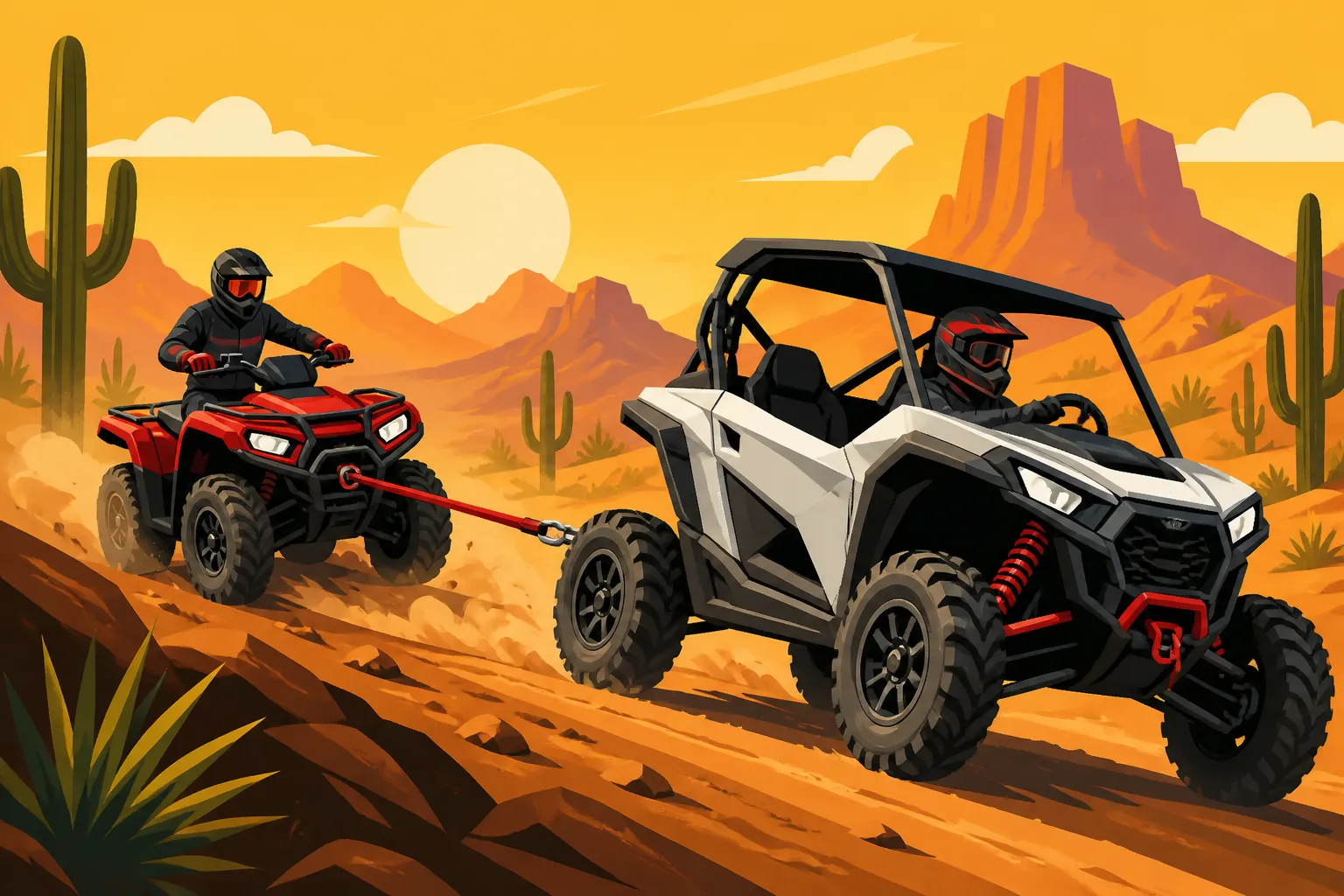
If the disabled ATV or UTV rolls freely, steers, and can be controlled, a careful low-speed tow may be an option. The towing machine needs enough control and capacity for the terrain and load; a small ATV pulling a full-size UTV through deep sand is not a sensible plan. Even with suitable machines, avoid steep side slopes, blind turns, and narrow sections where the towed vehicle could collide with the towing one.
Sometimes the sensible decision is to leave the machine in a safe location and seek outside help. That may mean arranging a suitable recovery vehicle, contacting a local operator, or asking land managers or emergency services for guidance where appropriate. Don’t assume a road-accessible tow truck can reach a remote trail. Tell whoever is helping you the exact location, access route, machine type, and what appears to be wrong.
For trip planning, it helps to know the route’s difficulty and access before you unload. Arizona Trails Rated for Full-Size Rigs can help frame the kind of terrain your vehicle may encounter, while Arizona Trailhead Parking and Staging is useful when thinking through where a recovery vehicle could realistically meet your group.
Prepare for a Trail-Side Tow
Carry recovery gear that matches the machine
A recovery kit is only useful if its parts are appropriate for the load and in good condition. Consider carrying purpose-made recovery straps or ropes, rated shackles or connectors compatible with your equipment, gloves, a basic tool kit, a tire repair solution, and a flashlight. Follow the machine and gear manufacturers’ instructions for attachment points, capacity, and use.
Do not treat any convenient piece of the machine as a recovery point. A bumper, suspension arm, tie-down loop, or hitch ball may not be designed to handle a pulling load. Use manufacturer-designated recovery points and confirm that the connection is secure before tension is applied. If you cannot identify a suitable point, don’t guess.
Keep straps and connectors in a place where they stay clean and accessible. A strap buried under camping gear is little help when a machine is stuck in a wash. Before a ride, inspect the gear for cuts, fraying, damaged stitching, corrosion, or bent components. Replace damaged equipment rather than trusting it because it worked on a previous outing.
The right gear depends on the situation. A winch can be useful when the vehicle and anchor setup are appropriate, but it doesn’t make every recovery safe. Recovery Gear for Deep Sand and Winching Out of a Sandy Wash cover related situations worth considering when building a desert kit.
| Situation | Safer first consideration | Avoid |
|---|---|---|
| Flat tire on stable ground | Repair or replace the tire if you have suitable tools | Dragging the machine over sharp rocks |
| Machine stuck in soft sand | Assess whether a controlled winch or recovery setup is appropriate | Spinning tires or making repeated high-force pulls |
| Machine rolls and steers normally | Consider a slow, controlled tow on suitable terrain | Towing fast or through terrain the disabled driver cannot manage |
| Wheel, steering, or suspension damage | Stop and assess; arrange appropriate recovery help | Pulling the machine without knowing whether it can roll safely |
| Fire risk or injured rider | Move people to safety and seek emergency help | Delaying care to recover the machine |
Agree on signals and roles before tension goes on the line
A recovery should not become a group of people shouting different instructions around a loaded strap. Choose one person to direct the operation, and make sure both drivers understand the plan before moving. Agree on simple signals or use radios if the machines are far enough apart that voices may not carry.
Everyone who is not directly involved should stand well clear of the machines, strap, and likely path of movement. Never stand between the towing vehicle and the disabled machine, and don’t step over a tensioned line. If a strap or connector fails, it can move suddenly. Keep bystanders away and stop if anyone is in the danger area.
The driver of the disabled machine should know whether it is expected to steer, brake, or remain in neutral, based on the machine’s condition and the manual’s guidance. If the driver cannot operate the vehicle safely, don’t continue as though the tow is routine. A person who is injured, overheated, or panicked should not be asked to manage a moving vehicle.
Before each attempt, pause and check the connection, the intended route, and the position of everyone nearby. Use smooth, deliberate movement rather than sudden acceleration. If the machine does not move as expected, stop and reassess; more force is not automatically the answer.
Tow Carefully Through Arizona Terrain
Match the recovery method to the ground
Loose sand can tempt a driver to accelerate hard, but wheelspin may dig the machine in deeper or create a sudden jerk when traction returns. Clear loose material from around the tires if it is safe to do so, reduce unnecessary weight where practical, and consider whether a winch or a different recovery direction is more appropriate. For a deeper look at the problem, see Winching Out of a Sandy Wash.
Rocky ground calls for a different approach. A disabled vehicle can catch a tire, steering part, or undercarriage on an edge while being pulled. Look for the smoothest available route and avoid dragging the machine over obstacles that could worsen the damage. If the route requires a steep climb, a tight turn, or a side-hill traverse, it may be safer to stop and arrange a more suitable recovery.
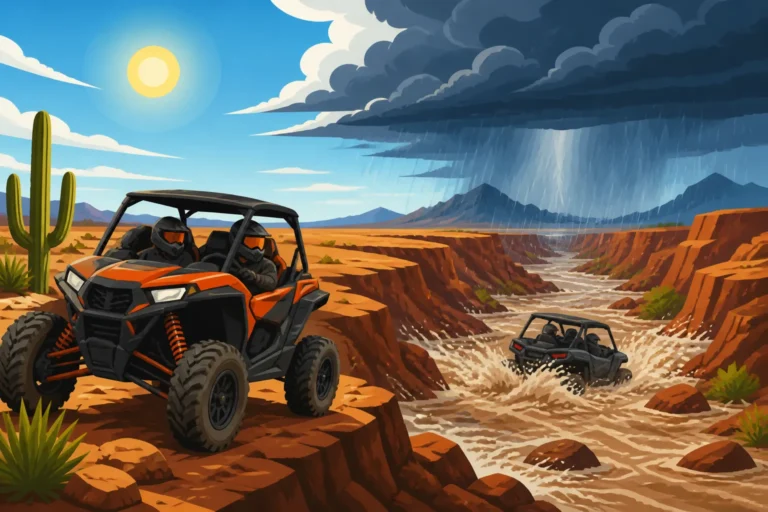
Wash bottoms and low crossings deserve special caution, especially when weather could change conditions. A wash can be dry at your location while rain elsewhere affects the route ahead. Don’t assume that because a machine entered a wash safely it can be pulled out through the same path. Flash Flooding in a Desert Wash is a useful reminder to consider water and changing conditions before committing to a recovery route.
Desert vegetation, fragile ground, and trail edges matter as well. Don’t cut a new path through plants or bypass a difficult section onto ground that may be closed or sensitive. Check the route and land access before moving the group, and avoid blocking a trail longer than necessary. Apps such as onX Offroad can help you review your route and location, but use mapped information alongside posted signs and land-management directions.
Keep the tow slow, short, and controlled
If the machine is suitable for towing and the route is manageable, keep the pull slow and steady. The towing driver should avoid abrupt throttle changes, hard braking, and sharp turns. The disabled driver should maintain control only if the machine’s condition allows it and the agreed plan calls for it. If either driver loses sight of the other, the strap shifts unexpectedly, or the vehicle begins to slide, stop.
Choose the shortest safe route to a stable place, not necessarily the shortest route on the map. A short pull over rough rocks may be worse than a longer route on firm, open ground. Don’t tow farther than needed simply to reach a favorite trailhead or campsite; get to a location where the machine can be inspected and loaded safely.
A second vehicle should not be pulled into terrain it cannot safely navigate. The truck or trailer that brought the machines may be parked on a road or at a staging area for a reason. If a recovery vehicle cannot safely reach the disabled machine, don’t force it down an unsuitable trail. Arrange a recovery method designed for the access and conditions.
Using onX Offroad before and during a ride can help your group keep track of trail position and plan a return toward a known access point. It should not replace direct observation, route signs, or a backup navigation plan. Cell Service in the Arizona Backcountry and Carrying a Satellite Messenger in the Arizona Desert are relevant if your route takes you beyond reliable phone coverage.
Plan for Heat, Communication, and Getting Home
Treat the breakdown as a group safety problem
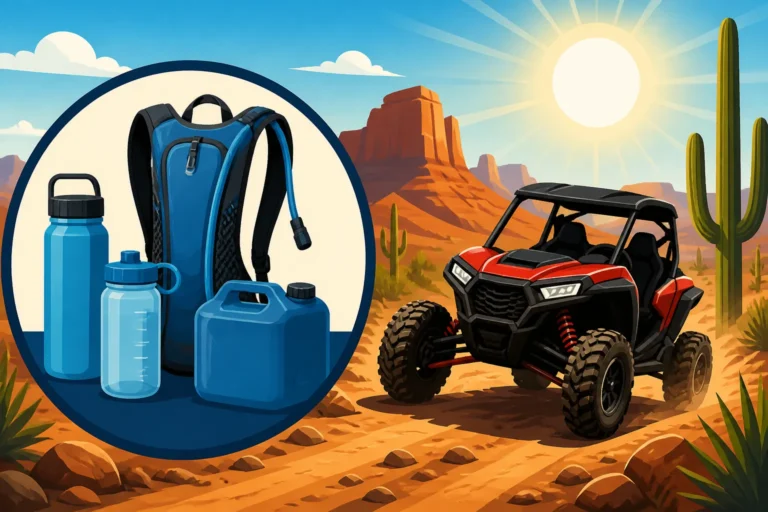
In Arizona, a disabled machine can leave riders exposed while they troubleshoot, wait, or walk out. Keep drinking water available and use shade where possible, such as a safe, stable vehicle canopy or other appropriate shelter. Avoid putting someone in charge of a long walk without assessing distance, heat, water, terrain, and communication first.
Watch for signs that someone is becoming unwell, including unusual confusion, weakness, dizziness, nausea, or difficulty functioning. Stop the recovery and focus on the person’s safety. Heat Illness on a Summer Trail offers more context for recognizing why a mechanical delay can become a health concern.
Before leaving the machine to get help, make sure the group has a clear plan. Decide who stays, who communicates, and how you will reconnect if people become separated. Share your planned route and expected return with someone who is not on the ride. If you have a satellite messenger, test that everyone knows how to use it before you need it.
A phone may still be useful for location details, photos of the machine, and contacting help, but don’t plan a remote ride around the assumption that a call will go through. Keep offline maps or another navigation option available. onX Offroad may help identify your position in relation to mapped routes, but a separate communication plan is still important.
Make the next ride easier to recover from
After the machine is back at the staging area, don’t rush to reload and head home without checking for damage. Look over tires, wheels, steering, suspension, undercarriage, recovery points, and the equipment used during the tow. A machine that appears to roll normally may still have a problem that makes riding unsafe. If you’re unsure, transport it for inspection rather than riding it out.
Write down what happened while the details are fresh: where the machine stopped, what the ground was like, what equipment helped, and what you wish you had carried. That small debrief can improve the next outing. If the problem was a puncture, update your repair supplies. If the route was too difficult for the group’s vehicles or experience, choose a more suitable route next time.
Before another trip, check the route’s access and restrictions, identify staging options, share your plan, and confirm that the group’s machines and recovery equipment are suited to the terrain. Arizona routes vary widely, from sandy desert tracks to rocky mountain roads. A plan that works near a broad, accessible trail may not work on a remote or narrow route.
A breakdown is stressful, but it doesn’t have to become a dangerous recovery. Stop, assess the people and the machine, use equipment as directed, and be willing to call for help when the terrain or damage exceeds what your group can manage safely.
Disclaimer
This article is for general informational purposes only and does not constitute professional advice. Laws, prices and regulations vary by location and change over time. Consult a qualified professional for guidance on your specific situation.