What an Arizona Officer Asks For
A stop on an Arizona trail can be routine, but it is easier when you know which documents may matter and where to find them. The request depends on whether you are riding off-road or on a public road, whether the machine is yours, and what land you are on. Here’s what to have ready—and what each item does and does not prove.
What an Officer May Ask You to Show
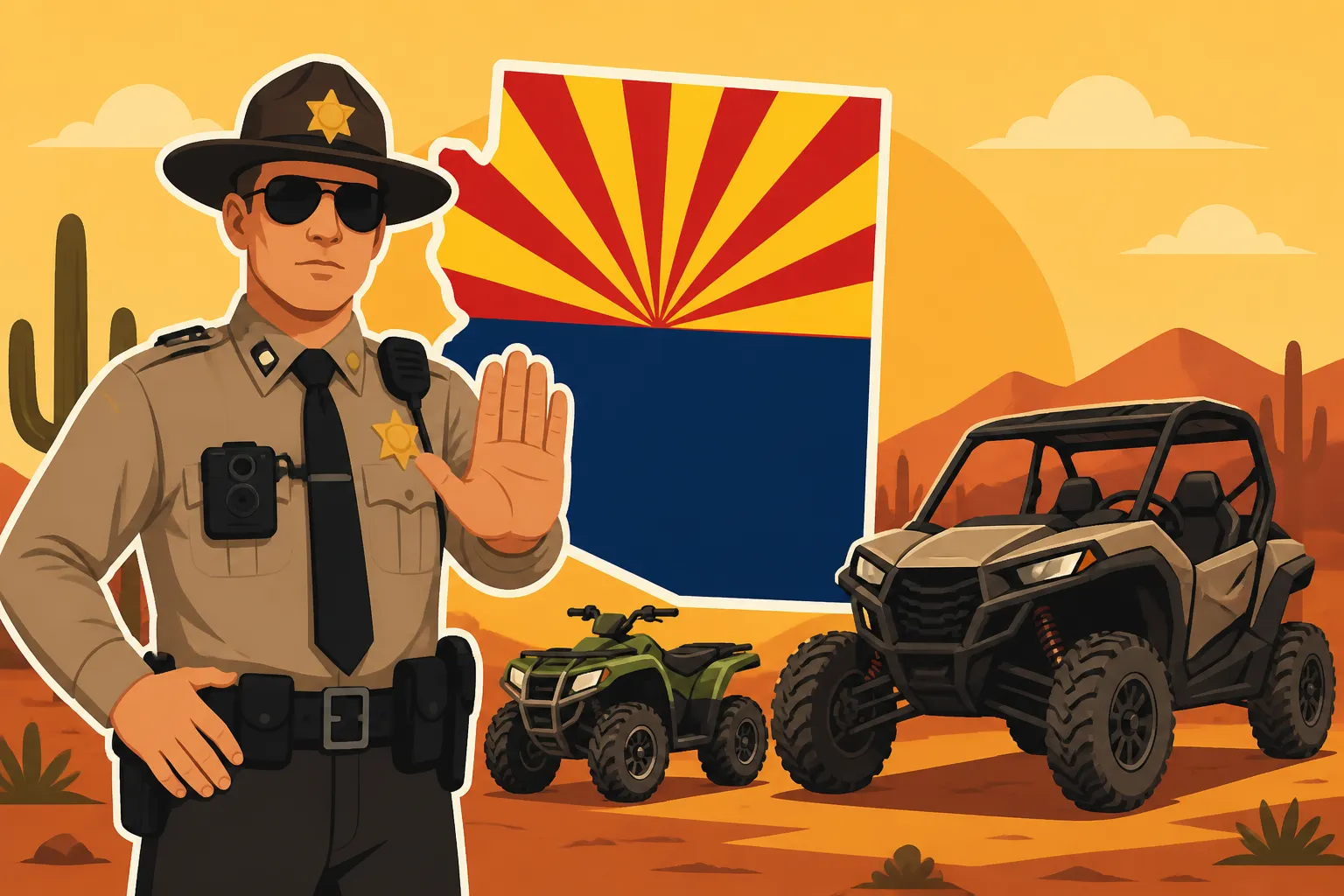
There is no single document packet that fits every ATV or UTV stop. An officer may ask questions about the machine, its registration or decal, your permission to be in the area, and whether you are following rules for that location. A road section can bring additional questions about the operator, insurance, and road-legal equipment.
A request is not necessarily a sign that you have done something wrong. Officers may be checking compliance, responding to a complaint, or making sure a rider can safely continue. Be prepared to answer calmly and show relevant documents without assuming that one card or decal covers every requirement.
| What may be checked | What it helps show | Important limitation |
|---|---|---|
| OHV decal or street-legal registration | That the machine has the applicable Arizona credential for its use | A decal is not permission to ride anywhere |
| Identification | Who you are and, where relevant, whether you meet age or operator rules | Do not assume a driver’s license is required for every off-road trail |
| Proof of ownership or permission | Why you have the machine or authority to use it | A bill of sale does not replace registration or land access permission |
| Land permit or authorization | Whether your activity is allowed on certain land | Requirements depend on the land manager and activity |
| Insurance documents | Coverage for road use where required | A policy may exclude off-road use or particular riders |
| Safety-course record, if applicable | Completion of a course required for the rider or trip | Requirements can depend on the rider and current rules |
The decal or plate
For many Arizona machines used off-highway, the OHV decal is an important thing to have in order and displayed as required. An officer may look for it, check that it belongs to the machine, or ask whether the machine is registered. A machine with street-legal registration may be treated differently for decal purposes; don’t assume the same rule applies to every plate or machine. See Street-Legal Plates in Place of an Arizona Decal and What Arizona Riders Need Before They Ride.
A decal is not a trail pass. It does not, by itself, authorize access to private property, closed routes, or every kind of public land. Some land managers require a separate permit or have their own restrictions. If you are riding on State Trust Land, check the permit rules before you go. Arizona State Trust Land Recreational Permits explains why an OHV credential and a land-use permit serve different purposes.
Your identity and operator eligibility
An officer may ask for identification, especially if there is a question about age, who is operating the machine, or who is responsible for it. What an operator must carry or be eligible to do can depend on where the machine is being used and whether it is on a public road. Do not treat a regular driver’s license as a universal off-road requirement—or assume that having one automatically makes every road section legal.
Young riders may be subject to additional rules, including requirements related to age, supervision, training, or protective equipment. The details can turn on the rider’s age and the riding location. If a young person is coming along, review Arizona Education Rules for Under-18 Riders rather than relying on an adult’s documents to cover the whole group.
Proof the machine is yours or that you may use it
An officer may ask who owns a machine if its identification or registration raises questions, if it appears abandoned, or if the rider says it belongs to someone else. A title or registration record can help identify the owner. A bill of sale may help explain a recent purchase, but it does not necessarily establish that registration and other requirements have been completed.
If you are borrowing a machine, ask the owner for permission and make sure you can explain whose machine it is. Carrying a copy of the owner’s contact details can help resolve an avoidable question, though it is not a substitute for the required credentials. For visitors, the machine’s home-state paperwork and Arizona requirements are separate things to consider. Arizona’s Non-Resident OHV Decal covers a credential that may apply to visiting riders.
Insurance and road equipment
On a public road, the questions can change quickly. If your machine is registered for road use, an officer may ask for proof of insurance or check whether the machine has the equipment and registration required for that use. A decal or trail registration alone does not make an ATV or UTV road legal.
Keep your insurance information accessible, and confirm that the policy covers the machine and the way you are using it. Some policies have exclusions or limits for off-road operation, borrowed machines, or particular riders. Arizona Insurance Minimums for Road Riding is useful background if your route includes a public-road section.
How the Location Changes the Questions
Where you are stopped matters. A route may cross land managed by different agencies, pass through private property, or include a short stretch of public road. Requirements can change at those boundaries, so a rider who has the correct decal can still be somewhere they are not allowed to ride.
On an off-highway route
On a trail or other off-highway route, an officer may focus on the machine’s decal or registration, the rider’s age and conduct, and whether the route is open to motorized use. They may also ask where you entered the area or where you are headed if access or route status is in question.
Your map, route notes, or downloaded navigation data can help you explain your plan, but they do not override a closure or land restriction. Check current land-management information before heading out, particularly if you are near a boundary or using an unsigned two-track.
On State Trust Land
A decal and a State Trust Land recreational permit do different jobs. If your ride includes State Trust Land, the applicable permit may be needed in addition to the machine’s credential. An officer or land manager may ask about both, and the permit may be tied to the people or activities covered by it. Confirm what your permit allows, including whether it covers your group and planned use.
Do not assume that a map app’s land boundary is precise enough to settle a disagreement at the roadside. When possible, use current official maps and make a note of the land status before you ride. If you are unsure whether a route crosses State Trust Land, plan as if you need to resolve that question before entering.
On private land
Permission from a landowner is different from an OHV decal or public-land permit. If you are riding on private ground, be able to explain who gave permission and what access was granted. Permission to cross a property may not include permission to stage, camp, or ride wherever you choose.
A neighbor’s casual invitation may be hard to verify in the middle of a disagreement. If access is important to your route, get clear permission in advance and keep the owner’s contact information available. A registration credential does not settle a trespass question.
On a public road or road crossing
A public-road segment can bring questions about whether the machine is properly registered for road use, whether the operator is legally eligible to drive there, and whether required insurance and equipment are in place. The rules can differ from those for off-highway use. A machine that is lawful on a trail may not be lawful on the road beside it.
Before riding a road section, check that the specific road is open to OHVs and that your machine and operator meet the requirements for that use. Don’t infer road access from a nearby trailhead or from seeing another machine on the pavement. Which Arizona Roads Are Open to OHVs can help you think through the access question.
How to Handle a Stop and Keep Documents Organized
A brief, orderly response is usually more useful than searching through a phone or arguing about what another rider told you. Keep your hands visible, follow instructions, and answer the question asked. If you do not understand a request, ask politely what document or information the officer needs.
Do not guess at an answer. If you are unsure whether a credential applies, say so and provide what you have. If an officer points out a possible violation, avoid turning the roadside conversation into a confrontation. Make a note of the details afterward and use the appropriate process if you need to challenge a citation.
A practical preparation routine:
- Check the route and land status. Confirm current closures, access limits, and any land-specific permit requirements before leaving.
- Check the machine’s credentials. Make sure the decal or registration applies to that machine and is displayed as required.
- Check the operator and passengers. Review applicable age, supervision, helmet, and other requirements for each rider.
- Check road sections separately. Confirm road access, registration, insurance, operator eligibility, and equipment rather than assuming trail credentials are enough.
- Keep useful records accessible. Store the owner’s contact information, purchase or registration documents, insurance details, and relevant permits where you can retrieve them.
- Review current rules before a trip. Requirements can change, and the land manager’s rules may be different from the machine’s registration requirements.
You can keep paper copies in a water-resistant sleeve or document pouch, and store digital copies on your phone as a backup. A small document holder from a retailer such as Amazon may help keep papers together, but it does not make a phone copy or a receipt an official substitute for a required document. Avoid leaving sensitive originals loose in an exposed machine, and never rely on a phone alone where there may be no service or battery power.
For visitors, plan ahead rather than expecting to sort out every requirement at a checkpoint. Confirm whether your home-state registration is relevant, whether an Arizona decal applies, and whether your planned land access needs another permit. Arizona Rules for Visiting Riders and Why a Decal Alone Will Not Let You Stage help distinguish machine credentials from access and staging requirements.
Common Misunderstandings to Avoid
“I have a decal, so I can ride here.” The decal addresses a machine-related requirement; it does not open a closed route or grant access to private or restricted land.
“The machine belongs to my friend, so their paperwork is enough.” The owner’s documents may help identify the machine, but the operator still needs to follow rules that apply to them. Make sure you have permission and can identify the owner.
“I’m off-road, so road rules don’t matter.” A ride can include a public-road crossing or connector. Those sections may carry different requirements. Treat them as separate parts of your route.
“A bill of sale proves everything.” A bill of sale can help document a transaction, but it is not automatically a title, a current registration, proof of insurance, or permission to use a particular parcel.
“A map app shows the route, so it must be open.” Navigation data can be incomplete or outdated. Check official access information and closures before relying on a mapped line.
“If an officer asks, I must have one exact document.” The officer’s questions depend on the situation. A useful response is to understand what each record proves and provide the relevant information without claiming that one paper satisfies every rule.
The best preparation is a short check before the ride: know which credential belongs to the machine, what permission or permit applies to the land, and what extra rules apply to any road section. For more on carrying paperwork, see Do You Carry Papers on an Arizona Trail.
Disclaimer
This article is for general informational purposes only and does not constitute professional advice. Laws, prices and regulations vary by location and change over time. Consult a qualified professional for guidance on your specific situation.