Registering Through Arizona MVD or a Third Party
One of the most common headaches for new or even experienced off-highway vehicle (OHV) owners in Arizona is figuring out the registration and titling process. It can feel like navigating a maze of paperwork, long lines, and confusing requirements, leaving many riders wondering if they're doing it right. This comprehensive guide will walk you through everything you need to know about registering your ATV or UTV in Arizona, explaining the differences and advantages of using the Arizona Motor Vehicle Division (MVD) directly versus opting for a convenient third-party service provider.
Understanding Arizona OHV Registration: The Basics
Before you even think about hitting those stunning Arizona trails, you've got to make sure your machine is properly registered. It's not just a suggestion; it's a legal requirement that keeps you compliant and supports the very trails you love to ride. Understanding the fundamentals of this process is the first crucial step to a hassle-free experience.
Why Registration Matters for Your ATV or UTV
Imagine you're out exploring the breathtaking beauty of the Sonoran Desert, enjoying a perfect day on the trails, when suddenly you come across a ranger. The first thing they'll ask for, after a friendly greeting, is proof that your machine is registered. An un-registered OHV can lead to a citation, ruining an otherwise perfect day. But it's more than just avoiding fines; proper registration is about contributing to the OHV program itself. The fees collected from registration go directly into maintaining and improving the trails, creating new riding areas, and funding essential safety and education programs. It's a vital system that benefits every rider in the state. For a deeper dive into what your decal supports, check out [What the OHV Decal Buys an Arizona Rider].
The Core Components of Arizona OHV Registration
When we talk about OHV registration in Arizona, we're really talking about two main components: the Certificate of Title and the Off-Highway Vehicle (OHV) Decal. The title is your proof of ownership, a legal document establishing that the machine belongs to you. Think of it like the deed to a house, but for your quad or side-by-side. The OHV Decal, on the other hand, is what allows you to legally operate your machine on public lands and designated OHV routes. It's an annual sticker that needs to be displayed prominently on your license plate. You'll often hear people refer to "registration" when they mean the decal, but both pieces are essential for complete compliance. You can learn more about this crucial sticker by reading [Arizona's Annual OHV Decal Explained].
Who Needs to Register Their Machine in Arizona?
This is a question that often causes confusion. Generally, any OHV that will be operated on public lands or designated OHV routes in Arizona needs to be registered and display a valid OHV Decal. This includes ATVs, UTVs, dirt bikes, and even some custom-built machines like sand rails. There are very few exceptions, such as machines used exclusively on private property with permission, or specific farm and ranch machines used solely for agricultural purposes. Even if your machine is street-legal and carries a traditional MC or RV plate, you still need to acquire an OHV Decal if you plan to take it off-road on public lands. Don't assume your street-legal status exempts you from the decal; it's a separate requirement for off-road use. If you're wondering about those specific exemptions, the article [Arizona OHV Rules for Ranch and Farm Machines] might be helpful.
The Arizona Motor Vehicle Division (MVD) Direct Route
For many, the first thought when it comes to vehicle registration is heading straight to the MVD. It's the traditional path, and while it might sometimes come with a reputation for longer waits, it's a perfectly valid and direct way to get your ATV or UTV registered and titled.
The Traditional MVD Experience: What to Expect
Visiting an Arizona MVD office can be a mixed bag. On one hand, you're dealing directly with the state agency responsible for all vehicle services, which means you're getting information straight from the source. On the other hand, MVD offices can be busy, and wait times can vary significantly depending on the time of day, day of the week, and location. It's often compared to a trip to the DMV in other states – expect to take a number, find a seat, and settle in. You'll typically speak with a customer service representative who will review your documents, process your application, and issue your title and decal (or provide temporary paperwork). While some services are moving online, physically obtaining a title and decal for a new registration usually requires an in-person visit.
Many riders will tell you that the key to a smoother MVD experience is preparation. Know exactly what documents you need (we'll cover that shortly), arrive early, and consider going on a weekday rather than a Saturday if that's an option for you. Some MVD locations are busier than others, so if you have the flexibility, checking online for estimated wait times or exploring a less central location might save you some time.
Preparing Your Documents for MVD Submission
This is where the rubber meets the road. Showing up at the MVD without all your ducks in a row is a surefire way to get sent home empty-handed. For an OHV registration and title, you'll generally need:
- Proof of Ownership: This is paramount. For a new machine, it's typically the Manufacturer's Certificate of Origin (MCO). For a used machine, it's the previous owner's properly signed-off Certificate of Title and a Bill of Sale. If you're dealing with a private sale, a clear and comprehensive bill of sale is critical. Resources like LawDepot can provide templates for a solid bill of sale, ensuring all necessary details are included to protect both buyer and seller.
- Application for Arizona Certificate of Title at an Arizona MVD Office: This form is often called a Title and Registration Application. You can usually find it on the Arizona MVD website to fill out in advance.
- Identification: Your valid Arizona driver's license or another form of government-issued ID.
- Proof of Insurance: While OHV decals generally don't require insurance unless the machine is street-legal, it's always good to have proof of liability insurance, especially if you plan to make it street-legal or if your lender requires it.
- Payment: Be prepared to pay the title fee, registration fees, and any applicable sales or use taxes. Check the MVD website for current fees.
It's highly recommended to make copies of all your documents before you head to the MVD office. Having a folder with originals and copies can be a lifesaver if anything goes amiss.
Navigating the MVD Office: Tips for a Smooth Visit
Once you've got your documents in hand, heading to the MVD still requires a bit of strategy. First, consider checking the Arizona MVD website for office locations and their operating hours. Some offices are appointment-only for certain services, so it’s wise to confirm before you drive all the way there.
When you arrive, look for signs directing you to the appropriate window or service area for "Titles and Registration" or "Vehicle Services." You'll typically take a number and wait for it to be called. While you wait, double-check your paperwork one last time. When your number is called, approach the counter calmly and present your documents. Be clear and concise in explaining what you need – "I'm here to title and register an OHV." If you have any questions, don't hesitate to ask the representative. They are there to guide you through the process, even if they sometimes seem rushed. Patience and politeness go a long way in ensuring a smoother interaction. For more detailed information, see [Titling an ATV at an Arizona MVD Office].
Exploring Third-Party MVD Service Providers
Beyond the official MVD offices, Arizona offers another avenue for vehicle services: third-party MVD service providers. These are privately owned businesses authorized by the state to perform many of the same transactions as the MVD, often with a focus on speed and convenience.
What Are Third-Party MVD Providers?
Think of third-party MVD providers as licensed agents for the state's Motor Vehicle Division. They are private businesses, usually with a distinct storefront, that can process vehicle titles, registrations, license plate renewals, and, crucially for us, OHV decals. They are part of a network of authorized providers that the state uses to extend its services and improve access for residents. These offices are particularly prevalent in busy metro areas like Phoenix and Tucson, but you'll find them in smaller communities across the state as well. Unlike the MVD, these providers typically aim to offer a more personalized and quicker experience, often with shorter wait times and more streamlined processes. They are often called "Authorized Third Party Providers" or "MVD Express" type services.
Advantages of Using a Third-Party Service
The primary reason many OHV owners opt for a third-party provider is convenience and speed. Imagine walking into an office, getting your transaction handled in a fraction of the time you might spend at a traditional MVD office, and walking out with your decal and temporary registration almost immediately. That's the promise of these services.
Here are some key advantages:
- Shorter Wait Times: This is often the biggest draw. Third-party providers are usually less crowded and more efficient, meaning you can get in and out quicker.
- Extended Hours: Many third-party offices offer more flexible hours, including evenings and Saturdays, making it easier to fit into a busy schedule.
- Personalized Service: Staff at these offices often have more time to walk you through the paperwork and answer your specific questions without the pressure of a long line behind them. They can be particularly helpful if you have a slightly complicated titling situation.
- Immediate Results: In many cases, you can walk out with your new OHV decal and temporary registration right then and there, rather than waiting for them to be mailed.
- Location Accessibility: With numerous locations, you might find a third-party provider closer to your home or work than the nearest MVD office.
For those who value their time and want to avoid the potential hassle of a busy MVD office, a third-party provider can be a real game-changer. You can find a list of these providers by searching for [Third-Party MVD Providers That Register OHVs].
Potential Drawbacks and Considerations
While third-party providers offer significant benefits, there are a couple of points to consider:
- Additional Fees: Because they are private businesses, third-party providers typically charge a small service fee on top of the standard state fees for titles, registrations, and decals. This fee is usually reasonable, but it's an extra cost you wouldn't incur at a direct MVD office. Always ask about their fees upfront so there are no surprises.
- Limited Services: While they handle most common vehicle transactions, some highly specialized or complex MVD services might still require a visit to a full MVD office. However, for standard OHV titling and registration, they are usually fully equipped.
- Not All Providers Are Equal: Just like any business, the quality of service can vary. It's a good idea to check reviews or ask for recommendations if you have a choice of providers in your area.
For most OHV owners needing a new registration and title, the added convenience often outweighs the small service fee. It truly comes down to what you prioritize: saving a few dollars or saving a significant amount of time and potential stress.
Key Documentation for Both Registration Paths
Regardless of whether you choose the MVD or a third-party provider, the necessary paperwork remains largely the same. Having everything in order before you go is the single most important factor in a smooth process.
Proof of Ownership: The Foundation of Registration
This cannot be stressed enough: you absolutely need solid proof that you own the ATV or UTV you're trying to register. This is the cornerstone of the entire titling and registration process.
- New Machines: If you're buying a brand-new machine from an authorized dealer, they will typically provide you with a Manufacturer's Certificate of Origin (MCO or MSO). This document legally certifies the first transfer of ownership from the manufacturer to the dealer, and then from the dealer to you. The dealer will often handle the initial titling paperwork for you, passing along the MCO with your name as the first owner.
- Used Machines (Private Sale): This is where many people run into trouble. When buying a used OHV from a private seller, you need the vehicle's original Certificate of Title, properly signed and dated by the previous owner, releasing their interest in the machine. A bill of sale is also critically important. While not always strictly required by the MVD in all cases if you have a perfectly signed title, a robust bill of sale protects you if there are any discrepancies or questions later. It confirms the sale price, date, VIN, and buyer/seller information. Using a reliable template, perhaps from LawDepot, can ensure you don't miss any vital clauses. If you buy a machine and the seller never signed for it, you're in for a headache; that's when you'll wish you had read [Titling a Machine the Seller Never Signed For].
Essential Forms You'll Encounter
Beyond the proof of ownership, there are specific forms you'll need to complete.
- Arizona Title and Registration Application: This is the primary form for titling and registering your OHV. It asks for detailed information about you, the owner, and the specific details of your machine, including its Vehicle Identification Number (VIN), make, model, and year. You'll need to accurately fill out sections related to applying for a new title, requesting an OHV decal, and indicating how taxes will be paid. Double-check all spellings and numbers, especially the VIN, as errors can cause delays.
- Lien Holder Information (if applicable): If you financed your OHV purchase, your lender will be listed as a lien holder on the title. You'll need their full legal name and address to include on the application. They will often send their specific lien forms directly to the MVD or third-party provider. For more on this, see [Liens on an Arizona OHV Title].
- Emissions Exemption Affidavit (if applicable): While most OHVs are exempt from emissions testing, if your machine is street-legal or you are registering certain types of vehicles, you might encounter this. However, for typical off-road only ATVs and UTVs, it's generally not a concern.
- Power of Attorney (if someone is registering on your behalf): If you're sending someone else to handle the registration for you, they'll need a legally executed Power of Attorney document specifically authorizing them to conduct vehicle transactions on your behalf.
Understanding Fees and Taxes Involved
Registering your OHV isn't free, but the fees are generally straightforward.
- Arizona Certificate of Title Fee: There is a one-time fee to issue your initial title.
- OHV Decal Fee: This is an annual fee that needs to be renewed each year. It's a critical piece of the OHV program funding. You can find the specific current cost in [Arizona OHV Decal Price and Processing Fee].
- Vehicle License Tax (VLT): This is a tax assessed on your vehicle in lieu of personal property tax. It's calculated based on a percentage of the vehicle's assessed value and depreciation schedule.
- Sales Tax: If you bought your machine from a dealer in Arizona, sales tax would have been collected at the time of purchase. If you bought it in a private sale or brought it into Arizona from another state, you might owe sales or use tax to the state. This is a common point of confusion, and the MVD (or third party) will help you calculate and pay any outstanding taxes. For details on this, refer to [Arizona Sales Tax on a Machine Purchase].
- Third-Party Service Fee: As mentioned, if you use a third-party provider, expect a small additional charge for their services.
It's always a good idea to visit the MVD or a third-party provider's website, or give them a call, to confirm the exact current fees and taxes applicable to your situation before you go. This way, you can ensure you have the correct payment method ready, whether cash, check, or card.
The Titling Process: A Crucial Step Often Confused
Many people use "registration" and "titling" interchangeably, but they are distinct processes. While they often happen concurrently for an OHV, understanding their individual importance is key.
Why a Separate Title is Important for Your OHV
The Certificate of Title is the legal document that proves ownership of your ATV or UTV. It contains key identifying information about your machine, such as the VIN, make, model, and year, along with the owner's name and any lien holders. This document is crucial for several reasons:
- Proof of Ownership: It's your ultimate legal proof that the machine belongs to you. This is vital for insurance claims, in case of theft, or if you ever need to dispute ownership.
- Resale Value: When you go to sell your OHV, a clear, properly transferred title is essential. Buyers will (and should) insist on it, as it confirms they are buying a legitimate machine with no outstanding ownership issues.
- Security for Loans: If you finance your OHV, the lender will require a title to record their lien, ensuring their financial interest is protected.
- Preventing Fraud: The title helps prevent theft and fraud by creating a clear chain of ownership. Without a title, proving you legally own the machine can be incredibly difficult, often requiring a bonded title process, which is a whole other headache. You can learn more about its importance in [Arizona Certificate of Title for an Off-Highway Vehicle].
Titling Through MVD Versus a Third Party
Both the MVD and third-party providers can issue a Certificate of Title for your OHV. The process is virtually identical in terms of paperwork and requirements, but the experience differs:
- MVD Direct: At the MVD, a representative will process your title application, verify your proof of ownership, and calculate any applicable taxes. The physical title document itself is typically mailed to you a few weeks after your visit, as MVD offices don't usually print permanent titles on the spot.
- Third-Party Providers: Third-party providers also handle the full titling process. They will review your documents, submit the application electronically to the MVD, and usually provide you with immediate temporary registration. Like the MVD, the permanent title document will likely be mailed to you directly from the state in a few weeks. The advantage here is often the efficiency of the initial transaction and less time spent waiting.
The critical thing is that no matter which route you choose, the outcome is the same: a legal Arizona Certificate of Title for your OHV. The choice is purely about the convenience of the service.
Special Scenarios: Liens, Out-of-State, and Salvage Titles
Sometimes, the titling process isn't as straightforward as a clean private sale. Here are a few common situations:
- Machines with Liens: If you bought your OHV with financing, the lender will be recorded as a "lien holder" on the title. Once you pay off the loan, the lender will send you a "lien release" document. You'll then need to take this document to the MVD or a third-party provider to have the lien removed from your title and a clear title issued to you. For more on this, check out [Lien Release Once the Loan Clears].
- Out-of-State Machines: Moving to Arizona with an OHV from another state, or buying one out of state and bringing it in, requires special attention. You'll need to transfer your out-of-state title to an Arizona title. This often involves presenting your previous state's title, proof of Arizona residency (if applicable), and potentially paying Arizona use tax if you haven't paid sales tax equivalent to Arizona's rate in the original state. You can read up on this in [Registering an Out-of-State Machine in Arizona].
- Salvage and Rebuilt Titles: If an OHV has been declared a total loss by an insurance company, it receives a "salvage title." Before it can be registered and legally operated again, it must be rebuilt and pass a special MVD inspection, after which it will receive a "rebuilt title." Buying a machine with a salvage or rebuilt title requires extra due diligence, as it signals significant prior damage. [Salvage and Rebuilt Machines in Arizona] has more information.
- No Ownership History / Bonded Title: In very rare cases, if you acquire an OHV without any traditional proof of ownership (like an abandoned machine or one with a lost chain of titles), you might have to apply for a "bonded title." This is a complex process involving a surety bond and a waiting period to protect against potential claims of prior ownership. This is definitely a situation where you might appreciate the guidance of a third-party provider, or you could consult [Bonded Title for a Quad in Arizona].
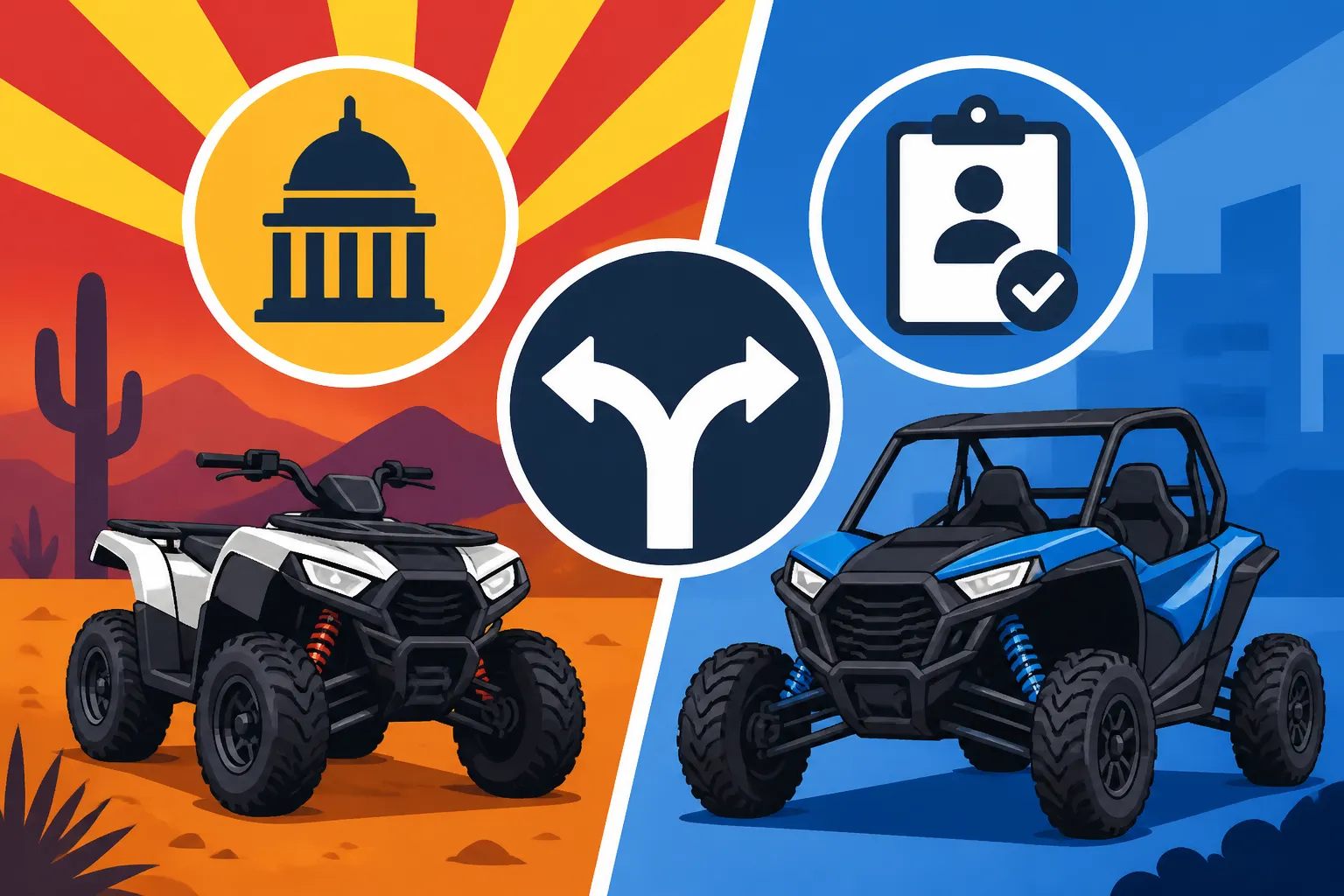
Making the Right Choice: MVD vs. Third Party
Deciding between the MVD and a third-party provider ultimately comes down to your personal preferences, priorities, and the complexity of your situation. Both are valid options, but they offer different experiences.
Assessing Your Needs and Priorities
Before you even leave the house, consider what matters most to you:
- Time vs. Cost: Are you willing to pay a small extra fee to save potentially hours of waiting? Or is saving every dollar paramount, even if it means a longer, less convenient process?
- Simplicity of Transaction: Is your OHV registration straightforward (e.g., a new purchase with all paperwork in order), or do you have a more complex situation (e.g., an out-of-state title transfer, a lien release, or a missing bill of sale)? If it's complex, the personalized attention at a third-party office might be invaluable.
- Location and Availability: How far is the nearest MVD office compared to a third-party provider? What are their respective operating hours, and do they fit your schedule?
- Patience Level: Let's be honest, dealing with bureaucracy can test anyone's patience. If you're someone who gets easily frustrated by long lines and potentially impersonal service, a third-party provider might be worth the extra cost.
For a brand new OHV with an MCO and no liens, either option will likely be smooth. For a tricky used machine purchase with questionable paperwork, the expertise and dedicated service of a third-party provider might be invaluable in helping you navigate the requirements.
Cost, Convenience, and Time: A Comparative Look
Let's break down the key differences in a handy table:
| Feature | Arizona MVD Office | Third-Party MVD Provider |
|---|---|---|
| Cost | State fees only (no additional service charge) | State fees + small service fee |
| Convenience | Can be less convenient due to potential wait times | Generally more convenient, often faster & more personal |
| Time | Wait times can vary, potentially longer | Usually quicker processing and shorter waits |
| Service Scope | Full range of MVD services | Most common vehicle services, including OHV registration |
| Hours | Standard government business hours | Often extended hours (evenings, Saturdays) |
| Immediate Decal | Sometimes, but permanent title is mailed | Often immediate decal and temporary registration |
| Personalization | Less personalized, higher volume | More personalized service, dedicated staff |
This table clearly illustrates the trade-offs. If your budget is extremely tight, the MVD is the way to go. If your time is valuable and you want a quicker, smoother experience, the third-party option is probably best.
When a Third-Party Provider Shines Brightest
There are definitely situations where a third-party provider truly earns its small service fee:
- Busy Schedules: If you work a 9-to-5 job and can't easily get away during standard business hours, a provider with evening or Saturday hours is a lifesaver.
- Complex Paperwork: If you have an unusual situation – like a machine with a missing title from a distant relative, or an OHV brought in from a state with different titling conventions – the guidance of a knowledgeable third-party agent can be incredibly helpful. They deal with these nuances regularly and can often foresee potential issues before you even get to the counter.
- Immediate Needs: If you're heading out on a trip next weekend and suddenly realize your decal is expired, getting an immediate replacement at a third-party provider can save your plans.
- Peace of Mind: For many, the ability to get through the process quickly and efficiently, knowing it's handled correctly, is worth the modest additional cost. It eliminates the stress and uncertainty that can sometimes accompany a trip to a busy MVD office.
- Forms Guidance: When dealing with documents like a bill of sale, especially for a private party purchase, an entity like LawDepot can provide the necessary legal templates. A third-party provider, familiar with these standard documents, can quickly verify that your LawDepot bill of sale is complete and correctly filled out for Arizona's requirements, preventing potential delays.
Ultimately, the choice is yours, but knowing both options exist empowers you to select the path that best suits your needs for getting your ATV or UTV legally ready for the Arizona trails.
Beyond Registration: What Happens Next?
Getting your OHV registered and titled is a major accomplishment, but it's not the absolute end of your responsibilities. There are a few ongoing considerations to keep in mind to ensure you remain compliant and ready to ride.
Receiving and Displaying Your Decal and Plate
Once your registration and titling process is complete, you'll receive your Arizona OHV Decal and, if applicable, your license plate (usually an MC or RV plate, even for off-road only machines depending on weight and other factors). The OHV Decal is a sticker that must be affixed to your license plate in a specific location: the upper-left corner. This placement is not just a suggestion; it's a rule to ensure visibility and consistency for law enforcement. Always ensure your decal is securely attached and clearly visible, as a faded or missing decal can still lead to a citation. For precise instructions, read [Decal Placement on the Upper-Left Corner].
The license plate itself should be mounted on the rear of your OHV, clearly visible, and free from obstruction. Make sure it's securely fastened so it doesn't get lost on a bumpy trail ride. Remember, even if your machine is purely for off-road use, it still requires that license plate for the decal to be affixed to.
Annual Renewals and Staying Compliant
Your Arizona OHV Decal is only valid for one year from the date of purchase. It's an annual renewal, similar to car registration, but focused on your off-highway privileges.
- Renewal Reminders: The Arizona MVD typically sends out renewal notices by mail or email (if you've opted for electronic notifications) a few weeks before your decal is set to expire. Pay attention to these reminders!
- Online Renewal: Many OHV owners find renewing their decal online to be the easiest method. You can usually do this through your Arizona Game and Fish Department Portal Account. This is a quick and convenient way to pay the annual fee and have your new decal mailed directly to you. Check out [Renewing an Arizona Decal Online] for a step-by-step guide.
- In-Person Renewal: You can also renew your decal at any MVD office or authorized third-party provider. This is a good option if you need to renew multiple machines, have questions, or prefer to conduct the transaction in person.
- Timely Renewal: Don't let your decal expire. Riding with an expired decal is just like riding with no decal at all and can result in penalties. Plan to renew a few weeks in advance to allow time for the new decal to arrive in the mail if you renew online. If you're planning a trip, be sure your decal won't expire mid-adventure.
Staying on top of your renewals is a simple but critical part of being a responsible OHV owner in Arizona.
Understanding the [Arizona OHV Fund and Trail Projects]
Finally, it's worth taking a moment to appreciate where your registration and decal fees go. The money collected from OHV registrations and decals in Arizona is funneled directly into the Arizona OHV Recreation Fund. This fund is managed by the Arizona State Parks and Trails department in conjunction with the Arizona Game and Fish Department.
This fund is absolutely vital for maintaining and expanding the incredible network of trails we enjoy in Arizona. It pays for:
- Trail Maintenance and Development: This includes grading roads, clearing debris, installing signage, and building new trails to ensure safe and enjoyable riding.
- Education and Safety Programs: Funding for OHV safety courses, public awareness campaigns, and youth riding programs.
- Enforcement: Supporting law enforcement efforts to ensure responsible riding and protect natural resources.
- Staging Area Improvements: Building and maintaining staging areas, parking lots, and restrooms at popular trailheads.
- Resource Protection: Efforts to prevent environmental damage and preserve Arizona's natural beauty for future generations of riders.
When you pay your OHV registration and decal fees, you're not just paying a tax; you're directly investing in the future of OHV recreation in Arizona. It's a system designed to ensure that the sport can continue to thrive in one of the most beautiful and diverse riding destinations in the country. Knowing this can make the registration process feel a little less like a chore and a lot more like a contribution to a vibrant community and a shared passion.
Disclaimer
This article is for general informational purposes only and does not constitute professional advice. Laws, prices and regulations vary by location and change over time. Consult a qualified professional for guidance on your specific situation.