Overnight Trailer Parking in a Desert Town
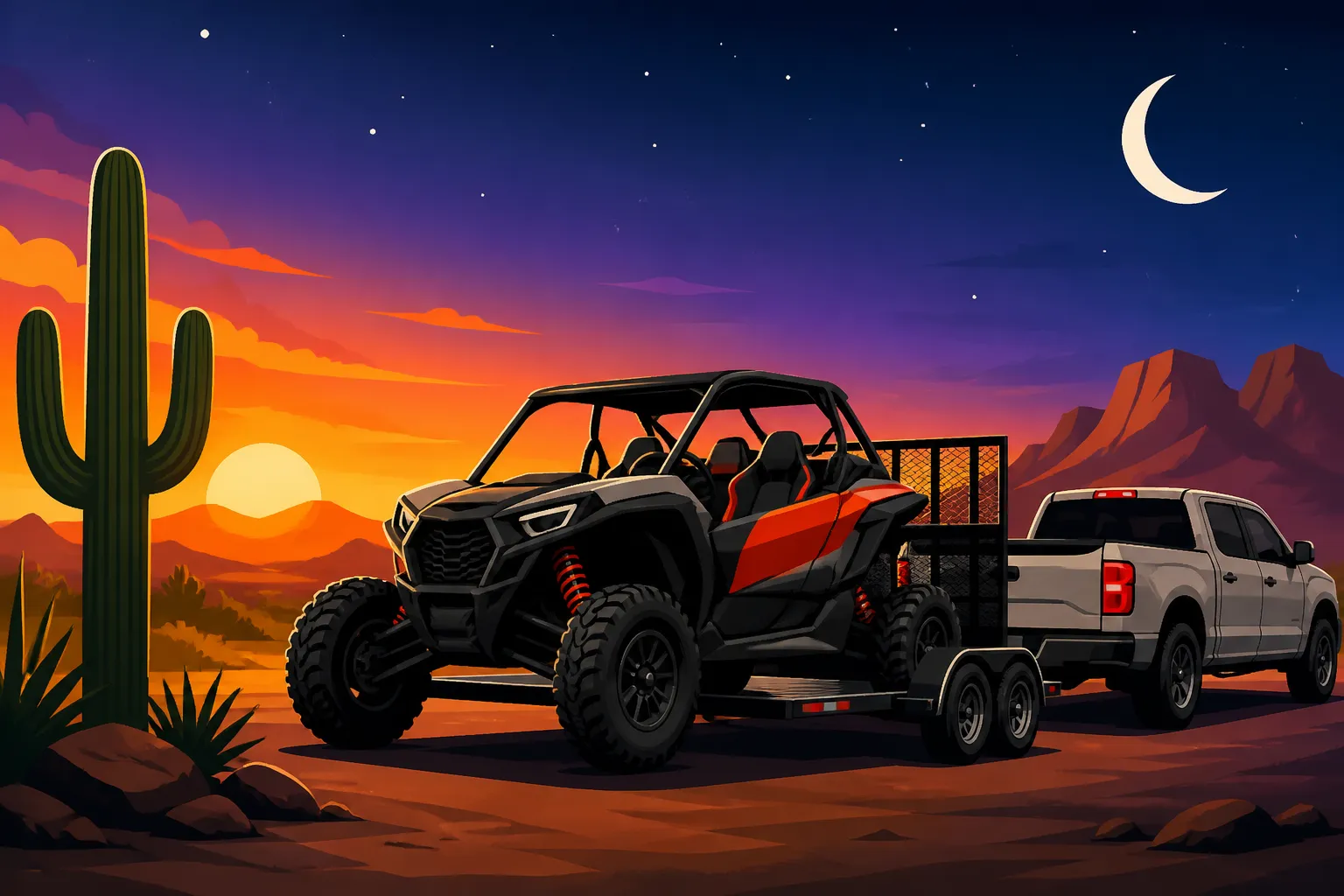
Leaving an ATV or UTV and its trailer overnight in an unfamiliar Arizona town can feel like an awkward mix of parking, security, and trip-planning problems. A hotel lot may not fit your rig, a trailhead may not allow overnight parking, and street rules can vary from one town to another. This guide explains how to find a legal, practical place to park and what to check before you unhitch.
Choose an overnight parking option before you arrive
A trailer that fits comfortably in a driveway at home can be a challenge in a busy desert town. It may be too long for a standard parking stall, hard to maneuver through a crowded motel lot, or too conspicuous to leave unattended without permission. Treat overnight parking as part of your ride plan, not a last-minute detail.
Compare the main parking choices
The most useful option depends on your trailer size, where you are staying, and whether you need to unload the machine that evening. A lodging property may be convenient, but never assume that a reservation automatically includes space for a truck and trailer. Some properties can accommodate a rig only in certain areas or when there is room; others may not allow trailers at all.
| Parking option | Why it can work | What to confirm |
|---|---|---|
| Hotel or motel lot | Keeps your trailer near your room | Trailer permission, space, maneuvering room, and whether parking is assigned |
| Campground or RV park | Often designed for larger vehicles | Whether overnight trailer parking is allowed with your booking and whether you can leave without moving other vehicles |
| Paid storage lot | May provide a designated place to leave a trailer | Access hours, security arrangements, vehicle dimensions, and whether loaded trailers are accepted |
| Public street or town lot | May be convenient in some locations | Local overnight rules, time limits, signage, and any restrictions on trailers |
| Trailhead or staging area | Places your rig near the ride | Whether overnight parking is allowed and whether the site has a posted closing time or other conditions |
Think about the entire setup, not just the trailer. A long truck-and-trailer combination needs room to turn, back up, and leave without blocking a fire lane or another vehicle. If you plan to unhitch, make sure the parking arrangement permits it and that the trailer can be left in a position that does not create a hazard.
If you are riding near Sedona, Lake Havasu City, Flagstaff, Kingman, or another Arizona destination, confirm details directly with the property or relevant local authority. Conditions can differ between towns and between individual lots. For help planning where you will leave the rig relative to your route, Arizona Trailhead Parking and Staging is a useful companion topic.
Ask specific questions when you call
A quick phone call can prevent a frustrating arrival after dark. Instead of asking only, “Can I park a trailer?” give the property the details that affect whether the setup will fit: approximate trailer length, number of vehicles, whether the trailer is enclosed or open, and whether you intend to leave it attached to the tow vehicle.
Ask where the parking would be and whether the space is guaranteed or simply available when you arrive. A vague “there should be room” may not be reassuring if you are arriving during a busy weekend with a full-size rig. Ask whether you need to arrive before a certain time, whether there is a separate entrance for larger vehicles, and whether you may unload the machine on site.
It is also worth clarifying what “overnight parking” means to the property. Staff may allow a vehicle to remain in a marked space but not allow a trailer to be unhitched, equipment to be unloaded, or gear to be stored outside. If the answer is important to your plan, request confirmation in a message or note the name of the person who gave you permission.
When choosing lodging, look for details aimed at riders and people traveling with trailers, but still confirm the arrangement directly. Guides to Lodging in Sedona for Riders and Lodging in Lake Havasu City for OHV Trips can help you think through where to stay in relation to your riding plans without assuming every property offers trailer parking.
Check rules at streets, lots, and riding areas
A wide shoulder or quiet-looking lot is not automatically an approved overnight parking spot. Parking rules may be posted at the entrance, on signs along a street, or in local regulations. At a trailhead, the rules for daytime staging may differ from the rules for leaving a vehicle overnight.
Do not assume a trailhead allows overnight parking
Trailheads and staging areas are designed to help riders access routes, but that does not mean a trailer can stay there overnight. A site may have a posted closing time, restrictions on camping, limits on parking, or other conditions. Even where overnight parking is permitted, leaving a loaded trailer may raise practical security concerns.
Check the site information and signs before you commit to the plan. Look for details about hours, designated parking areas, vehicle or trailer restrictions, and whether camping is allowed. If the information is unclear, contact the agency or land manager responsible for the site. Avoid treating another rider’s past experience as permission for your own trip; rules and conditions can change.
A map app can help you understand where a trailhead sits in relation to town, but it does not establish that parking is legal. Use it to plan the drive, then verify the parking rules separately. When planning the ride itself, Checking Arizona Trail Status Before You Drive can help you think through route access and changing conditions, while Planning an Arizona Riding Trip covers the wider logistics of getting your group and equipment to the right starting point.
Verify local street and business-lot restrictions
Street parking is especially easy to misread when a town is quiet. A curb that looks suitable may have time limits, permit restrictions, or rules that apply specifically to oversized vehicles and trailers. Check posted signs, and do not rely on the absence of a sign as proof that overnight parking is permitted.
Business lots need the same care. A grocery store, restaurant, or shopping-center lot may appear spacious, but it is private property and may not allow overnight parking. Leaving a trailer there without permission could lead to a complaint, a request to move, or other consequences. Ask the property owner or manager rather than assuming that a corner of the lot is unused.
Also consider the effect your rig has on nearby residents and businesses. Do not block entrances, sidewalks, accessible spaces, loading areas, or emergency access. Keep the trailer within the approved parking area, and avoid running an engine or unloading gear late at night. Being considerate makes it easier for visitors with trailers to be welcomed in small towns.
Make the parking spot practical and secure
A legal space can still be a poor choice if you cannot maneuver into it or if your equipment is exposed in a way that makes you uneasy. Before booking or driving to a lot, think through how you will arrive, park, secure the trailer, and leave the next morning.
Check fit, turning room, and departure access
Measure the trailer and tow vehicle, including the full combination if you plan to keep them connected. Then ask whether the proposed space can accommodate that length with enough clearance to get in and out. If the property has a narrow driveway, tight turns, low branches, a steep entrance, or vehicles parked close together, a nominally available space may be unusable.
Consider what happens if you need to leave early. Can you pull out without asking another guest to move a vehicle? Will a gate be locked? Is access available before the office opens? These details matter if you want to reach a trailhead at first light or if weather changes your plans overnight.
If you are bringing a larger setup, Arizona Trailhead Parking for a Toy Hauler offers related planning considerations. Even if your rig is smaller than a toy hauler, the same basic questions apply: know your dimensions, ask about turning room, and do not wait until you arrive to discover that the lot is too tight.
Reduce risk without treating any lot as guaranteed secure
Choose a well-lit location when one is available, and keep the trailer within the area the property has approved. Lock the hitch or coupler, secure ramps and other removable equipment, and take valuables with you rather than leaving them visible. If the trailer has a cover or enclosed body, use it as intended, but do not assume that concealment replaces sensible security practices.
Before leaving the rig, check that the load is stable and that tie-downs, straps, and doors are secure. A machine that shifts during transport can damage itself or the trailer, and a loose ramp can become a hazard. Tying a Machine Down for the Highway is relevant before you begin the drive as well as when you are preparing for the next leg of the trip.
Keep your registration and ownership paperwork accessible, but do not leave sensitive documents where they can be seen through a window. Take a few minutes to photograph the parked setup and the surrounding area. That record can help you remember how the trailer was positioned and document its condition if you notice a problem later.
Build parking into the ride plan
Overnight parking is easier to solve when it matches the rest of your trip. Decide where you will stay, how you will reach the trail, and whether you plan to keep the trailer attached or leave it behind before you choose a route.
Match the parking location to your trailhead
A room close to restaurants may not be convenient if it leaves you far from the riding area or forces you to tow through narrow, congested streets in the morning. Conversely, staying nearer a trailhead is not useful if there is nowhere suitable to leave the trailer overnight. Compare the whole route, including the approach to your lodging, the drive to the staging area, and the return trip.
Tools such as onX Offroad can help you examine route locations and plan how a trail area relates to nearby roads and destinations. Use mapping as a planning aid, not as proof that a road is suitable for your trailer or that a parking area permits overnight use. Check access information and local restrictions separately, especially when a route crosses different types of public or private land.
For trips where the trailer will remain at a campground, confirm that the campground allows you to leave it while riding and that the access route suits your tow vehicle. Dispersed Camping Near Arizona Trailheads may help you compare camping with staying in town, but do not assume that dispersed camping rules also authorize leaving a trailer at a nearby trailhead.
Plan for heat, weather, and an early departure
Arizona conditions can make a small logistics problem feel bigger. In warm weather, plan so you are not standing beside a loaded trailer in the midday heat while trying to find another parking spot. Arriving with enough daylight to inspect the lot and maneuver calmly is often more comfortable than attempting a tight reverse after dark.
Weather can also affect the parking plan. During monsoon conditions, avoid choosing a place where runoff could collect or where access depends on a low crossing. Check the local forecast and any relevant route or closure information before setting out. If you need to change trailheads, make sure the new plan does not depend on an unverified parking area.
Finally, leave enough time in the morning to inspect the trailer, confirm the load is secure, and drive out without rushing. A workable overnight spot is one that is permitted, large enough, accessible at the time you need it, and suitable for the people and equipment traveling with you. Confirming those points before the trip is far less stressful than trying to solve them from a crowded lot.
Disclaimer
This article is for general informational purposes only and does not constitute professional advice. Laws, prices and regulations vary by location and change over time. Consult a qualified professional for guidance on your specific situation.