Tying a Machine Down for the Highway
That moment you're cruising down I-17 or US-60, maybe heading out to the Cinder Hills or Lake Havasu, and you glance in your rearview mirror only to see your prized ATV or side-by-side shifting slightly on the trailer. Your heart practically leaps into your throat. It's a terrifying thought: losing your machine on the highway, not just for the damage to your vehicle but for the very real danger it poses to others. This guide is all about giving you the peace of mind that comes from knowing your off-highway vehicle is absolutely rock-solid secure every mile of your Arizona adventure.
The High Stakes of Highway Hauling: Why Tie-Downs Aren't Optional in Arizona
Riding an OHV in Arizona is all about freedom, but getting that machine to the trailhead safely requires a hefty dose of responsibility. When you're trailering your ATV or UTV across the vast Arizona landscape, whether it's the long stretch to Parker or the winding roads up to Flagstaff, your tie-down strategy isn't just about convenience; it's about safety, legality, and protecting your significant investment. Skimping here can lead to consequences far more severe than just a scratched fender.
The Real Risks of an Unsecured Load
Imagine a worst-case scenario: your UTV breaks free on the highway. The immediate thought is the horrific danger it presents to other drivers. A loose OHV becomes an unguided missile, a heavy projectile that can cause catastrophic accidents, serious injuries, or even fatalities. The sheer weight and mass of these machines mean any detachment is an extremely high-risk event, and frankly, it's something no responsible rider ever wants to be the cause of. Beyond the immediate danger, even a slight shift can compromise your trailer's balance, leading to swaying, loss of control, and potential jackknifing, especially at highway speeds or in windy conditions common in our open deserts.
Then there's the damage to your machine itself. Even if it doesn't completely detach, a loose tie-down can allow your ATV or UTV to bounce and rub against the trailer, damaging its frame, suspension components, or bodywork. Scratches, dents, and broken plastics can add up to costly repairs, eating into your riding budget. A few minutes saved by rushing the tie-down process could cost you hundreds, even thousands, in repair bills later on. It's a stark reminder that precision and care upfront save a lot of headaches and money down the road.
Legal and Financial Consequences
Beyond the immediate safety concerns, an improperly secured load carries significant legal and financial ramifications here in Arizona. Law enforcement takes this seriously, and for good reason. If an officer spots your machine shifting or notes insufficient tie-downs, you could be pulled over and cited for an unsecured load. These citations aren't just a slap on the wrist; they come with fines and can delay your trip significantly while you find a way to properly secure your vehicle. In a more severe incident, if your machine does come off your trailer and causes an accident, you're looking at civil liability. This means you could be sued for property damage, medical expenses, lost wages, and pain and suffering incurred by anyone affected.
Think about your insurance, too. While [Insuring an ATV in Arizona] is crucial for riding, your auto or trailer insurance might deny a claim if it's determined that the accident was due to negligence in securing your load. This could leave you on the hook for all damages out of pocket. Moreover, the cost of replacing a high-value side-by-side or ATV is substantial, and if insurance won't cover it, you're facing a complete loss. Protecting your investment means taking every precaution, and that starts with understanding the [Weight Limits That Decide What Your Decal Covers] for your trailer and machine, and using the right equipment to secure it.
Your Essential Tie-Down Arsenal: Straps, Anchors, and Accessories
When it comes to securing your off-highway vehicle, you can't just grab any old rope or strap. This isn't a job for bargain-bin equipment. The forces at play on the highway, from bumps and turns to emergency braking and wind shear, demand high-quality, purpose-built gear. Investing in the right tools for the job is a small price to pay for the safety of your machine and everyone else on the road.
Choosing the Right Tie-Down Straps
The world of tie-down straps can seem a bit overwhelming, but focusing on a few key types will simplify your choice. For heavy loads like ATVs and UTVs, you'll primarily be looking at ratchet straps. These offer superior tensioning power, allowing you to really crank down on your machine for a snug fit that won't loosen easily. Look for straps with a minimum width of 1.5 to 2 inches for good load distribution.
When selecting straps, it’s absolutely critical to pay attention to two ratings: Working Load Limit (WLL) and Break Strength. The break strength is the point at which the strap will snap, but the WLL is the maximum weight the strap is designed to safely hold during regular use. Always choose straps where the combined WLL of all straps used exceeds the weight of your machine. For example, if your UTV weighs 1,500 pounds, and you're using four straps, each strap should have a WLL of at least 375 pounds. Using straps with a WLL of 500-1000 lbs per strap is a safe bet for most OHVs.
Consider the material of the straps as well. Most quality tie-downs are made from polyester webbing, which offers good resistance to stretching and UV degradation – a crucial factor here in Arizona's intense sun. Look for straps with heavy-duty, coated hooks that won't scratch your machine or the trailer and won't bend under pressure. Also, a reputable legal document service like LawDepot can assist with understanding purchase agreements, which, while not directly related to tie-downs, forms part of the overall responsible ownership of your machine.
Secure Anchor Points: Trailer and Machine
The strongest straps in the world are useless without solid anchor points on both your trailer and your machine. On your trailer, you'll typically find D-rings, E-track systems, or stake pockets. Ensure these are securely bolted to the trailer frame and rated for the weight you're hauling. Give them a good tug and inspect them for rust, cracks, or loose fasteners before each trip. Adding extra anchor points to a basic utility trailer is often a smart move for OHV hauling, allowing for more versatile and secure strapping.
On your ATV or UTV, identify the strongest points of the frame. Avoid using suspension components, axles, or plastic body parts as tie-down points. Instead, look for control arms (close to the frame), the main frame rails, or dedicated tow hooks if your machine has them. The goal is to secure the machine by its chassis, minimizing movement of its suspension during transit. Many riders opt for "soft loops" or "axle straps" – these are short, soft loops of webbing that can be wrapped around a frame component without scratching paint or chrome, and then the ratchet strap hooks into these soft loops. This protects your machine's finish while providing a secure attachment point.
Beyond the Straps: Essential Accessories
While straps are the main event, a few accessories can significantly enhance your tie-down system and protect your investment. Wheel chocks are a simple but effective way to prevent your machine from rolling on the trailer, adding another layer of security, especially during loading and unloading. You can place them in front of and behind the tires. Another often-overlooked item is rub strips or corner protectors for your straps. These prevent the strap from rubbing against sharp edges on your machine or trailer, which can fray and weaken the strap over time. They also distribute pressure more evenly, reducing the chance of marring your machine's finish.
For longer hauls or very bumpy terrain, some riders add shock-absorbing tie-downs or spring-loaded tensioners. These specialized straps have built-in elasticity that helps absorb road vibrations and bumps, reducing the strain on your machine and preventing the straps from loosening over time due to constant micro-movements. While not strictly necessary for every trip, they offer an extra layer of peace of mind, especially if you're frequently traveling on less-than-perfect Arizona roads. Remember to also consider the overall [Trailer Registration for Hauling Quads in Arizona] requirements, as a properly registered trailer is part of being road-ready.
Mastering the Cinch: A Step-by-Step Tie-Down Guide for ATVs and UTVs
Alright, you've got the right gear. Now let's talk technique. There's a method to the madness of securing your machine, and getting it right means systematically addressing each point of contact and ensuring consistent tension. Rushing this critical step is where most people go wrong, leading to precarious situations down the road.
Positioning Your Machine on the Trailer
Before you even think about straps, proper positioning of your ATV or UTV on the trailer is key. Aim for an even weight distribution. Generally, you want about 60-65% of the machine's weight forward of the trailer's axle(s) to ensure proper tongue weight. Too much weight forward can overload your tow vehicle, while too much weight in the rear can cause dangerous swaying at highway speeds. Visually center the machine from side to side to prevent uneven loading and keep your trailer stable.
Once positioned, engage the parking brake on your ATV or UTV. If your machine is equipped with a transmission that allows for it, put it in gear. This simple step provides an initial layer of security, preventing accidental rolling before you even start strapping. For UTVs, it's also a good idea to put the machine in "park" if it has that option, and ensure any doors or gates are securely latched to prevent them from opening during transit.
The Four-Point Tie-Down Method
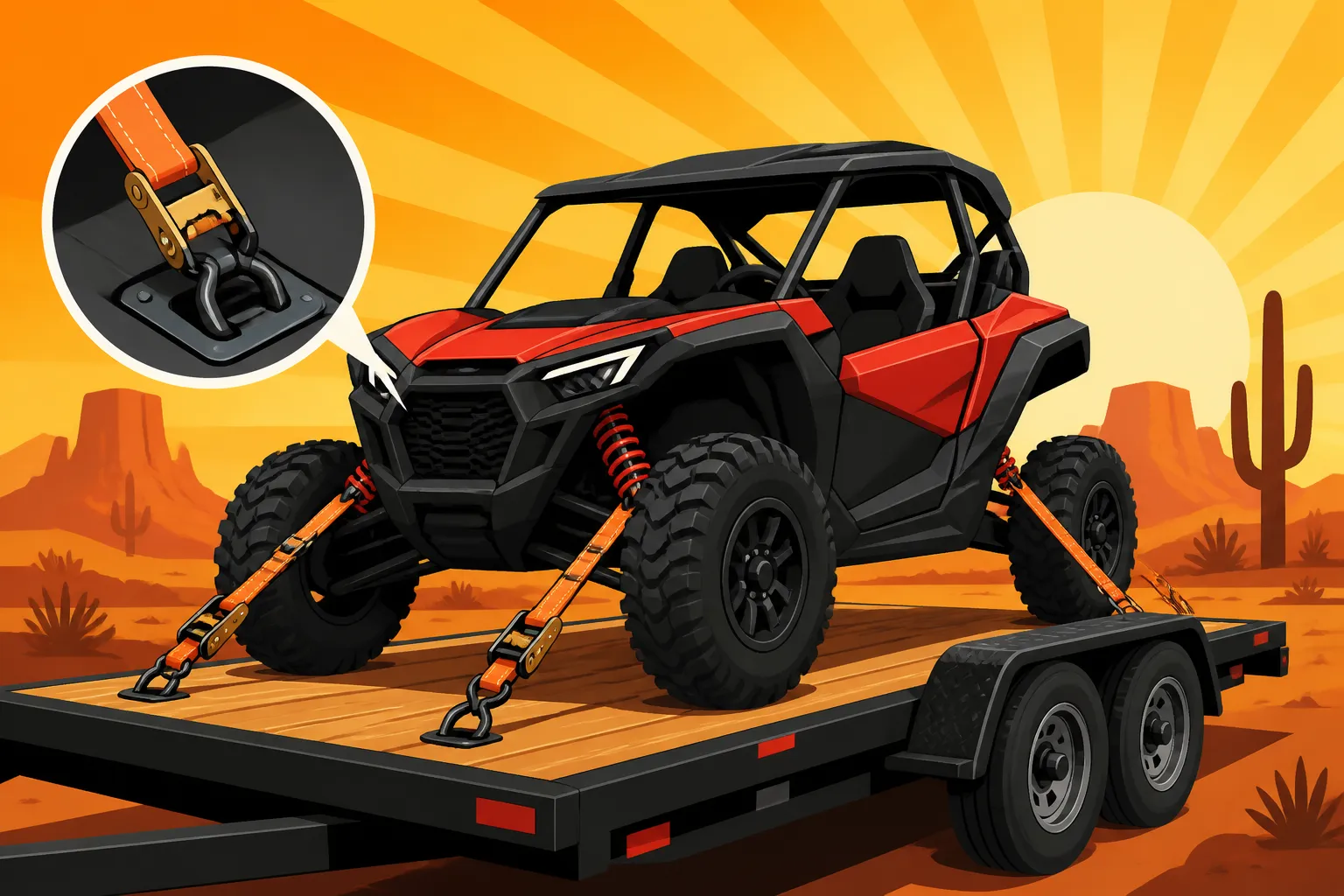
The gold standard for securing an OHV is the four-point tie-down method. This involves using at least four separate straps, one attached to each corner of your machine, pulling outwards and downwards at an angle. The idea is to create opposing forces that lock the machine into place, preventing both forward/backward and side-to-side movement.
Here's how to execute it:
- Front Straps: Attach one strap to a sturdy, low anchor point on the front left of your machine (e.g., a lower A-arm or frame point) and angle it forward and slightly outwards to a trailer anchor point. Repeat on the front right side, creating a V-shape of tension. These straps should pull the machine forward and slightly down.
- Rear Straps: Now, move to the rear. Attach a strap to a sturdy, low anchor point on the rear left of your machine and angle it backward and slightly outwards to a trailer anchor point. Repeat on the rear right. These straps should pull the machine backward and slightly down, effectively "pinching" it between the front and rear forces.
- Cross-Strapping (Optional but Recommended for UTVs): For larger UTVs, or if you want extra security, consider cross-strapping. This involves running the front left strap to the rear right trailer anchor, and the front right strap to the rear left trailer anchor. This creates even more lateral stability.
- Tensioning: Start by hand-tightening all four straps until they're snug. Then, systematically tighten each ratchet strap, working diagonally (front left, rear right, front right, rear left) or by alternating front and back. The goal is to compress your machine's suspension slightly. You want it to be "flexed" but not bottomed out. Over-tightening can damage suspension components, while under-tightening will allow movement. A good test is to try and rock your machine – it should move with the trailer, not independently.
Final Checks and Mid-Trip Inspections
Before you pull out of the driveway, do a thorough walk-around.
- Visual Check: Are all straps securely hooked? Are they straight and free of twists? Is there any slack?
- Tug Test: Give each strap a good pull. The machine should not budge.
- Clearance: Double-check that no straps are rubbing against sharp edges or exhaust components.
- Excess Strapping: Coil or tie off any excess strap material. Leaving long tails flapping in the wind can lead to them unraveling, getting caught in your wheels, or even hitting other vehicles. Many riders use bungee cords or zip ties for this.
Your work isn't done once you're on the road. The vibrations and bumps of highway travel can cause straps to loosen, especially during the first few miles. Plan to pull over safely after about 10-15 miles and re-check all your tie-downs. Give them another snugging if needed. For longer trips, make a habit of checking your tie-downs every time you stop for gas or a break. This proactive approach ensures your machine remains secure for the entire journey and helps prevent you from becoming part of an [Arizona OHV Crash Reporting] statistic due to an unsecured load.
Beyond the Basics: Troubleshooting and Common Tie-Down Traps
Even with the best intentions and gear, mistakes happen. Knowing what to look for and how to avoid common pitfalls can save you a lot of grief and ensure your machine arrives at its Arizona destination ready for adventure.
Identifying and Fixing Common Tie-Down Errors
One of the most frequent errors is under-tightening. Riders often fear damaging their suspension, so they don't apply enough tension. The result? The machine bounces independently of the trailer, which eventually loosens the straps and can lead to detachment. The solution is to ensure you compress the suspension slightly, making the machine and trailer act as one unit. Another mistake is using the wrong angle. Straps should always pull outward and downward. If they're pulling straight down, they're not providing proper lateral stability. Make sure your trailer anchor points are positioned to allow for these crucial angles.
Twisted straps are also a common issue. While a minor twist might seem harmless, it significantly reduces the strap's strength and can lead to uneven tensioning and premature wear. Always ensure your straps are laid flat and straight. Finally, forgetting to secure accessories is an easy oversight. Spare tires, fuel cans, coolers, or tool bags carried on the OHV itself need to be secured independently or removed and placed in your tow vehicle. These items can become projectiles if they come loose. Regularly inspect your straps for wear, fraying, or damaged ratchets. Arizona's intense sun can degrade webbing over time, so replace worn straps immediately.
Protecting Your Machine from Trailer Wear and Tear
Beyond the initial tie-down, consider the long-term health of your machine when trailering. Constant vibrations can cause wear where metal meets metal or where straps rub. Use padding – old towels, rubber mats, or specialized strap sleeves – wherever a strap crosses over a sensitive area like a painted frame, a plastic fender, or an aluminum rim. This prevents chafing and preserves your machine's finish.
Also, be mindful of where dirt and debris might accumulate during transit. If you're hauling a muddy machine, consider pressure washing it before trailering, or at least covering critical areas. Dirt and grit trapped under straps or between your machine and the trailer can act like sandpaper, slowly grinding away at your vehicle's surfaces. After arriving at your destination, or at least before long-term storage, remove the straps to allow your machine's suspension to decompress fully and to check for any hidden wear points that might need attention on future trips.
When to Consider Professional Help or Upgrades
If you're consistently struggling to get your machine securely tied down, or if you're hauling a particularly heavy or oddly shaped OHV, don't hesitate to seek advice. Many powersports dealers and trailer shops can offer guidance, demonstrate proper techniques, or even install additional anchor points on your trailer. If you're frequently traveling long distances or encountering rough roads, it might be worth upgrading to an enclosed trailer, which offers superior protection from the elements and provides more internal tie-down options, or investing in a specialized OHV trailer with integrated wheel chocks and unique strapping systems designed specifically for ATVs and UTVs.
Remember, the goal is not just to get your machine from point A to point B, but to get it there safely and intact. A little extra time, the right gear, and a methodical approach to tying down your machine mean you can hit Arizona's trails with confidence, knowing your investment is secure behind you. From a simple bill of sale facilitated by LawDepot when you bought your machine, to the straps you use to haul it, every step contributes to responsible OHV ownership.
Disclaimer
This article is for general informational purposes only and does not constitute professional advice. Laws, prices and regulations vary by location and change over time. Consult a qualified professional for guidance on your specific situation.