Can You Ride an OHV on an Arizona Highway?
It's a common daydream for many Arizona OHV owners: imagine just hopping on your side-by-side or ATV from your driveway and riding directly to your favorite desert trailhead, maybe even cruising a stretch of highway to get there faster. The reality, unfortunately, is a bit more complex, and often, much more restrictive than riders hope. This guide is here to untangle the rules about riding off-highway vehicles on Arizona's highways, clarify what "street legal" truly means in our beautiful state, and help you understand the safest and most lawful ways to get your machine where it needs to go.
The Core Rule: Arizona's Highway Prohibition for OHVs
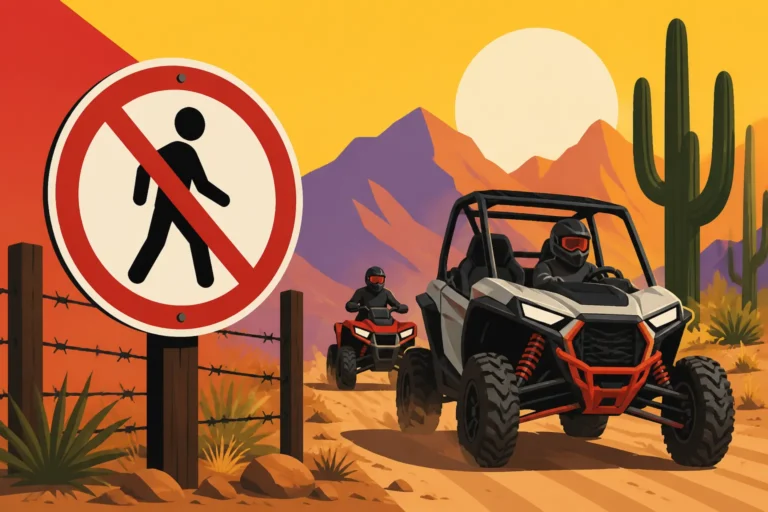
Let's cut right to the chase, because this is where many riders get confused or, frankly, disappointed. In Arizona, off-highway vehicles, even those that have been modified to be "street legal," are generally not permitted to operate on state highways, U.S. routes, or interstates. This isn't just a suggestion; it's a fundamental aspect of Arizona Revised Statutes, specifically designed with safety in mind.
Think about the dynamics: you're on an open highway, cars and trucks are zipping by at 65, 75, or even 85 miles per hour. Your OHV, while powerful and fun on the trail, simply isn't engineered for those speeds or the constant flow of heavy traffic. The speed differential alone creates an incredibly dangerous situation, not to mention the lack of crash protection compared to a passenger car. The state's primary concern here is preventing serious accidents, and that means keeping slower, lighter, and less protected vehicles off our major arteries. It's a tough pill to swallow when you're itching to hit the trail, but it's a rule with very good reasons behind it.
Understanding "Highway" in Arizona Law
When the law talks about "highways," it's referring to more than just the multi-lane interstates with massive concrete barriers. In Arizona, a "highway" is broadly defined as the entire width between the boundary lines of every way or place of whatever nature when any part of it is open to the use of the public for purposes of vehicular travel. This includes the big ones like I-10, I-17, U.S. Route 60, and many of our State Routes (SRs). These are the roads designed for higher speeds, longer distances, and commercial travel.
So, while you might dream of taking your Polaris RZR or Can-Am Maverick straight from your home in Queen Creek to the Florence Junction trails via US-60, that's a clear violation. The legal definition aims to capture those primary roads where the risks are highest due to speed and volume. It’s crucial to distinguish these from the smaller county roads or city streets that you might be able to legally navigate with a street-legal OHV, which we'll discuss in more detail shortly. Misunderstanding this distinction can lead to significant fines, or worse, a dangerous situation on the road.
Limited Exceptions for Crossing and Short Distances
Now, like many rules, there are some very narrow exceptions, primarily around crossing a highway. You can cross a public highway, road, or street at approximately a ninety-degree angle to the roadway, and only if the operation can be done safely. This means you’re not cruising down the highway, even for a short bit; you’re simply traversing it to get from one legal riding area or permitted road to another.
Imagine you're on a county road that suddenly dead-ends into a major highway, with another permitted dirt road directly across. The law might allow you to cross that highway in the most direct, perpendicular manner possible, given it's safe to do so. However, this is not an invitation to ride parallel to the highway for any distance, even just to the next turn-off. It’s a very limited allowance, solely for the purpose of connecting two otherwise legal routes. Even then, you must yield to all traffic and ensure there's absolutely no risk. Law enforcement takes a dim view of anyone who tries to stretch this exception, and rightfully so. Your best bet is always to avoid highways entirely with your OHV unless there is absolutely no other option for a short, direct crossing. For more on navigating these situations, check out [Crossing an Arizona Highway on a Machine].
What It Means to Be "Street Legal" in Arizona (and Why It's Not a Highway Pass)
The term "street legal" often gives OHV owners a false sense of freedom when it comes to Arizona's major roads. While making your machine street legal does open up new avenues for riding, it's critical to understand that it does not grant you unrestricted access to all public roads, especially not highways. Being street legal in Arizona primarily means equipping your OHV to safely and legally operate on designated county roads and city streets where OHV use is not otherwise prohibited.
Think of it this way: your side-by-side or ATV can become much like a small, specialized car in terms of equipment, allowing it to merge with lower-speed traffic. This is fantastic for riding from a small town out to the trails, or using local roads to connect different segments of your off-road adventure. However, it doesn't magically transform your machine into a vehicle capable of safely navigating the high speeds and heavy volume of a multi-lane highway. The modifications are about visibility, control, and basic road safety at lower speeds, not about highway performance or collision protection.
Equipping Your OHV for Public Road Use
To be considered street legal in Arizona, your OHV needs a specific set of modifications and equipment, designed to make it more visible and controllable in a mixed-traffic environment. These aren't just cosmetic changes; they are functional requirements to ensure you can signal, see, and be seen by other drivers. Many companies, including brands like SuperATV, offer comprehensive kits that make this conversion process much easier, providing everything from turn signals to mirrors.
Here’s a general rundown of what you’ll typically need:
- Headlights and Taillights: These need to be operational for both day and night use, ensuring you're visible from front and rear.
- Brake Lights: Essential for signaling when you're slowing down or stopping.
- Turn Signals: For indicating your intentions when changing lanes or turning.
- Rear-View Mirror: At least one, allowing you to see traffic behind you. Some riders opt for side mirrors as well.
- Horn: An audible signal, loud enough to be heard from 200 feet away.
- License Plate Light: To illuminate your rear license plate at night.
- Muffler and Spark Arrestor: To control noise and prevent wildfires. This is crucial for both street and off-road use.
- DOT-Approved Tires: Your tires must be rated for highway use, not just off-road.
- Windshield: Some vehicles may require a windshield to be considered street legal.
- Seatbelts/Restraints: If your machine has seats, they need appropriate restraints.
- Proper Registration and Plate: Your machine needs to be registered with the Arizona Motor Vehicle Division (MVD) and display the correct license plate.
Once all these modifications are in place, you'll apply for a street-legal title and plate through the MVD. It's a significant process, but it allows for much greater flexibility in getting to and from trails, or even just running errands in your community. For a deeper dive into the specific items, read [What Arizona Requires on a Street-Legal Machine].
The Plate Distinction: MC vs. RV
When you go through the process of making your OHV street legal in Arizona, you'll notice a distinction in the type of license plate you receive: either an "MC" plate or an "RV" plate. This isn't just a bureaucratic detail; it signifies how your vehicle is classified and, to some extent, where it's legally allowed to operate. Neither of these plates, however, grants you blanket access to Arizona highways.
-
MC Plates (Motorcycle Plates): If your OHV is classified as a motorcycle by the MVD, you'll receive an MC plate. This typically applies to traditional ATVs (quads) and some dirt bikes. Vehicles with an MC plate generally have more flexibility on lower-speed public roads, similar to street-legal motorcycles. They are typically subjected to the same rules as motorcycles regarding helmets and other safety gear when on the street. Learn more about this classification with [MC Plates and Street-Legal Machines].
-
RV Plates (Recreational Vehicle Plates): Most side-by-sides (UTVs) and larger off-road vehicles that meet the street-legal requirements will be issued an RV plate. This classification acknowledges their recreational nature and their larger size. While an RV plate makes your UTV legal for many county roads and city streets, it explicitly does not permit highway operation. The "RV" designation often reminds owners that these are still recreational vehicles, even when road-ready. For more on this, consult [RV Plates and Off-Highway Only Machines].
The key takeaway is that regardless of whether you have an MC or an RV plate, Arizona's primary highways remain off-limits. These plates are about integrating your OHV into the local road network, allowing you to traverse small towns or connect to trailheads via less-trafficked routes, not about cruising alongside semi-trucks on I-10.
To help clarify the requirements and limitations, here's a quick comparison:
| Feature/Requirement | Street-Legal OHV (MC/RV Plate) | Operation on Arizona Highways |
|---|---|---|
| Headlights/Taillights | Required | Generally Prohibited |
| Brake Lights | Required | Generally Prohibited |
| Turn Signals | Required | Generally Prohibited |
| Horn | Required | Generally Prohibited |
| Mirrors | Required (at least one rear-view) | Generally Prohibited |
| DOT Tires | Required | Generally Prohibited |
| Windshield | Often required for UTVs | Generally Prohibited |
| Muffler/Spark Arrestor | Required | Generally Prohibited |
| Speed | Suited for lower speed limits | Incompatible with highway speeds |
| Safety | Enhanced for local roads | Inadequate for highway traffic |
| Legal Access | City streets, county roads (unless prohibited) | Strictly limited to crossing |
Navigating Local Roads and Designated Routes
So, if highways are largely out of the picture, where can you ride your street-legal OHV on paved roads in Arizona? This is where the beauty of being street legal really shines. The ability to use local roads significantly enhances your off-road experience, making it easier to access trails, resupply, or simply enjoy a scenic drive through a small town.
The general rule of thumb is that street-legal OHVs are permitted on most city streets and county roads, provided those roads aren't specifically designated as off-limits. Many of Arizona's smaller towns, particularly those that embrace the OHV lifestyle, are very welcoming to street-legal machines. You'll often see them parked outside restaurants or gas stations, becoming an integral part of the local transportation fabric. This capability turns a day of trail riding into a more seamless adventure, allowing you to link up different trail systems or stop for that well-deserved burger after a long day in the dirt.
Riding on City Streets and County Roads
For street-legal OHVs, county roads and most city streets are your primary paved pathways. These roads typically have lower speed limits, less traffic volume, and are often the connecting tissue between your home, a staging area, and the actual dirt trails. For example, if you're staying at a campground outside Payson, you could legally ride your street-legal UTV into town for supplies, then take a county road directly to a forest access point. This convenience is a huge draw for street-legal conversions.
However, a critical caveat is that individual cities and counties retain the right to restrict or prohibit OHV use on their roads. This means that while generally permissible, you can't assume every single road within city limits is open. Before you head out, especially if you're visiting a new area, it's always wise to do a quick check on local ordinances. Many smaller towns in Arizona, especially those in popular riding areas, are quite accommodating. But some larger, more urbanized areas might have stricter rules. It's truly a case-by-case situation. When in doubt, it’s best to err on the side of caution or specifically look up the local laws. To help with this, you can look for [Finding an Arizona City's OHV Ordinance].
Forest Service and BLM Road Access
Beyond city streets and county roads, street-legal OHVs are incredibly valuable for accessing and riding on the vast network of Forest Service (FS) and Bureau of Land Management (BLM) roads across Arizona. These are often unpaved, but they are technically public roads and are generally open to properly registered and equipped OHVs. These roads serve as vital arteries, connecting trailheads, dispersed camping areas, and even providing scenic routes in themselves.
Many of Arizona's most iconic riding areas, like the Mogollon Rim or the vast Sonoran Desert landscapes, are crisscrossed with FS and BLM roads. Your street-legal status allows you to navigate these roads freely, provided you have your [Arizona's Annual OHV Decal Explained] and are adhering to all other land use rules. This means you can ride from your camp, perhaps on a named forest road, across several miles of dirt and gravel, to link up with a specific trail system or reach a viewpoint. These roads are typically shared with other vehicles, including passenger cars, trucks, and even larger off-road rigs, so responsible, defensive driving is always a must. Always be aware of speed limits, road conditions, and any seasonal closures. For more detailed information on regulations, check out [Arizona Rules on Forest Service Roads] and [Arizona Rules on BLM Roads].
Practical Advice and Avoiding Penalties
Riding your OHV in Arizona, whether on or off the pavement, is an incredible experience. But to keep it fun and safe, and to avoid legal headaches, a little preparation and knowledge go a long way. Understanding the rules, carrying the right documents, and knowing the consequences of non-compliance are essential for every rider. After all, nobody wants their epic desert adventure to end with a hefty fine or, even worse, a preventable accident.
The laws are there for a reason, primarily for your safety and the safety of others sharing the roads and trails. Ignoring them not only puts you at risk but also contributes to negative perceptions of the OHV community, potentially leading to further restrictions down the line. We all want to preserve access to Arizona's incredible landscapes, and that starts with being responsible and informed riders.
Always Carry Your Paperwork
This cannot be stressed enough: always carry your required paperwork with you when operating your OHV, both on public roads and off-highway. If you're pulled over by a law enforcement officer or a ranger, they will ask for it, and not having it can lead to delays, additional fines, or even citations. Imagine you're out exploring a remote trail near the Bradshaw Mountains, and a Forest Service ranger pulls up to check on you. Fumbling through your pockets only to realize you left your registration back at camp is a frustrating way to end an otherwise perfect day.
Here's what you should always have accessible, preferably in a waterproof pouch or a secure compartment on your machine:
- Your Driver's License: Required to operate any motor vehicle on public roads, including street-legal OHVs.
- OHV Registration: Proof that your machine is properly registered with the Arizona MVD.
- Arizona OHV Decal: Even if you have a street-legal plate, if you're riding off-highway, the decal is required.
- Proof of Insurance: If your machine is street legal, it must be insured to meet Arizona's minimum liability requirements, just like a car.
- Arizona State Trust Land Recreational Permit (if applicable): If you're riding on State Trust Land, this permit is mandatory.
Having these documents readily available makes any interaction with law enforcement quick and painless, allowing you to get back to enjoying your ride faster. For more tips on keeping your documents safe and accessible, check out [Do You Carry Papers on an Arizona Trail?].
Understand the Penalties for Improper Use
The consequences of misusing your OHV, particularly by illegally riding on highways or otherwise violating regulations, can range from inconvenient fines to severe legal repercussions. Arizona law enforcement, including MVD officers, county sheriffs, and federal land management rangers, are well-versed in OHV regulations and don't hesitate to enforce them.
Penalties can include:
- Fines: Riding illegally on a highway, or failing to have proper registration, decals, or safety equipment, can result in significant monetary penalties. These fines are often designed to be a strong deterrent, and they can add up quickly. For a sense of what violations might cost you, see [Arizona Fines for Illegal Road Riding].
- Vehicle Impoundment: In more serious cases, especially for repeat offenses or dangerous driving, law enforcement has the authority to impound your OHV. This not only means paying impound fees but also dealing with the hassle of retrieving your machine, which can be a lengthy and expensive process.
- Loss of Riding Privileges: Depending on the severity and frequency of violations, you could face a temporary or even permanent loss of your OHV riding privileges in Arizona.
- Legal Charges: In cases involving reckless driving, driving under the influence (DUI), or accidents, you could face criminal charges, which carry far more severe penalties than simple citations.
Beyond the legal penalties, there’s the inherent risk to yourself and others. Operating an OHV on a highway is incredibly dangerous due to the speed and mass of other vehicles. Even a minor collision at highway speeds can have catastrophic consequences. Always prioritize safety and legal compliance. It’s far better to trailer your machine to a legal access point than to risk your life, your machine, and your wallet by attempting an illegal highway run.
Disclaimer
This article is for general informational purposes only and does not constitute professional advice. Laws, prices and regulations vary by location and change over time. Consult a qualified professional for guidance on your specific situation.