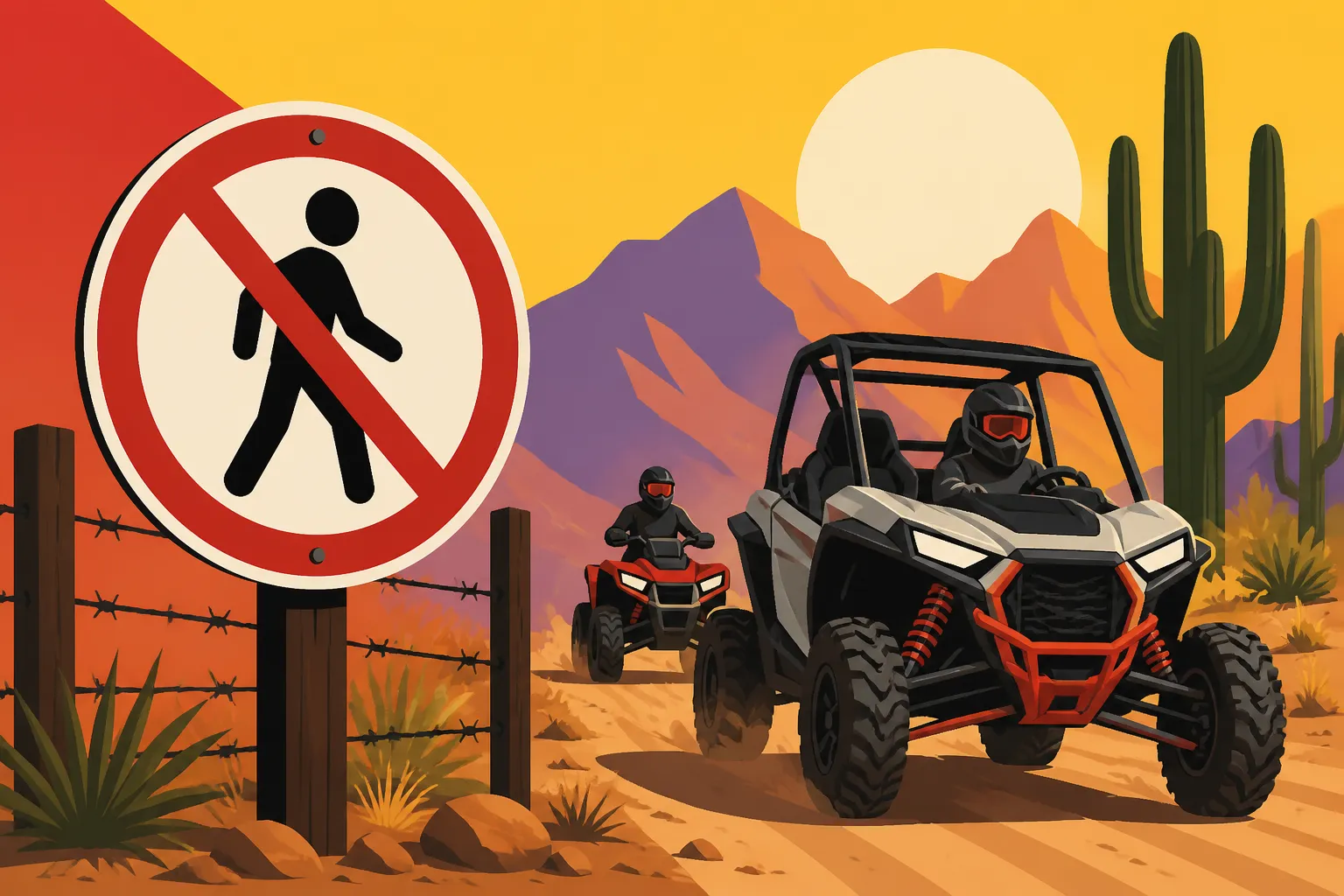
Arizona Trespass Rules Along Desert Roads
Many Arizona ATV and UTV riders often find themselves wondering where they can legally ride, especially when a dusty two-track seems to vanish into private land or a ranch gate unexpectedly appears. The vastness of the Arizona desert can be deceiving, and inadvertently crossing onto private property, state trust land without a permit, or even protected wilderness areas can lead to serious legal trouble and hefty fines. This comprehensive guide will help you understand Arizona's trespass rules along desert roads, so you can enjoy your ride without unwelcome surprises.
Understanding Arizona's Varied Land Designations
The Arizona desert isn't just one big, open space. It's a mosaic of different land types, each with its own rules and regulations regarding access and Off-Highway Vehicle (OHV) use. Misunderstanding these designations is a primary reason riders accidentally trespass. It's a frustration many of us have felt, staring at a map trying to figure out if that enticing dirt path is legal or not.
Public Lands: BLM and Forest Service
Much of Arizona's desert landscape falls under the jurisdiction of federal agencies like the Bureau of Land Management (BLM) and the U.S. Forest Service. These are generally accessible for recreational OHV use, but with critical caveats. Riders often assume that if a road looks "open" or "unmaintained," it must be public land. However, this is a dangerous assumption. Even on public lands, specific areas might be designated as wilderness, national monuments, or other protected zones where motorized travel is strictly prohibited or limited to designated routes. Always check an [Arizona Motor Vehicle Use Map] before you head out.
The key to riding responsibly on these lands is to stick to designated routes. These are usually marked on Motor Vehicle Use Maps (MVUMs), which are available online or at local ranger district offices. Going off a designated trail, even if it's just to cut a corner or explore a tempting side path, can easily lead you into a restricted area. Imagine navigating a winding dirt road near the Coronado National Forest; what starts as a clearly marked route could transition into a closed-off area if you're not paying attention to signage or a map. It's not always about gates and fences; sometimes it's just a small sign you missed in the dust. You’ll want to review [Arizona Rules on Forest Service Roads] to stay compliant.
Furthermore, even within designated riding areas on BLM or Forest Service land, certain times of the year might see temporary closures due to fire restrictions, wildlife migration, or environmental recovery efforts. Always check the current status of the area you intend to ride. A quick call to the local ranger district or checking their website can save you a lot of trouble, and ensure you're not inadvertently impacting sensitive resources or riding into a dangerous situation.
State Trust Land and Permits
Arizona State Trust Land comprises millions of acres throughout the state, often interspersed with public and private parcels. These lands are managed to generate revenue for specific beneficiaries, primarily public schools. While they might look like open desert, they are absolutely not public land in the same way BLM or Forest Service land is. To legally recreate on Arizona State Trust Land, including simply driving on a road that crosses it, you must possess a valid [Arizona State Trust Land Recreational Permits]. Without one, you are trespassing, plain and simple.
Many riders are caught off guard by this rule. They might be driving a well-worn two-track near Tucson, thinking they're on open public ground, only to be approached by a State Land Department officer asking for their permit. The land might not have fences or "No Trespassing" signs visible from every angle. This is where diligent trip planning comes into play. If your route crosses state trust land, which many popular desert roads do, you need that permit. It's a small fee for peace of mind and legal access, preventing a potentially much larger fine. [Camping on Arizona State Trust Land] also requires this permit, even if you’re just staging for a day trip.
It’s easy to feel frustrated when seemingly open land requires a permit, especially when the boundaries aren't crystal clear. However, understanding the purpose behind State Trust Land – to fund public services – can help put it in perspective. The permit fees go directly to these beneficiaries, so by purchasing one, you're not just staying legal, you're contributing to a good cause. Just be sure to purchase it beforehand, as there are no on-site options, and having proof of purchase readily available is crucial if you encounter an officer.
Private Property and Deeded Land
This is perhaps the most straightforward but also the most frequently violated land designation. Private property in Arizona can range from vast cattle ranches and mining claims to small residential parcels on the outskirts of desert communities. Entering private land without express permission from the landowner is a clear act of trespass. Often, desert roads run adjacent to, or even directly through, private property, making it easy to unintentionally cross boundaries.
The challenge in the desert is that boundaries aren't always clearly marked. A fence might be down, a sign might have faded or been vandalized, or the property line might simply be a subtle shift in terrain that's impossible to discern while riding. However, the onus is on the rider to know where they are. Imagine a scenario where you're following a scenic route near Kingman, and suddenly you're on a private mining claim or a ranch road. Even if there's no gate, a "No Trespassing" sign, or even a fence, if you're on land that is legally owned by someone else, you are trespassing. This is why tools like GPS units with detailed land ownership maps, often enhanced by apps like [onX Offroad for Arizona Trails], are indispensable for responsible riding.
It's tempting to think, "What's the harm if no one's around?" But private property is just that – private. Landowners have legal rights and often legitimate reasons for restricting access, from protecting livestock and equipment to maintaining privacy or avoiding liability. Disregarding these rights can not only lead to legal trouble but also fosters animosity towards the entire OHV community, making it harder for everyone to enjoy the desert responsibly.
Common Scenarios Leading to Trespass on Desert Roads
Riders often find themselves in trespass situations not out of malice, but due to a combination of oversight, lack of information, and sometimes, simply poor judgment. Understanding these common pitfalls can help you avoid them, saving you from a lot of grief and potential fines.
Unmarked or Poorly Marked Boundaries
One of the biggest challenges in the vast Arizona desert is the sheer difficulty of identifying property lines. Unlike urban areas with clear fences and street numbers, desert boundaries can be incredibly subtle. A barbed wire fence might be decades old and in disrepair, or a "No Trespassing" sign might have fallen down, been shot up, or faded beyond recognition. This can be especially true on old mining roads or cattle trails that have existed for generations.
Consider an old two-track winding through the Bradshaw Mountains. What appears to be a public access road could, without warning, transition onto private property owned by a long-standing ranching family. If you're relying solely on visual cues, it's easy to miss the exact point where public access ends and private ownership begins. This is why relying on up-to-date maps and GPS technology is absolutely crucial. A good GPS system, particularly one loaded with property boundary overlays, can provide an invaluable safeguard against accidental trespass. For instance, a durable GPS mount from SuperATV could be essential for keeping your navigation visible and secure on rough desert roads, minimizing distractions that might lead you to miss a critical boundary marker.
Detouring from Designated Trails
The temptation to explore a tantalizing side trail, cut a corner, or find a "secret" route is strong for many off-road enthusiasts. However, these detours are prime opportunities for accidental trespass. Designated OHV trails and roads are established for a reason – they’ve been vetted for legal access, safety, and environmental impact. When you leave these established routes, you're entering uncharted territory where land ownership and restrictions are unknown.
Imagine you're riding a clearly marked trail near the Table Mesa area north of Phoenix. You see a faint track leading off into a pristine wash that looks like an exciting shortcut. Following that track, you might inadvertently enter a private landholding or, even worse, a designated wilderness area where motorized vehicles are strictly forbidden. The penalties for entering wilderness areas can be severe, reflecting the critical need to preserve these sensitive ecosystems. Stick to the routes you know are legal, and use your maps to confirm any "new" path before you commit. Remember, [Arizona Rules on Forest Service Roads] often require you to stay on designated routes.
This isn't just about avoiding a ticket; it's also about preserving the trails for everyone. Cutting new tracks or riding in restricted areas can cause irreparable damage to fragile desert ecosystems, leading to closures and stricter regulations for all riders. It's a classic case of a few bad apples spoiling it for the bunch, so let's all do our part to tread lightly and stick to the designated paths.
Riding Through Ranch and Farm Lands
Arizona's rural areas are dotted with ranches, farms, and agricultural operations. Many of these properties have dirt roads that lead to pastures, watering holes, or remote outbuildings. While these roads may appear public, they are almost always private property. Even if there's no gate, a "No Trespassing" sign might be obscured or simply not present at every access point.
It's common for riders to mistakenly believe that because a road is unpaved, it's fair game. This simply isn't the case. Ranchers rely on these roads for their livelihood and often have expensive livestock and equipment that can be spooked or damaged by passing OHVs. Riding through someone's working ranch, even if you're just passing through, is a serious violation. This applies to both large commercial operations and smaller homesteads. Always assume a road leading to any kind of agricultural activity is private unless you have explicit permission from the landowner or official documentation proving it's a public right-of-way. You might encounter similar issues with [Arizona OHV Rules for Ranch and Farm Machines] if you're not careful.
The disruption caused by an OHV can be significant to ranching operations. Livestock can be stressed or scattered, gates might be left open allowing animals to escape, and valuable equipment could be damaged. These aren't minor inconveniences; they directly impact a rancher's livelihood. When in doubt, always respect the boundaries, even if they're not overtly marked with "No Trespassing" signs.
Consequences and Penalties for OHV Trespass in Arizona
Trespassing with an OHV in Arizona is not just a polite request to turn around; it carries legal weight and can result in significant penalties. Ignorance of the law is generally not a valid defense, and the consequences can be far more severe than many riders anticipate.
Legal Ramifications and Fines
Arizona's trespass laws are designed to protect private property rights and preserve public lands. For OHV operators, a simple trespass can escalate into a criminal misdemeanor. This means not just a citation, but potentially a court appearance, fines, and even jail time, depending on the severity and history of the offense. The Arizona Revised Statutes detail these laws, and law enforcement officers, including county sheriffs, state park rangers, and BLM agents, are authorized to enforce them.
A first-time offense for criminal trespass can carry fines that range from hundreds to thousands of dollars. Repeated offenses or trespass that causes damage to property or resources can lead to much higher penalties. For example, if you trespass on private land and cause damage to a fence or disturb livestock, the landowner can pursue civil damages in addition to any criminal penalties levied by the state. This means you could be on the hook for repairs, lost income, and legal fees. It's far more costly than simply buying a [Arizona State Trust Land Recreational Permits] or investing in robust navigation. [What an Arizona Ranger Asks a Rider For] can include proof of legal access, so always be prepared.
These legal consequences can also include points on your driving record, which could affect your insurance rates or even your ability to drive on paved roads. A misdemeanor on your record isn't something to take lightly, and it can follow you for years. It’s a harsh reality that a moment of inattention or a poor decision can have such lasting repercussions.
Vehicle Impoundment and Forfeiture
One of the most immediate and impactful consequences of OHV trespass is the potential for your machine to be impounded. Law enforcement officers have the authority to seize vehicles used in the commission of a crime, including criminal trespass. Once impounded, you'll face not only the trespass fines but also impoundment fees, daily storage charges, and potentially towing costs, which can quickly add up to hundreds or even thousands of dollars.
In more egregious cases, or for repeat offenders, your OHV could even be subject to forfeiture. This means the state could permanently seize your vehicle, effectively taking away your machine entirely. While this is typically reserved for more serious offenses or repeat violations, the possibility alone should serve as a strong deterrent. Imagine having your prized side-by-side, which you've invested heavily in with accessories like SuperATV upgrades for enhanced performance and protection, taken away over an accidental detour. It's a devastating outcome that makes understanding and respecting land boundaries critically important.
The financial hit from impoundment and forfeiture can be truly staggering, especially for a new or high-value machine. It's not just the initial cost of the fines; it's the ongoing daily storage fees and the hassle of navigating the impound process. Forfeiture, on the other hand, means losing your investment entirely, a stark reminder of the serious nature of trespass laws.
Environmental Damage and Resource Restoration Costs
Beyond legal and financial penalties, OHV trespass often results in environmental damage, and responsible riders are increasingly held accountable for this impact. Going off-trail on sensitive desert ecosystems can destroy fragile cryptobiotic soil crusts, damage native plant life, disturb wildlife habitats, and contribute to erosion. If your trespass leads to such damage, you could be ordered to pay for resource restoration.
Restoration costs can be astronomical, especially in sensitive areas. Reclaiming damaged land, replanting native species, or repairing erosion scars often requires specialized equipment and expertise. These costs can easily dwarf any fines associated with the trespass itself. Furthermore, damage to public resources can lead to broader restrictions on OHV access for all riders, punishing the entire community for the actions of a few. This is why initiatives like "Tread Lightly!" are so important, emphasizing responsible riding that respects the environment.
It’s easy to underestimate the delicate nature of the desert ecosystem. What might seem like a small shortcut or a bit of fun exploring off-trail can have long-lasting, detrimental effects on the environment. The cumulative impact of many riders making these small transgressions can lead to significant ecological degradation, impacting water quality, soil stability, and native plant and animal populations. These are the kinds of damages that can take decades, if not centuries, to recover from.
Preventative Measures and Best Practices for Arizona Riders
The best way to avoid trespassing is through proactive planning, education, and responsible riding habits. A little effort upfront can save you a lot of headache and expense later on, ensuring your desert adventures remain stress-free and legal.
Utilizing Maps and GPS Technology
In the Arizona desert, a good map and GPS are as essential as fuel and water. Do not rely solely on visual cues or memory, especially when exploring new areas. Before you head out, consult detailed maps that show land ownership boundaries. Digital mapping applications, often available for smartphones or dedicated GPS devices, can display layers for BLM, Forest Service, State Trust Land, and private parcels. Many apps, like [onX Offroad for Arizona Trails], allow you to download maps for offline use, which is critical in areas with no cell service.
Take the time to plot your route, identify potential areas of concern, and understand where you might need a [Arizona State Trust Land Recreational Permits]. Regularly check your GPS during your ride to ensure you're staying on designated and legal routes. A small investment in mapping technology and a secure mounting solution for your OHV, perhaps a robust dash mount from SuperATV, can be the most effective defense against accidental trespass. Always have a physical backup map too, just in case your electronics fail. [Planning an Arizona Riding Trip] should always start with good navigation.
It's common to feel overwhelmed by the sheer amount of information on some of these maps, but a little practice makes it much easier. Get familiar with the legend, understand the different color codes for land ownership, and learn how to interpret contour lines. The more comfortable you are with your mapping tools, the less likely you are to stray into restricted areas.
Respecting Fences, Gates, and Signage
This might seem obvious, but it bears repeating: respect all fences, gates, and signs you encounter. A closed gate, even if unlocked, typically means "No Entry" unless you have explicit permission. If you open a gate to pass through (with permission), always close it behind you. A "No Trespassing" sign, regardless of its condition or how remote it appears, is a direct legal warning.
Even if a fence is in disrepair, or a sign is faded, treat it as a boundary. The absence of a sign does not automatically imply public access. If you're unsure about a boundary, err on the side of caution and turn back. Remember, it's your responsibility to know where you are riding. Never assume that because others have ridden a path before you, it's automatically legal or permissible. [Arizona Trespass Law for Riders] is clear on this point, and it’s always better to be safe than sorry.
It’s a simple rule, but it's one that prevents a vast majority of trespass issues. Treat every fence and gate as a deliberate barrier, and every sign as a legally binding instruction. Doing so not only keeps you out of trouble but also builds trust between riders and landowners, which is vital for maintaining access to riding areas.
Communicating with Landowners and Local Authorities
When in doubt, ask. If you plan to ride an area that appears to border private land, or if you're curious about accessing a specific private road, try to contact the landowner. Many ranchers or private property owners are amenable to granting permission, especially if you approach them respectfully and understand their concerns. They might even share valuable local knowledge about trails or conditions.
Similarly, if you have questions about specific land designations or routes, reach out to the local BLM or Forest Service office, or the Arizona State Land Department. They are resources available to help you ride legally and responsibly. A quick phone call or email before your trip is a small price to pay for avoiding legal trouble. Building good relationships with local communities and landowners can also foster a more positive image for the entire OHV community.
You might be surprised at how helpful public land managers can be. They often have the most up-to-date information on trail conditions, temporary closures, and specific regulations for their jurisdiction. Don't be shy about reaching out; they prefer to help you ride legally and safely rather than deal with enforcement actions after a trespass has occurred.
Navigating Special Use Areas and Restricted Zones
Beyond general private and public lands, Arizona has specific areas with unique regulations that OHV riders must be particularly aware of. These often represent sensitive ecosystems, historical sites, or areas critical for public safety.
Wilderness Areas and National Monuments
Arizona is home to numerous designated wilderness areas and national monuments, such as Organ Pipe Cactus National Monument or the Agua Fria National Monument. These areas are established to preserve natural and cultural resources, and motorized vehicle use is severely restricted or outright prohibited. In wilderness areas, the goal is to provide an experience "untrammeled by man," meaning no motorized vehicles, no mechanized equipment, and often, even bicycles are prohibited.
Many desert roads run adjacent to these areas, and it can be easy to cross into them unintentionally if you're not paying close attention to your maps and boundary markers. Penalties for violating wilderness or monument regulations are typically severe, reflecting the protected status of these lands. Always consult a detailed map, such as a BLM Travel Management Map, to identify these restricted zones. [Arizona Wilderness Boundaries and Machines] outlines these restrictions, which are rigidly enforced by federal agents. Don't assume a dirt road near one of these areas is open unless explicitly shown as a designated route.
It's common to see wilderness boundaries delineated by simple signs or posts, rather than imposing fences. These subtle markers can be easily missed if you're riding at speed or not actively navigating. The consequences for violating these rules are not just fines; they can include a ban from future use of federal lands, which can significantly impact your ability to enjoy the outdoors.
Indian Reservations and Tribal Lands
Arizona has a significant number of Native American reservations, which are sovereign nations with their own laws and regulations. Accessing tribal lands for any recreational purpose, including OHV riding, requires explicit permission from the tribal government. These lands are not public in the federal or state sense, and riding without permission is a serious offense that can lead to arrest, fines, and impoundment by tribal law enforcement.
Some tribes may offer permits for certain activities, while others may strictly prohibit outside recreational use. Never assume that an unmarked road crossing onto tribal land is open. Always research and obtain necessary permits in advance if your planned route might even brush against a reservation boundary. Respect for tribal sovereignty and cultural resources is paramount. Trying to navigate these areas without prior research is a recipe for trouble.
The cultural significance and unique legal status of tribal lands mean that unauthorized entry is not just a minor infraction; it's a deep disrespect to the tribal nation. Always err on the side of extreme caution and secure explicit permission before venturing anywhere near reservation boundaries. This might involve contacting the tribal parks and recreation department or the tribal government directly well in advance of your trip.
Military Reservations and Restricted Airspace
Scattered across Arizona are various military reservations and training ranges, such as the Barry M. Goldwater Range. These areas are strictly off-limits to unauthorized civilian access due to ongoing military operations, live-fire training, and unexploded ordnance. Entering these zones is not just trespassing; it can be incredibly dangerous and lead to severe federal penalties.
These areas are typically well-marked with signs and fences, but their vastness means it's still possible to stray onto them if you're disoriented or not paying attention. Always respect all warning signs and never attempt to enter a military reservation. Use your maps to identify these zones and plan your routes far away from their boundaries. The risk is simply too high.
The dangers of entering a military reservation cannot be overstated. Beyond the legal consequences, you could be in immediate peril from unexploded ordnance or live-fire exercises. These are not areas to casually explore; they are active military zones where your safety is not guaranteed. Always give these areas a wide berth and ensure your navigation keeps you well clear of their perimeters.
The Role of Signs, Fences, and Property Markers
While often present, signs, fences, and property markers aren't always definitive or consistently maintained in the vast desert. Understanding their purpose and limitations is key to correctly interpreting the landscape and avoiding trespass.
Legal Weight of "No Trespassing" Signs
In Arizona, "No Trespassing" signs hold significant legal weight. Under state law, these signs serve as formal notice that entry is prohibited. They don't need to be placed every few feet; strategically placed signs at common access points are generally sufficient to convey notice. Ignoring such a sign, whether it's on a private ranch road or at the entrance to a restricted area, is a clear act of criminal trespass.
Even if a sign is old, faded, or slightly obscured by vegetation, its presence still communicates the landowner's intent to restrict access. A common misconception is that if you don't see a sign, you're not trespassing. However, as discussed, the burden of knowing where you are riding lies with the rider. Always be vigilant for signs, and if you encounter one, respect it. It's better to turn around and find an alternative route than to risk a citation.
It’s often frustrating to encounter a poorly maintained sign, making you question its validity. But the safest approach is always to assume it’s legally binding. If you have any doubt about the status of a road or property, it’s always best to retreat and seek clarification, rather than push forward and risk a legal confrontation.
Fences and Gates as Boundaries
Fences and gates are physical manifestations of property lines and access control. A fence, whether barbed wire or chain link, generally indicates a boundary you should not cross without permission. A closed gate, regardless of whether it's locked or unlocked, is usually a clear indicator that the property beyond is private or restricted.
It's common for riders to encounter open gates on ranch roads, leading them to believe the road is public. This is often not the case. Ranchers leave gates open for livestock movement or to allow passage for authorized personnel. An open gate is not an invitation for public use. Always assume that a closed or even open gate on a non-public road means restricted access. If you find yourself in a situation where a gate needs to be opened to pass through (with prior permission), always ensure it's closed securely behind you to prevent livestock from escaping.
Leaving a gate open on private land, even inadvertently, can have severe consequences for the landowner, from lost livestock to increased liability. This is why many ranchers are understandably protective of their property and can be quite firm with trespassers. Always be mindful of the potential impact of your actions.
Survey Markers and Natural Boundary Features
In many remote desert areas, formal signs and robust fences may be few and far between. Here, property lines might be indicated by more subtle means, such as old survey markers, rock cairns, or even natural topographical features like washes, ridges, or specific vegetation changes. While these are less explicit than a "No Trespassing" sign, experienced riders and local law enforcement often understand their significance.
Relying on these subtle cues requires significant local knowledge or, more reliably, the use of detailed mapping technology. For instance, a boundary might follow the centerline of a specific wash for several miles before cutting across a mesa. Without a GPS overlay showing these lines, it would be impossible to know you were adhering to a legal path. This is another area where investing in quality accessories for your OHV, such as a SuperATV GPS mount, becomes a practical necessity for responsible desert exploration. It allows you to keep your eyes on the terrain while still monitoring your position relative to known boundaries, ensuring you're always on legitimate territory.
Learning to recognize these subtle markers can greatly enhance your ability to navigate responsibly, but they should always be corroborated with a reliable map. Never rely solely on visual observation in vast, undeveloped areas where boundaries can be ambiguous to the untrained eye.
Here's a table comparing different land types and their general access rules for OHVs:
| Land Type | General OHV Access | Permit/Fee Required? | Common Identifying Features | Risk of Trespass if Uninformed |
|---|---|---|---|---|
| BLM / Forest Service | Designated routes only | No (for general access) | MVUMs, official signage, marked trails | Moderate (off-trail, wilderness) |
| Arizona State Trust | Designated routes only | Yes | AZ State Land Dept. maps, subtle markers | High (without permit) |
| Private Property | Permission required | No | Fences, gates, "No Trespassing" signs (may be absent) | Very High (without permission) |
| Wilderness Areas | Prohibited (motorized) | N/A | Wilderness boundary signs, topographical maps | Very High (strict enforcement) |
| Tribal Lands | Explicit tribal permission | Varies | Tribal signage, cultural markers | Very High (sovereign nation) |
| Military Reservations | Strictly Prohibited | N/A | Extensive fencing, clear warning signs | Extreme (danger + severe penalties) |
Disclaimer
This article is for general informational purposes only and does not constitute professional advice. Laws, prices and regulations vary by location and change over time. Consult a qualified professional for guidance on your specific situation.