Arizona Rules for a Rider Under 12
A child under 12 may be able to ride an ATV or UTV in Arizona, but age alone does not settle whether a particular machine or route is appropriate. Parents need to consider supervision, engine size, helmets, land access and any course or permit requirements. The safest approach is to check the rules for the machine and riding location before unloading.
Arizona’s age and supervision rules
Arizona’s rules for young OHV operators depend partly on engine size and who is accompanying the rider. A commonly cited state restriction applies to operators under 16 using an OHV with an engine capacity greater than 90 cubic centimeters: the young operator must be accompanied by a parent or legal guardian. Because a child under 12 falls within that age group, do not treat the rule as permission to ride a large machine alone.
“Accompanied” should mean an adult is present and able to supervise, not simply reachable by phone or waiting somewhere else. Stay close enough to intervene, keep the child in sight, and choose terrain that matches the rider’s actual control and judgment. A legal exception is not a recommendation that a child use a machine that is too powerful or too large.
Age-based machine guidance and legal restrictions are not always the same thing. A manufacturer may recommend a minimum rider age or a particular engine class; a parent should take those recommendations seriously even when the machine might otherwise be legally operated with adult supervision. Check the owner’s manual and the machine’s passenger and weight limits. A child who can reach the controls while parked may still struggle to steer, brake or keep control on uneven ground.
For a closer look at the different youth requirements, see [Arizona Age Rules for Young Riders] and Youth Machine Size Rules Arizona Parents Ask About. The broader requirements for older minors are covered in Arizona Rules for Operators Under 18 and Arizona Education Rules for Under-18 Riders.
Supervision is not the same as riding together
An adult riding nearby can help a child make safer decisions, but supervision does not remove the need to assess each hazard. A young rider may have little warning before encountering loose rock, deep sand, a steep grade, traffic or another group on a narrow route. Keep the route short and manageable, and do not let a child follow riders who are traveling faster than the child can safely manage.
A parent or guardian should also explain clear boundaries before the engine starts: where the child may ride, what to do if the group stops, and when to get off the machine. Agree on a simple signal for stopping. If the child is tired, frightened or having trouble keeping pace, end the ride or switch to a safer activity rather than pushing through.
Where a child under 12 may ride
The riding location matters as much as the rider’s age. Public land, State Trust Land, private property, streets and managed riding areas can have different rules. A parent’s permission does not automatically make a route legal, and a machine’s registration or decal does not grant access to every parcel of land.
On public riding areas, check the land manager’s current route and area rules before setting out. Some roads or trails may be closed to motorized use, restricted by vehicle width, or subject to temporary closures. A route shown on an old map may no longer be open. Use current travel information and stay on routes designated for motorized travel.
State Trust Land is a separate consideration. A route that appears open or connects to public land may cross Trust Land, where a recreational permit may be required. The child’s age does not replace the land-access requirement. Review Arizona State Trust Land Recreational Permits and Crossing Arizona State Trust Land before planning a ride that may enter Trust Land.
On private land, get permission from the owner and follow any conditions they set. Permission to ride on a ranch or family property does not necessarily mean the child can take the machine onto a public road or neighboring land. For more detail on private property, see Arizona Rules on Private Land.
| Riding location | What a parent should check | Common mistake to avoid |
|---|---|---|
| Public land or a designated OHV area | Open routes, machine restrictions, current closures, required decal and youth rules | Assuming every visible track is an authorized route |
| State Trust Land | Whether the route crosses Trust Land and whether the rider needs the required permit | Treating an OHV decal as permission to use Trust Land |
| Private property | Owner permission, boundaries and any property-specific conditions | Riding beyond the area the owner approved |
| Public road or street | Whether OHVs are allowed on that specific road and what road-use requirements apply | Assuming a child may ride on the road because the machine is registered |
A child’s riding area should also be physically suitable. Avoid routes with fast road crossings, blind corners, steep drop-offs, deep washes or heavy traffic. Keep the group together, and make sure the child knows not to leave the route to follow an animal, another rider or an apparent shortcut.
A public-land decal, when required, is not a universal access pass. It does not authorize a rider to enter closed routes, cross private property without permission or ignore Trust Land permit rules. The location, land manager and machine type can all affect what applies.
Helmets, education and machine fit
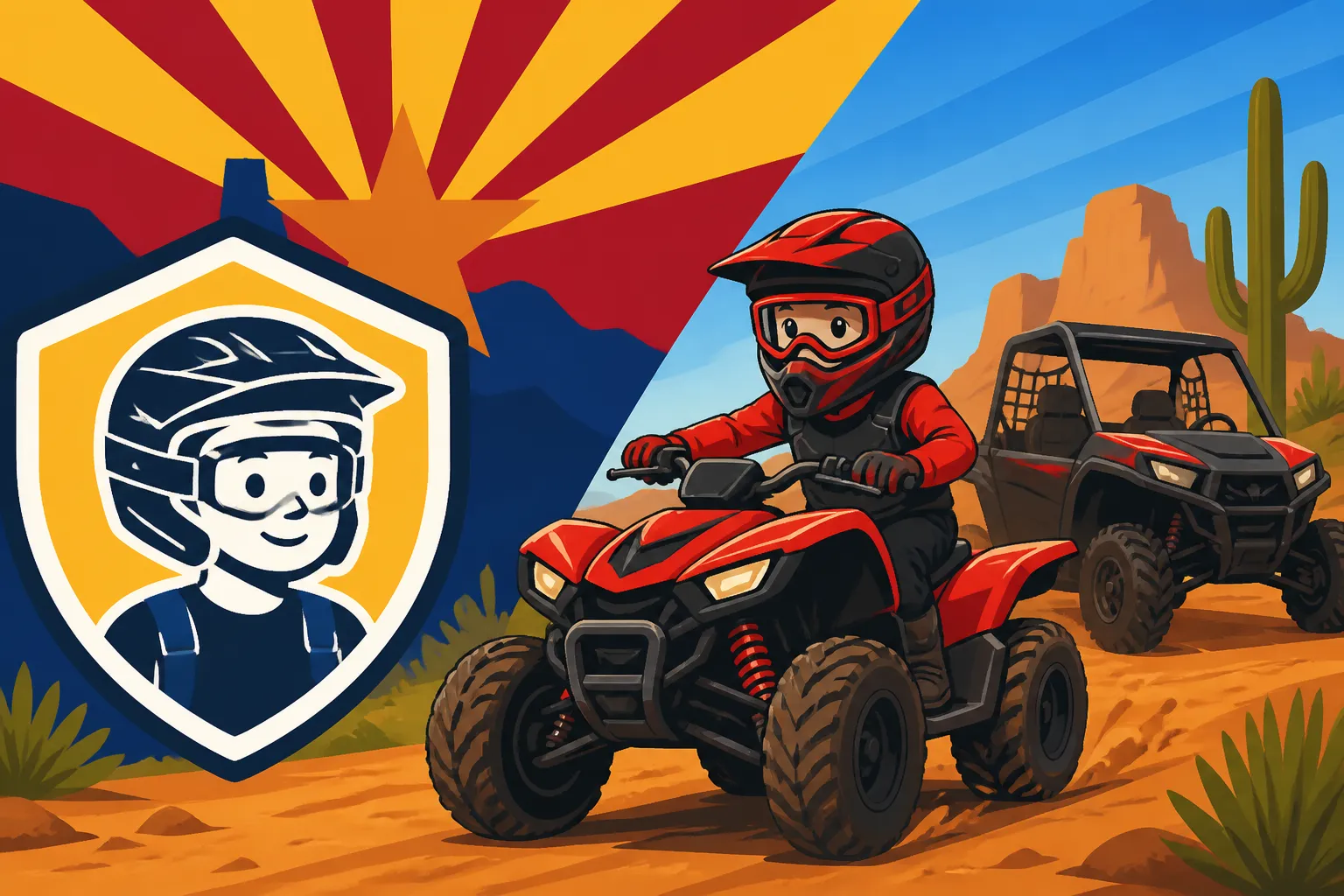
A rider under 12 should wear a properly fitted helmet whenever riding. Arizona has helmet requirements for young riders, and a helmet that is loose, damaged or poorly fastened may not protect the child as intended. Choose protective gear that fits the child now; an adult-sized helmet that shifts around is not a safe substitute. See Arizona Helmet Requirements on State Land for more on helmet rules.
Eye protection matters too. Dust, grit, insects and branches can interfere with a child’s vision, especially in a group ride where another machine is kicking up debris. Use suitable goggles or other protective eye gear, and make sure the child can see clearly without removing it. Gloves, long sleeves, long pants and sturdy footwear help protect against scrapes and hot machine parts.
A child should be able to operate the controls without stretching, leaning dangerously or losing a secure seated position. Before riding, have the child demonstrate that they can:
- Reach and use the throttle and brakes comfortably.
- Steer through a slow turn without losing control.
- Stop promptly when asked.
- Keep both hands and feet in the proper positions.
- Follow directions and stay within the agreed riding area.
These checks do not replace a course or legal requirement. They are a practical way to identify a poor fit before the child is exposed to trail hazards. If the child cannot control the machine confidently in a flat, open area, do not take it onto a trail.
Arizona may require OHV education for some young operators or riding situations. Requirements can depend on the current law, the type of riding and the decal or access rules that apply. Confirm whether the child needs to complete a course and carry proof of completion before the trip; do not assume that an adult’s course or decal covers the child. See Written and Skills Testing in Arizona for related youth-operator information.
Also distinguish training from permission to ride. A completed course does not override an age or machine-size restriction, make a closed route legal, or provide a land permit. Likewise, having the required decal does not mean the child is ready for a difficult trail.
A pre-ride check for parents
Before taking a child under 12 out, work through the details in order. Checking the rules at home is easier than trying to resolve them at a trailhead.
- Identify the machine. Confirm its type, engine capacity, passenger capacity and manufacturer’s rider guidance. Do not rely on appearance or a seller’s description alone.
- Check the youth rule. Confirm how Arizona’s age and engine-size requirements apply to that machine, and whether adult accompaniment is required. If the rules are unclear, verify them with the relevant official authority before riding.
- Confirm the location. Identify the land manager and check whether the route is currently open to that type of OHV. Check separately for State Trust Land, private parcels and road sections.
- Check decal, permit and course requirements. Determine which requirements apply to the child and machine. A requirement for one rider, vehicle or type of land may not automatically satisfy another.
- Fit the protective gear. Check the helmet, eye protection, clothing and footwear before the engine is started. Fasten the helmet securely and make sure it stays in place when the child moves their head.
- Practice in a controlled area. Let the child practice starting, stopping and turning at low speed. If the child is uncomfortable or cannot manage the controls, stop there.
- Choose a route the child can handle. Keep the first ride short, avoid difficult terrain and leave room to turn back. Do not let the group’s pace dictate the child’s speed.
- Set supervision rules. Keep the child within sight, agree on a stop signal, and explain that the child must stop and wait if separated from the group.
If an officer or land manager asks about the child’s operation, the parent may also need to answer questions about supervision and compliance. A child’s mistake can have consequences for the adult responsible for them. See Who Gets the Ticket When an Arizona Child Rides and Citations Arizona Writes to Parents for related information.
The practical standard is straightforward: use a machine the child can control, supervise closely, wear protective gear, and ride only where the machine and rider are allowed. When any one of those conditions is uncertain, pause the outing and confirm the requirement rather than relying on a guess.
Disclaimer
This article is for general informational purposes only and does not constitute professional advice. Laws, prices and regulations vary by location and change over time. Consult a qualified professional for guidance on your specific situation.