Arizona Helmet Requirements on State Land
Arizona’s helmet rule is easy to misread because “state land” can mean different places, and the requirement depends chiefly on a rider’s age. If you’re planning an ATV or UTV trip, this guide explains who must wear a helmet, what to check before riding, and why a permit does not change the safety rule.
Who Must Wear a Helmet on Arizona State Land
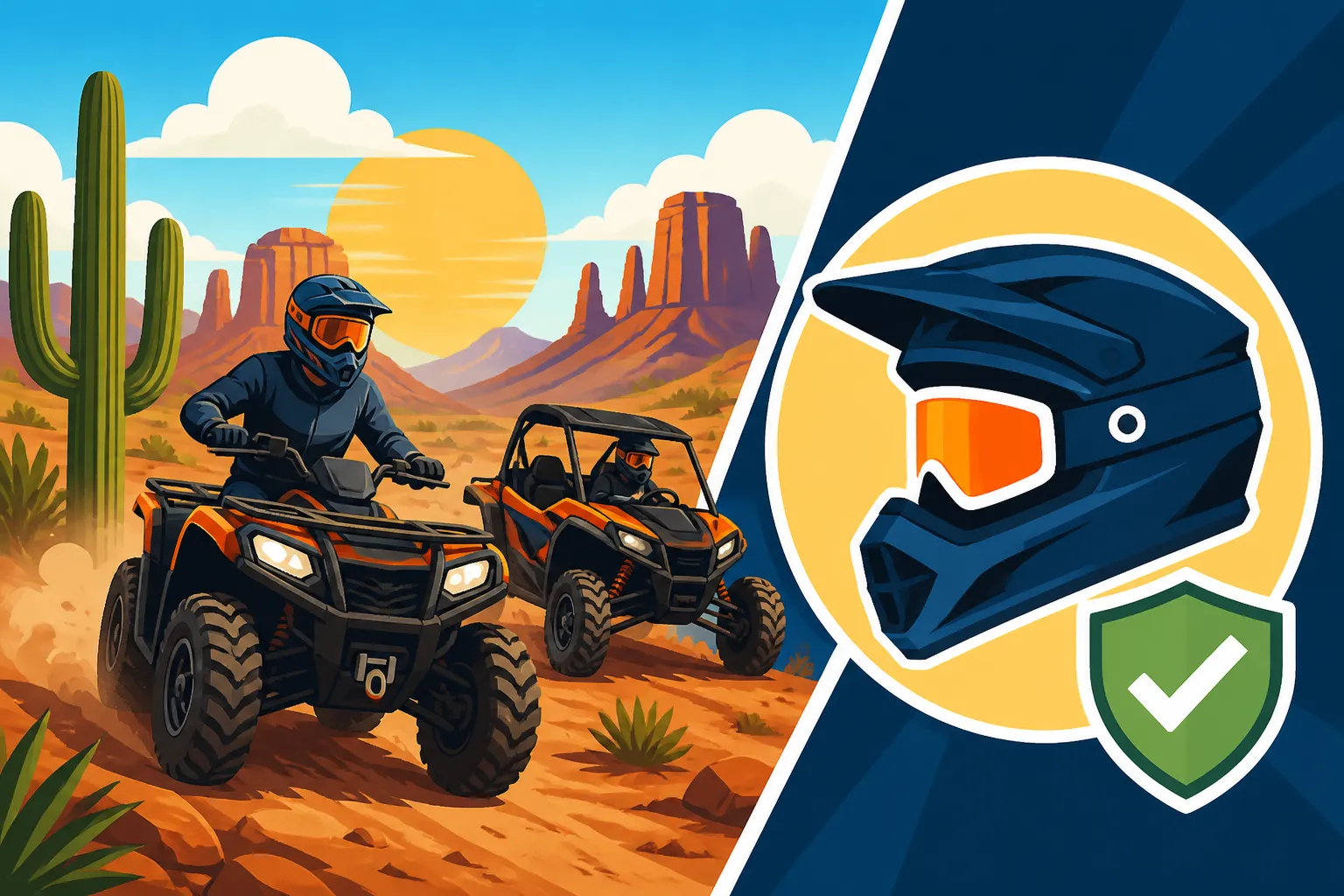
In Arizona, riders under 18 must wear protective headgear when operating or riding as a passenger on an off-highway vehicle on public or state land. The rule applies to both ATV and UTV riders. A passenger under 18 needs a helmet even if an adult is driving.
The requirement is about the rider’s age and where the machine is being operated. It does not depend on whether the child is driving, how slowly the vehicle is moving, or whether the trip is short. A child riding around a staging area or traveling a short distance on a route is still riding an OHV.
For adults, Arizona does not impose the same general under-18 helmet requirement for OHV riding on public or state land. That is a legal distinction, not a recommendation that adults ride bareheaded. Helmets reduce the risk of serious head injury in a rollover, collision, fall, or encounter with rough terrain. Adult riders should consider a helmet essential equipment even where a specific helmet mandate does not apply.
| Rider and setting | General helmet takeaway |
|---|---|
| Operator under 18 on public or state land | A helmet is required |
| Passenger under 18 on public or state land | A helmet is required, even when an adult operates the machine |
| Adult on an OHV in an off-highway setting | The under-18 requirement does not apply, but wearing a helmet is strongly advisable |
| Rider on a public road | Check the separate rules for road use and the machine’s registration |
| Rider on private land | Do not assume public-land rules apply unchanged; the landowner, activity, and other laws may matter |
The table is a practical summary, not a substitute for checking rules that apply to a particular parcel or route. If the machine will travel on public roads as part of the ride, do not treat the off-highway helmet rule as the only rule to consider. Street-legal operation can bring separate equipment and operating requirements. See [Arizona Helmet Rules for a Passenger Under 18] and Arizona Helmet Standards on Public and State Land for related details.
What “state land” means
Arizona has several kinds of land, and riders often use the phrase “state land” loosely. State Trust Land is one category; it is not interchangeable with federal land, a state park, private property, or every place that appears open on a map. Public-land rules can apply across different kinds of land, while access and permit requirements may vary by manager.
For riders, the practical approach is to identify the land manager before heading out. Confirm that the route is open to motorized use, whether a permit or other authorization is required, and whether the vehicle can legally access the route. A helmet requirement does not itself grant permission to ride. Likewise, having permission to access land does not cancel a helmet requirement for a rider under 18.
If the route crosses State Trust Land, review Arizona State Trust Land Recreational Permits and Crossing Arizona State Trust Land. Those issues are separate from helmet use: a properly helmeted rider can still be on a route that is closed or requires authorization.
Choosing a Helmet That Works for the Ride
The law’s age-based requirement is only useful if the helmet is a suitable one and is worn correctly. A loose, damaged, or poorly secured helmet can shift or come off during an impact. Start with a helmet intended for motorized riding, sized for the rider, and suitable for the machine and terrain.
Many families use a DOT-compliant motorcycle helmet as a straightforward way to choose protective headgear. Check the helmet’s certification label and manufacturer information rather than relying on a product title, a seller’s description, or the appearance of a sticker alone. Helmet standards and legal wording can change, so confirm current Arizona requirements if you need to establish whether a particular helmet meets the rule.
Fit matters as much as the label
A helmet should sit level on the head, cover the forehead, and feel snug all around without causing sharp pressure points. If it rocks easily from side to side or lifts when the rider moves their head, it may be too loose or the wrong shape. Fasten the chin strap each time. A helmet that is sitting on the rider’s head but not secured is not ready for a ride.
When selecting a helmet for a child, do not buy one that is much too large on the assumption that the child will grow into it. A helmet that does not fit now may move during a crash. Have the child try it on with the strap fastened, and make sure they can keep it in place comfortably. Recheck fit as the child grows.
A helmet also needs to be in serviceable condition. Look for cracks, crushed areas, damaged straps, loose hardware, or signs that it has been involved in a hard impact. Follow the manufacturer’s instructions for replacement and storage. A helmet can be damaged even if the outer shell does not show an obvious crack.
Match the helmet to the vehicle and conditions
ATV and UTV rides can involve dust, branches, rocks, wind, and changing temperatures. A full-face helmet offers more coverage than an open-face design. Some riders also use eye protection, a face shield, or goggles to help keep debris out of their eyes. Check that the chosen combination works together: goggles should fit the helmet opening, and a shield should not interfere with vision or ventilation.
A UTV’s roll cage, doors, netting, or seat belt do not replace a helmet for a rider under 18 where the helmet rule applies. Those features address different risks. A rollover can still cause a rider’s head to strike part of the vehicle, and a helmet does not replace the required restraint system. Follow the vehicle maker’s instructions for belts, nets, and seating, and keep each occupant in a designated seat.
Adults may choose different helmet styles based on the route, machine, and comfort needs. Whatever the choice, prioritize a secure fit, appropriate certification, and clear vision. Avoid modifications that compromise the shell or strap system, and do not use a helmet that has been altered in a way the manufacturer does not allow.
If you’re shopping online, including through Amazon, read the actual manufacturer specifications and sizing guidance, not just the listing title. Confirm that the product is intended for motorized riding, inspect its certification information, and make sure you can return or exchange it if the fit is wrong. A low price or attractive design does not tell you whether the helmet fits or is suitable.
Planning a Ride With Children or Teenagers
A helmet rule is one part of planning a ride with a young person. The child must also be an appropriate operator or passenger for that machine, and the route must suit their ability. A helmet cannot make an oversized, unstable, or improperly occupied vehicle safe.
Before leaving, check the vehicle’s passenger capacity and instructions. Do not carry a passenger on a machine designed for one rider. In a UTV, each person should use a designated seat and the restraint the manufacturer specifies. Never assume that a child can safely share an adult seat or ride in a cargo area.
Arizona has additional rules and safety requirements affecting young OHV operators. Depending on age and circumstances, education, supervision, or other requirements may apply. Review Arizona Rules for Operators Under 18 and Arizona OHV Education Requirements before a child operates a machine. Those rules are distinct from the helmet requirement: completing an education requirement does not make a helmet optional.
Check the helmet before every ride
A quick check helps catch problems before the vehicle starts:
- Confirm that every rider under 18 has a helmet intended for motorized riding.
- Check the helmet’s size and fit, especially if the rider has grown since the last trip.
- Inspect the shell, liner, strap, and fastener for damage or unusual wear.
- Fasten the chin strap and confirm that the helmet stays in place when the rider moves their head.
- Make sure goggles or a shield do not block vision or interfere with the helmet.
- Recheck the plan for passengers, seating, restraints, and the route.
Make this a routine rather than a last-minute question at the trailhead. A helmet that is left at home, does not fit, or has a broken strap can force the group to change plans. It is better to catch that before driving out.
Rentals and borrowed machines
If you rent or borrow an ATV or UTV, ask in advance whether helmets are supplied and what sizes are available. A shop may provide equipment, but the rider still needs to check fit and secure it properly. If a child’s size is not available, bring a suitable helmet rather than assuming an adult helmet can be adjusted enough to work.
Confirm who is responsible for the vehicle’s passenger equipment and what the rental agreement requires. The rental operator’s instructions do not replace Arizona law. Similarly, a machine owner lending a vehicle to a visitor should not assume the visitor knows the helmet rule. Make expectations clear before the ride.
For a rented machine, age restrictions, driver qualifications, passenger limits, and route restrictions may also affect the trip. See [Arizona Rental Rules for Riders Under 18] and Arizona Rental Rules for Passengers if those issues are part of your plan.
Permits, Land Access, and Other Rules Are Separate
A common mistake is to treat a permit, decal, or registration as an all-purpose pass. These serve different purposes. A helmet requirement concerns protective equipment. A permit or land authorization concerns whether and how a person may use a particular property. Vehicle registration or an OHV decal may address another set of requirements.
Before riding, identify the land and check the rules for that land manager. State Trust Land, federal land, state parks, county roads, and private property can have different access conditions. Some routes are closed to motorized travel, and an open-looking track may not be an authorized route. A permit does not necessarily allow riding anywhere on the land it covers.
The same separation applies to road sections. A trail ride may include a road crossing or a stretch of road open to OHVs. The requirements for that part of the trip can differ from those for riding off-road. Check the route and the rules for road operation, rather than assuming that the helmet rule for off-highway use answers every question. See Arizona Rules on Forest Service Roads and Arizona Rules on BLM Roads when those land managers are involved.
A practical pre-trip check
Use this sequence when planning a family ride:
- Identify the land. Find out whether the destination is State Trust Land, federal land, a state park, private property, or a mix.
- Confirm motorized access. Check current maps and notices from the land manager. Do not rely solely on a route line in a navigation app.
- Check authorization. Determine whether the rider needs a permit, decal, registration, or other permission for the machine and land.
- Review rider requirements. Confirm age-related rules, operator qualifications, education requirements, passenger capacity, and supervision needs.
- Prepare protective gear. Fit and secure helmets for riders under 18, and consider helmets for adults as well.
- Check the machine. Verify seating, restraints, tires, lights, and other equipment appropriate to the route.
- Recheck conditions. Access restrictions and route conditions may change. Confirm before departure, particularly if the trip depends on a specific crossing or trail connection.
If you are unsure whether a route qualifies as public or state land for the helmet rule, do not guess based on the landscape or the fact that there is no gate. Confirm the land status and applicable requirements with the responsible agency. If the route includes private property, get permission and check any rules that apply to that property and activity. Arizona Rules on Private Land covers the separate question of riding on private ground.
Common Helmet Mistakes to Avoid
The most important mistake is treating the rule as applying only to the person driving. A passenger under 18 is also covered on public or state land. Another is assuming a child can skip a helmet for a short trip, a slow ride, or a brief stop-to-stop transfer. The safer and simpler rule for a trip is to have the helmet on and secured whenever the young rider is on the machine.
Other errors are less obvious:
- Buying a helmet by age instead of fit. Children the same age can need different sizes and shapes.
- Leaving the strap loose. A helmet can shift or come off if it is not fastened.
- Relying on a product description alone. Verify manufacturer information and certification details.
- Treating a UTV cage as a substitute. A cage and restraints do not replace head protection where it is required.
- Assuming a permit changes the safety rule. Access permission and equipment requirements are separate.
- Assuming every “state” or “public” parcel has the same access rules. Land status and route authorization need separate checks.
- Ignoring road sections. Rules for off-highway riding do not automatically cover street-legal operation or every public-road segment.
- Using a helmet after significant damage. Follow the manufacturer’s guidance after an impact or when the helmet shows signs of damage.
Adults sometimes take the legal minimum as a signal that a helmet is unnecessary. That is a personal risk decision, but it is not a sound safety shortcut. A helmet can reduce exposure to head injuries, while eye protection, seat belts, sensible speed, and route selection address other hazards. No single piece of gear eliminates risk.
When in doubt, choose the more protective option and confirm the current rule with the land manager or appropriate Arizona agency before the trip. The key legal takeaway remains straightforward: riders under 18 need protective headgear when operating or riding as a passenger on an OHV on public or state land.
Frequently Asked Questions
Does a child passenger need a helmet if an adult is driving?
Yes. A passenger under 18 must wear a helmet on an OHV on public or state land. The requirement is not limited to the operator.
Do adults have to wear helmets on Arizona state land?
The general under-18 OHV helmet requirement does not apply to adults. Adults should still wear helmets for protection, and separate rules may apply if the machine is being operated on a public road or under a specific land-use condition.
Does a State Trust Land permit replace the helmet requirement?
No. A permit addresses access or authorized use; it does not cancel the helmet requirement for a rider under 18. You may need to satisfy both access rules and safety rules.
Can a child use any helmet that fits?
Do not assume that any helmet is suitable. Choose protective headgear intended for motorized riding, verify its certification and manufacturer information, and make sure it fits snugly and fastens securely. Check current requirements if you need to confirm a specific helmet meets Arizona’s rule.
Disclaimer
This article is for general informational purposes only and does not constitute professional advice. Laws, prices and regulations vary by location and change over time. Consult a qualified professional for guidance on your specific situation.