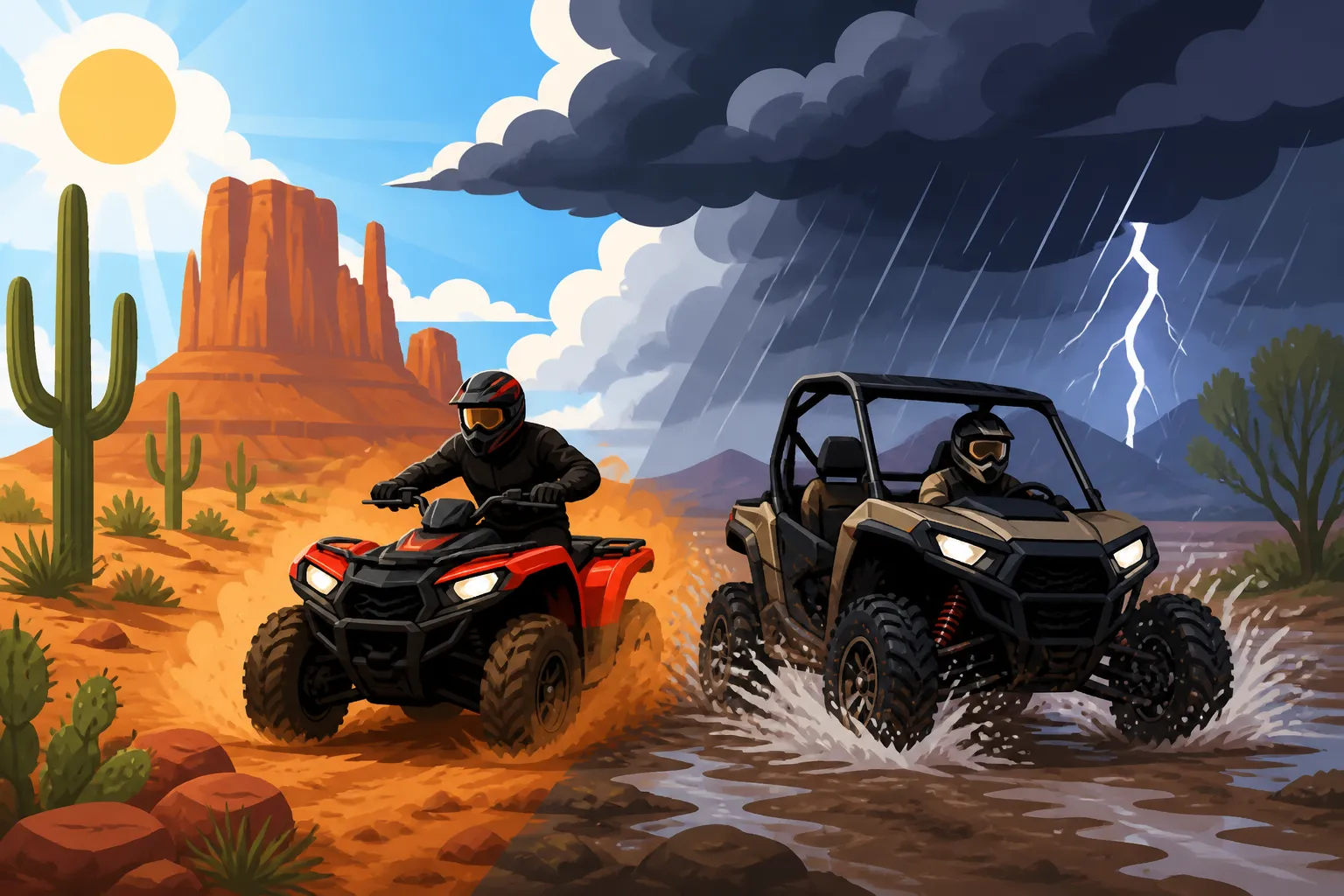
Arizona Monsoon Months and Riding
Arizona’s monsoon can turn a familiar ATV or UTV route into a muddy climb, a flooded wash, or a road blocked by storm damage. The season brings dramatic scenery, but showers are highly localized and a storm miles away can send water through a dry canyon. This guide explains when monsoon riding makes sense, how to plan around changing conditions, and when to turn back.
When Arizona’s Monsoon Season Affects ATV and UTV Riding
What months are monsoon months in Arizona
Arizona’s designated monsoon season generally runs from June 15 through September 30. That’s a broad seasonal window, not a promise of daily rain. Storm activity is often more noticeable in July and August, but timing and rainfall vary by year, elevation, and location. A sunny morning in Phoenix or Tucson does not mean the trails near Flagstaff, Sedona, or the Mogollon Rim are dry.
For riders, the important detail is that monsoon weather can change quickly. A route that was dusty and easy to follow on the way out may be wet, rutted, or crossed by flowing water on the return. A thunderstorm may also build over higher ground while the trailhead remains clear. If you’re planning a ride near a canyon or drainage, check the forecast for the whole area rather than relying on what the sky looks like where you’re standing.
Arizona’s monsoon patterns are explained further in Arizona Monsoon Season and Flash Flooding. Treat the season as a reason to plan more carefully, not as a reason to assume every ride will be rained out. Early starts can help you avoid some afternoon storms, but they don’t remove the need to watch the sky and reassess your route.
How monsoon weather changes across Arizona
Conditions differ sharply between Arizona’s low desert and higher country. Around Phoenix and the Sonoran Desert, monsoon storms can bring intense rain, dust, lightning, and rapid flooding while temperatures remain punishingly hot. Near Flagstaff and the Mogollon Rim, cooler temperatures don’t eliminate the risks: storms can make forest roads slick, reduce visibility, and create runoff on steep or rocky routes. Sedona’s red-rock terrain can also become slippery when wet, and a storm over one drainage may leave another route dry.
That contrast is one reason a general forecast for a nearby city can be misleading. Check conditions for the trail system and surrounding terrain, and look at the forecast along your entire planned route. Before heading toward higher elevations, review Riding Arizona High Country in Summer for planning considerations that differ from a low-desert ride.
It also helps to think in terms of exposure and escape options. A short loop near a well-used staging area gives you more ways to head back if clouds build. A long route through narrow washes or remote country may leave you with fewer safe choices once the weather turns. If the forecast calls for storms, choose a route where you can retreat without needing to cross a drainage that could be carrying water.
How to Plan a Monsoon Ride
Check weather and route conditions before you leave
Check the forecast for the riding area, not only your home, hotel, or staging lot. Look for thunderstorm chances, storm timing, wind, and any weather alerts. Then check the route and access information as well. A storm can leave a road blocked or damaged even after the rain has stopped, and a route that looks passable on a map may have an exposed wash crossing or a steep, vulnerable section.
Use Checking Arizona Trail Status Before You Drive as part of your pre-trip routine. If your ride depends on a particular access road, confirm that the road and trailhead are open before towing out. A map app such as onX Offroad can help you review your planned route and identify alternate tracks, but a mapped route is not confirmation that it is open, safe, or passable after a storm. Verify conditions with the relevant land manager when possible.
Have a simple decision point before you go. For example: if thunderstorms are expected to build over the route during the ride, you’ll choose a shorter loop or postpone. Agreeing on that in advance can prevent the familiar trail-day argument where one person wants to push on because the sky still looks clear.
Choose a route with room to adapt
On a day with possible storms, favor a route that has clear turnarounds and more than one way back. Avoid making a remote canyon, steep crossing, or single access road your only exit. If your route includes a wash, ask whether you can stay on higher ground or choose a different loop. A little less distance is a fair trade for a route that lets your group change plans quickly.
Before setting out, share the route and expected return time with someone who isn’t riding. Make sure everyone in the group knows the plan and the point at which you’ll turn around. For help thinking through vehicle staging and parking, see Arizona Trailhead Parking and Staging. Keep your vehicle and trailer out of washes and other low spots, even if they are dry when you arrive.
A paper map or an offline map is useful if cell service drops. onX Offroad can be useful for reviewing tracks and possible alternatives before you leave, but download or prepare what you need ahead of time rather than assuming a connection will be available in the backcountry. Your backup plan should work if a phone battery dies, a route is blocked, or the group has to return by a different track.
| Riding condition | More cautious choice | Reason |
|---|---|---|
| Storms forecast near the route | Shorten the ride or reschedule | Storm timing can shift, and rainfall may be intense |
| Dark clouds building over nearby high ground | Turn back toward a safe exit | Runoff can reach a wash before rain reaches you |
| Trail surface is wet, slick, or visibly eroding | Stop and reassess | Continued traffic can increase risk and damage |
| Water is moving across a road or trail | Do not enter the crossing | Depth and current can be hard to judge |
| Access or closure information is unclear | Confirm with the land manager | A route may be closed or unsafe after a storm |
Prepare for heat as well as rain
Monsoon clouds can make the desert feel cooler for a short time, but heat remains a serious concern. Humidity, riding effort, protective gear, and time spent stopped on the trail can all add to the strain. Carry more water than you expect to need, and don’t treat a cloudburst as a substitute for drinking water. For a fuller plan, use Water Planning for an Arizona Trail Day and learn the warning signs described in Heat Illness on a Summer Trail.
Pack rain protection that works with your riding gear, but keep your priorities in order: staying dry matters less than avoiding lightning, floodwater, or an unsafe route. Secure loose items so they don’t blow out of a vehicle or trailer in strong wind. Bring a charged phone, a way to navigate offline, and a first-aid kit. In remote areas, a satellite messenger can provide an important backup when ordinary phone service is unavailable.
Tell the group what you’ll do if rain starts. Decide whether you’ll stop in a safe location, return by a known route, or wait for conditions to improve. Don’t stop beneath an isolated tree during lightning, and don’t shelter in a wash or drainage. The best emergency plan is one that doesn’t require anyone to guess while weather is already deteriorating.
Flash Floods, Lightning, and Trail Conditions
Never assume a dry wash is a safe crossing
A dry wash can flood after rainfall upstream, even when the sky above you is blue. Water may arrive suddenly, carrying mud, branches, and debris. It can also rise faster than it appears from a distance. Never drive an ATV, UTV, or tow vehicle into moving water when you can’t confidently assess the crossing; in practical terms, the safest choice is to turn around rather than test it.
The risks of runoff are covered in Flash Flooding in a Desert Wash and Rain 20 Miles Away and a Flooded Canyon. Keep in mind that the danger can come from a storm you can’t see. If you hear a sudden rush, notice water rising, or see debris moving through a channel, get out of the drainage and move to higher ground if you can do so safely. Don’t park or camp in a wash while waiting for a storm to pass.
A group should agree that anyone can call a stop when conditions seem unsafe. If one rider sees a change in the water or hears thunder, pause the ride and reassess together. Waiting for someone else to raise the concern can waste valuable time, especially when the route has a narrow exit or a crossing ahead.
Take wet ground seriously
Monsoon rain changes the way trails behave. Loose sand can shift, rocky surfaces can become slick, and clay or fine dirt may cling to tires. A shallow rut can deepen under repeated traffic. In wooded or higher-elevation areas, runoff may also wash debris across a road or obscure where the surface edge has broken away.
Slow down when the ground is wet, leave extra room between vehicles, and avoid sudden steering or braking on slippery sections. Don’t assume the rider ahead has chosen a safe line simply because they made it through. If a hill or crossing looks beyond your group’s ability, turn around rather than adding risk to an already difficult surface.
There’s also a leave-no-trace consideration. Spinning tires through wet soil can widen a route, create new ruts, or damage the trail. If a route is too soft to travel without digging it up, wait for conditions to improve or choose another area. Check Arizona Fire Restrictions by Stage before heading out, too: storms may bring lightning, but rain does not automatically mean that every closure or restriction has ended.
Treat lightning and poor visibility as reasons to stop
A thunderstorm can arrive with little warning, and open desert terrain may offer few places to shelter. If thunder is close or lightning is visible, get off exposed ridges and avoid standing near isolated trees or tall objects. Follow current safety guidance and seek appropriate shelter if available; a vehicle with a hard-topped enclosed cab is safer than remaining exposed on an open machine, but it does not make the surrounding trail safe to continue.
Rain, dust, and low clouds can also make it difficult to see other riders, trail markers, and changes in the ground. Slow down, increase following distance, and use lights when visibility drops. If you can’t see far enough to ride safely, stop in a location away from washes and traffic, then decide whether it’s safer to wait or return by a known route.
Don’t rely on a phone map to guide you through poor visibility or storm damage. onX Offroad can help you see your location and planned route, but it can’t show you whether a wash is flooding or a road has eroded since the map was prepared. Use it as one planning tool, stay alert to the terrain, and be willing to abandon the route.
Deciding Whether to Ride or Turn Back
Use clear turn-around triggers
It’s easier to make a cautious decision when you’ve agreed on the warning signs in advance. Turn back or stop in a safe place if you see water moving across the route, hear thunder getting closer, encounter heavy rain or blowing dust, or find that the trail has become slick enough that your group is struggling to maintain control. A blocked road or fresh erosion is another reason not to improvise a new route through unfamiliar ground.
A useful group rule is that nobody has to prove a trail is dangerous before the group changes plans. If a rider feels uneasy about a crossing or weather shift, take that concern seriously. The goal isn’t to complete the loop at all costs; it’s to bring the group and machines back safely.
If you turn around, use the route you know rather than following an unfamiliar track to save time. Check your map, keep the group together, and stop somewhere safe if visibility or conditions worsen. If you’re using onX Offroad, keep the route visible as a navigation aid, but confirm turns against the terrain and don’t let a line on the screen persuade you to continue into unsafe conditions.
Check again after the storm
A storm passing overhead doesn’t mean a route is ready to ride. Water may still be draining through low areas, and roads can remain muddy, washed out, or blocked by fallen branches. Before towing back to the area, check access and closure updates again. If information is incomplete, choose a different riding area rather than finding out at the end of a long drive.
When you do return, ride gently and watch for fresh damage. Avoid driving around a barrier or creating a new track to bypass a flooded or damaged section. Report a serious hazard to the appropriate land manager when practical. Leaving a route alone until it is safe protects both riders and the trail.
Monsoon riding can still be rewarding: cooler cloud cover, dramatic desert skies, and a landscape that looks completely different after rain. The trick is to stay flexible. Pick a route with safe exits, keep an eye on weather beyond the trailhead, and treat flowing water and lightning as firm reasons to stop rather than challenges to push through.
Disclaimer
This article is for general informational purposes only and does not constitute professional advice. Laws, prices and regulations vary by location and change over time. Consult a qualified professional for guidance on your specific situation.