Arizona Fire Restrictions by Stage
A planned Arizona ride can change quickly when dry weather prompts fire restrictions, and “Stage 1” does not mean the same thing on every parcel of land. This guide explains how stages generally work, what ATV and UTV riders should check before leaving home, and how to avoid a preventable fire or citation when conditions are dry.
How Arizona fire restrictions work
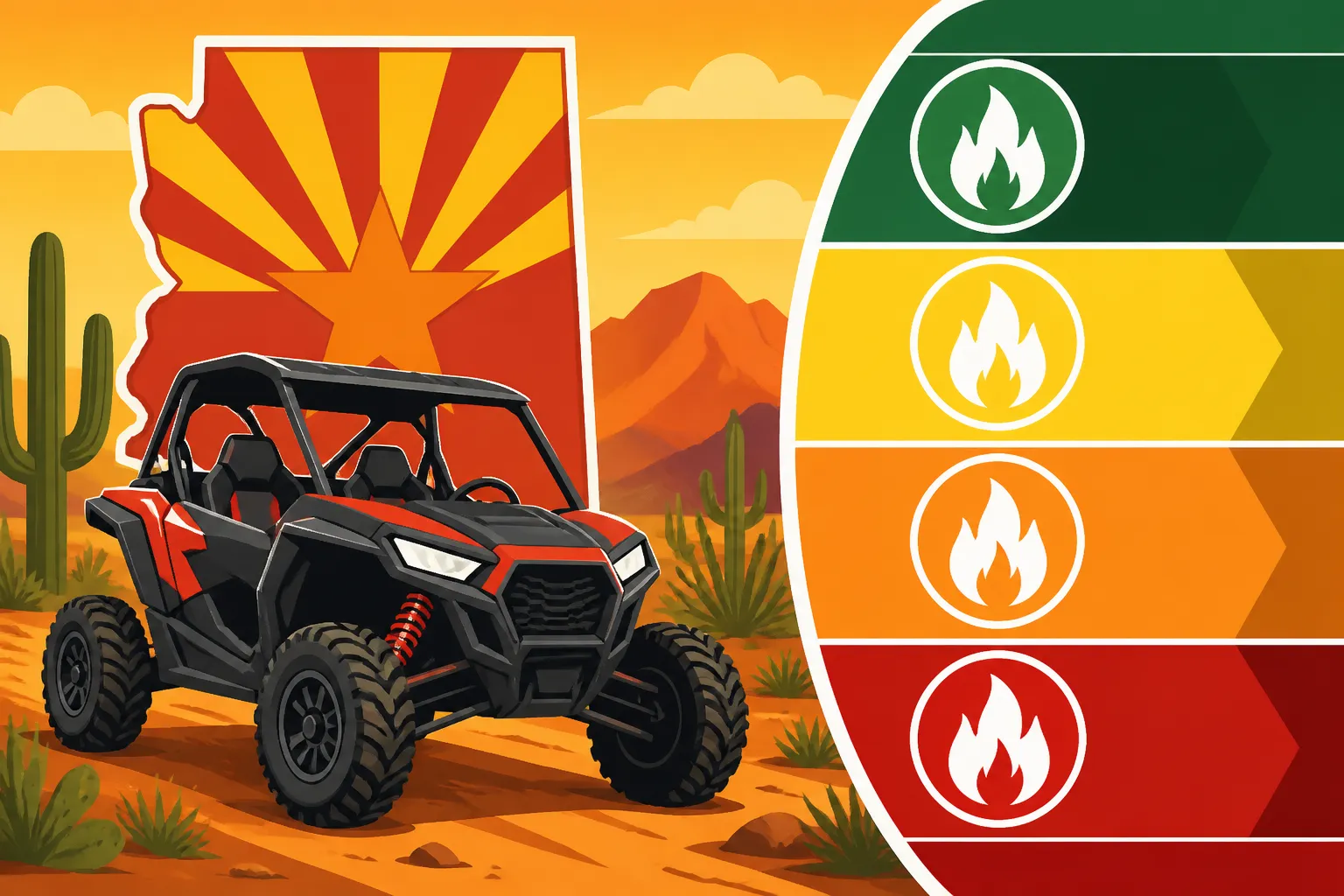
Fire stages are a framework, not one statewide rulebook
Arizona does not have one fire-restriction notice that automatically governs every trail, road, and campsite. Restrictions may be issued by federal land managers, state agencies, tribal governments, counties, cities, or private landowners. A route that crosses more than one jurisdiction can therefore pass through areas with different rules, even if the landscape looks continuous.
Agencies commonly use stages to communicate escalating fire danger and increasingly strict limits on activities that could start a fire. The stage number is useful shorthand, but it is not a complete description of what is allowed. One agency’s Stage 1 restrictions may differ from another agency’s, and a local order may include conditions that do not appear in a general explanation of that stage.
This is why a screenshot of a restriction notice from last season—or a friend’s recollection of what was permitted on a previous ride—is not enough. Check the official order for the specific land and date you plan to visit. Read the details, including any maps, exceptions, start times, and expiration language.
Stages often tighten restrictions as fire danger increases
In broad terms, Stage 1 restrictions often limit activities such as campfires, smoking, or equipment use that can produce sparks, especially outside developed or designated areas. Stage 2 restrictions commonly add stronger limits and may prohibit more types of open flame or spark-producing work. These are general patterns, not guarantees. The written order is what matters.
A restriction may also apply differently to a day ride than to an overnight trip. For example, a rule may address fires at dispersed campsites but say nothing about riding on an open route. Another order may restrict access to a specific area altogether. Riders need to distinguish between a restriction on an activity and a closure of the land or route itself.
The practical takeaway is simple: do not assume that “no campfires” is the only rule, or that a trail remains open just because motorized travel is not mentioned in a social-media post. Look for the full notice from the managing agency. For a broader seasonal picture, see [Arizona Stage One Fire Restrictions] and [Arizona Stage Two Fire Restrictions].
What fire restrictions mean for ATV and UTV riders
An open trail does not automatically make every activity legal
Some fire orders leave established roads and trails open while restricting campfires, smoking, target shooting, or certain equipment. Others close roads, trails, staging areas, or entire blocks of land. The wording can be precise: a route might remain open to travel while stopping, camping, or staging off-route is restricted.
Pay attention to how the notice defines the affected area. A closure boundary may follow a road, a forest boundary, a parcel line, or a map polygon that is not obvious from the ground. An OHV route can also run near land with a different manager. If you cross from national forest to Bureau of Land Management ground, for example, do not assume a notice issued for one agency’s land covers the other—or that the neighboring agency has no restrictions of its own.
In practical terms, keep riding, camping, and vehicle access as separate questions. Confirm that the route is open, then check whether your planned stops, overnight camp, cooking setup, or maintenance activity are permitted. Before heading to a popular destination, review [Where Arizona Closure Notices Are Posted] and [Checking Arizona Trail Status Before You Drive].
A spark arrestor is important, but it does not cancel other duties
A properly maintained spark arrestor can reduce the chance that hot particles leave an exhaust system, and it may be required for riding in particular settings. But having one does not give a rider permission to ignore a fire order. Restrictions can address multiple ignition sources, and an agency may require equipment to meet specific standards or be in good working condition.
A spark arrestor is only one part of a careful pre-ride inspection. Check that the exhaust is secure, the machine is not leaking fuel or oil, and wiring or aftermarket parts are not rubbing against hot components. Remove dry grass, seed heads, and other plant material from around the exhaust and engine. A UTV that has just crossed tall, dry vegetation may carry combustible debris in places that are easy to miss.
The same care applies to trailers and tow vehicles. A dragging safety chain can throw sparks, while hot exhaust or a catalytic converter can ignite dry grass if a vehicle is parked off the road. Use a stable, cleared parking area where permitted, and avoid pulling onto dry vegetation simply because the shoulder looks convenient. For more detail on equipment, see [Arizona's Spark Arrestor Requirement] and [Why a Spark Arrestor Runs Whenever the Engine Does].
| Riding or trip activity | What to check | Safer approach |
|---|---|---|
| Riding an established route | Whether the route is open under the specific order | Confirm the route and land manager before departure |
| Stopping for a break | Rules on stopping, parking, and leaving the route | Use an allowed, durable surface away from dry vegetation |
| Cooking or making a fire | Restrictions on open flame, stoves, and charcoal | Read the order carefully; do not assume a stove is exempt |
| Carrying or using tools | Rules for equipment that can create heat or sparks | Postpone nonessential repairs or spark-producing work |
| Towing a trailer | Chain condition, tire condition, and parking location | Secure chains and keep hot vehicle parts off dry grass |
| Riding during a closure | Whether access is limited by route, boundary, or land unit | Turn around rather than testing an unclear boundary |
How to check restrictions before a ride
Identify every land manager along your route
Start with the route, not just the destination name. “We’re riding near Flagstaff” or “we’re going to the desert outside Phoenix” is too broad to establish which rules apply. A ride can involve national forest, BLM land, state trust land, a county road, or private property. Each may have a different responsible office and a separate restriction notice.
Use a current travel map to identify the roads and trails you intend to ride and the land boundaries they cross. onX Offroad can help with route planning and seeing mapped land information, but treat any app as a planning aid rather than the final authority on fire restrictions. Confirm boundary questions, closures, and active orders with the relevant land manager before you unload.
This matters especially when a route has several access points or crosses a jurisdiction boundary without a visible sign. If you are planning a ride around Coconino National Forest, for instance, verify the specific forest area and any neighboring land involved rather than relying on a general search for “Flagstaff fire restrictions.” For map-reading help, see [Finding the Right Travel Management Map] and [Reading an Arizona Motor Vehicle Use Map].
Verify the order and its effective dates
Once you know who manages the land, find that agency’s official restriction notice. Check the order itself, not only a short headline or a reposted summary. The notice may specify which activities are prohibited, where the restrictions apply, when they begin, and whether they remain in place until another announcement.
Look closely for map attachments and descriptions of boundary roads. If your route lies close to a closure edge, do not guess based on a phone map’s appearance. Contact the responsible office if the written boundary is unclear. Save the notice or its details for reference, but check again shortly before departure because conditions and orders can change.
A planning app can make it easier to review a route and identify the offices to contact. onX Offroad may be useful for organizing a route and checking mapped context; still, open the agency’s own notice for the restrictions that govern your trip. A responsible plan uses both: a map for route awareness and official information for the rule. See [Arizona Fire Restrictions by Stage] and [Where Arizona Closure Notices Are Posted] for related planning considerations.
Stage-specific planning for a desert or high-country ride
Before a Stage 1 ride
When Stage 1 restrictions are in effect, resist the temptation to interpret the stage label as permission to proceed with anything not expressly mentioned in a short summary. Read the full order and note restrictions on fires, smoking, camp stoves, equipment, and vehicle access. If you are riding with a group, share the relevant rules before meeting at the trailhead so everyone arrives with the same expectations.
Pack for a ride that does not depend on an open flame. Bring enough water and food that you will not need to improvise a cooking setup, and keep smoking materials controlled and fully extinguished if smoking is allowed at all. Do not toss cigarette ends, matches, or hot ash. Even a small ember can travel or land in dry grass beyond the spot where it was discarded.
Before unloading, look over the staging area. Check for signs, posted notices, dry vegetation, and any local direction about parking or idling. A Stage 1 order may leave a route open but still restrict an activity you expected to do at camp. If your trip depends on a campfire or a particular cooking method, choose a different plan rather than trying to find a loophole.
Before a Stage 2 ride or a full closure
A Stage 2 notice should prompt a more cautious review, not just a quick check for campfire rules. Some orders may prohibit a wider range of flame or spark-producing activities, and others may close specific roads or areas. Because the exact terms vary, the stage number alone cannot tell you whether your machine, route, or planned stop is allowed.
If a route is closed, do not treat a nearby alternative track as an acceptable substitute. An unmarked two-track may be outside the legal route network, cross private or restricted land, or enter the same closure area from another direction. Turn around at the boundary and use a route that the managing agency confirms is open. A closure is not a challenge to navigate around.
If the order is unclear, choose the conservative option: postpone, relocate, or contact the land manager before riding. This is especially sensible when the trip includes dispersed camping, a long route with limited exits, or an area where a fire could threaten homes, wildlife, or public access. For updates and route-planning context, consult [Arizona Fire Restrictions by Stage], [Full Closures on Arizona Public Land], and [Arizona Road Closures During Fire Restrictions].
A practical fire-safety checklist for riders
Prepare the machine, trailer, and group
Before loading, inspect the machine for fuel leaks, damaged wiring, loose exhaust components, and packed vegetation. Give particular attention to the area around the engine, exhaust, skid plates, and suspension, where dry material can collect during a ride. If you have recently changed the exhaust or installed accessories, make sure the setup remains secure and appropriate for the places you plan to ride.
Inspect the tow vehicle and trailer, too. Confirm that safety chains cannot drag, tires are in sound condition, and the trailer wiring is not dangling near the road. At a staging area, park only where allowed and avoid dry grass or brush. These small checks take a few minutes, but they address preventable sources of heat and sparks before the group is spread out on a trail.
Designate someone in the group to verify the day’s restrictions and communicate them at the trailhead. That person should know the route, the land managers involved, and the plan if a road or staging area is closed. Group leaders can also review [Arizona Fire Restrictions by Stage] and [Planning an Arizona Riding Trip] before setting a departure time.
Ride in a way that limits fire risk
Stay on routes that are open and designated for motorized travel. Cutting across vegetation can damage the landscape and may bring a hot exhaust or undercarriage into contact with dry plants. If a route is blocked by a closure sign, fire activity, or an agency barrier, stop and turn around rather than creating a new path around it.
Choose breaks carefully. Avoid parking over dry grass, brush, or other material that could touch hot vehicle components. Do not leave a machine idling unattended, and do not conduct repairs involving sparks or open flame unless the order permits the work and the location is appropriate. If a machine develops a mechanical problem, move only as far as is safely and legally necessary, then contact help rather than attempting a risky roadside repair.
Keep your group together and make sure every rider understands the plan for a closure or emergency. In a dusty convoy, riders at the back may not see a warning sign or hear an instruction immediately. Use a clear regrouping procedure, carry navigation information that remains usable where cell service is weak, and tell someone at home where you intend to ride. More planning advice is available in [Cell Service in the Arizona Backcountry] and [Riding Alone in the Arizona Desert].
If you see smoke or discover a fire
Do not assume a small flame will stay small. Move away from the immediate danger, warn other riders, and contact emergency services or the responsible land manager when it is safe to do so. Share clear location information, including a nearby road, trail name, mile marker, or recognizable landmark. If you use a mapping app such as onX Offroad to understand your position, communicate the location in a way dispatchers or agency staff can use, and do not delay reporting while trying to perfect a map pin.
Do not ride toward a fire to get a closer look or to help without direction. Wind can shift, smoke can obscure the route, and a wash or narrow canyon can become hazardous quickly. Leave room for emergency vehicles, keep other riders from entering the area, and follow instructions from responders or law enforcement.
After the immediate danger has passed, do not return through a closed area until officials reopen it. Roads may remain restricted because of fire activity, damaged infrastructure, crews working, or hazards that are not visible from the trail. Check official notices again before planning a return trip, and make sure the route you use is permitted for motorized travel.
Disclaimer
This article is for general informational purposes only and does not constitute professional advice. Laws, prices and regulations vary by location and change over time. Consult a qualified professional for guidance on your specific situation.