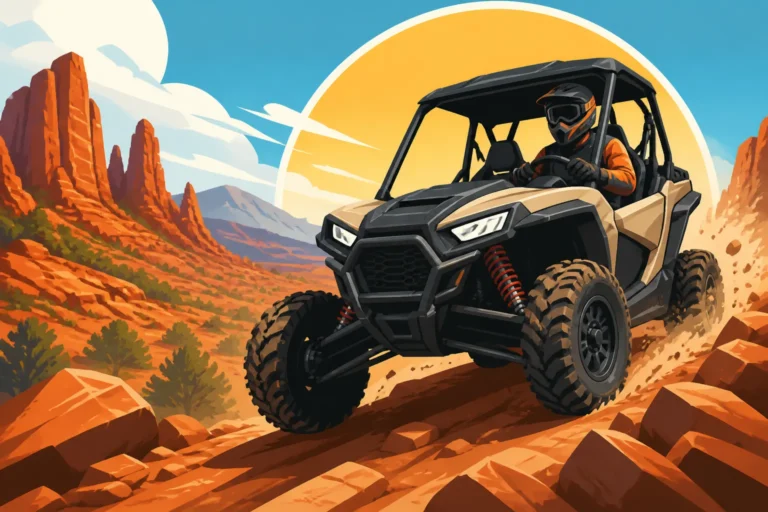
Crossroads OHV Area Near Parker
Crossroads OHV Area near Parker is an appealing desert ride, but it’s easy to arrive without checking the route, land access, or conditions first. This guide explains how to plan a safer visit, what to expect from the riding, what to confirm before unloading, and how to prepare for the heat and remote stretches around Parker.
Planning a ride at Crossroads OHV Area
Where the area fits into a Parker trip
Crossroads OHV Area is associated with Parker, in western Arizona’s La Paz County, and is one option for riders exploring the Parker and Colorado River region. It can fit into a weekend based in Parker or a broader trip that also takes in the [Lake Havasu and Parker Strip]. The practical advantage of a local riding area is that you can plan a ride without treating the day as a long-distance expedition—but desert conditions still call for careful preparation.
Before setting out, pin down the specific staging point and route you intend to use. “Crossroads” on a map or in a riding conversation may not give you enough information to identify a legal entrance, an open route, or a place where trailers can safely park. Check current land-management information and a detailed map before you leave, especially if your plan involves connecting routes or exploring beyond the area you already know.
It also helps to plan your day around your group rather than simply picking the longest loop available. A newer rider, a family with children, and an experienced group in full-size UTVs may have very different ideas of a comfortable ride. A shorter first outing gives everyone a chance to assess the terrain, vehicle handling, and pace before committing to a longer route.
Check routes and boundaries before unloading
Desert routes can cross or approach land with different access rules. A trail that appears continuous on a phone screen may lead to a closed route, private property, or land requiring additional permission. Use land-management maps and posted signs to confirm where motorized travel is allowed, and don’t create a new track to get around an obstacle. For general map-reading pointers, see [Reading an Arizona Motor Vehicle Use Map] and [Arizona Trails on State Trust Land].
A GPS app can be useful for tracking your position, but it shouldn’t be your only source of information. Download maps for offline use before leaving town, and compare your intended route with current official access information. Riders who use onX Offroad can save a route in advance and keep a reference available when cellular service is weak. Still, an app’s displayed route is not a substitute for obeying signs or confirming current land rules.
If you’re unfamiliar with the area, keep the first ride conservative. Choose a route that allows an easy return to the staging area, identify a turnaround point, and tell someone who isn’t riding where you plan to go. A simple plan matters if a machine develops a problem or the group needs to head back earlier than expected.
What to expect on the ride
Terrain, pace, and vehicle fit
Expect a desert environment where conditions can change along a ride. Depending on the route, you may encounter open stretches, uneven ground, loose or sandy sections, rocky areas, and washes. Don’t assume that every route has the same surface or difficulty, or that a path suitable for one machine will be comfortable for another. Check the route details and assess what your group can handle before you leave the staging area.
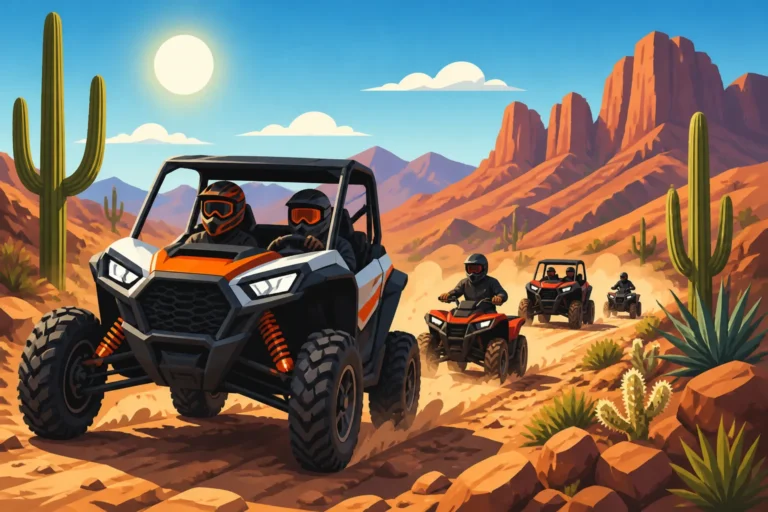
A suitable vehicle is one that matches both the route and the riders. A machine’s width, ground clearance, tires, and passenger capacity all matter, particularly when the route is narrow or the ground is rough. For a multi-machine group, agree on a pace that allows the least experienced rider to keep up safely. Leave space between vehicles so the rider behind isn’t forced to drive through another machine’s dust cloud without a clear view.
| Planning question | What to consider |
|---|---|
| How experienced is the group? | Choose a route and pace that suit the least experienced rider. |
| What machines are coming? | Confirm that width, clearance, tires, and passenger capacity suit the intended route. |
| How long will the ride take? | Include time for stops, navigation, and an early return if conditions change. |
| Are you relying on phone service? | Download maps and share the plan before leaving the staging area. |
| Could weather change the route? | Recheck conditions, especially if rain may affect washes or access roads. |
Don’t let a route name, an online track, or another rider’s description make the decision for you. Conditions change, and a route that felt straightforward to someone in a different machine may be a poor fit for your group. If you reach a section that looks unsafe or outside your comfort level, turn around rather than pressing on because you’ve already invested time in the ride.
Plan around weather and daylight
The Parker area can be intensely hot, and the open desert offers limited shade. Cooler parts of the year are generally more comfortable for a longer outing, while summer riding calls for extra caution and a realistic plan to avoid the hottest part of the day. Check the forecast before you leave, but also pay attention to what you see on the ground: dark clouds, rising water, or changing wind can be a reason to shorten the ride.
Rain can create serious risks even when it falls some distance from your location. A dry wash may not remain safe if water is moving downstream from a storm elsewhere. Don’t enter flowing water or try to cross a flooded wash. For more on this hazard, read [Arizona Monsoon Season and Flash Flooding]. If conditions are changing, return by a known route and avoid riding into a wash to see whether it is passable.
Set a turnaround time that leaves a comfortable margin before dark. Navigation takes longer when visibility is poor, a machine needs attention, or the group has to stop. If your ride is running behind, shorten the route rather than trying to recover time by driving faster.
Permits, access, and responsible riding
Confirm the rules for your machine
Before riding, check which land-management rules apply to your planned route and whether your machine has the required Arizona OHV decal or registration. Requirements can depend on the machine and where it is being operated; a plate or registration from another state does not automatically answer every Arizona access question. Visitors should review [Arizona's Non-Resident OHV Decal] and confirm the rules that apply to their specific vehicle and trip.
A decal is not blanket permission to ride anywhere. Some routes or parcels may have separate restrictions, and access can depend on land ownership, posted closures, or seasonal conditions. Confirm the route’s status before departing, then follow signs on the ground. If you’re unsure whether a route is open to motorized use, don’t assume that it is.
Keep required documents accessible and check your machine before you head out. A brief pre-ride check—tires, fuel, lights, brakes, steering, and basic recovery equipment—can prevent a small issue from becoming a stranded group. If you’re traveling with visitors or lending a machine, make sure everyone knows which routes are part of the plan and what local requirements to check.
Respect the area and other trail users
Stay on established, open routes. Cutting a new track can damage fragile desert ground and create future problems for other riders. Give other machines room, slow down when passing, and keep dust and noise in mind near homes, roads, and staging areas. If you meet a group traveling the opposite direction, ease off the throttle and pass with care rather than assuming everyone can move aside quickly.
Pack out everything you bring in, including food scraps and small repair items. Secure loose equipment before riding, and don’t leave trash beside a staging area or trail. If you find a route blocked or an access issue, turn around and report it through the appropriate land manager rather than moving barriers or bypassing a closure.
A considerate ride also means being honest about your group’s limits. If a passenger is uncomfortable, a rider is overheating, or a vehicle is having trouble, stop somewhere safe and reassess. A good day at Crossroads is not measured by distance covered; it’s one where everyone returns safely and the routes remain in good shape.
A practical checklist for ride day
Pack for heat, navigation, and minor problems
Carry more water than you expect to need, and keep it accessible to the driver and passengers. Don’t rely on finding water along the route. Sun protection matters even when the ride begins early: wear suitable clothing, use sun protection, and take breaks before anyone feels unwell. [How Much Water a Desert Ride Needs] is a useful companion for planning a day in Arizona’s dry climate.
Bring offline navigation, a charged phone, and a backup way to communicate if the group separates. Cell coverage can be unreliable in remote areas, so agree on a regrouping point and a simple plan for what to do if one machine stops. A basic tool kit, tire-repair supplies, a first-aid kit, and recovery equipment suited to your vehicle can help with common problems. Know how to use the gear before you need it.
OnX Offroad can help you prepare a saved route and track your position, but conserve your phone battery and don’t depend on a live connection. A paper map or another offline reference is a useful backup. Share your destination and expected return time with someone who is not on the ride.
Use a simple pre-departure routine
A short routine helps catch details that are easy to overlook when everyone is eager to ride:
- Confirm the staging location, route access, and current closures.
- Check weather and consider whether heat, wind, or rain could affect the plan.
- Verify that each machine has the required equipment and meets applicable access rules.
- Agree on the route, pace, regrouping points, and turnaround time.
- Tell someone outside the group where you’re going and when you expect to return.
- Check fuel, tires, brakes, steering, lights, water, and communication gear.
- Reassess at the staging area. If conditions or the group’s readiness don’t feel right, choose a shorter ride or postpone.
That last step is worth taking seriously. It can be frustrating to load up, drive out, and then decide the conditions aren’t right. But changing the plan before you’re far from the staging area is much easier than trying to solve a preventable problem deeper in the desert. A flexible route, a well-prepared group, and respect for local access rules make a visit to Crossroads OHV Area far more enjoyable.
Disclaimer
This article is for general informational purposes only and does not constitute professional advice. Laws, prices and regulations vary by location and change over time. Consult a qualified professional for guidance on your specific situation.