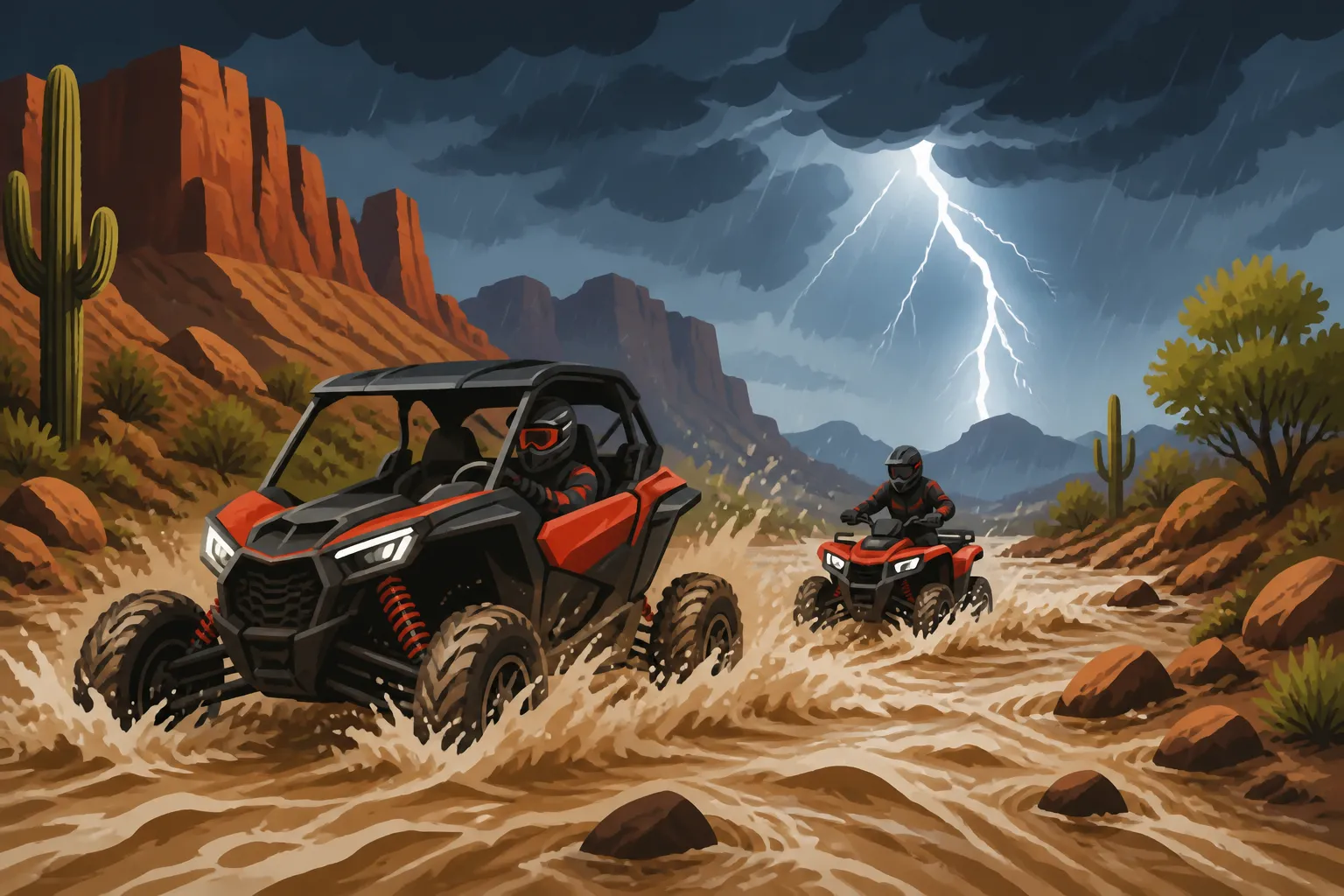
Arizona Monsoon Season and Flash Flooding
Arizona’s summer monsoon can turn a familiar desert route into a dangerous place in minutes. Rain falling miles away may rush through a dry wash beneath your ATV or UTV, even while the sky above you looks clear. This guide explains how to plan around Arizona flash flooding, recognize rising risk, and decide when to turn back or wait.
Why Arizona Monsoon Rides Can Change So Quickly
Rain far from your trail can still cause a flood
In Arizona, a wash can look harmless until a fast-moving surge arrives from rain falling somewhere upstream. The storm may be beyond the ridge or out of sight, so a blue patch of sky overhead does not prove the route is safe. Water can funnel through desert channels and canyons, carrying mud, branches, rocks, and debris with it.
That distance between a storm and its runoff is what makes flash flooding especially hard to judge from the driver’s seat. A route near the Sonoran Desert foothills, for example, might remain dry while rainfall over higher ground sends water toward a crossing farther down the drainage. A group can be caught between the storm and the water it produces, with little time to find higher ground.
A dry channel is not a safe place to stop and watch for long. If you hear a low rumble, see a muddy surge, or notice debris moving in the water, leave the channel immediately and move to higher ground if you can do so without crossing the flow. Don’t try to drive through water to “beat” it.
Desert washes can go from dry to hazardous
A wash is a natural drainage route, not a dependable road surface. Some trails and two-tracks cross washes repeatedly, and dry crossings can be ordinary parts of a ride. The danger is that the channel may collect water from a large area, and the first visible trickle may not represent the full volume that follows.
Water depth can also be difficult to judge. Muddy water hides the bottom, while fast-moving water can push a machine sideways or undermine the sand and gravel beneath it. Even a small amount of moving water can destabilize a vehicle, particularly where the channel is narrow, the bank is steep, or the bottom is soft. A UTV’s size does not make it flood-proof, and an ATV can be swept away more easily than its rider expects.
When you plan a route, mark the washes and low crossings where you may need to make a decision. A map app such as onX Offroad can help you understand the route and surrounding terrain before leaving, but no digital map can tell you whether a crossing is passable at that moment. Treat the map as a planning aid, not permission to enter a flooded channel.
The season brings more than rain
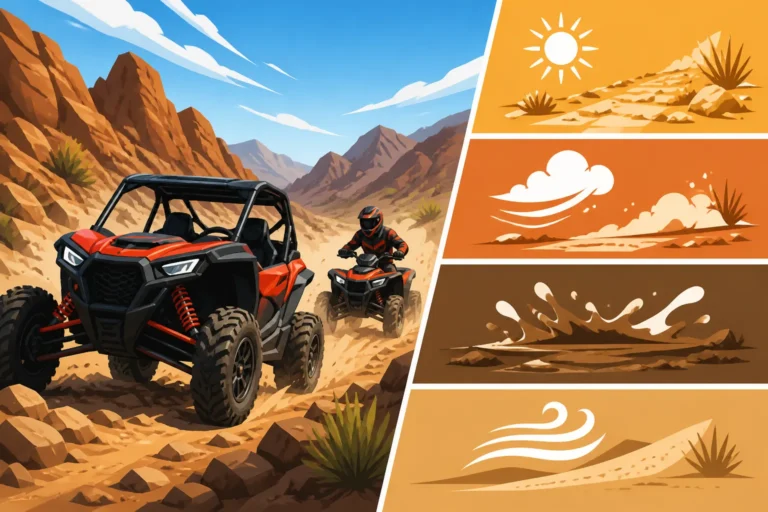
Monsoon weather can arrive with lightning, strong winds, blowing dust, reduced visibility, and sudden temperature changes. A ride that begins under intense sun can become a poor place to be once a thunderstorm moves over exposed terrain. Dust and rain can make it harder for a group to stay together, see trail markers, or spot rocks and washouts.
The combination matters. A storm can make a familiar route slippery while lightning makes open ridgelines and isolated trees unsafe places to wait. Heavy rain can obscure trail edges or create new ruts, while wind can drop branches onto a route. If you are planning a ride near areas such as Table Mesa north of Phoenix or the foothills around Tucson, account for exposure and limited shelter as well as the possibility of a wash flooding.
For general seasonal context and ride planning, see Arizona's Best Riding Months — but remember that a good month for riding does not guarantee safe conditions on a particular day. Check the forecast for the whole route area, not just the town where you are staying.
Plan Your Ride Around Storm Risk
Check the forecast for the route, not just the trailhead
Before leaving, check the forecast and alerts for the route’s full drainage area. A forecast for Phoenix may not describe conditions near Four Peaks or a route outside Tucson. Likewise, checking the sky from a staging area won’t tell you what is happening in the mountains or upstream from a crossing. Look for thunderstorms, flood watches or warnings, and changing conditions along the route you intend to ride.
A general weather app is useful, but use more than one source when storms are a possibility. Look at weather alerts and radar, and check official closure notices for the land manager responsible for the area. Conditions and access rules can change, so confirm them close to departure. A storm visible on radar is a reason to reassess, not an invitation to see how close you can get.
Set a clear turnaround rule before the group starts. For example, decide that the ride is canceled if storms are forecast over the route, or that the group will turn back at the first thunder, rising water, or loss of safe visibility. Agreeing in advance makes it easier to make a conservative decision when friends are already geared up and reluctant to abandon the plan.
Choose a route with safer options
A good monsoon-season route is one where you have realistic alternatives if weather changes. Consider whether you can return by the same route, move to higher ground, or reach a staging area without crossing a drainage that could flood. A loop that depends on passing through several narrow washes may leave few safe choices once rain begins.
Study the terrain before loading the trailer. Look for low points, canyons, steep-sided drainages, and routes that parallel a wash for a long distance. In unfamiliar areas, make a note of likely escape routes and places where the group could stop safely away from the channel. A route that looks short on a screen may take much longer when you need to turn around, help a rider, or navigate around a closure.
Digital maps can help you prepare, especially where trail networks are complex or signage is sparse. onX Offroad can be part of that planning, alongside official land-management maps and current closure information. Download or otherwise prepare route information before entering areas with weak reception; do not assume you’ll be able to load a map once you are already deep in the backcountry. For more navigation advice, see [Finding the Right Travel Management Map] and [Cell Dead Zones in the Arizona Backcountry].
Pack for delays, not just the planned ride
A monsoon ride may take longer than expected even if you never encounter a flooded crossing. A blocked route, a mechanical issue, or a storm that forces you to wait can turn a short outing into a long one. Carry enough water for everyone, plus food, sun protection, a first-aid kit, basic repair items, and a way to communicate when cell service is unavailable.
Tell someone who is not riding where you are going and when you expect to return. Share the route, the machines in the group, and what that person should do if you miss your check-in. If your plans change, update them when you can. A paper or offline route backup is useful if a phone battery dies or reception disappears.
Group preparation matters too. Agree on a lead rider and a sweep rider, keep the group together at junctions, and make sure every driver knows the turnaround plan. If a storm approaches, don’t split up to scout different routes. A few minutes saved by separating may create a much bigger problem if one part of the group reaches a flooded channel or loses contact.
Recognize Trouble and Make a Safe Decision
Notice the warning signs before water reaches the trail
Some flood warnings are easy to miss if you are focused on driving. Watch the sky in every direction, including over ridges and behind you. Darkening clouds, repeated thunder, visible rain shafts, or a sudden shift in wind are reasons to pause and reassess. Rain does not need to fall directly on the trail for conditions to deteriorate there.
Pay attention to changes in the wash itself. Rising water, new muddy runoff, floating debris, or a fresh wet line on the bank can signal that more water is coming. A small amount of water may arrive ahead of a larger surge. If the wash is already flowing, or you cannot tell whether the water is rising, do not enter it to test the depth.
A storm can also make it harder to notice hazards that were already present. Dust, glare, rain, and low cloud can reduce visibility; wet rock and loose soil can change traction; and debris can hide a rut or edge. If you have to concentrate simply to keep the machine under control, continuing deeper into the route is not a good bet. Stop in a safe place away from the wash and make a deliberate plan.
Turn around before the route becomes a trap
Turning back early can feel frustrating, especially if you drove a long way to reach the trail. It is still a better outcome than reaching a crossing that has become impassable with no safe route around it. Make the decision while you still have room to turn around, rather than waiting until water blocks the way ahead and threatens the route behind you.
Never drive into moving floodwater to judge its depth or momentum. A crossing that looks shallow can conceal holes, a washed-out surface, or a strong current. The water can carry debris that strikes the machine, and the underlying sand may give way under the tires. Do not assume that a larger UTV, four-wheel drive, or a snorkel makes a crossing safe.
If the route back requires crossing a wash that has begun to flow, do not force your way through. Move away from the channel to higher ground if possible and contact emergency services if anyone is in immediate danger. Avoid parking in the wash or beneath a steep bank, where runoff or falling debris may put the group at risk. Keep the group together and conserve phone battery while you wait for help or a safe change in conditions.
Know when waiting is safer than driving
When thunder or heavy rain arrives, stop riding in an exposed area and move away from ridgelines, isolated trees, and open high points. Choose the safest available location outside a drainage channel. A narrow canyon or wash may look like shelter from wind or rain, but it can become dangerous if runoff arrives from upstream.
Waiting does not always mean the route will become safe again. A storm can leave deep mud, damaged trail surfaces, debris, or new erosion after the rain has stopped. Don’t resume simply because the sky has brightened. Check the route ahead, assess whether the group can return safely, and be willing to end the ride if conditions are uncertain.
If the group is delayed, prioritize people over equipment. Keep riders out of the channel and away from unstable banks. If someone is injured, trapped, or at immediate risk, call emergency services when possible and provide your location as clearly as you can. A map app such as onX Offroad may help you identify nearby route names or landmarks, but tell responders about visible features too, such as a road junction, trail marker, or staging area.
What to Do When a Wash Is Flowing
Do not cross, walk, or ride through moving water
If water is flowing across the route, stop before the edge and keep a safe distance. Do not attempt to cross on an ATV, in a UTV, or on foot. The visible surface does not reveal the current’s strength, the depth of the water, or whether the bottom is intact. Even when water appears calm, the channel may have a hidden drop or soft section that can trap a person or machine.
Do not follow another vehicle through simply because it made the crossing. Conditions can change between attempts, and one successful crossing does not establish that the next one is safe. A machine can become stuck or swept sideways, putting its driver and passengers in danger and leaving fewer safe options for everyone behind it.
Also avoid standing on the bank to watch a surge pass. Banks can be undercut and collapse, and debris can arrive after the first flow. Move away from the drainage to higher, stable ground. If there is no safe way to return, stay out of the water and contact emergency services if the situation requires rescue.
Choose a safe place to wait or turn back
Look for higher ground that is well away from the wash, not a small mound in the middle of its flood path. Avoid steep slopes, loose rock, and places where a landslide or falling debris is possible. If you can safely retrace your route without crossing flowing water, return toward the staging area. If not, do not gamble on a crossing to escape.
Keep the group together and make sure riders are accounted for. If weather, visibility, or noise makes it hard to communicate, use simple agreed signals and stay close enough that nobody disappears from view. Conserve phone battery, and share your location with your emergency contact or responders when you can. A prepared offline map can help describe your position, but it is no substitute for a working emergency plan.
Once water has passed, resist the urge to drive through the channel immediately. The flow may rise again, and the crossing may have changed shape. It can take time for runoff to settle, and a channel that appears quiet may still carry a surge from upstream. If there is doubt, wait in a safe location or seek another route that does not require crossing.
After the storm, check the route before riding again
A washed-out crossing can be hard to recognize from a distance. Look for fresh debris, exposed rocks, steep drop-offs, muddy water, and banks that appear freshly cut. Don’t walk onto a soft or undercut edge to inspect it. If a trail looks damaged, turn around and report the hazard to the appropriate land manager when you have a safe opportunity.
Storm damage is not limited to washes. Water can create deep ruts, remove sections of trail, cover route markers, or leave slippery mud on rock. A route that was appropriate for a stock machine in dry conditions may be substantially more difficult afterward. When in doubt, choose a known, stable route or end the ride.
Check for closures before returning on another day. Land managers may temporarily close access to protect riders, crews, or damaged terrain. For related planning and safety information, see [Arizona Monsoon Months and Riding], [Flash Flooding in a Desert Wash], and [Arizona Trail Closures During Fire Restrictions].
Monsoon Ride Planning Checklist
Use a simple go or no-go framework
A checklist helps turn a vague feeling of concern into a consistent decision. Use it before loading up, then reassess at the staging area and during the ride. If conditions change, the answer can change too. No single item guarantees safety, but several warning signs together are a strong reason to choose another day or a different route.
| Check | Lower-risk sign | Reason to postpone or change plans |
|---|---|---|
| Forecast | No storms expected over the route or its drainages | Thunderstorms, flood alerts, or uncertain storm movement |
| Route | Multiple safe ways back without low crossings | The route depends on narrow washes or a single crossing |
| Visibility | Clear enough to see terrain and stay with the group | Rain, dust, or darkness makes navigation difficult |
| Water | Washes are dry and no runoff is visible | Flowing water, rising water, or fresh debris |
| Preparation | Offline navigation, water, communication plan, and turnaround rule | The group lacks a reliable way to navigate or contact help |
Treat the table as a prompt for judgment, not a scoring system. One serious concern, such as a flowing wash or a flood warning over the drainage, is enough to cancel or reroute. Several smaller concerns can add up: a distant storm, weak cell service, a route with no easy exit, and a group that includes inexperienced drivers may make postponing the sensible choice.
If someone in the group is uncomfortable with the conditions, take that seriously. Nobody should have to argue for a cautious call while the group is already committed to the route. Agree before departure that any rider can ask for a pause or turnaround, and that the group will stop together to discuss it.
Build a safer ride plan step by step
Start by choosing a route that matches the group’s experience and leaves practical options if weather develops. Review official maps and current closure information, identify major drainages, and note where the route could become isolated. Use onX Offroad or another mapping tool to prepare, but confirm access with the responsible land manager and don’t rely on phone reception in remote terrain.
Next, check forecast conditions for the whole area and set a firm go or no-go rule. Tell a contact your route and return time, and make sure each rider knows the plan. Carry water, food, first aid, communication equipment, and the essentials needed to manage a delay. When the ride begins, reassess at every major change in weather or terrain rather than assuming the original plan still fits.
Finally, be ready to shorten the ride. Turning around before reaching the most scenic section can be disappointing, but the landscape will still be there another day. A flexible plan gives everyone a better chance of returning safely, without making a risky crossing the price of completing the route.
Use maps as one part of a broader safety plan
Mapping tools are helpful for understanding where a trail goes and how it connects with surrounding routes. onX Offroad can assist with route preparation and offline navigation, while official maps and land-manager notices help clarify access and closures. Review both before you leave, especially if your planned ride crosses several drainages or enters an area with limited services.
A map cannot show whether a wash is currently flowing, whether a recent storm damaged a trail, or whether a route has been closed since you last checked. It also cannot guarantee that you can reach the next junction safely. Keep an eye on real conditions, and treat the terrain—not the phone screen—as the final signal to stop, turn around, or wait.
For more advice on route preparation, see Planning an Arizona Riding Trip. If you are in doubt about the forecast or the condition of a drainage, choose a route with fewer crossings or postpone the ride. In Arizona monsoon season, changing the plan early is often the most important safety decision of the day.
Disclaimer
This article is for general informational purposes only and does not constitute professional advice. Laws, prices and regulations vary by location and change over time. Consult a qualified professional for guidance on your specific situation.