Arizona Rules for a Child Passenger
There's nothing quite like sharing the thrill of Arizona's stunning desert trails with your family, and for many, that means bringing the kids along for an off-road adventure in an ATV or UTV. But before you load up the little ones and head out, it's absolutely vital to understand Arizona's specific rules and regulations regarding child passengers. This comprehensive guide will walk you through everything you need to know to keep your young passengers safe and your ride legal, tackling the common confusions and frustrations parents often face when navigating these guidelines.
Understanding Arizona's Core Rules for Youth Passengers
When you’re dreaming of those perfect family outings in the Arizona desert, perhaps exploring the [Hualapai Mountain Riding Near Kingman] area or hitting the washes around [Standard Wash OHV Area Access], the safety of your children is, naturally, your top priority. But what does Arizona law actually say about having kids as passengers on your off-highway vehicle? It can feel like a minefield of regulations, and getting it wrong isn't just a risk to safety, but also to your wallet and peace of mind.
Age and Seating Requirements on Off-Highway Vehicles
First and foremost, it's crucial to understand that not all off-highway vehicles (OHVs) are created equal when it comes to carrying passengers, especially children. Arizona law is quite clear: an off-highway vehicle must be designed by the manufacturer to carry more than one person if you intend to have a passenger. This means that if your ATV is a single-rider model, even if it has a small rack or a somewhat padded seat behind the operator, it is generally not legally designed or safe for a passenger, let alone a child. Trying to squeeze a child onto such a machine is not only incredibly risky due to balance and control issues, but also a violation of the law.
For UTVs (Utility Terrain Vehicles), which often come with multiple seats, the rules are generally more accommodating. These machines are built with passenger safety in mind, featuring proper seating positions and often seat belts as standard equipment. However, even with a multi-passenger UTV, the number of passengers cannot exceed the manufacturer's designed capacity. Each passenger, child or adult, must have a designated seating position that is equipped with a functional seatbelt if the machine came with them from the factory. No lap-sitting, no standing, and certainly no riding in cargo beds unless they are specifically designed with proper seating and restraints from the factory. Many parents are surprised by the strictness of these rules, often thinking that as long as the child is "holding on tight," it's okay, but the law and safety standards demand much more.
Manufacturer Recommendations and Machine Capacity
Those little stickers and warnings plastered on your ATV or UTV aren't just there for decoration; they are critical safety and legal guidelines from the manufacturer. When it comes to child passengers, these recommendations are paramount. If your ATV explicitly states "no passengers," that's a hard and fast rule in Arizona. Ignoring it not only puts your child in grave danger but also leaves you liable for potential fines and legal repercussions in the event of an accident. The manufacturer's design capacity takes into account the vehicle's balance, braking, and suspension systems, all of which are compromised when you exceed the intended load or passenger count.
For UTVs, while they are built for multiple passengers, you must adhere strictly to the number of seats and seatbelts provided. Attempting to fit four people in a two-seater UTV, for example, is a direct violation of both manufacturer guidelines and Arizona law. This isn't just about comfort; it's about the physics of the machine and its ability to safely handle the weight and distribution of passengers, especially during sharp turns, climbs, or unexpected bumps on rough desert terrain. Before you even think about putting a child in your OHV, take the time to locate and read these manufacturer labels. They are your first line of defense in ensuring a safe and legal ride, and often explain why [Youth Machine Size Rules Arizona Parents Ask About] are so important for all riders.
Safety Gear and Best Practices for Young Riders
Beyond the basic seating rules, ensuring your child is properly equipped with safety gear is non-negotiable when riding an OHV in Arizona. The desert can be unpredictable, and even a slow-speed tip-over can result in serious injury if children aren't adequately protected. Many parents know helmets are important, but the specifics of Arizona law and other crucial gear often get overlooked, leading to unnecessary risks.
Helmet and Eye Protection Mandates for Minors
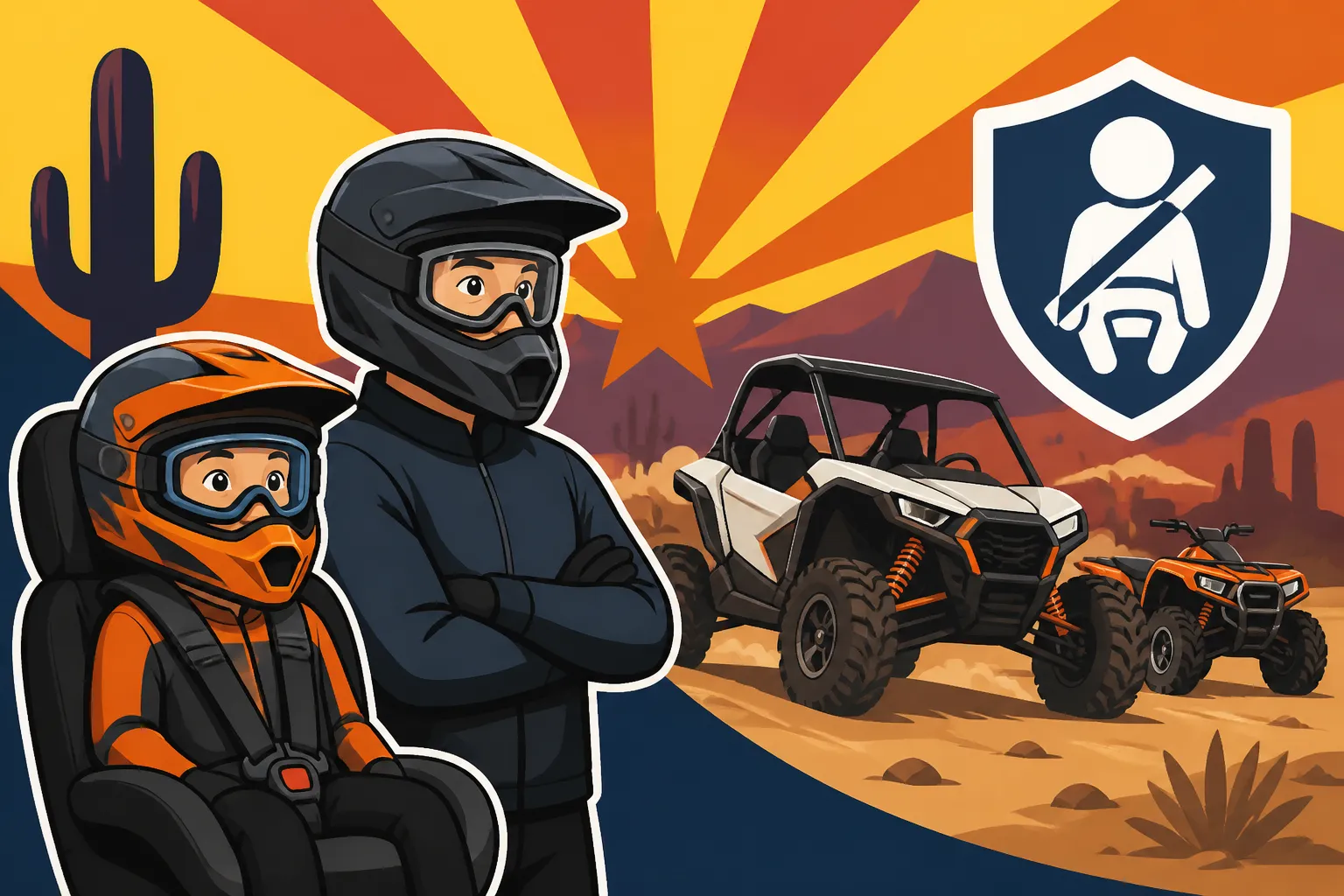
Arizona law is very clear on this: any person under the age of 18 operating or riding as a passenger on an off-highway vehicle must wear a protective helmet. This isn't a suggestion; it's a legal requirement designed to protect against head injuries, which are among the most serious types of injuries sustained in OHV accidents. The helmet must be properly fitted and securely fastened, and it must also meet federal safety standards (like DOT certification). A bicycle helmet or a novelty helmet simply won't cut it. This rule applies whether you're cruising down a scenic trail in [Sedona Trails Open to Side-by-Sides] or just riding around a private property.
Equally important, and often overlooked, is eye protection. Along with a helmet, children under 18 must wear eye protection while riding. This means goggles or a face shield that is integrated into the helmet. The Arizona desert is famous for its dust, flying debris, and sometimes even low-hanging branches. Without proper eye protection, a child's vision can be instantly obscured, leading to a loss of balance or a collision. Imagine a small rock kicking up from your front tire and hitting a child's unprotected eye—it's a terrifying thought. So, when you're gearing up, remember that a certified helmet and effective eye protection, as outlined in [Arizona Helmet Rules for Riders Under 18], are just as essential as fastening a seatbelt.
Seatbelts, Doors, and Restraint Systems
For UTVs, which are increasingly popular for family rides, seatbelts are a critical component of passenger safety. Every occupant, including children, must use the seatbelt provided by the manufacturer. It sounds obvious, but it's easy for kids to unbuckle themselves or for parents to be less vigilant on slower sections of a trail. The seatbelt must be worn correctly, low across the hips and snug across the chest, without any slack. Remember that seatbelts are designed to keep occupants inside the vehicle in the event of a roll-over or sudden stop. A child who isn't properly restrained can be ejected from the vehicle, with potentially catastrophic consequences.
Beyond seatbelts, UTVs often come with doors or side nets. These are not just for aesthetics; they provide an additional layer of containment, preventing arms, legs, or even an entire child from accidentally falling or being thrown out during a dynamic ride. For those who want to enhance the safety of their UTV, especially when regularly carrying young children, aftermarket accessories are a popular choice. Companies like SuperATV, for instance, offer a variety of robust aftermarket doors, full and half windshields, and even harness systems that can provide a more secure and protective environment for your most precious cargo. While these aren't always legally mandated, they represent a proactive approach to safety that many experienced off-roaders embrace, adding peace of mind on those adventurous days out.
Legal Implications and Parental Responsibilities
The thought of an accident is enough to make any parent anxious, but beyond the physical safety of your children, there are significant legal implications if you fail to adhere to Arizona's OHV passenger laws. What might seem like minor oversight can lead to serious penalties, affecting your finances and even your ability to ride in the future. Understanding these responsibilities is key to enjoying the trails worry-free.
Citations and Penalties for Non-Compliance
Let's be frank: Arizona's law enforcement, including park rangers and sheriff's deputies, takes OHV safety very seriously, especially when it involves children. If you're caught with a child passenger violating the rules—whether it's an underage child without a helmet, a child riding on a single-seat ATV, or too many passengers for the vehicle's capacity—you, as the adult operator or owner, are going to face consequences. These aren't just stern warnings; they are often citations that come with substantial fines. Depending on the specific violation, the penalties can quickly add up, turning a fun family day into a very expensive lesson.
Beyond the immediate financial hit, there could be broader legal ramifications, particularly if an accident occurs while a child passenger rule is being violated. Your insurance coverage might be jeopardized, and you could face civil liabilities. It's a stark reminder that these laws are in place for a reason: to prevent injuries and fatalities. So, before you leave the staging area, double-check every aspect of your child's setup to ensure full compliance. It's a small effort that can save you significant trouble down the line, as further detailed in [Citations That Reach an Arizona Parent].
Supervising Young Passengers in the Desert Environment
Riding with children isn't just about ticking boxes on a legal checklist; it’s about constant, active supervision and adapting to the unique challenges of the desert. Arizona's desert trails, while beautiful, can be grueling. Extreme heat, choking dust, rough terrain, and long distances can quickly wear down even the most enthusiastic young passenger. What might be an exhilarating experience for an adult can become uncomfortable, frightening, or even dangerous for a child if they aren't properly managed.
Parents have a responsibility to monitor their child's comfort levels, ensuring they are hydrated, protected from the sun, and taking breaks when needed. This means carrying plenty of water – far more than you think you'll need – and planning your routes to include shaded rest stops. Children, especially younger ones, might not articulate their discomfort until it's too late. Watching for signs of fatigue, dehydration, or overheating is critical. Riding in groups can be helpful, allowing for shared vigilance and support. Remember, the goal is to create positive memories, not to push a child to their physical limits, which could lead to a negative association with off-roading. Taking these precautions is a crucial part of [Supervising a Young Rider in the Desert].
Special Considerations for Street-Legal OHVs with Children
The concept of a "street-legal" OHV adds another layer of complexity to passenger rules, particularly when children are involved. While the ability to drive your UTV from a trailhead to a local restaurant in a town like Sedona is incredibly convenient, it also means your machine is subject to standard road laws, which can differ significantly from off-road regulations. It's not enough to just put a license plate on your UTV; you need to understand the full scope of what it means for your child passengers.
Road-Specific Passenger Rules and Requirements
When your OHV transitions from dirt trail to paved public road, it generally becomes subject to the same passenger laws as any other street-legal vehicle, with some nuances. This means that if you're driving a street-legal UTV with a child passenger on a public street or highway, you must ensure they are properly restrained according to Arizona's seatbelt laws. For younger children, this could even extend to car seat or booster seat requirements, depending on the child's age, weight, and height, just as it would in a regular car. Many UTVs, while offering multiple seats, are not inherently designed to accommodate standard child safety seats without modification, making this a critical area to research before you hit the blacktop.
Additionally, certain OHV components that are optional off-road become mandatory on the street. For instance, proper mirrors, headlights, taillights, and turn signals are all essential for street legality. While these don't directly relate to child passengers, they contribute to the overall safety of the vehicle in a street environment, which indirectly protects your child. It's a complex dance between OHV-specific laws and general motor vehicle codes, and getting it wrong on the street can lead to violations that are often more severe than off-road infractions. For more on making your machine road-ready, check out [Making a UTV Street Legal in Arizona].
Differences Between Off-Road and On-Road Regulations
The primary distinction between off-road and on-road regulations for child passengers typically revolves around the strictness of restraint systems and, potentially, the applicability of standard motor vehicle child safety seat laws. Off-road, the focus is often on manufacturer-provided seating and seatbelts, coupled with helmet and eye protection for minors. On paved roads, especially if the OHV is fully street-legal and registered as a motor vehicle, the full suite of state motor vehicle laws, including specific mandates for child restraint devices for infants and toddlers, may come into play. This is a critical point that many OHV owners overlook.
Furthermore, visibility requirements often differ. While a [Whip Flags on a Road Section of a Ride] is excellent for dust and dunes, reflective tape and proper lighting become paramount on public roads, particularly at dusk or night. The nature of the risks also changes; while off-road riding involves obstacles and terrain challenges, on-road driving introduces interaction with other full-size vehicles at higher speeds. This means defensive driving and ensuring your child passengers are fully protected within the confines of a multi-passenger UTV, just as they would be in a car, are absolutely crucial. It's about recognizing that the environment dictates the rules, and a versatile machine requires a versatile understanding of how to keep your family safe.
Here's a quick look at the key rules for child passengers on OHVs in Arizona:
| Rule Category | Off-Road OHVs (ATVs/UTVs) | Street-Legal OHVs on Public Roads |
|---|---|---|
| Designed Seating | Required: Must be manufacturer-designed for multiple passengers. | Required: Must be manufacturer-designed for multiple passengers. |
| Passenger Limit | Must not exceed manufacturer's designed capacity. | Must not exceed manufacturer's designed capacity. |
| Seatbelts/Restraints | Required: All occupants must use manufacturer-installed seatbelts. No lap-sitting. | Required: All occupants must use manufacturer-installed seatbelts. May include child safety seat rules for younger children (check local laws). |
| Helmets (Under 18) | Required: Properly fitted, DOT-compliant helmet for all under 18. | Required: Properly fitted, DOT-compliant helmet for all under 18. |
| Eye Protection (Under 18) | Required: Goggles or integrated face shield for all under 18. | Required: Goggles or integrated face shield for all under 18. |
| Doors/Nets | Highly Recommended (especially for UTVs with children). Aftermarket options (e.g., from SuperATV) available. | Recommended for safety, may be required by specific ordinances for street use. |
| Supervision | Essential: Active monitoring for comfort, hydration, and fatigue in desert conditions. | Essential: Active monitoring for comfort, adherence to traffic laws, and general road safety. |
Disclaimer
This article is for general informational purposes only and does not constitute professional advice. Laws, prices and regulations vary by location and change over time. Consult a qualified professional for guidance on your specific situation.