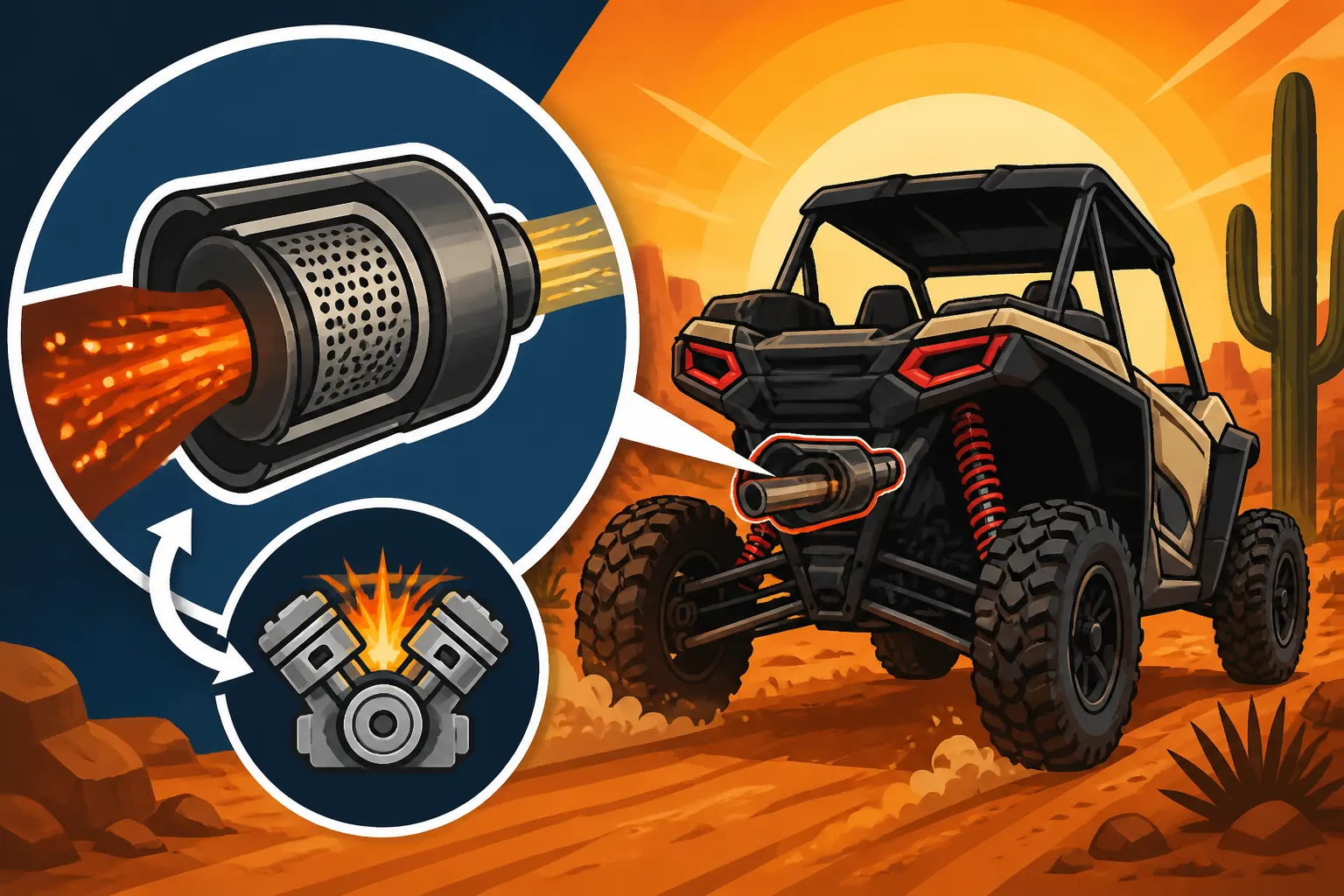
Why a Spark Arrestor Runs Whenever the Engine Does
If you’ve ever found yourself wondering why that little spark arrestor on your ATV or UTV is always, always working whenever your engine is humming, you’re not alone. It might seem like a small, unassuming part, but its constant operation is crucial, especially here in our beautiful, often fire-prone Arizona desert. This guide is going to pull back the curtain on this vital piece of your machine, explaining exactly why it's a continuous, active part of your exhaust system and not just something that kicks in when it feels like it, ultimately ensuring you stay legal and our trails stay safe.
Understanding the Constant Threat: Why Sparks Are a Problem
Riding off-road in Arizona is an incredible experience, offering everything from the red rocks of Sedona to the vast expanses of the Sonoran Desert. But with that beauty comes responsibility, especially when it comes to fire. Our landscape is often dry, covered in highly flammable scrub, grass, and trees. This makes us particularly vulnerable to wildfires, and a single spark from an exhaust system can be all it takes to ignite a devastating blaze. This inherent risk is the foundational reason why spark arrestors are designed to be "always on." They're not a switch you flip; they are an integral, passive, and continuous part of your exhaust system.
The Scourge of Wildfires in Arizona
Anyone who lives in or rides through Arizona has seen the devastating effects of wildfires. They can close trails for years, destroy vast tracts of wilderness, threaten homes, and even claim lives. Many of these fires are human-caused, and a significant number are attributed to sparks from off-highway vehicles. The dry conditions, especially in the late spring and early summer before the monsoon season, create a tinderbox environment where even a tiny ember can quickly escalate into an inferno. The consequences of starting a fire, even accidentally, are severe, both legally and environmentally.
How Sparks Escape Without an Arrestor
Without a properly functioning spark arrestor, hot carbon particles – essentially tiny embers – can be ejected from your ATV or UTV's exhaust pipe. These carbon particles are a natural byproduct of internal combustion. As the engine burns fuel, it creates these microscopic bits of unburnt carbon. When your exhaust gases rush out, these hot particles are carried along with them. If they land on dry grass, leaves, or even just dust, they can easily ignite a flame. A spark arrestor is designed to capture and extinguish these glowing particles before they ever leave your exhaust system, making it an essential piece of safety equipment that simply has to be working every single second the engine is running.
The Inner Workings: How a Spark Arrestor Does Its Job
A spark arrestor isn't some complex electronic device; it's a marvel of simple, effective engineering. It's essentially a screen or a series of baffles and vanes located within your muffler or exhaust pipe. The "why" it runs whenever the engine does lies in its fundamental design as a passive filter. It's not something that activates; it's a physical barrier that the exhaust gases and any suspended particles must pass through.
Internal Design: Vanes and Baffles
Most spark arrestors work on a centrifugal force principle. As exhaust gases, carrying those potentially dangerous carbon particles, enter the spark arrestor chamber, they are forced to change direction rapidly, often by a series of internal baffles or vanes. These vanes create a swirling motion, much like a cyclone. The heavier, glowing carbon particles, due to their inertia, are flung outwards against the walls of the chamber. This causes them to lose speed and collide with the cooler metal surfaces, extinguishing them before they can exit the exhaust. They then fall into a collection chamber at the bottom of the arrestor. For simpler designs, a fine mesh screen might be used, physically blocking any particles larger than a certain size from escaping. The key is that this process happens constantly as long as there's exhaust flow.
The Role of Exhaust Flow and Centrifugal Force
Think of it like a miniature dust devil inside your muffler. The exhaust gases are always flowing when the engine is running, and that constant flow is precisely what the spark arrestor utilizes. The design ensures that all exhaust gases pass through the arrestor's mechanism. This continuous flow generates the necessary centrifugal force or ensures that every particle is funneled through the screen. Because the engine is always producing exhaust, and the exhaust is always flowing, the spark arrestor is inherently and perpetually performing its function. There's no "off" switch because its operation is entirely dependent on the physical movement of gases from your engine.
Why It Needs Constant Operation
The threat of fire is constant when an engine is running, whether you're idling at a trailhead, cruising down a dirt road, or tackling a steep climb. Every revolution of the engine has the potential to produce those dangerous hot carbon particles. Therefore, the spark arrestor must be engaged and functioning continuously to provide protection. It's not about specific speeds or engine loads; it's about the very act of combustion. This is why it’s not an add-on feature you activate, but an integrated component that is always working to safeguard our environment and ensure compliance with rules like [Arizona's Spark Arrestor Requirement].
Arizona's Stance: Laws, Regulations, and Enforcement
Arizona takes the prevention of wildfires very seriously, and that includes strict regulations regarding spark arrestors on OHVs. These aren't just good ideas; they are legal requirements enforced by various agencies across the state. Understanding and adhering to these rules is crucial for any rider in Arizona.
Arizona's Spark Arrestor Requirement
In Arizona, it's not enough to simply have a spark arrestor; it must be a specific type. State law, echoing federal requirements for public lands, mandates that all off-highway vehicles operated on public or state trust lands must be equipped with a U.S. Forest Service (USFS) approved spark arrestor. This means the device has undergone testing and meets stringent standards to prove its effectiveness in preventing fire. You can't just slap any screen on your exhaust; it needs to be certified. This requirement is non-negotiable and is a foundational aspect of responsible OHV use in our state. The law is designed to cover every moment your engine is running, which again underscores why the arrestor must be a constant, always-on component.
USDA-Approved Spark Arrestors in Arizona
When we talk about "USFS approved," we're referring to devices that meet the standards set by the U.S. Department of Agriculture (USDA) Forest Service. These standards are rigorous, ensuring that the spark arrestor can effectively capture carbon particles without significantly impeding engine performance. You'll often see a stamp or label on your muffler or exhaust indicating this approval, usually with "USFS approved" or a specific code. If you're buying an aftermarket exhaust, like one from SuperATV, it's critical to verify that it explicitly states its USDA/USFS approval. Without this certification, even if it looks like it should work, it might not meet legal requirements, and you could face penalties. It’s also why simply modifying your exhaust to look like it has an arrestor won't cut it if it's not certified.
Penalties for Non-Compliance
Riding without a USFS-approved spark arrestor, or with one that is damaged and ineffective, can lead to serious consequences. Law enforcement, including Arizona State Parks Rangers, Forest Service officers, and BLM rangers, regularly patrol popular OHV areas and check for compliance. Fines can be substantial, and you might even have your ride cut short if an officer deems your machine a fire hazard. Beyond the monetary penalties, there's the much graver risk of actually starting a fire, which can carry even harsher legal repercussions, including restitution for damages and even criminal charges. It's a risk simply not worth taking, especially when the solution is a permanent, always-working part of your exhaust. These [Arizona Penalties for a Missing Plate] or missing decal are often paired with spark arrestor violations, demonstrating the state's comprehensive approach to OHV safety and compliance.
Maintenance and Inspection: Keeping Your Spark Arrestor Trail-Ready
Because your spark arrestor is always "on," it's constantly doing its job of collecting those carbon particles. This means it needs regular attention to ensure it continues to function effectively. Neglecting maintenance can lead to reduced performance, potential fire hazards, and non-compliance with Arizona's regulations.
Checking for Damage and Blockages
Before every ride, or at the very least, before major trips, you should visually inspect your spark arrestor. Look for any signs of physical damage, such as dents, cracks, or holes in the screen or exhaust housing. These can compromise its ability to capture sparks. More commonly, you'll need to check for blockages. Over time, the collected carbon can build up and restrict exhaust flow. This can lead to decreased engine performance, overheating, and potentially a fire hazard if the buildup itself becomes hot enough to ignite. A simple visual inspection can often reveal a heavily clogged screen or an exhaust tip that looks unusually restricted. If you have an aftermarket exhaust, like a SuperATV model, be sure to follow their specific maintenance recommendations.
When to Clean Your Arrestor
The frequency of cleaning depends heavily on how much you ride and the type of fuel and oil your machine uses. Generally, many manufacturers recommend cleaning the spark arrestor every 20-50 hours of operation, or more frequently if you notice a drop in engine performance or excessive carbon buildup. Cleaning typically involves removing the screen or end cap, brushing away the carbon deposits with a wire brush, and ensuring all passages are clear. Some designs have removable core baffles that make cleaning easier. Always consult your ATV or UTV owner's manual for specific instructions on how to access and clean your machine's spark arrestor. It's a dirty job, but a vital one for keeping your machine running well and staying safe. If the screen is beyond cleaning or damaged, then [Replacing a Burned-Out Spark Arrestor] becomes a necessary step.
Replacing a Burned-Out Spark Arrestor
Sometimes, a spark arrestor can get damaged beyond simple cleaning, or the screen can become so brittle from heat cycles that it breaks. In such cases, replacement is the only option. Riding with a damaged or ineffective spark arrestor is the same as riding without one in the eyes of the law and, more importantly, in terms of fire risk. When replacing, always ensure you're getting a USFS-approved part. If you're considering an aftermarket exhaust system, many reputable brands, including SuperATV, offer complete systems or replacement spark arrestors that meet these standards. Do your research to ensure compatibility with your machine and compliance with Arizona regulations. Always confirm the replacement part is indeed USDA-approved, as this is a key part of [Arizona's Spark Arrestor Requirement].
Beyond Compliance: The Broader Impact of Spark Arrestors
While adhering to Arizona's spark arrestor laws is about staying legal and avoiding fines, the true impact of these devices goes much deeper. It's about protecting the environment we love to explore, ensuring access for future generations, and fostering a sense of community responsibility among riders.
Protecting Our Public Lands
Our Arizona public lands—from national forests to BLM areas—are precious resources. They provide vast opportunities for recreation, critical habitats for wildlife, and vital watersheds. Wildfires devastate these lands, destroying ecosystems, polluting air and water, and often taking decades for recovery. By ensuring your spark arrestor is always operating effectively, you are directly contributing to the preservation of these lands. You are helping to prevent the irreversible damage that a single spark can cause, safeguarding the natural beauty that draws us all to the desert. This dedication to land stewardship is a cornerstone of responsible OHV riding. It's why things like [Arizona Fire Restrictions by Stage] are so critical, and why your small part can make a huge difference.
Being a Responsible Rider
A well-maintained, USFS-approved spark arrestor is a hallmark of a responsible OHV rider. It signifies that you understand the risks associated with our sport and are actively taking steps to mitigate them. This responsibility extends beyond just fire prevention; it builds trust with land managers, other recreational users, and the communities surrounding our riding areas. When riders demonstrate care for the land, it helps ensure continued access to trails and prevents further restrictions. Conversely, widespread non-compliance can lead to areas being closed to OHV use, impacting everyone. So, while it's a small component, its continuous operation and your attention to it speak volumes about your commitment to responsible riding. Remember, your actions impact the collective reputation of all OHV enthusiasts.
The Peace of Mind a Good Arrestor Brings
Knowing that your machine is properly equipped with a functioning spark arrestor provides invaluable peace of mind. You can hit the trails with confidence, knowing you've done your part to prevent accidental fires. This isn't just about avoiding a ticket; it's about the genuine relief of not having to constantly worry about being the cause of a devastating blaze. When you're out enjoying the stunning Arizona landscape, you want to be fully immersed in the experience, not plagued by unnecessary concerns. That little piece of metal, working silently and continuously with your engine, ensures you can do just that. It's a small detail that contributes enormously to a stress-free and enjoyable ride.
| Spark Arrestor Type | How It Works | Maintenance | Pros | Cons |
|---|---|---|---|---|
| Screen Type | Fine mesh screen blocks particles | Needs frequent cleaning, can clog easily | Simple, effective, often integrated into mufflers | Can restrict flow if clogged, prone to damage |
| Centrifugal Type | Vanes create swirling motion, flinging particles | Less frequent cleaning, particles collect | Better flow, less prone to clogging | More complex design, harder to inspect internally |
| Aftermarket Systems | Can be either screen or centrifugal, USFS approved | Varies by design, follow manufacturer's guide | Often provide performance gains, USFS cert. | Cost, may require tuning, quality varies |
Arizona's Ongoing Commitment to Safety and Access
Arizona’s commitment to safe and responsible OHV use is evident in its continuous efforts to educate riders and enforce regulations. The fact that the spark arrestor is always active and required whenever your engine is running isn't just an arbitrary rule; it's a critical safety measure derived from years of experience dealing with the devastating impact of wildfires. By understanding that [Why a Spark Arrestor Runs Whenever the Engine Does] is about constant vigilance against fire, you become a more informed and responsible member of the riding community.
This is also why educational components, like Arizona's new mandatory OHV decal course, emphasize these details. It’s not just about the decal itself, but about fostering a deeper understanding of how to operate your machine safely and sustainably in our unique desert environment. Whether you're a seasoned local or a visiting snowbird, taking the time to learn and apply these rules ensures that Arizona's incredible trail system remains open and enjoyable for everyone. This shared responsibility helps to safeguard our trails for all to experience the thrill of off-road adventure without the constant threat of preventable disasters.
Disclaimer
This article is for general informational purposes only and does not constitute professional advice. Laws, prices and regulations vary by location and change over time. Consult a qualified professional for guidance on your specific situation.