Deputy Enforcement on Arizona Back Roads
There’s a unique thrill that comes with exploring Arizona’s vast network of dirt roads and trails on your ATV or UTV. The open desert, the mountain views, the sheer freedom – it’s what draws so many of us out there. But let's be honest, that little bit of anxiety about encountering a deputy or ranger on a remote back road is a real thing for many riders. No one wants a fun day to end with a ticket or, worse, a tow. This guide is here to walk you through what to expect when you encounter law enforcement on Arizona's diverse public lands, helping you understand the rules and ride with confidence.
Understanding the Authority: Who's Patrolling Arizona's Back Roads?
It’s easy to think of "the law" as one big, monolithic entity, but out on Arizona’s back roads, you'll find a patchwork of agencies, each with its own jurisdiction and set of rules they enforce. Knowing who's who and what they care about can save you a lot of grief and confusion. It’s not just about avoiding a ticket; it’s about understanding the system that keeps our trails open and safe.
Different Agencies You Might Encounter
When you’re kicking up dust on a scenic desert trail, you could run into a few different uniforms. Each agency has a specific mission, and while there's often overlap, their primary focus might differ. For example, a county sheriff is going to be concerned with general public safety and state laws, while a Forest Service officer might zero in on environmental regulations or specific permit requirements. It’s a good idea to know whose turf you're on.
You might see deputies from a county Sheriff's Office, especially on county roads or state trust lands within their jurisdiction. Arizona Department of Public Safety (DPS) officers patrol state highways, but they also have authority on many public roads, particularly those that might be considered "street legal" or connect to major arteries. Then there are the federal agencies: the U.S. Forest Service (USFS) and the Bureau of Land Management (BLM) manage vast tracts of land, and their rangers enforce specific federal regulations regarding land use, resource protection, and designated routes. Finally, the Arizona Game and Fish Department (AZGFD) has officers focused on hunting, fishing, and wildlife laws, but they also play a significant role in enforcing OHV regulations, especially those related to [Arizona's Annual OHV Decal Explained] and safe operation on public lands.
Their Jurisdictions and What They Enforce
Understanding where each agency’s authority begins and ends can sometimes feel like navigating a legal labyrinth. Generally, county sheriffs enforce all state and local laws within their county boundaries, which includes many of the rural roads and trails. DPS primarily focuses on traffic laws on state routes but can enforce any state law anywhere. Forest Service and BLM rangers are primarily concerned with federal regulations pertaining to their specific land management plans. This means they'll enforce rules about staying on designated trails, having proper permits for certain areas (like Bulldog Canyon), and protecting natural resources. Game and Fish officers, while enforcing wildlife laws, also have statewide authority to check OHV registration, decals, and proper operation.
The key takeaway is that almost any law enforcement officer you encounter on public land, regardless of their specific uniform, can enforce basic OHV laws like proper registration, decal display, and safe operation. They often work collaboratively, too. For instance, a Forest Service ranger might pull you over for being off a designated trail, and then discover you don't have an [Arizona's Annual OHV Decal Explained], calling in AZGFD for that specific violation. It’s less about arguing jurisdiction and more about ensuring your machine and your riding habits comply with all applicable laws, no matter whose badge you see.
Common Violations That Catch a Deputy's Eye
Let’s be real, most of us aren't out there trying to break the law. We just want to enjoy our ride. But sometimes, ignorance of a specific rule, or a lapse in maintenance, can lead to an unexpected stop. Deputies and rangers are trained to spot things that are out of compliance, not just malicious behavior. Knowing what they're looking for can help you proactively address potential issues before you even hit the dirt.
Decal and Registration Compliance
This is probably the most common reason for an OHV stop on Arizona’s back roads. Every off-highway vehicle (OHV) in Arizona, with very few exceptions for private land use, needs to have a current OHV decal. It’s non-negotiable. Officers are trained to spot a missing or expired decal from a distance. They’ll also check that your decal is affixed correctly – typically to the upper-left corner of your license plate, if your machine is plated. If your machine is registered as street legal, they'll check for proper plates and up-to-date registration, just like any other vehicle on the road.
If you’re caught without a current decal, or if it’s improperly displayed, you’re looking at a citation. Even if you've recently bought one and it's in the mail, you technically need proof. It’s always best to have your [Arizona's Annual OHV Decal Explained] in place before you leave for your ride. Officers might also verify your proof of ownership or [Arizona Certificate of Title for an Off-Highway Vehicle]. This is especially true if something about your machine looks suspicious, like a recently applied decal on a beat-up machine, or if the VIN appears tampered with.
Equipment Requirements for Street-Legal and Off-Highway Machines
Whether you’re riding a dedicated off-highway machine or one you’ve made [Making a UTV Street Legal in Arizona], there are specific equipment requirements that deputies and rangers check for. For all OHVs on public land, a [Arizona's Spark Arrestor Requirement] is mandatory. This is a fire safety issue, and officers take it very seriously, especially during dry seasons. They'll also check your muffler to ensure it meets noise limits. Some aftermarket exhaust systems, while they might sound cool, can put you out of compliance.
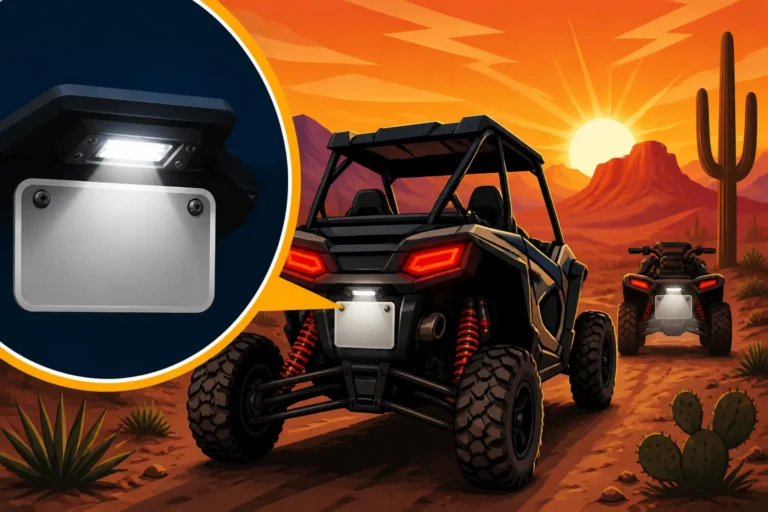
If your machine is street legal, the list of requirements grows significantly. You'll need working headlights (including a low beam/high beam), taillights, brake lights, turn signals, a horn audible from 200 feet, at least one rear-view mirror, a license plate light, and a windshield if your machine came with one. SuperATV and other aftermarket companies offer conversion kits to help meet these requirements, but ensuring everything is installed and working correctly is your responsibility. Officers often look for these details when you’re riding on a county road or near a populated area. A missing mirror or a non-working turn signal is an easy catch for a patrol officer.
Rules of the Road: Speed, DUIs, Reckless Riding
Even on a dirt road far from pavement, the rules of the road still apply. Speed limits, while often unposted in remote areas, are always implied: "reasonable and prudent for the conditions." Deputies and rangers will absolutely cite you for excessive speed, especially if you’re kicking up massive dust near residences, other riders, or campsites. They're looking for signs of dangerous or [Arizona Penalties for Reckless Riding] that endanger others or damage the environment.
Perhaps the most serious offense you can commit on an OHV, on or off-road, is operating under the influence. Arizona has strict DUI laws, and they apply to OHVs just as they do to cars. [Arizona Alcohol Limits for OHV Operators] are the same as for regular vehicles. Officers patrolling back roads are trained to spot impaired drivers, and the consequences of an OHV DUI are severe, including hefty fines, potential jail time, and the loss of your driving privileges. Open container laws also apply. It's simply not worth the risk to yourself or others.
Environmental and Trespassing Offenses
Arizona has vast public lands, but they are not a free-for-all. Many areas have strict rules about where you can and cannot ride. "Staying on designated routes" is a huge one for Forest Service and BLM lands. Officers will look for evidence of off-trail riding, creating new "two-tracks," or damaging vegetation. This often ties into [Arizona Rules on Forest Service Roads] and [Arizona Rules on BLM Roads]. Penalties for resource damage can be significant.
[Arizona Trespass Rules Along Desert Roads] are also enforced. While some back roads may seem abandoned, many traverse private property, state trust land, or even tribal land. Entering private property without permission is trespassing, regardless of whether there's a fence. State Trust Land requires a permit for recreational use, and while Game and Fish officers often check for this, other agencies might as well. Ignorance is no excuse when it comes to riding where you shouldn’t, and officers take property rights seriously. Always check your maps and know where you're riding.
What Happens During an OHV Stop on a Back Road?
So, you see flashing lights behind you on a dusty road. Your heart might do a little jump, but staying calm and knowing what to do can make the encounter smooth and respectful. Deputies and rangers are primarily concerned with safety and compliance, and a cooperative attitude goes a long way.
Initial Contact: What to Expect and How to Respond
When an officer signals you to stop, do so safely and promptly. Pull to the right side of the road, if possible, in a spot that allows the officer to approach safely. Turn off your engine. If you're in a side-by-side, keep your hands visible, perhaps on the steering wheel. If you're on an ATV, keep them on the handlebars. Wait for the officer to approach you. Don't start digging for your documents until they ask.
When the officer speaks, listen carefully. They'll typically explain why they stopped you – perhaps for an expired decal, a perceived violation, or even just a routine check in a known riding area. Be polite and respectful. Answer their questions truthfully, but don't volunteer excessive information. "Officer, how can I help you?" is a good starting point. This isn't the time to argue or get defensive. Your attitude can significantly influence the tone of the interaction.
Document Checks: Papers You Need to Carry
Just like driving a car, you need to have certain documents accessible when operating an OHV on public land. The officer will typically ask for your driver's license (or other form of identification), proof of registration for the OHV, and if applicable, proof of insurance for street-legal machines. If you're on State Trust Land, they might also ask for your State Trust Land Recreational Permit.
It’s a good practice to keep all your important papers – license, registration, decal receipt, and any permits – in a waterproof bag or pouch that you carry with you on the machine. This ensures they're protected from dust and moisture and are easily retrievable. Consider carrying a copy of the official [Arizona's Annual OHV Decal Explained] regulations or a map if you're in an area with complex access rules. Having everything in order and readily available shows responsibility and can help expedite the stop. You can also expect them to confirm the VIN on your machine matches your registration.
Machine Inspections: What Officers Look For
Beyond your paperwork, officers might do a quick visual inspection of your machine to ensure it meets basic safety and equipment requirements. For all OHVs, they'll often check for a [Arizona's Spark Arrestor Requirement] – sometimes they'll even ask to see it or tap the exhaust to check if it's rattling loose. They'll also look at your tires to ensure they're not excessively worn, and that your machine doesn't have any obvious leaks or mechanical issues that could pose a safety or environmental hazard.
For street-legal machines, the inspection will be more thorough, checking all the lights, horn, mirrors, and even tire tread depth. They might even check the sound level of your exhaust, especially if you have an aftermarket system. If something is obviously out of compliance – like a headlight that’s not working or an excessively loud muffler – they will likely issue a citation. This is where investing in quality components from trusted brands like SuperATV that meet regulations can pay off, ensuring you're not caught off guard by a faulty part.
Avoiding Trouble: Best Practices for Arizona Back Road Riders
The best way to handle law enforcement encounters on back roads is to avoid them altogether, at least the kind that results in a ticket. Being proactive, prepared, and informed about your responsibilities can make all the difference. It's not just about compliance; it's about being a responsible member of the riding community and preserving access to our incredible trails.
Pre-Ride Checks and Maintenance
Before every ride, give your machine a quick once-over. Check your tires for proper inflation and any damage. Make sure all your lights are working, especially if you plan to ride anywhere near dusk or on public roads. Check your oil and fluids. Ensure your [Arizona's Spark Arrestor Requirement] is clean and properly installed. These aren't just good safety habits; they address common things an officer might spot as a violation. A broken taillight can easily turn into a reason for a stop.
Regular maintenance is also key. Keeping your machine in good working order not only prevents breakdowns but also ensures it meets all regulatory requirements. For example, a poorly maintained exhaust system could become excessively loud, attracting unwanted attention. If you’ve added aftermarket parts, like those from SuperATV, make sure they’re installed correctly and comply with Arizona's specific regulations, particularly if you're building a street-legal machine. This diligence can save you from a roadside citation.
Knowing the Rules for Your Specific Ride Area
Arizona is huge, and the rules can vary depending on where you are. A Forest Service trail might have different rules than a BLM area, and both will differ from State Trust Land or county roads. Before you head out, do a little research. Check the specific regulations for your chosen riding spot. Are there designated trails only? Are there fire restrictions in place? Is an [Arizona State Trust Land Recreational Permits] required?
Utilize resources like the Arizona Game and Fish Department's OHV website, Forest Service motor vehicle use maps (MVUMs), and BLM travel management plans. These resources clearly delineate legal riding areas and any restrictions. Being caught off a designated trail is a common environmental violation and can lead to hefty fines. Ignorance of the law is never an excuse, so taking a few minutes to confirm the rules for your destination is always a smart move.
Responsible Riding Etiquette
Beyond the letter of the law, practicing good riding etiquette can also help you avoid unwanted attention. This includes keeping your dust down when passing other riders, hikers, or residences. Respect posted speed limits, especially in areas with other users. Always yield to horses and hikers. Be mindful of noise, particularly near residential areas or sensitive wildlife habitats. These might not be direct violations, but they can draw complaints, which often lead to increased law enforcement presence in an area.
Think about how you present yourself as a rider. Maintaining a clean machine, riding safely, and showing respect for the environment and other users sends a positive message. Deputies and rangers are often there to ensure public safety and preserve our riding opportunities. By demonstrating responsible behavior, you contribute to a positive perception of OHV recreation, which benefits all of us in the long run.
Penalties and Consequences for OHV Violations
Nobody wants to deal with the aftermath of an OHV violation. Beyond the immediate inconvenience of being stopped, the financial and legal consequences can be significant. Understanding these potential penalties can serve as a strong motivator to ensure you're always riding legally and responsibly.
Fines, Court Appearances, and Points
The most common penalty for minor OHV violations is a fine. These can range from relatively small amounts for things like a missing decal to hundreds of dollars for more serious infractions like operating off-trail or equipment deficiencies. Many violations are considered civil infractions, similar to a parking ticket, but others, like reckless driving or operating without a valid license, can be criminal misdemeanors. If you receive a citation, you'll typically have a court date or an option to pay the fine online. Ignoring a citation can lead to much more severe consequences, including warrants for your arrest.
For violations involving moving offenses, such as speeding or [Arizona Penalties for Reckless Riding], points can be assessed against your driver's license. Accumulating too many points can lead to increased insurance rates or even suspension of your driving privileges. This is a critical point: while an OHV might feel different from a car, many of the same traffic laws and consequences apply, especially if you're stopped on a public road. Make sure to consult the [Arizona OHV Ticket Amounts] if you ever receive a citation, to understand the exact charges and process.
Impoundment and Machine Seizure
In more serious cases, particularly with repeat offenders, or for violations like extreme reckless driving or a DUI, your OHV could be impounded or even seized. Impoundment means your machine is towed away, and you'll have to pay towing and storage fees, in addition to any fines, to get it back. These fees can quickly add up, often costing more than the original fine.
Seizure is even more serious and typically reserved for severe criminal offenses, where the machine itself might be considered evidence or an instrument of the crime. Losing your machine, even temporarily, can be a major headache and a significant financial burden. This is why agencies, including [Arizona Game and Fish OHV Contacts], emphasize responsible riding and compliance with all laws – they want you to enjoy the trails, not lose your vehicle.
The Impact on Your Driving Privileges
As mentioned earlier, many OHV violations, especially those related to operating under the influence or reckless behavior, can directly impact your regular driving privileges. A DUI on an OHV carries the same weight as a DUI in a car. It can lead to the suspension or revocation of your driver's license, making it impossible for you to legally drive any vehicle, including your car, for a set period. This can have ripple effects on your employment, family responsibilities, and overall daily life.
Additionally, certain convictions can stay on your record, potentially affecting future background checks or insurance rates. It’s a stark reminder that the fun of off-roading comes with serious responsibilities. Knowing what an Arizona officer asks for and having your [Keeping the Paperwork on the Machine] readily available, along with a deep understanding of the rules, protects not just your pocketbook, but your freedom to ride and drive.
| Violation Category | Common Examples | Potential Consequences | Enforcing Agency (Primary) |
|---|---|---|---|
| Registration/Decal | Missing/Expired OHV Decal | Fine, Potential for machine impoundment | AZGFD, Sheriff, DPS |
| Improperly displayed Decal | Fine | AZGFD, Sheriff, DPS | |
| Equipment | No Spark Arrestor / Loud Exhaust | Fine, Citation for fire safety/noise | USFS, BLM, AZGFD, Sheriff |
| Missing/Non-functional Street-Legal Gear | Fine, "Fix-it" ticket, Off-road only restriction | DPS, Sheriff | |
| Operation | Speeding / Reckless Riding | Fine, Points on license, Machine impoundment, DUI (if applicable) | Sheriff, DPS, USFS, BLM, AZGFD |
| Operating Under the Influence (DUI) | Arrest, Heavy fines, License suspension, Machine seizure | Sheriff, DPS, USFS, BLM, AZGFD | |
| Operating Off Designated Trails | Fine, Environmental damage citation, Restricted access | USFS, BLM, AZGFD | |
| Permits/Access | No State Trust Land Permit | Fine, Trespassing citation | AZGFD, State Land Dept. |
| Trespassing on Private Property | Arrest, Fine, Machine impoundment | Sheriff |
Disclaimer
This article is for general informational purposes only and does not constitute professional advice. Laws, prices and regulations vary by location and change over time. Consult a qualified professional for guidance on your specific situation.