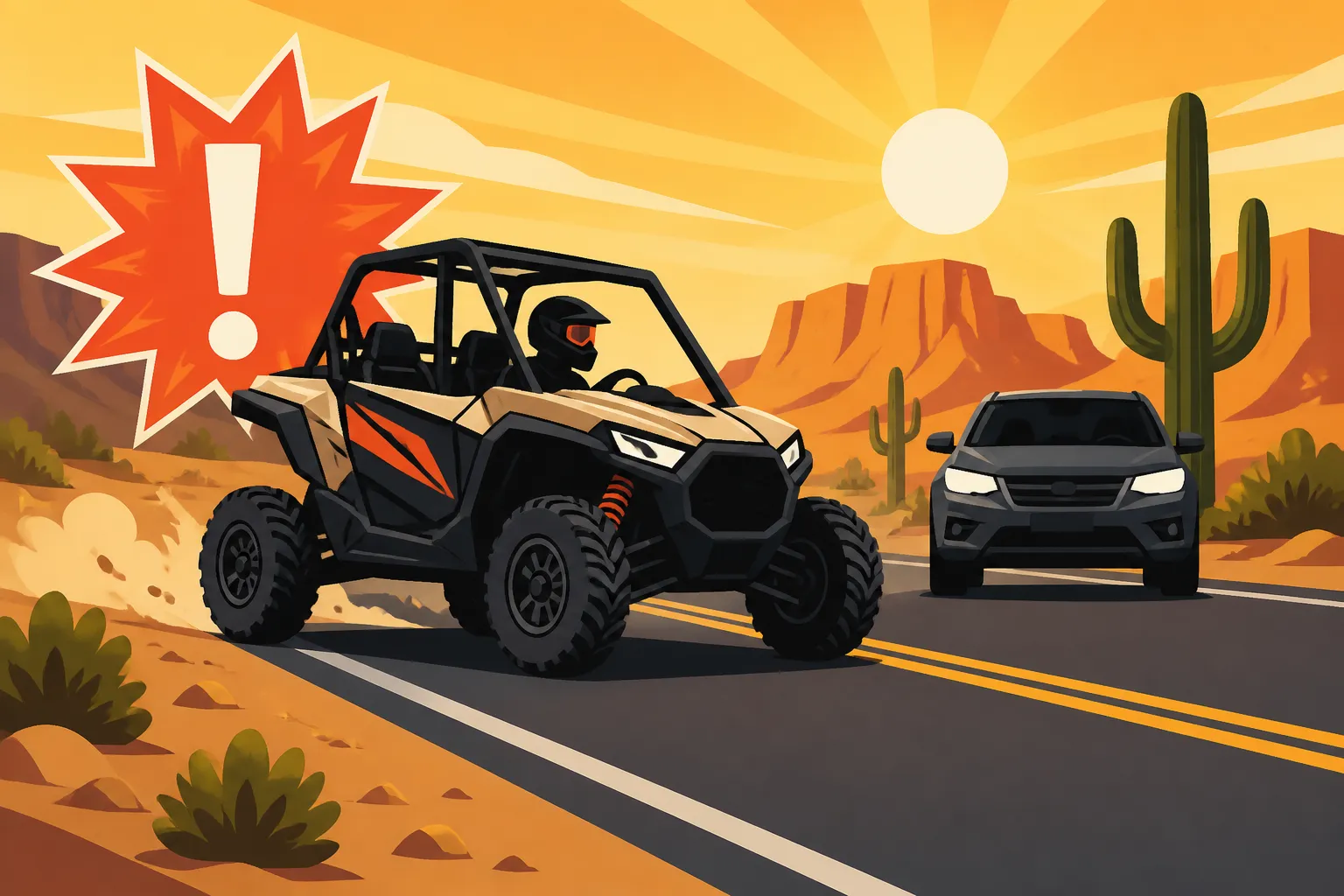
Crossing an Arizona Highway on a Machine
Many of us have been there: enjoying a fantastic trail ride, only to find a major highway or busy paved road blocking our path to the next section of adventure. It's a moment that can cause a lot of head-scratching, or worse, lead to dangerous decisions or hefty fines if you don't know the rules. This guide is all about navigating those tricky highway crossings safely and legally with your ATV or UTV in Arizona, helping you understand the dos and don'ts so your ride stays fun and compliant.
Understanding Arizona's Highway Crossing Rules for OHVs
This section will define what a highway is in Arizona's eyes for OHVs and clarify the crucial difference between merely crossing it and riding on it. It's a distinction that can save you from a ticket and keep you safe.
The Legal Framework for OHV Road Use
Arizona's rules around off-highway vehicles (OHVs) and paved roads can feel like a maze, and it’s understandable why riders get confused. The state generally wants OHVs off the main asphalt, but recognizes that sometimes, there's no other way to get from one section of trail to another. This is where the concept of a legal crossing comes into play. The Arizona Revised Statutes (ARS) lay out these specifics, but it often feels like you need a law degree to decipher them. Essentially, if your machine isn't street-legal with all the proper registration, plates, and insurance, you generally can't just cruise down a highway.
The primary aim of these regulations is safety – for OHV riders, passenger vehicles, and pedestrians. Highways are designed for faster-moving, enclosed vehicles, and an open-air ATV or UTV presents a different dynamic. Ignoring these rules isn't just about avoiding a fine; it's about minimizing the risk of a serious accident. For many of us, the joy of off-roading is the freedom, but that freedom comes with a responsibility to understand and respect the established boundaries, especially when it comes to shared public thoroughfares. It means knowing when you can and cannot use the road.
What Constitutes a "Highway" or "Crossing" in Arizona?
In Arizona, the term "highway" often refers to any public road or part thereof, which can be confusing because it doesn't always mean a multi-lane interstate. Even some two-lane paved roads in rural areas might be classified in a way that restricts OHV use. The critical distinction for OHV riders is that Arizona law may allow for the direct, perpendicular crossing of a highway from one off-highway route to another, provided the crossing is made at an angle of approximately ninety degrees to the roadway and at a place where no undue interference with other vehicular traffic will result. This is a very specific allowance, not a free pass to drive on the pavement.
Think of it this way: you're transitioning from dirt to dirt, and the highway is just a short, necessary bridge in between. It's not an opportunity to ride parallel to the highway for any distance, even if it's just a few hundred feet. The intent is strictly to get from one side to the other as quickly and safely as possible. Many riders get tripped up here, thinking "a short distance" is acceptable, but legally, the "crossing" definition is quite narrow. Always confirm the specific road's classification, especially in more populated areas, as local ordinances can add further restrictions. [Which Arizona Roads Are Open to OHVs] discusses this in more detail.
The Crucial "Crossing" vs. "Riding" Distinction
This is perhaps the most vital piece of information for any Arizona OHV rider contemplating a paved road. Crossing a highway means moving directly across it from one designated off-highway route to another, usually at an intersection or a safe, visible point. It's a quick, perpendicular maneuver. Riding a highway, on the other hand, means traveling along it, even for a short stretch, in the flow of traffic. Unless your OHV is fully street-legal—meaning it has all the required safety equipment, is titled as a street-legal vehicle, has an MC plate, and carries minimum liability insurance—riding along a highway is generally prohibited.
A common scenario might be encountering a paved county road that you think is part of a trail system, only to find yourself alongside cars for a half-mile. If your machine isn't street-legal, that half-mile is a violation. Law enforcement takes this seriously, and ignorance of the law isn't a valid defense. The fine for illegal road riding can be significant, not to mention the safety risk. Always err on the side of caution: if you're not sure, don't ride on the pavement. The goal is to always have [Do You Carry Papers on an Arizona Trail?] and all your machine's documentation handy for any ranger or deputy who asks.
| Feature | Highway Crossing (Permitted with conditions) | Highway Riding (Generally Prohibited for OHVs) |
|---|---|---|
| Duration | Brief, immediate transition | Extended travel along the road |
| Direction | Perpendicular (approx. 90 degrees) | Parallel to vehicle flow |
| Purpose | Connect two off-highway routes | Utilize road as a travel route |
| Legality | Limited allowance under specific statutes | Illegal unless OHV is street-legal |
| Safety Risk | Moderate, requires vigilance | High, especially with mixed traffic |
| Required Gear | Standard OHV safety gear | Full street-legal equipment (lights, mirrors, horn, etc.) plus registration/insurance |
Essential Equipment for Highway Crossings
Even for a quick, legal highway crossing, you need to ensure your machine and you are equipped to maximize visibility and safety. This isn't just about compliance; it's about making sure other drivers see you and react appropriately.
Maximizing Your Machine's Visibility
When you're out on the trails, blending into the desert landscape is often part of the fun. But when you hit a paved highway, you want to stand out as much as possible. This means ensuring your machine's lights are functioning perfectly. Headlights, taillights, and brake lights are not just for night riding; they are crucial during daylight hours to make your OHV noticeable to fast-moving highway traffic. Consider adding extra reflective tape to your machine or helmet, especially if you anticipate any crossings near dusk or dawn. Many riders add [Whip Flags on a Road Section of a Ride] not just for dust, but for visibility on the horizon.
Beyond lights, think about your machine's general condition. Is it covered in so much dust and mud that your taillights are obscured? Give them a quick wipe. Are your turn signals (if equipped, which is essential for street-legal machines and highly recommended for any machine crossing a road) clear and bright? If you've upgraded your UTV with accessories from a brand like SuperATV, make sure any lighting components you've added are operational and properly aimed to enhance visibility, not blind oncoming drivers. The more visible you are, the safer your crossing will be.
Signaling Your Intent and Alerting Drivers
When you approach a highway you intend to cross, communicating your intentions to other drivers is paramount. If your OHV has turn signals (and again, for street-legal machines, these are mandatory), use them well in advance. Even if your machine isn't street-legal, hand signals are universally understood and can make a huge difference. Point clearly in the direction you intend to go (straight across) and make eye contact with drivers if possible.
A working horn is another critical piece of equipment. While you might not typically use it on the trail, a quick, audible honk can grab the attention of a distracted driver before you enter the roadway. The goal here is proactive communication. Don't assume other drivers see you or understand your movements. Be overt with your actions and signals to minimize any ambiguity. This proactive approach applies whether you're on a beefed-up side-by-side or a nimble ATV; safety demands clear communication that leaves no doubt about your next move.
Personal Protective Gear for Road Sections
While Arizona law has specific [Arizona Helmet Rules for Riders Under 18], wearing a DOT-approved helmet is always a smart choice, even for short highway crossings, regardless of age. On the trail, you might encounter slow speeds and soft landings, but on a paved highway, even a low-speed impact can have severe consequences due to the unforgiving surface. Full-face helmets offer the best protection from impacts and road debris, and it's simply good practice for any road-involved riding.
Beyond a helmet, eye protection is non-negotiable. Dust, debris, or even insects can become dangerous projectiles at highway speeds, impairing your vision at a critical moment. Goggles or a full-face shield are essential to maintain clear sight of traffic. Robust gloves, long sleeves, and long pants also offer a layer of protection against scrapes and road rash in the event of an unplanned dismount. Remember, while the crossing might be brief, the risk on pavement is different and often higher than on dirt. Don't skimp on personal safety gear just because it's a "short" crossing. [Arizona Helmet Standards on Public and State Land] reinforces the importance of proper headwear.
Safety Considerations for Crossing Busy Roads
Crossing a major highway isn't like crossing a quiet dirt road. It requires heightened awareness, careful timing, and an understanding of traffic dynamics to ensure everyone's safety.
Assessing Traffic and Timing Your Move
This is where your defensive driving skills really come into play. Before you even think about putting a tire on the pavement, come to a complete stop at the edge of the roadway. Look both ways, repeatedly, just as you would when crossing on foot. Don't just glance; actively scan for approaching vehicles. Remember that OHVs are often lower to the ground and less visible than passenger cars, so give yourself an extra margin of safety, especially with the sun in your eyes.
Pay attention to the speed of oncoming traffic. Are vehicles moving at highway speeds (often 55+ mph)? This means they'll cover ground quickly. Estimate the time it will take for you to cross safely, and only proceed when you have an absolutely clear and ample gap in traffic from both directions. Never try to "beat" a car or truck, especially a semi-truck which requires a much longer stopping distance. Patience is your best friend here. If there’s a consistent flow of traffic, wait for a natural break or for traffic to clear significantly. It's better to wait an extra five minutes than risk an accident.
Group Riding Etiquette During Crossings
If you're riding with a group, highway crossings require extra coordination. The general rule is to cross one machine at a time, or in very small, tightly knit sub-groups if traffic allows, ensuring each rider has a clear path. The lead rider should assess the traffic, make the initial crossing, and then, if safe, signal to the next rider when it’s clear to proceed. This systematic approach prevents multiple machines from being exposed to traffic simultaneously and reduces confusion for oncoming drivers.
Never assume the entire group can cross in one go, no matter how small the gap in traffic. Communication is key: use radios, hand signals, or designated spotters to ensure everyone is on the same page. Children or less experienced riders should always be positioned towards the front of the group during a crossing, or at least be directly supervised. For those riding larger machines, like a Polaris RZR with a full SuperATV cage, remember your size and acceleration when timing your entry and exit from the paved road. Safety in numbers doesn't mean safety in chaos on a highway.
Situational Awareness at Intersections and Curves
Not all highway crossings are created equal. Some might be at well-marked intersections with clear sight lines, while others could be on a blind curve or near the crest of a hill. Always prioritize crossings at locations with the best possible visibility for both you and oncoming drivers. If a spot looks dicey—limited sight lines, overgrown vegetation, or a sharp curve—it’s probably not a safe place to cross. Consider finding an alternate route rather than risking it.
Be aware of other potential hazards: road signs that obscure vision, sun glare during certain times of day, or driveways that might have unexpected traffic entering the highway. If you're using a GPS or a mapping app like onX Offroad, try to preview your route and identify potential crossing points in advance, looking for those that offer the widest, clearest views. The more information you have about the immediate area, the better prepared you'll be to make a safe and legal crossing. [Blind Curves on a Desert Mountain Road] can be particularly tricky, making crossing an absolute no-go.
Avoiding Highways Altogether: Planning Your Route
The safest highway crossing is often the one you don't have to make. Smart route planning can save you a lot of stress and potential legal trouble, letting you focus on the fun parts of your ride.
Utilizing Motor Vehicle Use Maps (MVUMs) and GPS
In Arizona, your best friend for avoiding unwanted highway encounters is a good map, specifically Motor Vehicle Use Maps (MVUMs). These maps, provided by the U.S. Forest Service and Bureau of Land Management (BLM), clearly designate which roads and trails are open to motorized vehicles, and often, what types of vehicles. They'll also show where those trails intersect or run adjacent to paved roads, giving you a clear picture of the terrain ahead. Always consult the most current MVUMs for the area you plan to ride. [Reading an Arizona Motor Vehicle Use Map] is a crucial skill for any rider, not just for safety but for staying legal.
Beyond MVUMs, modern GPS devices and mapping apps (like Gaia GPS or the aforementioned onX Offroad) are invaluable. They allow you to meticulously plan your route, identifying every trail, dirt road, and potential pavement interaction before you even leave home. Many apps allow you to overlay different map layers, including satellite imagery, which can reveal subtle details about road crossings, like visibility, shoulders, and the nature of the intersecting terrain. Planning minimizes surprises and helps ensure you stick to legal OHV routes, avoiding headaches later on.
Finding Alternate Routes and Connectors
Sometimes, what looks like the most direct path on a map might involve an illegal stretch of highway. This is where the beauty of Arizona's vast network of dirt roads and trails really shines. Often, with a little extra navigation or a slightly longer detour, you can find a legal dirt connector or a less-trafficked county road that's open to OHVs, completely bypassing the need to touch a major highway. These might be old ranch roads, powerline service roads, or designated OHV corridors specifically designed to link trail systems without involving main roads.
Don't be afraid to explore these alternatives. A few extra miles on dirt are almost always preferable to a stressful, potentially illegal, or dangerous dash across a paved highway. Check with local ranger districts or OHV clubs; they often have the most up-to-date information on permissible routes and connectors that might not be immediately obvious on a standard map. This is where community knowledge truly pays off, and places like [Arizona's 40,000 Miles of OHV Trail] often include many legal connecting routes.
Staging Areas and Trailer Use to Avoid Pavement
If a trail system requires a highway crossing that you're uncomfortable with, or if it's simply unavoidable and your machine isn't street-legal, consider using a trailer to move your OHV. Staging areas are strategically located parking lots or open spaces designed for riders to unload their machines and start their off-highway adventure directly. If a trail continues on the other side of a highway, and there's another staging area nearby, it might be worth the effort to load up, drive the highway section, and unload again.
This approach eliminates the risk entirely and ensures you're always operating legally and safely. While it might add a bit of time to your day, it's a small price to pay for peace of mind and avoids any potential fines. Many experienced riders in areas with fragmented trail systems rely heavily on this method. It's also an excellent strategy when exploring new areas or tackling trails where you're unsure about the local road regulations. [Trailer Registration for Hauling Quads in Arizona] is essential if you go this route, ensuring your trailer is also compliant.
Common Mistakes and Penalties
Even with the best intentions, mistakes can happen. Knowing what pitfalls to avoid and the consequences of illegal actions can help keep you on the right side of the law, protecting your wallet and your riding privileges.
Misinterpreting Road Classifications and Intent
One of the most frequent mistakes riders make is misunderstanding which roads are "highways" and which are simply "county roads" or "rural routes" where OHV use might be permitted. Just because a road is paved and leads to a trail doesn't automatically mean you can ride your non-street-legal OHV on it. Arizona has a hierarchy of roads, and the rules vary greatly. For example, some small towns or communities have specific ordinances restricting OHV access on any paved street within their limits, even if the state allows limited use on county roads elsewhere.
Another common misinterpretation is blurring the line between "crossing" and "riding a short distance." As we discussed, crossing is generally a direct, perpendicular maneuver. Riding along a road, even for a few hundred feet to get to a different access point, is typically considered illegal unless your machine is fully street-legal. Riders often assume a "common sense" approach will suffice, but law enforcement officers are trained to uphold the letter of the law. When in doubt, assume less leeway, not more. [Arizona City Streets Open to OHVs] often have specific rules that you need to be aware of.
The Consequences of Illegal Highway Riding
Riding a non-street-legal OHV on an Arizona highway is a serious offense that can carry significant penalties. The most immediate consequence is typically a citation, which can result in a hefty fine. These aren't just minor traffic tickets; they can often be hundreds of dollars, sometimes more, depending on the specific statute violated and whether it's a repeat offense. Beyond the financial hit, you could face other administrative penalties, such as points on your driver's license (if applicable) or even a suspension of OHV riding privileges.
In addition to legal penalties, there are the very real safety risks. An OHV is not designed for highway speeds, nor is it as visible or protected as a standard vehicle. Collisions between OHVs and passenger cars on highways can be catastrophic, leading to severe injuries or fatalities. Your insurance might also be complicated or even voided if you're involved in an accident while operating your OHV illegally on a paved road. It's a risk that simply isn't worth taking for the convenience of avoiding a few miles of dirt. [What Riding Arizona Undecaled Costs You] can give you an idea of the penalties for machines not properly marked.
Encountering Law Enforcement on or Near Pavement
Arizona Game and Fish Department officers, county sheriffs, and even local police departments all have the authority to enforce OHV laws. They are typically very familiar with the subtle distinctions between legal and illegal OHV operation on and near paved roads. If you're pulled over while attempting to cross a highway, or worse, riding along it illegally, remaining calm and cooperative is always the best approach.
Be prepared to present your [Arizona MVD OHV Registration Explained], proof of ownership, and your OHV decal. If your machine is street-legal, have your MC plate visible and your insurance readily available. If your machine is not street-legal, an officer is likely to inquire about your intentions and your route. Explaining that you were making a direct, perpendicular crossing from one designated OHV route to another, if true and permissible, is important. However, arguing or being uncooperative will only escalate the situation. Officers are focused on safety and compliance, so demonstrating that you understand and respect the rules, even if you made a mistake, goes a long way.
Disclaimer
This article is for general informational purposes only and does not constitute professional advice. Laws, prices and regulations vary by location and change over time. Consult a qualified professional for guidance on your specific situation.