Getting an MC Plate for a Side-by-Side
There's nothing quite like the freedom of an Arizona side-by-side, but sometimes, you want to take that freedom to the pavement. Maybe you need to connect two fantastic trail systems without loading up the trailer, or perhaps you just want to run into town for a quick bite after a morning on the dirt. The frustration is real when you hit a paved road and realize you're limited, but making your side-by-side street legal with an MC plate in Arizona isn't just a pipe dream; it's a practical reality. This guide is all about cutting through the confusion and showing you exactly how to get that coveted MC plate so your UTV can legally cruise Arizona's roads.
Understanding Arizona's Street Legal Requirements for Side-by-Sides
Before you even think about rolling your side-by-side onto public pavement, it's crucial to understand what Arizona expects from a street-legal off-highway vehicle (OHV). It's not just about slapping on a couple of mirrors; there are very specific laws that dictate what makes a UTV road-worthy in the Grand Canyon State. This isn't just about avoiding a ticket; it's about your safety and the safety of everyone else on the road.
Why an MC Plate, Not an RV Plate?
This is often the first point of confusion for many side-by-side owners. You see "OHV" and think "Recreational Vehicle," which naturally leads many to assume an RV plate would be the goal for street legality. However, in Arizona, when you convert your side-by-side for street use, it's generally classified and registered as a motorcycle, earning it an "MC" plate. The RV plate, on the other hand, is specifically designated for traditional off-highway vehicles that do not meet street-legal requirements and are primarily for off-road use, even if they have an OHV decal.
The Arizona MVD recognizes that while a side-by-side might have four wheels and a steering wheel, its construction and intended use (even when street-legal) align more closely with the "motorcycle" category for registration purposes than with a full-blown recreational vehicle like a motorhome. This distinction is vital because the legal requirements for operating a vehicle with an MC plate on public roads are different from those for an RV plate or just an OHV decal. An MC plate signifies that your machine has passed the necessary inspections and has the required equipment to share the road safely with other traffic. Meanwhile, an RV plate on a side-by-side simply means it's registered as an OHV for off-highway use, even with the annual decal. For comprehensive information on what each plate signifies, you can check out [MC Plates and Street-Legal Machines] and [RV Plates and Off-Highway Only Machines].
The Core Equipment Mandates for Arizona Road Use
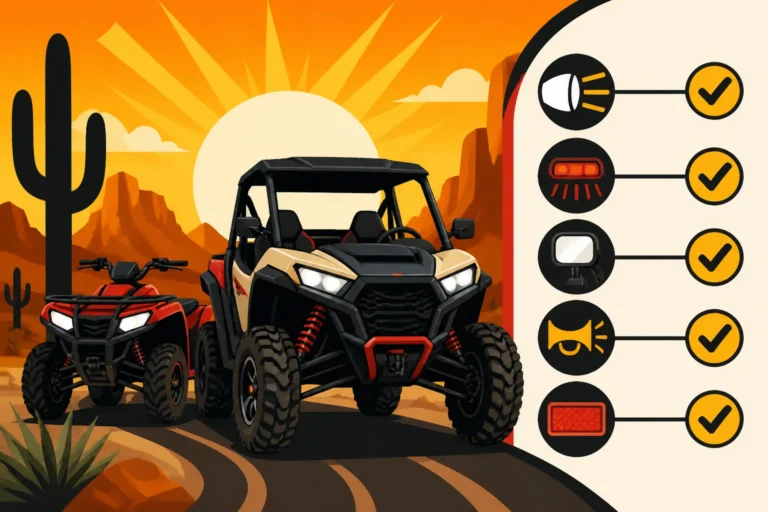
Converting your side-by-side to street legal status involves adding or upgrading several key pieces of equipment. Think of it as outfitting your machine to blend in safely with regular traffic, ensuring it can signal, stop, and be seen just like any other vehicle on the road. These aren't optional extras; they are non-negotiable legal requirements that the Arizona MVD will inspect for.
First and foremost, your side-by-side needs proper lighting. This means at least one white headlight visible from 500 feet, and a red taillight visible from 500 feet to the rear. Crucially, you'll also need working brake lights that illuminate when the brakes are applied. Beyond basic illumination, turn signals are a must, visible from both front and rear, so other drivers know your intentions. A working horn, audible from at least 200 feet, is also required to alert others to your presence. Many riders turn to aftermarket kits from reputable suppliers, and brands like SuperATV offer comprehensive street-legal kits that bundle many of these essential components, often simplifying the installation process.
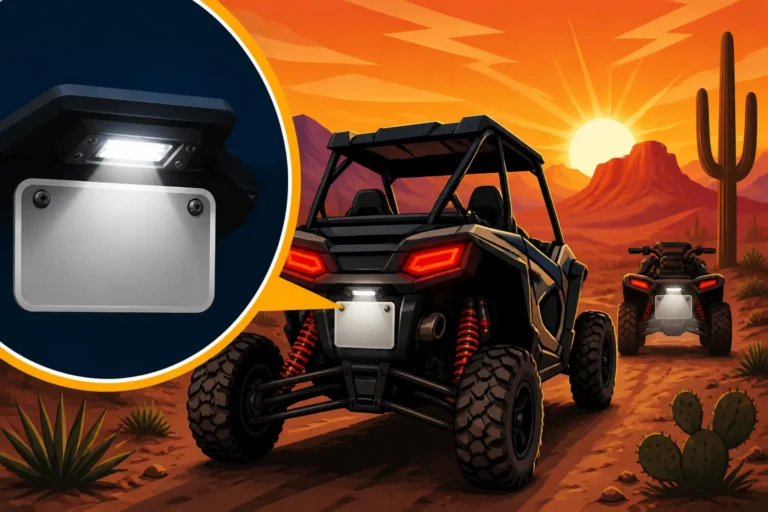
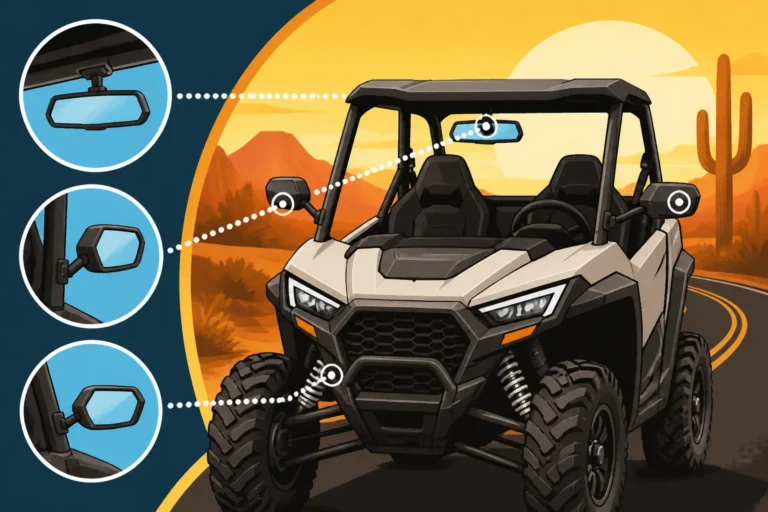
Next on the list are mirrors. You'll need at least one rearview mirror, mounted to provide a clear view of the road behind you, allowing you to see at least 200 feet to the rear. A windshield is also generally required, providing protection from debris and elements. Your tires must be DOT-approved, meaning they are designed and rated for safe use on public roads, not just for off-road traction. Finally, your machine must have seatbelts for all occupants, a license plate light to illuminate your MC plate at night, and a muffler that meets noise standards. For a detailed breakdown of all requirements, refer to [What Arizona Requires on a Street-Legal Machine].
Additional Safety Gear and Considerations
While the equipment mandates cover the mechanical necessities for road legality, there are also vital safety gear and considerations for the occupants. Arizona law has specific requirements for helmets and other protective equipment, especially for younger riders, which apply equally to street-legal side-by-sides.
For starters, anyone under 18 operating or riding in an OHV on a public road must wear a DOT-approved helmet. While not legally mandated for adults over 18, wearing a helmet is always a smart choice for any off-road or open-air vehicle, given the inherent risks. Eye protection, such as goggles or a face shield, is also highly recommended, especially given the open nature of most side-by-sides. Beyond personal gear, the machine itself should feature a robust roll cage and proper occupant restraint systems, like multi-point harnesses, especially if you plan on spirited driving or off-road excursions that connect with your road travels. These are crucial for protecting occupants in the event of an overturn or collision.
Lastly, don't forget about a spark arrestor. While you're making your machine street-legal, it's still an OHV, and Arizona requires all OHVs operating on public lands (which includes many county and forest service roads) to be equipped with a U.S. Forest Service approved spark arrestor. This is a fire safety measure, preventing hot carbon particles from igniting dry vegetation in our beautiful, and often very dry, desert and forest environments. It's a small but critical detail that many overlook when focusing solely on street-legal conversions.
Navigating the Arizona MVD Process for Street Legal Conversion
Once you've equipped your side-by-side with all the necessary components for street legality, the next step is to make it official through the Arizona Motor Vehicle Division (MVD). This process involves paperwork, potentially an inspection, and finally, obtaining your MC plate. It can seem daunting, but breaking it down into manageable steps makes it much clearer.
Documentation You'll Need at the MVD
Gathering all your paperwork before heading to the MVD or a third-party provider is probably the most crucial step in avoiding delays and frustration. Think of it as assembling your "street-legal conversion kit" of documents. You don't want to get to the front of the line only to realize you're missing a critical piece of paper.
The absolute cornerstone is your Certificate of Title. This document proves legal ownership of your side-by-side. If you bought your machine new from a dealer, they likely handled the initial title application. If you purchased it used, ensure the title is properly signed over to you by the previous owner, with any liens released. If you've just moved to Arizona, you'll need proof of Arizona residency. You’ll also need a bill of sale, especially if the title doesn’t fully reflect your purchase or if there are any questions about sales tax. The bill of sale acts as additional proof of ownership and is vital for accurate tax calculations. For those new to the state or purchasing a machine with an out-of-state title, make sure your VIN on the machine matches exactly what's on the title and any other proof of ownership. Any discrepancy, even a single character, can trigger a more involved VIN inspection process. For more on general OHV registration, refer to [Arizona MVD OHV Registration Explained].
Beyond ownership, you'll need proof of insurance. Unlike off-road-only machines, which don't require insurance by law for off-road use, a street-legal side-by-side operating on public roads must have minimum liability coverage. Make sure your insurance policy explicitly states that it covers your side-by-side for on-road use. You'll present this to the MVD. Having all these documents neatly organized in a folder will not only speed up your visit but also demonstrate to the MVD representative that you're prepared and serious about completing the process correctly. Remember, clarity and completeness in your documentation are your best friends here.
The Inspection: What to Expect
Once you have your paperwork in order and your side-by-side is fully equipped, the next hurdle is the MVD or authorized third-party inspection. This isn't usually a deep mechanical dive, but rather a verification that all the required street-legal equipment is present and functioning. The purpose is to ensure your machine meets the minimum safety standards to legally share the road.
When you bring your side-by-side in for inspection, an MVD agent or a trained representative at a third-party office will physically check for each of the mandated items. They’ll look for your headlights, taillights, brake lights, and turn signals, and they’ll ask you to demonstrate that they all work. They’ll want to hear your horn, check your rearview mirror(s), and verify the presence of a windshield. They’ll also confirm that your tires are DOT-approved and that you have a functioning license plate light. This is also where they’ll visually confirm your VIN, matching it against your title paperwork to ensure no errors or discrepancies exist. This is also a good time to mention that many riders find the process smoother through [Third-Party MVD Providers That Register OHVs] because these offices often specialize in OHV registrations and titling.
Common pitfalls during this inspection often revolve around simple oversights. Did you forget to wire in the turn signals correctly? Is your horn loud enough? Is your license plate light illuminating the plate sufficiently? Even small details like ensuring your seatbelts are accessible and in good condition can be part of the check. It's highly advisable to do a thorough self-inspection before your MVD appointment, just as a pilot does a pre-flight check. Test every light, honk the horn, check the mirror mounts, and ensure your windshield is securely attached. Catching these issues at home saves you the frustration of being turned away and having to reschedule.
Titling and Registering Your Street Legal Side-by-Side
After a successful inspection and with all your documentation validated, you're ready for the final steps: titling and registering your side-by-side for that coveted MC plate. This is where your machine officially transitions from an off-highway vehicle to a street-legal one in the eyes of the Arizona MVD.
First, you'll apply for the Certificate of Title if you don't already have an Arizona title for your side-by-side. Even if you have a title, you'll likely need to indicate during this process that you intend to register it for street use. This often involves specific forms that designate the machine for "street legal" operation. Once the title is processed or updated, you can then proceed with the registration. You will be registering for an MC (motorcycle) plate, which confirms your side-by-side meets all the street-legal requirements. At this point, you'll also purchase your annual OHV decal. This is a critical detail: even with an MC plate, if you plan to ride your side-by-side off-road on designated trails or public lands, the annual OHV decal is still mandatory. The MC plate allows you on the pavement, but the decal permits your off-road adventures.
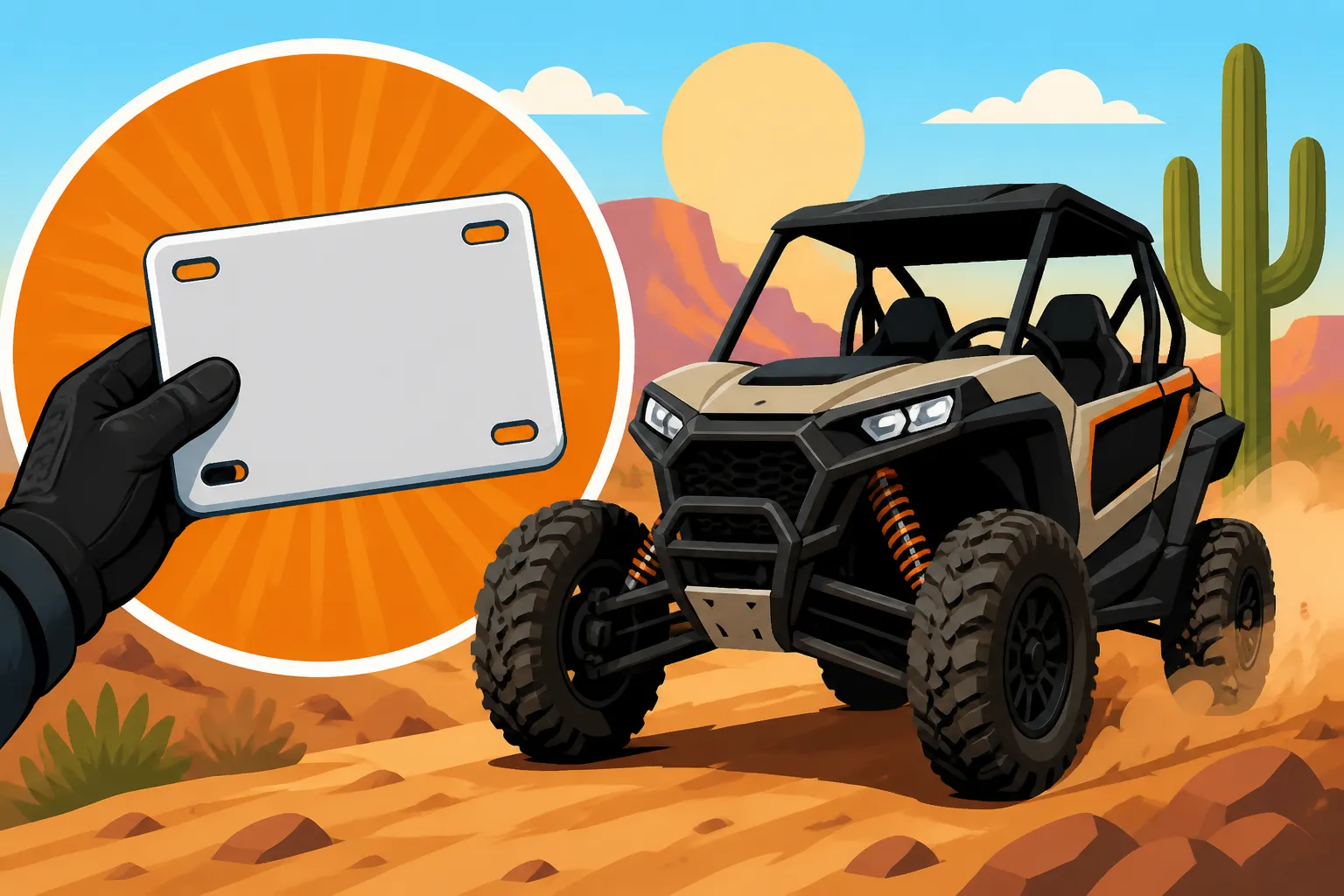
The MVD will assess the appropriate fees, which typically include a title fee, registration fee, and the annual OHV decal fee. These fees can vary, so it's always best to check the current rates on the Arizona MVD website or with your chosen third-party provider before your visit. Once all fees are paid and the paperwork is complete, you'll be issued your MC plate, which you’ll need to affix to the rear of your side-by-side in a visible location. Remember, this plate must be illuminated at night by your license plate light. For more specific details on the titling process, especially if you're getting a title for the first time, check out [Arizona Certificate of Title for an Off-Highway Vehicle]. This final step is the culmination of your efforts, granting you the legal authorization to enjoy both the dirt and the pavement.
Insurance, Emissions, and Ongoing Compliance
Getting your MC plate is a big step, but it's not a one-and-done deal. Just like any other registered vehicle, your street-legal side-by-side comes with ongoing responsibilities, including maintaining proper insurance, adhering to emissions standards where applicable, and ensuring you stay compliant with all Arizona road laws. Neglecting these aspects can lead to fines, revoked registration, or worse, leaving you unprotected in an accident.
Meeting Arizona's Insurance Minimums for Road Use
This is one of the most critical differences between an off-road-only OHV and a street-legal one. When your side-by-side gains that MC plate and hits the pavement, it becomes subject to Arizona's mandatory motor vehicle liability insurance laws. You simply cannot operate it on public roads without adequate coverage. The state requires minimum coverage levels, often referred to as 25/50/15. This typically means $25,000 for bodily injury liability per person, $50,000 for bodily injury liability per accident, and $15,000 for property damage liability per accident.
It's crucial to understand that your existing off-road OHV insurance policy might not automatically cover your machine for on-road use. Many policies are specifically tailored for off-highway risks and might exclude incidents on public streets. Therefore, you must contact your insurance provider and explicitly inform them that your side-by-side is now street-legal and will be operating on public roads. They will likely adjust your policy to include the necessary liability coverage, and it's wise to discuss options for comprehensive and collision coverage as well, especially given the investment most people have in their side-by-sides. Make sure you receive updated proof of insurance that clearly indicates your side-by-side is covered for street use, and always carry this documentation with you when riding. For more on this, consult [Arizona Insurance Minimums for Road Riding].
Emissions Testing: Is Your Side-by-Side Exempt?
Emissions testing is a fact of life for many vehicle owners in Arizona's two largest metropolitan areas: Phoenix and Tucson. When you convert your side-by-side to street-legal status and obtain an MC plate, it's natural to wonder if it will be subjected to these tests. The answer depends on a few factors, primarily the model year of your machine and where you live and register it.
Generally, specific emissions testing requirements apply to gasoline-powered vehicles registered in parts of Maricopa (Phoenix area) and Pima (Tucson area) counties. Vehicles newer than a certain model year are often subject to annual or biennial testing. However, some OHVs, particularly those that are older or fall outside specific weight or engine displacement categories, might be exempt. Additionally, if your side-by-side is an older model that pre-dates certain emissions regulations, it may also be exempt. The key is not to assume. It’s imperative to check the current Arizona Department of Environmental Quality (ADEQ) regulations or contact them directly, especially if you reside in a mandatory testing area. If your side-by-side does require emissions testing, you’ll need to ensure it passes before your MC plate registration can be renewed. This means your machine’s exhaust system, including catalytic converters if equipped, must be functioning properly. While many side-by-sides are built for rugged off-road performance, companies like SuperATV also offer performance parts that maintain emissions compliance. For details specific to your location and vehicle, review [Emissions Testing for OHVs in Phoenix and Tucson].
Staying Compliant: Renewals and Road Rules
Maintaining street-legal status for your side-by-side in Arizona is an ongoing commitment. It's not just about the initial conversion and plate; it's about continuous adherence to regulations. This includes annual renewals and a thorough understanding of the specific road rules that apply to OHVs.
Both your MC plate registration and your annual OHV decal will require renewal. The MC plate renewal keeps your machine street-legal, while the OHV decal ensures you can still enjoy off-road trails. These renewals typically happen on an annual basis, and it's your responsibility to ensure they are current. The Arizona MVD usually sends out renewal reminders, but it’s always a good idea to mark your calendar so you don't accidentally let your registration lapse, which can lead to fines or even your machine being impounded if caught on public roads. Beyond renewals, you must internalize the specific road rules for OHVs in Arizona. While you have an MC plate, your side-by-side isn't a car, and it won't be treated like one everywhere. This means understanding speed limits, which roads are open to OHVs (and which are not, like interstates), and any specific local ordinances that might restrict OHV use within city limits. Some cities or towns might have stricter rules regarding noise or operating hours.
Always keep your updated registration, proof of insurance, and driver's license (yes, you need a valid driver's license to operate a street-legal OHV on Arizona roads) readily accessible on your machine. A small waterproof pouch is a great investment for this. Being prepared and compliant not only prevents potential citations but also shows respect for the law and other road users.
The Realities of Riding a Street-Legal Side-by-Side in Arizona
Converting your side-by-side to street legal status with an MC plate fundamentally changes how you interact with your machine and the vast landscapes of Arizona. It opens up a new world of possibilities, from connecting remote trail systems to simply running a quick errand. However, it also introduces a new set of realities, including where you can legally ride and the specific challenges of sharing the road.
Where You Can (and Can't) Ride with an MC Plate
Having an MC plate for your side-by-side in Arizona certainly expands your riding horizons, but it doesn't give you carte blanche to drive anywhere a car can go. It's vital to understand the distinctions and limits to avoid costly mistakes or dangerous situations.
Generally, a street-legal side-by-side with an MC plate can be operated on most county roads, forest service roads, and many city or town streets, provided there isn't a specific local ordinance prohibiting OHV use. This means you can often drive from your home or staging area directly to a trailhead, eliminating the need to trailer for shorter distances. This capability is fantastic for accessing Arizona's [Arizona's 40,000 Miles of OHV Trail], allowing you to connect segments that might otherwise be separated by stretches of pavement. You can cruise through small trail towns, stop for gas or food, and truly make your OHV an integral part of your adventure. However, there are significant restrictions. Street-legal OHVs, including side-by-sides, are generally NOT permitted on Arizona's interstates (like I-10, I-17, or I-40) or major limited-access highways (such as US-60 in many areas). These roads are designed for high-speed traffic, and OHVs, even street-legal ones, typically do not meet the speed or safety requirements for such thoroughfares. Always check local regulations, as some smaller cities may have specific streets or areas where OHVs are prohibited. Ignorance of the law is never an excuse, so educate yourself on [Which Arizona Roads Allow OHVs] before you venture out.
Connecting Trails and Running Errands
The primary draw for many side-by-side owners to go through the street-legal conversion is the sheer convenience it offers. Imagine waking up at a campground on the edge of a vast trail system, hopping in your UTV, and legally driving a mile down the paved county road to the gas station for supplies, then crossing the street to a restaurant for breakfast before heading back to the dirt. This is the kind of freedom an MC plate provides.
No longer are you tethered to your truck and trailer, constantly loading and unloading for every short segment of pavement or small town crossing. This dramatically enhances the versatility of your machine, turning it into a legitimate dual-purpose vehicle. You can drive from [Riding Town to Trailhead in Arizona] seamlessly, extending your adventure without interruption. This is particularly valuable in areas like Sedona, Prescott, or the Lake Havasu region, where fantastic trail networks are often interspersed with paved roads and charming small towns. The ability to connect trails means you can plan longer, more diverse routes, experiencing different terrains without the logistical headache of trailer moves. Moreover, for those living in rural areas or near smaller communities, a street-legal side-by-side can become a practical second vehicle for quick errands, a trip to the post office, or a run to the hardware store, all while enjoying the open-air experience. It blends the utility of a light-duty truck with the excitement of an off-road machine.
Potential Challenges and Misconceptions
While the benefits of a street-legal side-by-side are clear, it's also important to be realistic about the challenges and misconceptions that can arise when operating one on public roads. It's not always smooth sailing, and being prepared for these realities can make your experience much safer and more enjoyable.
One of the biggest challenges is the reaction of other drivers. Many motorists are simply not accustomed to seeing a side-by-side on the same road as their cars and trucks. This can lead to unexpected maneuvers from other drivers, or them simply not seeing your smaller vehicle. You must be extra vigilant, defensive, and predictable in your driving. Use your turn signals well in advance, maintain appropriate following distances, and assume other drivers might not notice you. Another common issue is noise. While you must meet Arizona's muffler and noise standards, side-by-sides are inherently louder than most passenger cars. Be mindful of residential areas and try to keep noise to a minimum, especially early in the morning or late at night, to avoid bothering residents. This also helps foster a positive image for OHV enthusiasts.
A critical misconception is that "street legal" means "drive it like a car" everywhere. While you're on the pavement, you're still operating an OHV. Your off-road tires, while DOT-approved, may not handle like street tires on hard pavement, especially in wet conditions or during hard braking. Long stretches of high-speed pavement driving can also prematurely wear out knobby off-road tires. Moreover, the suspension and steering of a side-by-side are optimized for off-road performance, which can make on-road handling feel less refined than a dedicated road vehicle. Always ride within your machine's capabilities and your own skill level, and never push the limits just because you have an MC plate.
Maximizing Your Street Legal Conversion
Making your side-by-side street legal is more than just meeting the minimum requirements; it's about optimizing your machine for both on-road safety and off-road enjoyment. With careful planning and smart upgrades, you can enhance your side-by-side's versatility and ensure it performs reliably whether you're cruising pavement or tackling tough trails.
Essential Aftermarket Upgrades for Road Safety
While Arizona outlines the basic equipment for street legality, there are several aftermarket upgrades that can significantly enhance your safety and comfort on public roads, taking your conversion beyond just the bare minimum. These additions often improve visibility, functionality, and the overall driving experience.
Consider upgrading your horn to a louder, more attention-grabbing model. While the stock horn might meet the minimum audible distance, a robust air horn or an aftermarket electric horn can make a huge difference in getting the attention of distracted drivers. For lighting, while your DOT-approved headlights are sufficient, many riders opt for brighter LED headlights or even a street-legal light bar that can be switched between a low-beam setting for the road and a high-intensity flood for off-road night riding. Companies like SuperATV offer a range of lighting solutions that cater to both compliance and performance. Investing in better mirrors, perhaps larger ones with wider fields of view or even side-view cameras, can also greatly improve your awareness of traffic around you.
Another area to consider is tire choice. While DOT-approved tires are mandatory, you might want to select a tire that offers a good compromise between aggressive off-road traction and decent on-road manners. Some hybrid tires are designed for this dual purpose, providing a smoother, quieter ride on pavement while still offering capable performance on dirt. Finally, consider adding a wiper system to your windshield, especially if you anticipate riding in rain or dusty conditions, as clear visibility is paramount for road safety. These thoughtful upgrades contribute to a safer, more enjoyable, and more confident street-legal experience.
Proper Maintenance for On-Road Use
Once your side-by-side is street legal, your maintenance routine needs to evolve to account for the additional stresses of road driving. Pavement can be surprisingly hard on an OHV, and overlooking specific maintenance points can lead to premature wear or safety issues.
Regularly inspecting all your street-legal components is paramount. This means frequently checking your headlights, taillights, brake lights, and turn signals to ensure all bulbs are working and wiring is secure. Your horn should be tested often, and your mirrors should be checked for tightness and clarity. Pay close attention to your tires. Road driving, especially at higher speeds, can accelerate wear on off-road tire compounds. Regularly check your tire pressure – you might find that a slightly higher pressure is optimal for paved roads to reduce rolling resistance and increase fuel efficiency, while lower pressures are ideal for the trails. Adjusting pressure between road and trail use can significantly extend tire life and improve performance.
Brakes are another critical area. Road driving, particularly in traffic, can lead to more frequent and harder braking than typical trail riding. Inspect your brake pads, rotors, and fluid levels more often. The suspension components, while rugged for off-road, can also experience different kinds of stress on pavement. Check ball joints, bushings, and tie rods for wear, as tight steering and suspension are vital for safe road handling. Finally, ensure your engine cooling system is in top shape, as sustained higher RPMs on road can generate more heat than casual trail riding. A well-maintained street-legal side-by-side is not only safer but also more reliable for all your adventures.
Street Legal Kits: A Common Path to Compliance
For many side-by-side owners, piecing together all the individual components for a street-legal conversion can feel overwhelming. Sourcing the right lights, turn signals, mirrors, and wiring harnesses from various manufacturers can be time-consuming and lead to compatibility headaches. This is where dedicated street legal kits become an incredibly popular and practical solution.
These all-in-one kits are designed to provide most, if not all, of the necessary components in a single package, often tailored specifically for popular side-by-side models. A good kit will typically include DOT-compliant headlights, taillights, brake lights, turn signals, a horn, mirrors, and a license plate light, along with all the necessary wiring, switches, and instructions for installation. The biggest benefit is the peace of mind that comes from knowing you have a complete, integrated system designed to meet the legal requirements. Brands like SuperATV are well-known for offering such comprehensive kits, simplifying the conversion process significantly. Their kits often feature plug-and-play wiring, which reduces installation time and minimizes the need for complex electrical modifications.
While a kit might represent an upfront investment, it often saves money and frustration in the long run by preventing the purchase of incompatible parts or the need for extensive custom fabrication. Before buying any kit, however, always verify that it is specifically designed for your side-by-side's make and model and that it explicitly states compliance with Arizona's street-legal equipment requirements. Reading reviews and consulting with experienced installers or fellow riders can also provide valuable insights into which kits offer the best quality and easiest installation. Ultimately, a well-chosen street legal kit can be the fastest and most efficient way to get your side-by-side ready for its MVD inspection and that coveted MC plate.
Disclaimer
This article is for general informational purposes only and does not constitute professional advice. Laws, prices and regulations vary by location and change over time. Consult a qualified professional for guidance on your specific situation.