What Arizona Requires on a Street-Legal Machine
It’s a common Arizona frustration: you’ve got your awesome ATV or UTV, you love hitting the trails, but getting from your camp to the trailhead or just grabbing a quick bite in a small desert town means loading up the trailer. The thought of just hopping on your machine and cruising down a paved road to your destination feels like pure freedom, but the rules around making your off-highway vehicle (OHV) street-legal in Arizona can feel like navigating a maze of technicalities. This guide is here to untangle that, laying out exactly what Arizona demands to transform your off-road warrior into a street-legal cruiser, so you can enjoy the ultimate convenience and accessibility.
Understanding Arizona's Street Legal Framework for OHVs
For many of us, the lines between an off-highway vehicle and a regular street-legal car can feel a bit blurry, especially when you see other riders seemingly cruising their UTVs around town. The reality is, Arizona has very specific definitions and requirements that dictate whether your ATV or UTV can legally touch public roads beyond crossing them at designated points. It's not just a matter of slapping on a license plate; it's about a complete transformation of your machine to meet safety and equipment standards typically reserved for motorcycles and other street-approved vehicles.
The Distinction: OHV vs. Street-Legal Vehicle
At its core, an OHV in Arizona is defined by its primary purpose: off-road use. This means machines like ATVs, UTVs, dirt bikes, and sand rails are built for dirt, sand, and rocks, not asphalt. They typically have specialized suspension, tires, and gearing for rugged terrain, and often lack many of the safety and visibility features mandated for on-road vehicles. When you buy an OHV, you generally register it with the Arizona Department of Transportation (ADOT) and get an OHV decal, which allows you to ride on designated trails and public lands. This decal signifies off-road legality, but it does not grant you blanket permission to drive on city streets or state highways.
Converting your OHV to a street-legal vehicle fundamentally changes its classification in the eyes of the law. You're essentially upgrading it to meet the same standards as a motorcycle or an "autocycle," allowing it to share the pavement with cars and trucks. This isn't just about convenience; it’s about safety and regulatory compliance. The moment your wheels hit a paved public road, your machine is subject to a whole new set of rules, from equipment requirements to driver licensing and insurance. The OHV decal, while still needed for off-road use, becomes secondary to the state-issued license plate that declares its street legality. Without this conversion and the proper plate, driving your OHV on a paved road, even for a short distance, can lead to fines and citations.
Why Go Street-Legal? Pros and Cons
Deciding whether to make your ATV or UTV street-legal is a personal choice, often weighing the benefits of increased access against the investment of time and money. For many, the pros far outweigh the cons, opening up a whole new world of riding possibilities.
The most significant advantage of going street-legal is direct trail access. Imagine camping at a state park or an RV resort, and instead of wrestling your machine onto a trailer to drive it to the nearest trailhead, you simply buckle up, turn the key, and ride right out. This eliminates the need for a tow vehicle, a trailer, and the often-cramped staging areas. You can ride through a small town to grab supplies, visit a local restaurant, or simply explore the scenic county roads that connect your favorite trail systems. It offers an incredible sense of freedom and integrates your riding experience seamlessly into your travels. Another huge benefit is avoiding the hassle of loading and unloading for short road sections that connect two different trail networks. If a paved road spans a canyon, and the trail picks up again on the other side, being street-legal means you can legally use that road to continue your adventure without interruption.
However, going street-legal isn't without its drawbacks. The initial cost for aftermarket parts can be substantial. You're looking at investments in specialized lighting, mirrors, horns, and sometimes even windshields or DOT-approved tires. Installation can be DIY for the mechanically inclined, or you might pay a shop to handle the conversion. Beyond the parts, there’s the inspection process, which can be daunting if you’re unsure what to expect. You’ll also face ongoing costs: higher insurance premiums are typically required for street-legal machines compared to off-road-only policies, and you'll need to pay for annual registration renewal. Lastly, once street-legal, your machine is subject to all traffic laws, just like any other vehicle, which means more rules to follow and the risk of citations if you're not careful. For example, if you're riding with friends who aren't street-legal, you might find yourself waiting for them to trailer across a paved section while you cruise on ahead, momentarily breaking up the group's flow. It's a balance between newfound freedom and increased responsibility.
Essential Equipment for Street Legality in Arizona
Converting your ATV or UTV to street-legal status in Arizona requires more than just good intentions; it demands specific equipment to meet safety and visibility standards. Think of it like taking a dirt bike and adding all the necessary components to make it safe for sharing the road with cars. Each piece serves a critical function, ensuring that you and your machine are visible to other drivers and capable of communicating your intentions. Missing even one of these components can result in failing your inspection or, worse, a citation on the road.
Lighting and Reflectors
When you’re sharing the road with other vehicles, being seen, especially after dark or in inclement weather, is paramount. Arizona has strict requirements for lighting on any street-legal vehicle, and your converted OHV is no exception.
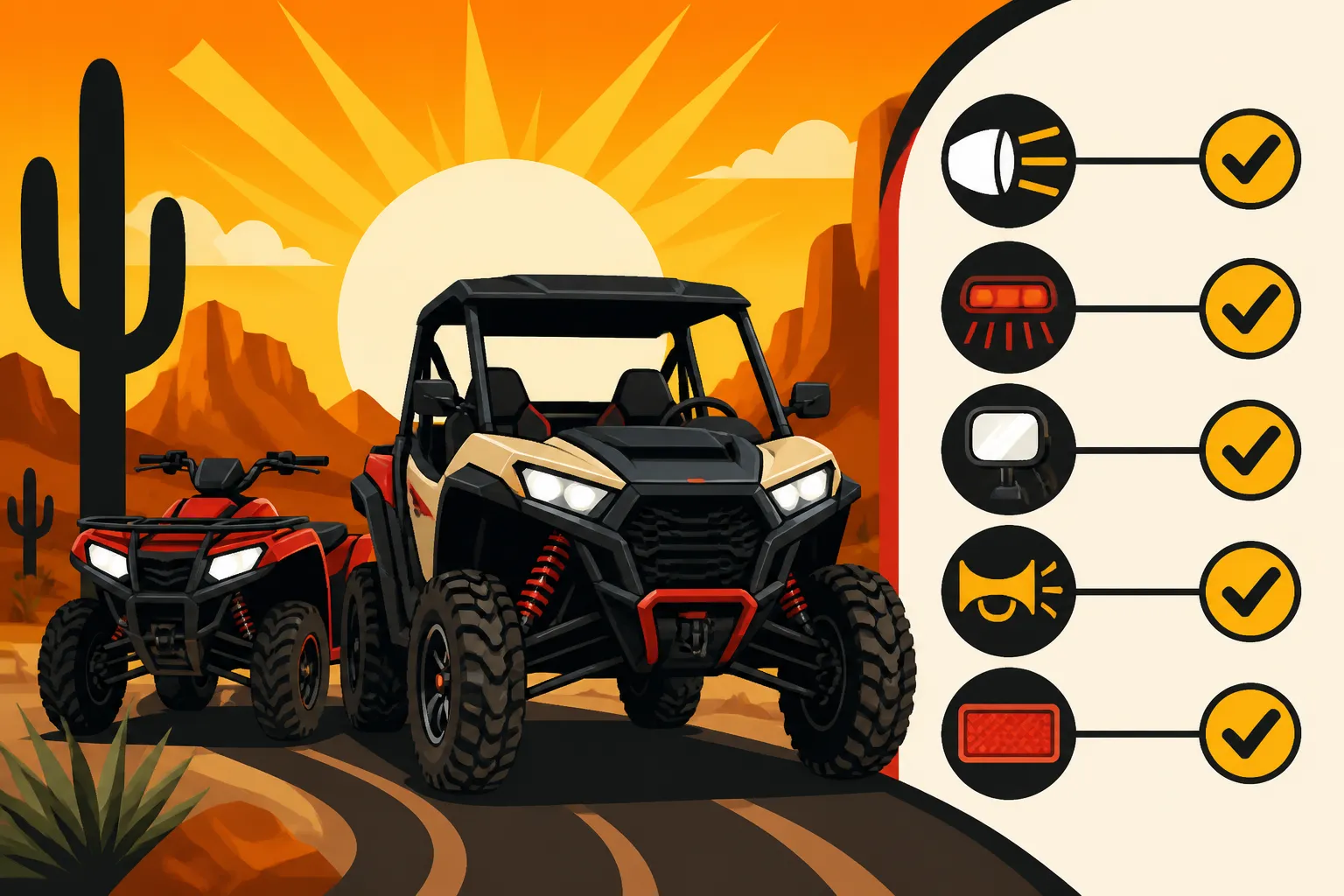
First up are your headlights. Your machine must have at least one headlight (though most UTVs come with two), capable of both high and low beams. These headlights need to be visible from a distance of 500 feet, which means they need to be bright and properly aimed. Just having the factory lights might not be enough if they’re designed for off-road visibility rather than road-legal standards. You'll want to ensure they meet DOT (Department of Transportation) specifications for intensity and beam pattern. Imagine riding home after a late afternoon trail ride, and the sun has dipped below the horizon. Proper, bright headlights, correctly aimed, are crucial for you to see the road ahead and for oncoming traffic to see you clearly. If your machine currently lacks a high/low beam switch or sufficient brightness, this will be one of your first upgrades. You can dive deeper into this topic by reading [Arizona's 500 Foot Headlight Rule].
Equally important are the lights at the rear of your machine. You'll need at least one red taillight that is visible from 500 feet. This taillight should also incorporate a brake light feature, illuminating brighter when you apply the brakes, signaling your deceleration to vehicles behind you. Additionally, a white light must illuminate your license plate, making it visible at night. This is often a small LED light positioned above or to the side of the plate. Beyond lights, red rear reflectors are also typically required to provide passive visibility, even if your lights fail. And don't forget turn signals! These are absolutely essential for communicating your intentions to other drivers. You'll need amber turn signals at both the front and rear of your machine. These should be clearly visible and easily actuated by the driver. Having these components ensures that when you're making a turn or changing lanes, other road users know exactly what you're doing. For more specific details on rear visibility, check out [Taillight Visibility From 500 Feet].
Mirrors, Horn, and Windshield
Visibility and the ability to alert others are key components of street legality. While your OHV might feel robust and agile, when it’s on the asphalt, it needs to interact with the larger, faster vehicles around it safely.
Rear-view mirrors are non-negotiable. Arizona law typically requires at least one rear-view mirror, but most riders opt for two (one on each side) for enhanced situational awareness. These mirrors must provide a clear view of the road behind you, allowing you to monitor traffic and potential hazards without constantly craning your neck. Aftermarket mirrors designed for UTVs are readily available and crucial for safe lane changes and overall awareness. Consider a scenario where you're driving your street-legal UTV on a two-lane county road, preparing to make a left turn. Without functional mirrors, checking for following traffic would be incredibly dangerous, relying on quick glances over your shoulder that could distract you from the road ahead. Good mirrors, properly adjusted, become your eyes in the back of your head.
Next, you need a horn. Not a little bicycle bell, but an audible horn that can be heard from a distance of 200 feet. This is your primary way of alerting other drivers or pedestrians to your presence in situations where they might not see you. It's a critical safety device, whether you're preventing an accident or simply giving a polite toot to a friend you spot roadside. Many aftermarket kits, including those from companies like SuperATV, will include a robust horn as part of their street-legal conversion packages, ensuring it meets the required decibel levels. For more on this, you can look into [The Horn Arizona Wants Audible at 200 Feet].
Finally, while a windshield is not always explicitly required by Arizona law for all street-legal OHVs, it's highly recommended, and for some classifications or interpretations, it might be expected. If your machine does not have a windshield, you and any passengers are required to wear eye protection (goggles or a face shield). A full windshield offers significant protection from wind, dust, insects, and road debris, greatly enhancing comfort and safety, especially when traveling at higher speeds on paved roads. Many manufacturers, including aftermarket specialists, offer durable, scratch-resistant windshield options that integrate perfectly with most popular UTV models. Even if not strictly mandated, it’s a wise investment for anyone planning to spend considerable time on public roads.
Tires, Brakes, and Exhaust System
Beyond visibility and communication, the fundamental mechanics of your machine must also be up to snuff for road use. This means a close look at what connects you to the road, how you stop, and how your engine vents its fumes. These components are critical for both safety and environmental compliance.
Your tires are the sole point of contact between your machine and the road, so they need to be appropriate for the task. While off-road tires are fantastic for gripping dirt and rocks, they might not be ideal, or even safe, for sustained highway speeds. Street-legal conversions generally require DOT-approved tires, which are designed for pavement use. These tires typically have a harder compound, a different tread pattern for better grip on asphalt, and are rated for higher speeds than purely off-road knobbies. The condition of your tires is also crucial – no excessive wear, cracks, or damage that could lead to a blowout. Imagine hitting an unexpected pothole on a paved road with worn-out off-road tires; the risk of a loss of control is significantly higher. Upgrading to DOT-approved tires ensures better handling, longer life on pavement, and compliance with street-legal requirements.
Brakes are another non-negotiable safety feature. Your street-legal OHV must have fully functional braking systems, typically involving both foot and hand brakes, capable of safely stopping the vehicle. This means ensuring your brake pads are in good condition, fluid levels are correct, and there are no leaks in the system. The braking system needs to be reliable and provide consistent stopping power, especially if you find yourself in an emergency braking situation on a busy road. A pre-inspection check should always include a thorough examination of your brakes to ensure they are up to standard.
Finally, let's talk about the exhaust system. For any vehicle on public roads, noise and emissions are regulated. Your OHV must be equipped with a muffler that is in good working order and does not exceed Arizona's noise limits. Aftermarket exhaust systems designed purely for performance might be too loud for street legality, drawing unwanted attention from law enforcement and potentially earning you a citation. Crucially, a spark arrestor is always required on your OHV, even when operating it on paved roads, as it's a fire prevention device. A missing or non-functional spark arrestor is a serious violation, especially in Arizona's dry climate. Ensure your exhaust system is not excessively modified and that it maintains the necessary spark arrestor to pass inspection. You can learn more about specific rules around sound by checking out [Arizona Muffler and Noise Limits] and understanding [Arizona's Spark Arrestor Requirement].
Safety Features and Occupant Restraints
While your OHV is built for rugged fun, converting it to street-legal status means adopting safety standards that protect occupants in the event of a collision or rollover, similar to traditional vehicles. This isn't just about ticking boxes for an inspection; it's about minimizing risk for everyone inside the machine when sharing the road with traffic. Arizona takes occupant safety seriously, especially when these machines are on public thoroughfares.
Seats, Seatbelts, and Roll Cage
When you're driving on public roads, the expectation is that occupants are safely secured within the vehicle. For a street-legal ATV or UTV, this means ensuring proper seating, restraints, and a robust protective structure.
First, the seats themselves. They must be securely mounted, designed to safely accommodate the number of passengers the vehicle is rated for, and in good condition. You can't just throw in a beanbag chair and call it a day. If your machine is designed for two people, it needs two proper seats; if it's a four-seater, all four seats must be functional and safe. This might seem obvious, but modifications to seat layouts need to consider structural integrity.
Crucially, seatbelts or harnesses are absolutely required for all occupants. These must be in good working order, properly anchored, and free from any fraying or damage. Just as you wouldn't drive a car without everyone buckled up, the same rule applies to your street-legal OHV. These restraints are your primary protection against ejection or injury in a sudden stop or collision. For those who frequently tackle challenging terrain, many enthusiasts upgrade to multi-point harnesses (like 4- or 5-point systems), which offer superior occupant retention compared to standard three-point seatbelts. Companies like SuperATV offer a range of aftermarket harnesses and seating solutions that can enhance both safety and comfort for street and trail use.
Finally, the roll cage. This is a critical safety component, especially for UTVs. A factory-installed roll cage is designed to protect occupants in the event of a rollover. If you have modified your roll cage, or if it has been damaged, it must meet structural integrity standards. For serious off-roaders, or those pushing the limits, some choose to upgrade their roll cages to stronger, custom-built units, but even a stock cage needs to be intact and undamaged for street legality. The roll cage works in conjunction with your seatbelts to create a survival space for occupants, a feature that becomes even more vital when operating on paved roads where collision speeds can be higher.
Helmets and Eye Protection
Even with a full roll cage and seatbelts, Arizona has specific requirements for helmets and eye protection, particularly for younger riders, acknowledging the open nature of many OHVs. These rules are in place to prevent head injuries and protect vision.
Helmets are a key safety device, especially for those in more open-air machines. In Arizona, all riders and passengers under the age of 18 are legally required to wear a DOT-approved helmet when operating or riding in an OHV on public roads. This applies whether you're on a dirt bike, an ATV, or a side-by-side. The helmet must be properly fitted and securely fastened. It's a simple rule but one that many parents grapple with. Imagine a scenario where a parent is driving their street-legal UTV to a nearby store with their 16-year-old child as a passenger. Even though they're on a paved road and might feel safe, both the driver (if under 18) and the passenger must be wearing helmets. This rule is absolute, regardless of the perceived safety of the road. You can find more detailed information on this by looking into [Arizona Helmet Rules for Riders Under 18].
Beyond helmets, eye protection is also a critical requirement. All riders and passengers of a street-legal OHV must wear eye protection (such as goggles, a face shield, or safety glasses) unless the vehicle is equipped with a windshield that provides adequate protection. This means if you're rocking an open-air UTV without a full windshield, everyone on board needs to have their eyes covered. This protects against wind, dust, insects, and road debris, all of which can severely impair vision and cause accidents. Even with a half-windshield, robust eye protection is often still advised. Think about the amount of dust and small debris that can be kicked up by other vehicles on the road – protecting your eyes ensures you maintain clear vision and control of your machine. For more specifics on this, check out [Eye Protection on an Arizona Road].
Documentation, Licensing, and Insurance Requirements
Getting your physical machine up to spec is only half the battle. To truly make your ATV or UTV street-legal in Arizona, you also need to satisfy all the administrative requirements. This involves specific types of registration, ensuring you have the correct driver’s license, and carrying the mandatory insurance coverage. Without these pieces of paperwork in order, even a perfectly equipped machine can lead to legal trouble.
Street-Legal Registration and Plates
This is where your OHV officially transitions from off-road only to road-ready. Instead of just an OHV decal, you’ll need a proper Arizona license plate.
The process typically involves getting an Arizona Certificate of Title for your machine, if you don't already have one that reflects current ownership. This title is your proof of ownership. Once you have a valid title, you can then apply for street-legal registration. For many ATVs and UTVs converted for street use, Arizona will issue an MC (Motorcycle) plate. This signifies that your machine is now classified and regulated much like a motorcycle. Other machines, particularly those heavier or more car-like, might receive an RV (Recreational Vehicle) plate, especially if they are designed to carry multiple passengers and have certain features. The key is that you will receive a metal license plate that must be affixed to the rear of your machine, clearly visible.
This plate then replaces the OHV decal as the primary indicator of its road-legal status. While you’ll still want to maintain an active OHV decal for trail riding on public lands, the MC or RV plate is what allows you to legally operate on paved roads. The application process will involve presenting proof of ownership, proof of insurance, and potentially a vehicle inspection report to ensure all the required equipment is in place. It's a critical step that formalizes your machine's new identity. To understand more about the types of plates, refer to [MC Plates and Street-Legal Machines], and for titling, check out [Getting an Arizona Certificate of Title for a Quad].
Driver's License and Insurance
Just like any other vehicle on the road, operating a street-legal ATV or UTV in Arizona comes with specific requirements for the driver and mandatory financial responsibility.
First, the driver. To legally operate a street-legal OHV on any public road in Arizona, you must possess a valid driver's license. This isn't just an OHV operator certificate; it's a standard Class D driver's license (or equivalent from another state). If you’re a teenager who only has an instruction permit, you typically cannot drive a street-legal OHV unaccompanied on public roads, just as you couldn't drive a car. This is a crucial distinction that often catches new street-legal OHV owners by surprise. The moment your wheels are on the pavement, you are subject to the same licensing laws as any car driver. Imagine getting pulled over by an Arizona State Trooper for a minor traffic infraction in your newly converted UTV. If you don't have a valid driver's license, that minor stop could quickly escalate into a more serious legal issue.
Second, insurance is mandatory. Arizona law requires all street-legal vehicles to carry minimum liability insurance coverage. This typically means minimums of $25,000 for bodily injury to one person, $50,000 for bodily injury to two or more people, and $15,000 for property damage (often referred to as 25/50/15 coverage). Your insurance policy must specifically cover your ATV or UTV for on-road use. A standard off-road-only policy will not suffice, nor will your car insurance or homeowners' policy typically extend to cover your street-legal OHV when it’s operating on public roads. You'll need to contact an insurance provider and explicitly ask for a policy that covers your converted OHV for street use. Carrying proof of this insurance is also required, and you should always have it with you when driving on public roads, just as you would in your car. To get a clearer picture of these requirements, you can read [Arizona Insurance Minimums for Road Riding] and [Arizona Liability Minimums for Street-Legal Machines].
Emissions Testing for Street-Legal OHVs in Arizona
While the idea of emissions testing might seem like something reserved for cars and trucks, some street-legal OHVs in Arizona may also be subject to these requirements. This often comes as a surprise to riders, who might assume their off-road machines are exempt. Understanding when and where this testing applies, and how to successfully navigate it, is crucial for maintaining your street-legal status.
When Emissions Testing Applies
The good news is that not every single street-legal ATV or UTV in Arizona needs to go through emissions testing. The requirement is primarily geographically specific, impacting vehicles registered in Arizona's two major metropolitan areas: the Phoenix and Tucson non-attainment areas. These are regions identified by the Environmental Protection Agency (EPA) as having air quality that does not meet national standards, leading to stricter environmental controls.
If your street-legal OHV is registered within one of these specific zip codes in the Phoenix or Tucson metro areas, it will likely need to pass an emissions test. The specific criteria for which vehicles need to be tested can also depend on the vehicle's model year and engine type, though most modern OHVs being converted will fall under the testing umbrella if they are in these areas. For instance, if you live in Surprise or Mesa (Phoenix area) or Oro Valley (Tucson area) and your UTV has an MC plate, expect to get a notice for emissions testing. If you live in a rural area like Payson or Kingman, however, you would typically be exempt from emissions testing, even if your machine is street-legal. This is one of those rules that really depends on your specific location, so it's always best to check the Arizona Department of Environmental Quality (ADEQ) website or your MVD records to confirm your obligations. For a deeper dive into this, check out [Emissions Testing for OHVs in Phoenix and Tucson].
Navigating the Emissions Test
Passing an emissions test can feel like a daunting task, especially with a machine that started its life designed purely for off-road adventures. However, with a little preparation, it's a hurdle that can be cleared.
The emissions test for street-legal OHVs in the applicable areas typically involves a visual inspection, a functional check, and a tailpipe emissions test. The visual inspection checks for the presence and proper function of emission control devices, such as the catalytic converter (if your machine came with one from the factory, which some newer UTVs do). The functional check might involve checking your engine's idle speed or other basic operating parameters. The most critical part is usually the tailpipe test, where a probe is inserted into your exhaust to measure pollutants like carbon monoxide and hydrocarbons.
Tips for passing often revolve around ensuring your machine is in good running order. Regular maintenance, such as fresh oil, a clean air filter, and properly functioning spark plugs, can make a big difference. It's also often recommended to drive your machine for at least 15-20 minutes before the test to ensure the engine is fully warmed up and all its systems are operating at optimal temperature. A hypothetical scenario might involve a rider who put a new, high-performance aftermarket exhaust system on their UTV. While it might sound great, if it removed or altered emission control devices, it could cause the machine to fail the test. If you've made modifications to your engine or exhaust, especially if they are not compliant with EPA standards, passing emissions could be a challenge. Aftermarket parts from companies like SuperATV are typically designed to integrate with factory systems, but if you're making major performance modifications, always consider their impact on emissions compliance. If your machine fails, you'll usually be given a grace period to make repairs and retest.
Understanding Where You Can and Cannot Ride
One of the biggest motivations for making your ATV or UTV street-legal is the expanded freedom to ride. However, "street-legal" doesn't mean "anywhere you want." Arizona has specific rules about which roads are open to OHVs, even those properly converted and plated. Navigating these rules is key to enjoying your machine without running afoul of local ordinances or state laws.
Open Roads and Restricted Areas
When your OHV is street-legal, it gains access to a much wider network of roads than its off-road-only counterparts. Generally, state highways (excluding interstates), county roads, and Forest Service roads are open to street-legal OHVs. This means you can cruise down a scenic highway to reach a distant trailhead, drive on unpaved county roads that connect one recreational area to another, or use Forest Service routes to explore vast swaths of national forests. This opens up countless opportunities for longer rides, connecting trails, and exploring new areas without the constant need for a truck and trailer.
However, there are important restrictions. Interstate highways (like I-10 or I-17) are strictly off-limits to OHVs, even if they are street-legal. These roads are designed for high-speed traffic, and OHVs typically don't meet the necessary speed or safety criteria for such environments. Similarly, while many county and state roads are open, some city streets may be restricted by local ordinances. Many towns and cities in Arizona have their own rules regarding OHV access on specific roads, especially within their urban cores. Always check local city ordinances if you plan to ride your street-legal OHV extensively within city limits. Wilderness areas, which are designated for non-motorized recreation, also remain completely closed to all motorized vehicles, regardless of their street-legal status. It’s crucial to know the boundaries of these areas. For more general guidance on where you can ride, read [Which Arizona Roads Are Open to OHVs]. If you're ever tempted to take a shortcut on an interstate, be sure to understand the consequences by reviewing [Can You Ride an OHV on an Arizona Highway?].
Crossing Roads and Trail Access
The true magic of having a street-legal OHV often lies in its ability to bridge the gap between paved roads and dirt trails seamlessly. It’s about more than just getting to the trails; it's about incorporating road sections into your rides.
For many riders, being street-legal means the ability to simply ride their machine from their garage or campsite directly to a trailhead. This eliminates the time-consuming and often cumbersome process of loading, trailering, unloading, and then finding parking at a sometimes-crowded staging area. Imagine your camp is a few miles down a paved county road from a fantastic OHV trail system. With a street-legal machine, you can simply ride out of your campsite, down the road, and right onto the dirt, completely skipping the trailer shuffle. This flexibility dramatically enhances the enjoyment and spontaneity of your riding trips. If you want to grab lunch in a small trail town like Crown King or Tortilla Flat, you can simply drive your UTV right into town and park. This level of convenience is a game-changer for many enthusiasts.
Street-legal status also permits legal crossing of highways and other paved roads that might otherwise act as impassable barriers between trail sections. For example, if a major state highway bisects a large OHV area, you can legally cross that highway at designated intersections to access the other side of the trail system. This allows for much longer, more continuous rides without needing to re-trailer or find alternative routes. This capability transforms disconnected trail segments into one massive, cohesive riding experience. It empowers you to explore vast areas, weaving between paved connections and rugged dirt paths, making your adventures more expansive and less fragmented. The convenience of simply riding from your lodging to the trailhead is a major benefit for many, as detailed in [Riding Town to Trailhead in Arizona].
| Requirement | Description | Common Component |
|---|---|---|
| Headlights | At least one, with high and low beam capability, visible from 500 feet. Must be DOT compliant. | OEM with high/low switch, or aftermarket LED headlight assembly. |
| Taillights | At least one red taillight, visible from 500 feet. Must include brake light function. | OEM taillight/brake light assembly, or aftermarket LED unit. |
| Turn Signals | Amber turn signals, front and rear, clearly visible, with an easy-to-use switch. | Aftermarket turn signal kit (often integrates with existing lights or adds new LED pods). |
| Plate Light | White light to illuminate the rear license plate, making it visible at night. | Small LED light mounted near the license plate. |
| Rear Reflectors | At least one red rear reflector. | Small stick-on or bolt-on reflectors, often included in conversion kits. |
| Rear-View Mirror | At least one mirror providing a clear view of the road to the rear. Two mirrors (left and right side) are highly recommended. | Aftermarket side mirrors, often clamp-on or roll-cage mounted. |
| Horn | Audible from 200 feet. | Aftermarket electric horn (often included in conversion kits). |
| Tires | DOT-approved tires for road use, in good condition. | DOT-rated all-terrain or street-specific tires. |
| Brakes | Fully functional braking system (foot and hand brakes), capable of safely stopping the vehicle. | OEM brake system in good repair, fresh pads, proper fluid levels. |
| Muffler | Functional muffler that keeps noise within legal limits. Must also include a spark arrestor. | OEM exhaust with spark arrestor, or quiet aftermarket system. |
| Seatbelts | Required for all occupants, securely mounted and in good working order. | OEM seatbelts or aftermarket multi-point harnesses (like those from SuperATV). |
| Roll Cage | Intact and undamaged factory roll cage, or properly designed aftermarket cage. | OEM cage, or upgraded aftermarket cage for enhanced protection. |
| Helmet (Under 18) | Required for all riders and passengers under 18. Must be DOT-approved. | DOT-approved full-face, modular, or open-face helmet. |
| Eye Protection | Required for all occupants unless vehicle has a windshield providing adequate protection. | Goggles, face shield (integrated with helmet), or safety glasses. |
| Valid DL | Driver must possess a valid Class D (or equivalent) driver's license. | State-issued driver's license. |
| Insurance | Mandatory liability insurance meeting Arizona minimums (25/50/15) specifically for on-road OHV use. | Insurance policy from a licensed provider covering the specific VIN for street use. |
| License Plate | Issued by Arizona MVD (MC or RV plate), displayed clearly on the rear of the machine. | Metal license plate from MVD. |
| OHV Decal | Still required for off-road use on public lands, even if street-legal. | Annual OHV decal from Arizona Game & Fish Department. |
| Emissions Test | Required for vehicles registered in Phoenix and Tucson metro areas, depending on vehicle age/type. | Passing certificate from an authorized ADEQ emissions testing station. |
Disclaimer
This article is for general informational purposes only and does not constitute professional advice. Laws, prices and regulations vary by location and change over time. Consult a qualified professional for guidance on your specific situation.