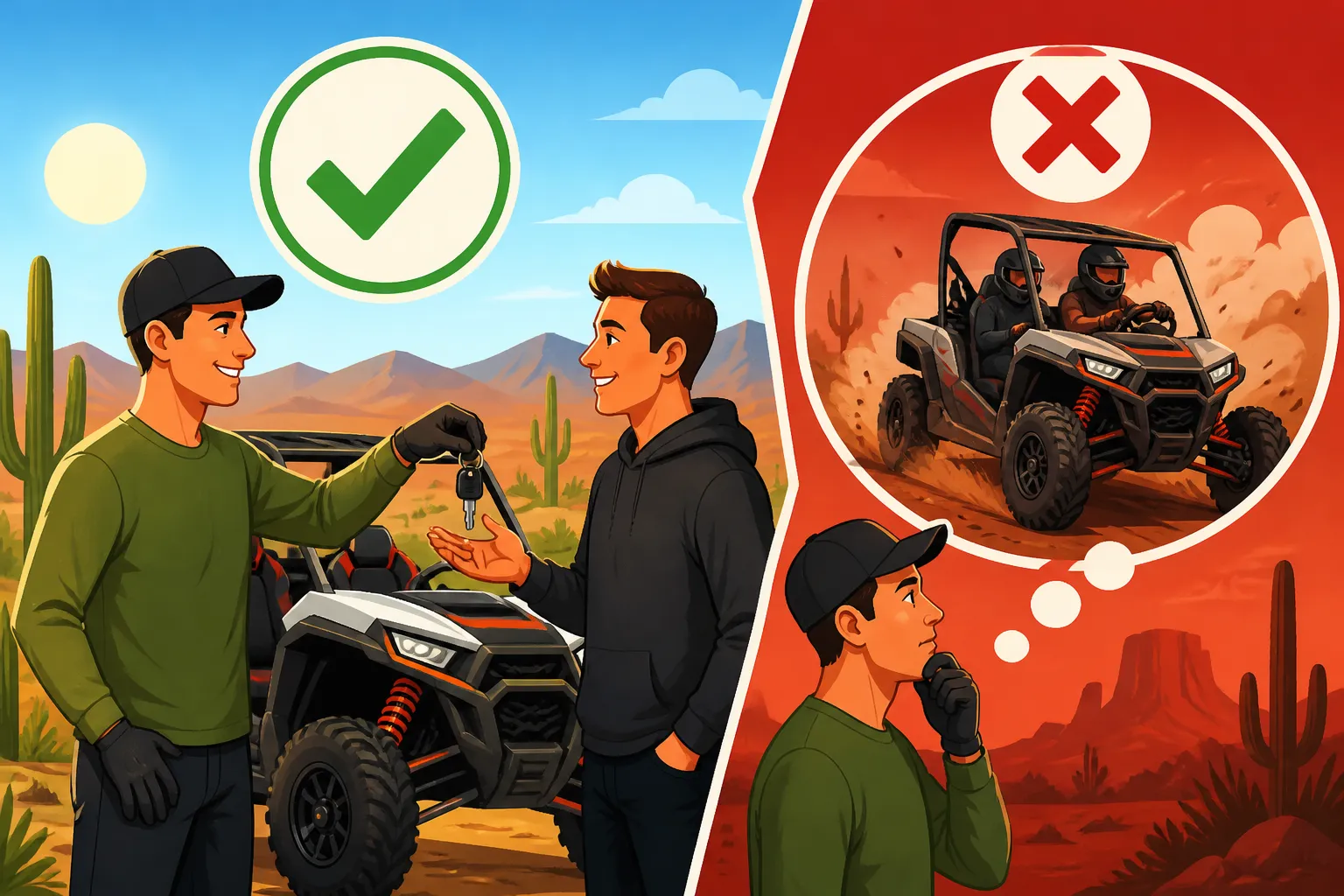
Lending Your Machine to a Visitor
Lending your Arizona ATV or UTV to a visitor can feel straightforward: hand over the keys and explain the route. But the machine’s decal and registration, the visitor’s riding privileges, and the land you plan to cross all matter. Use these checks to sort out what stays with the machine, what the visitor must arrange, and what to confirm before you ride.
Check the machine’s decal and registration first
Start with the machine, not the visitor’s home address. Arizona OHV decal requirements depend on the machine’s registration and intended use, and a decal attached to one machine is not a general riding pass for every vehicle in the group. Before lending yours, check that its decal is valid and properly displayed, or confirm that its registration qualifies it to ride without one.
A visitor does not necessarily need to buy a nonresident decal simply because they are the one operating your Arizona machine. The visitor-decal rules are not a substitute for checking the machine’s own status. If your machine already has the required Arizona decal, or its registration makes it exempt, ask Arizona Game and Fish whether that status covers the planned ride and the exact machine. For background on visitors’ obligations, see Arizona Rules for Visiting Riders and Decals for a Borrowed Machine.
| Machine situation | What to check before the visitor rides |
|---|---|
| Arizona machine with an OHV decal | Confirm the decal is current, belongs on that machine, and is displayed as required. |
| Machine registered as street legal | Check that the registration is valid and that the machine meets requirements for the roads on your route. Do not assume every plate replaces an OHV decal in every situation. |
| Out-of-state-registered machine | Check the Arizona rules for the machine’s registration and use. A visitor decal may be required for an eligible nonresident machine. |
| Machine with unclear or incomplete paperwork | Resolve the registration and decal question before riding on public or state land. |
A street-legal plate and an OHV decal are not interchangeable in every case. A machine’s registration category, where it is being operated, and its compliance with road equipment rules can affect what applies. If you plan to use public roads, trails, or a mix of both, confirm which requirements cover the machine rather than relying on what another rider told you. Street-Legal Registration Instead of a Decal explains the distinction.
Also check that the visitor is not planning to take your machine onto land that requires a separate permit. An OHV decal does not grant access to every parcel, and having permission to borrow the machine does not create permission to ride wherever you choose. Arizona State Trust Land has separate recreational permit requirements. Check whether the permit you hold covers the people in your group and the planned activity; do not assume that a visitor is included just because they are using your machine. See Arizona State Trust Land Recreational Permits before planning a route across Trust Land.
For a ride that crosses several land types, make a simple route check: identify where you will start, which trails or roads you will use, and whether they cross state, federal, tribal, or private land. Each land manager may have different access rules. A machine’s decal covers only the decal requirement; it does not replace a land-access permit, trail closure check, or landowner’s permission.
Confirm the visitor’s responsibilities as an operator
The owner’s paperwork does not make the visitor eligible to operate the machine. Before handing over the keys, check the rules that apply to the visitor’s age, experience, and planned riding area. Arizona has specific requirements for young operators, and other rules can apply when a machine is used on public roads. If the visitor is under 18, do not treat adult supervision or your permission as a substitute for checking the applicable requirements.
Arizona has an OHV education course requirement for certain operators and decal situations. Requirements can depend on the ride and the current program rules, so ask the visitor to confirm whether they must complete the course before operating. If the requirement applies, completing it before the trip is simpler than discovering the issue at a staging area. The course is separate from your informal machine walkthrough. See Who Must Take the Arizona Decal Course for the operator and course questions to resolve.
The visitor should also understand that rules follow the ride, not just the owner. They may need to follow helmet, eye-protection, passenger, speed, and road-use requirements even though the machine belongs to you. Rules can differ between public roads, public land, private land, and closed-course settings. If the route includes a road section, check that the machine is eligible to use it and that the operator meets any applicable requirements.
A few practical questions can prevent misunderstandings:
- Has the visitor operated this type of ATV or UTV before?
- Does the machine have enough seats for everyone, with each person in a designated seat?
- Do age-related rules apply to the operator or any passenger?
- Does the planned route include a public road or a land area with separate access rules?
- Does the visitor know how to stop, shift, use four-wheel drive, and respond to a rollover or breakdown?
Passengers need attention too. Do not add a rider to a machine that lacks a designated passenger seat, and follow the machine’s limits and safety equipment instructions. A passenger’s presence does not automatically create a separate decal requirement, but rules for passengers and access permits may still matter. For a specific decal question, see [Do Passengers Need an Arizona Decal?].
Prepare the machine and the paperwork
Before the ride, check the machine’s condition and make sure the visitor knows where its documents are. The registration record, proof of insurance if applicable, and any land permit information should be accessible. Whether you carry paper copies or use another reliable method, make sure the visitor can provide the information if asked. Do You Carry Papers on an Arizona Trail? and What an Arizona Ranger Asks a Rider For cover the kinds of documentation that can come up during a ride.
A quick handoff checklist helps keep the conversation practical:
- Verify the machine’s identification and status. Confirm the VIN, registration, and decal match the vehicle being lent. Check the decal’s condition and placement rather than assuming it is still readable.
- Confirm coverage for the route. Check that the planned roads and land are open to the machine, and identify any permit or access requirements.
- Discuss insurance. Do not assume your auto policy, homeowners policy, or the visitor’s coverage automatically protects a borrowed ATV or UTV. Contact the insurer and ask whether the visitor is covered as an operator, what uses are covered, and what exclusions apply. If the machine is street legal, ask specifically about road use.
- Inspect safety equipment. Check seat belts and nets in a side-by-side, tires, brakes, lights, mirrors where required, and any other equipment needed for the intended route. Provide helmets and eye protection when required or appropriate.
- Set clear use limits. Agree on who may operate, where the machine may go, whether passengers are allowed, and what to do if it gets damaged or stuck.
A written note is useful even for a friend or relative. It can record the loan period, the machine’s condition, who is allowed to drive, whether passengers are permitted, and who to call if there is a crash or mechanical problem. This is not a replacement for insurance or legal advice, but it reduces the chance of different assumptions about fuel, damage, recovery costs, or a late return.
If you are equipping a visitor, prioritize properly fitting protective gear over convenience. If you order spare goggles or other basic gear through Amazon or another retailer, check that the item fits the rider and is suitable for the conditions. A helmet that is uncomfortable or poorly fitted may not be worn correctly, so have the visitor try it on before the ride rather than leaving that decision until the trailhead.
A short orientation is worthwhile, especially if the visitor has little experience. Explain the controls, the machine’s passenger limits, how to use its safety systems, and what to do if it stalls or overheats. Make sure they understand that a UTV’s seat belts and protective equipment are intended to be used as designed, not removed for convenience. For a desert ride, review water, sun protection, dust, heat, and the plan for staying with the group.
Make a clear plan for the ride and the return
Choose a route that fits the visitor’s ability and the machine. A beginner may need a short, familiar route with room to stop and practice before tackling steep terrain, deep sand, or a narrow road section. Check current access information before leaving, and have a backup plan in case a trail is closed or weather changes. A route that is legal for your machine in one place may cross land where a different permit or permission is required.
Agree on a few rules before departure, not after a problem:
- The visitor will not let someone else operate the machine without your permission.
- The machine will stay on the planned open route and will not cross private or restricted land without permission.
- No one will ride beyond the number of designated seats or ignore the machine’s safety equipment.
- The visitor will stop and contact you if the machine develops a serious mechanical problem or is involved in a collision.
- The visitor will not continue riding if they are impaired, exhausted, overheated, or unsure how to handle the conditions.
At the end of the ride, check the machine together. Look for damage, lost equipment, warning lights, unusual sounds, and changes in tire condition. Confirm the fuel and return arrangement you agreed on. If there was a crash, injury, or damage to property, follow the applicable reporting and insurance procedures instead of treating the issue as a routine return.
The simplest way to lend an ATV or UTV responsibly is to separate three questions: is the machine properly registered or decaled, is the visitor allowed and prepared to operate it, and does the route allow that machine and group to be there? Answer each one before the ride. If any answer depends on an unclear registration, decal, permit, or insurance detail, verify it with the relevant agency or provider rather than sending the visitor out on an assumption.
Disclaimer
This article is for general informational purposes only and does not constitute professional advice. Laws, prices and regulations vary by location and change over time. Consult a qualified professional for guidance on your specific situation.