Registering a California Quad After Moving to Arizona
Moving from California to Arizona brings a lot of excitement, from the sunshine to the incredible desert trails just waiting for your off-highway vehicle (OHV). But then reality hits: you've got a quad or side-by-side that's perfectly legal in California, and now you're wondering how to make it compliant with Arizona's rules. It can feel like a mountain of paperwork and confusing regulations, but this guide is here to walk you through exactly how to register your California quad after moving to Arizona, making sure you're ready to hit those trails legally and confidently.
Understanding Arizona's Take on Your Out-of-State Machine
When you've just hauled your beloved quad or side-by-side from California across state lines into Arizona, it's easy to assume your existing registration is good to go. After all, it's still the same machine, right? Unfortunately, it doesn't quite work that way. Arizona has its own distinct set of rules for off-highway vehicles, and understanding these differences is the first crucial step in getting your machine legally trail-ready here in the Grand Canyon State. The good news is that while the systems differ, the process for a new Arizona resident isn't as daunting as it might first appear.
The Core Differences: California vs. Arizona OHV Rules
California's OHV system often revolves around the "Green Sticker" and "Red Sticker" program, which dictates when and where you can ride based on the vehicle's emissions standards and model year. You might be accustomed to just ensuring your sticker is current and visible. Arizona, however, operates on a different philosophy, focusing on a robust titling and annual decal system. Here, the state wants every OHV that operates on public land to be titled in Arizona, regardless of its original state of purchase, and to display a current [Arizona's Annual OHV Decal Explained]. This decal not only signals compliance but also contributes directly to the state's OHV fund, which maintains the very trails we all love to ride.
Another key difference is how the states approach proof of ownership and operation. In California, your registration card might have been your primary operational document. In Arizona, the Certificate of Title is king for ownership, while the annual decal and an accompanying registration card serve as proof of current operating privileges on public land. It's a subtle but important distinction that often catches new residents off guard. You'll also find that Arizona's OHV program is managed jointly by the Arizona Game and Fish Department (AZGFD) for the decal, and the Arizona Motor Vehicle Division (MVD) for titling, which means a couple of different stops or online portals might be involved.
Why Arizona Wants Your Machine Registered Here
Arizona isn't just trying to be difficult by requiring new registration for your California machine. There are very practical and beneficial reasons behind it, all designed to create a better and safer riding experience for everyone. First and foremost, the funds generated from OHV decals go directly into the Arizona OHV Recreation Fund. This fund is absolutely vital for maintaining, improving, and even creating new OHV trails across the state, as well as providing educational programs and enforcing OHV laws. Without these funds, our amazing network of trails in places like Sedona, Lake Havasu, and the Sonoran Desert simply wouldn't be sustainable.
Beyond funding, the registration and titling process ensures that the state has a clear record of who owns which machine. This helps immensely with theft recovery, proper identification in case of an accident, and overall accountability. It also brings all riders under a unified set of rules, promoting responsible land use and minimizing conflict with other recreational users and private landowners. When you title and decal your quad in Arizona, you're not just complying with the law; you're becoming an active participant in supporting and preserving the fantastic OHV opportunities that make Arizona a premier riding destination.
The Step-by-Step Process for Arizona Registration and Titling
Navigating the paperwork to get your California quad legally registered and titled in Arizona might seem like a lot, but if you break it down into manageable steps, it becomes much clearer. The key is to gather all your existing documents first, understand what Arizona needs, and then tackle the titling and decaling processes in turn. Don't worry, thousands of riders before you have gone through this, and the system is designed to accommodate new residents.
Gathering Your California Paperwork
The first thing you'll want to do is round up all the documents related to your quad from its time in California. This typically includes your California Certificate of Title, your most recent California registration card, and any bill of sale or purchase agreement you received when you acquired the machine. Having these documents readily available will significantly smooth the transition process to Arizona. The Arizona MVD will primarily be looking for clear proof of ownership to issue you a new Arizona title.
If, for some reason, your California title is lost or was never issued (which can happen with older machines or if it was only ever registered and not titled in California, which is common for smaller OHVs), you'll need to prepare for a few extra steps. You might need to contact the California DMV to request a duplicate title, or at the very least, obtain detailed registration records that prove your ownership. In situations where ownership is unclear, Arizona does have provisions for [Titling an Arizona Quad With No Ownership History], which might involve a bonded title, but having as much historical paperwork as possible is always the best starting point. Even a detailed personal bill of sale, especially if prepared using a template from a service like LawDepot, can help fill in gaps if your original purchase documentation is scarce.
Applying for an Arizona Certificate of Title
Once your California paperwork is in order, the next major step is to apply for an Arizona Certificate of Title for your quad. The title is the definitive proof of ownership in Arizona, and it's something every OHV operating on public land should have. You'll typically do this through the Arizona MVD or one of their authorized third-party providers. When you go, be prepared to present your California title, your Arizona driver's license or ID, and complete an Arizona Title and Registration Application form. The MVD agent will review your documents to ensure everything is legitimate and that the VIN (Vehicle Identification Number) matches.
A crucial part of this process will be a VIN inspection. This is a quick verification that the VIN on your machine matches the paperwork you're presenting. This inspection can sometimes be done at the MVD office itself, or you might be directed to a certified inspector or even a law enforcement officer, depending on the MVD location and the specific circumstances. Don't skip this step, as it's required to ensure the machine isn't stolen and that the paperwork accurately reflects the vehicle. Once everything is verified and the appropriate fees are paid, the MVD will process your application for an [Arizona Certificate of Title for an Off-Highway Vehicle], which will then be mailed to you.
Here's a quick look at the documents you'll generally need for titling your quad in Arizona:
| Document Type | Purpose | Source |
|---|---|---|
| California Title | Primary proof of ownership from previous state | California DMV |
| Arizona ID/License | Proof of residency and identity | Arizona MVD |
| Title & Reg. Application | Formal request for Arizona title and registration | Arizona MVD (form available online or in-office) |
| Bill of Sale (if applicable) | Secondary proof of ownership, especially for private sales | Seller/LawDepot template |
| Lien Release (if applicable) | Proof previous loan is paid off, if a lien was on the CA title | Lender |
| VIN Inspection (completed) | Verification of vehicle identity | MVD, authorized agent, or law enforcement |
Getting Your Arizona OHV Decal
After you've successfully applied for your Arizona Certificate of Title, the next vital step is to acquire your Arizona OHV Decal. While the title establishes ownership, the decal is what grants you legal access to Arizona's public lands and trails. This is often a separate but concurrent process, typically managed by the Arizona Game and Fish Department (AZGFD) through their online portal. Every OHV operating off-highway on public land in Arizona needs one, and it's a mandatory annual renewal.
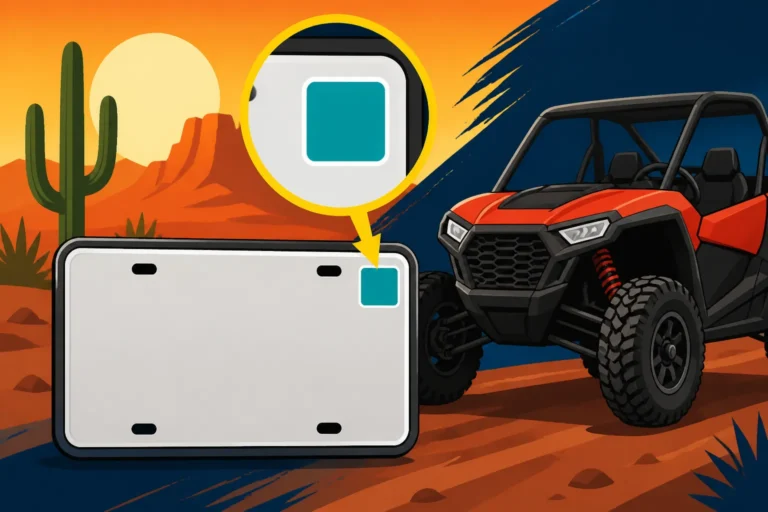
To get your decal, you'll need to visit the [Arizona Game and Fish Portal Account] online. If you don't have one, you'll need to create an account, which is a straightforward process. Through this portal, you can apply for and purchase your OHV decal. Another important requirement that many new residents might not be aware of is the mandatory OHV safety education course. If you haven't taken it already, you'll likely need to complete [Arizona's Free Mandatory OHV Decal Course] before your decal application can be fully processed. This course is designed to educate riders on safe and ethical practices specific to Arizona's unique desert environment. Once purchased and the course completed (if required), your decal will be mailed to you, along with a small registration card. Remember, this decal must be affixed correctly, typically on the upper-left corner of your license plate, as detailed in [Where the Arizona OHV Decal Goes on the Plate].
Common Hurdles and How to Clear Them
Even with a clear step-by-step guide, moving a vehicle across state lines can throw a few curveballs. Rest assured, many of these challenges are common, and there are established ways to work through them. Arizona's MVD and Game and Fish Department have seen it all, and understanding the potential sticking points beforehand can save you a lot of frustration.
Dealing with Lost Titles or Missing Paperwork
One of the most frequent headaches for anyone bringing an out-of-state machine into Arizona is a lost or missing title. Perhaps your California quad was an older model, and you never bothered to get a formal title, only a registration. Or maybe you simply can't find the original document amidst all your moving boxes. Whatever the reason, if you don't have a clean California title in your name, Arizona won't be able to simply issue you a new one. This is where the process can get a bit more involved.
Your first line of defense should always be to try and get a duplicate title from the California DMV. If that's not possible, or if the machine was never titled in California, Arizona does offer a path forward through a bonded title. A bonded title essentially provides an indemnity bond to the state, protecting them and future owners if someone else later claims legitimate ownership. This is a more complex process that involves proving ownership to the MVD through other means, like a comprehensive bill of sale (even a simple one created through a service like LawDepot can help establish intent), old registration documents, or even an affidavit of ownership. It can take time and requires a bond, but it is a viable option for [Titling an Arizona Quad With No Ownership History] when all other avenues for a clear title are exhausted.
Sales Tax and Use Tax Considerations
Ah, taxes. Just when you thought you were done with them after buying your quad, moving to a new state can sometimes bring them back into play. When you bring an OHV into Arizona from another state like California, Arizona's "use tax" comes into consideration. Essentially, use tax is a tax on goods purchased out-of-state for use within Arizona, and it's designed to level the playing field with sales tax paid on in-state purchases.
If you paid sales tax on your quad in California, Arizona generally gives you a credit for the amount of sales tax you previously paid. If the California sales tax rate was comparable to or higher than Arizona's, you likely won't owe any additional use tax in Arizona. However, if California's sales tax rate was lower, or if you didn't pay sales tax at all (e.g., if you bought it from a private party in California and weren't required to pay sales tax there), then Arizona will typically assess use tax on the declared value of your quad. It’s important to be transparent about your purchase price and any taxes paid. The MVD will have forms to declare this, and they will calculate any [Arizona Use Tax After an Out-of-State Buy] owed. Keep your original bill of sale handy to prove what you paid and any sales tax collected at the time.
Emissions Testing: Does Your Quad Need It?
For many new Arizona residents, especially those coming from California with its strict emissions standards, the question of emissions testing immediately comes to mind. California is well-known for its stringent vehicle emissions laws, and it's natural to wonder if your quad will need to pass similar tests here in Arizona. The good news for most off-highway vehicle owners is that, typically, OHVs are exempt from standard emissions testing requirements in Arizona, even in areas like Phoenix and Tucson where passenger cars are required to undergo testing.
This exemption holds true as long as your quad remains an off-highway vehicle, meaning it's only used on designated trails and private property, and not operated on public paved roads. However, there's a significant exception: if you decide to make your California quad street-legal in Arizona (a process that involves adding lights, mirrors, horn, etc., to meet street-legal requirements), then it might become subject to emissions testing if you plan to operate it in the mandatory emissions testing areas (parts of Phoenix and Tucson). For most riders sticking to the dirt, however, you can breathe a sigh of relief on the emissions front. Just make sure to check the specific requirements for [Emissions Testing for OHVs in Phoenix and Tucson] if you're planning any street-legal modifications.
After Registration: Staying Compliant and Riding Smart in Arizona
Congratulations, you've moved your California quad to Arizona, navigated the titling process, and secured your annual OHV decal! That's a huge step. But the journey doesn't quite end there. To ensure continued smooth riding and compliance with Arizona's regulations, there are a few more things to keep in mind, from proper decal placement to understanding local riding etiquette and rules. Staying informed helps keep the trails open and enjoyable for everyone.
Decal Placement and Renewal
Once your Arizona OHV decal arrives in the mail, it’s not enough to just keep it in your glove box. It must be prominently displayed on your machine's license plate. The specific rule is that the decal should be affixed to the upper-left corner of the license plate. This placement makes it easy for law enforcement or park rangers to quickly verify your compliance while you're out on the trails. Make sure to clean the area thoroughly before applying the decal to ensure good adhesion, as a decal that peels off can lead to unwanted attention from authorities. You can find more details on this in [Where the Arizona OHV Decal Goes on the Plate].
Remember, this isn't a one-time process. The Arizona OHV decal is an annual renewal. You'll need to renew it each year, typically around the anniversary of your initial purchase or a specific date set by AZGFD. The state usually sends out renewal reminders, but it's ultimately your responsibility to ensure it's current. Renewing is generally a quick and easy process through your [Arizona Game and Fish Portal Account] online. Missing the deadline can result in fines if you're caught riding with an expired decal, so mark your calendar for [Renewing an Arizona OHV Decal Each Year]!
Carrying Your Papers on the Trail
While your OHV decal on the plate is the most visible sign of compliance, it's also crucial to carry the accompanying registration card and potentially other documents with you when you ride. This card serves as an official record that your decal is current and provides specific details about your machine. In Arizona, law enforcement, including Game and Fish Rangers and Sheriff's deputies, have the authority to stop OHV riders to check for proper registration, decals, and proof of ownership.
Beyond your OHV registration, if you plan on riding on Arizona State Trust Land – which covers vast swaths of the desert and mountains – you will also need an [Arizona State Trust Land Recreational Permits]. This separate, inexpensive permit is mandatory for accessing and using these lands for recreation. You can usually purchase this online as well. Having all your necessary documents readily accessible, perhaps in a waterproof bag on your machine, ensures that you can quickly provide them if requested by an officer.
Understanding Arizona's Riding Rules
Riding in Arizona offers incredible freedom and diverse terrain, but it also comes with a responsibility to understand and follow the rules. Many of these rules are designed for safety, environmental protection, and ensuring harmonious use of public lands. For instance, all OHVs must be equipped with a USDA-approved spark arrestor to prevent wildfires, a critical concern in our arid environment, as outlined in [Arizona's Spark Arrestor Requirement].
Furthermore, Arizona has specific helmet laws. While adults are not always required to wear helmets on OHVs, riders under the age of 18 must wear a U.S. DOT-approved helmet when operating or riding as a passenger on an OHV, regardless of whether it's on public or private land. This is a non-negotiable safety rule detailed in [Arizona Helmet Rules for Riders Under 18]. Beyond specific equipment and age rules, always practice ethical riding: stay on designated trails, respect private property, and be mindful of noise, especially near residential areas. If you ever lend your quad to a friend or family member, consider using a simple agreement from a resource like LawDepot to clarify responsibilities and ensure they understand Arizona's specific OHV rules. Riding smart and safe makes the experience better for everyone, ensuring our access to these incredible trails for years to come.
Disclaimer
This article is for general informational purposes only and does not constitute professional advice. Laws, prices and regulations vary by location and change over time. Consult a qualified professional for guidance on your specific situation.