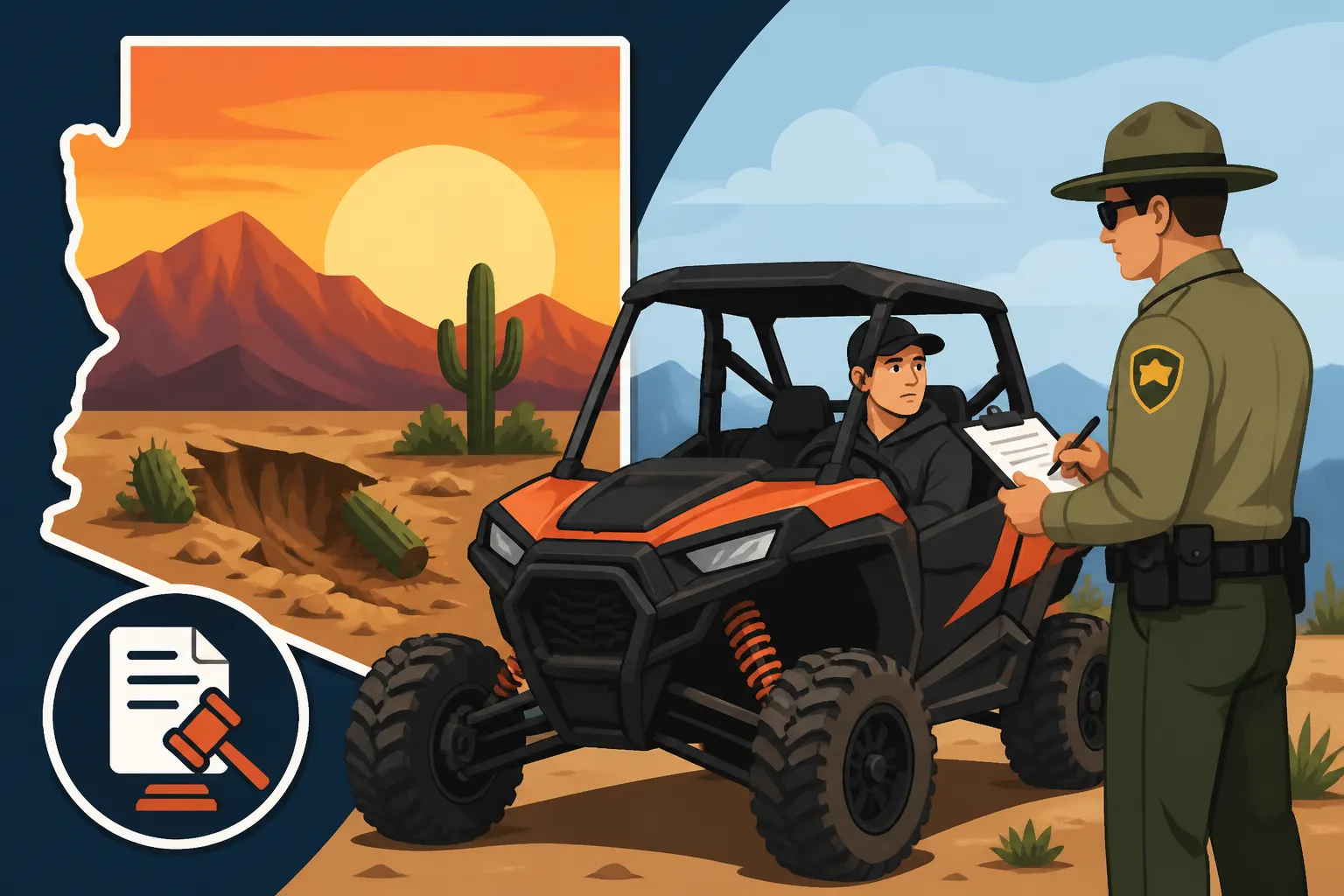
Arizona Resource Damage Citations
Arizona resource damage citations can turn a ride off the mapped route into a costly legal and practical problem. The rules depend on who manages the land, what was damaged, and which restrictions applied at the time. Knowing what counts as resource damage, what to do after a citation, and how to document a disputed incident can help you respond without making matters worse.
What Arizona considers resource damage
An OHV ride can affect more than the track beneath your tires. On public and other managed lands, resource damage generally means harming natural or cultural features, or traveling in a way that causes prohibited damage. The exact rule depends on the land and the authority responsible for it.
Examples can include:
- Driving off an open route and creating a new track through vegetation or fragile soil.
- Damaging a trail, fence, gate, sign, restoration area, or other land-management feature.
- Disturbing wildlife or sensitive habitat in a way that violates a closure or restriction.
- Entering a closed area, including land set aside for protection or restoration.
- Damaging an archaeological or historic site.
Not every tire mark or rut automatically means a resource-damage violation. Conditions matter. A route may be open but temporarily vulnerable after rain, or a posted closure may prohibit travel regardless of whether visible damage occurred. Conversely, a rider can cause damage by leaving an established route even if the machine does not get stuck or leave a deep rut.
The key question is not simply whether a place looks rideable. It is whether motorized travel is allowed there and whether your route and conduct comply with the rules. A road visible on a phone map may not be open to OHVs, and a wash or two-track is not automatically an approved route. Check current land-manager maps and notices before the trip, especially where routes cross between jurisdictions. Finding the Right Travel Management Map explains why route status matters.
Rules depend on who manages the land
Arizona rides can cross federal, state, local, tribal, and private property. Different land managers may have different route designations, closures, permit requirements, and enforcement procedures. A rule that applies on one parcel may not apply on the next.
For example, designated routes and access rules on Bureau of Land Management land are not interchangeable with those on national forest land. State trust land has its own access and permit considerations, and permission from a private landowner is a separate matter from public-land authorization. Arizona Trails on State Trust Land and Arizona Rules on BLM Roads cover two common situations where riders need to check the land type rather than assume general OHV access.
Wilderness boundaries deserve particular attention. Motorized travel is generally prohibited within designated federal wilderness, and a route that approaches or follows a boundary can be easy to misread on the ground. Use an authoritative map and stay on the open side of the boundary. See Arizona Wilderness Boundaries and Machines before planning a route near a protected area.
A resource-damage citation may be one part of an incident, not the only alleged violation. The same conduct could also be addressed under rules involving unauthorized travel, trespass, a closure, or another land-use restriction. That does not mean every case produces multiple citations; it means you should read each allegation separately and avoid assuming that resolving one automatically resolves the rest.
How citations and consequences can work
A citation is a formal allegation, not proof by itself that you committed the violation. It should identify the alleged conduct and provide instructions for responding. The issuing authority and the land involved determine where the matter goes and what process applies. Some cases may be handled through a court, while others may involve an agency process or additional claims. Read the document closely rather than relying on a general description of Arizona OHV rules.
Possible consequences vary. Depending on the facts and applicable rules, a case may involve a fine, a requirement to appear or respond, a separate assessment related to restoration, or other legal consequences. The amount and process can depend on the violation, land jurisdiction, and current law. Do not assume that a resource-damage allegation has a fixed statewide fine or that paying a citation settles every related issue.
| Situation | Why it can matter | Practical next step |
|---|---|---|
| You rode beyond a signed or mapped route | The area may be closed to motorized travel, even if it looks like a road | Save the map or route information you relied on and identify the route segment |
| A trail or site appears damaged | The authority may allege harm to land, vegetation, or a managed feature | Photograph the location only if you can do so safely and lawfully |
| You crossed a boundary without realizing it | Rules can change at a land-management boundary | Record the boundary location and check the official map layer |
| A citation lists several allegations | Each allegation may have a separate response requirement | Make a list of every count, deadline, and required contact |
| You are asked to pay for restoration | That request may be separate from a citation or court penalty | Ask for the written basis, itemization, and response procedure |
Land managers and officers may rely on observations, photographs, route maps, signs, witness accounts, or other information. Conditions can change between the incident and the date of a hearing, so preserve your own records promptly. Do not alter, remove, or repair a feature that may be part of an investigation unless the responsible authority has authorized it.
Enforcement may happen during a patrol, at a staging area, or after a report. A rider can also encounter more than one officer or agency when an incident involves multiple jurisdictions. Arizona Ranger and Deputy Checkpoints describes what riders may be asked to show during an encounter, while Arizona OHV Rules During Hunting Season is useful when seasonal activity or closures affect access.
What to do if you receive a resource damage citation
Treat the citation as a deadline-driven document. Do not ignore it because you believe the allegation is mistaken, because the damage seemed minor, or because you plan to contact the officer later. Missing a response date can make an already difficult matter harder to resolve.
- Read the full document. Note the issuing agency, alleged violation, location, response method, deadline, and any hearing or payment instructions. If the citation includes multiple counts, track each one.
- Keep every related record. Save the citation, maps, GPS track, permit or decal information, photographs, messages, and notes about the ride. Keep original files when possible and make a separate copy for working with them.
- Write down what happened while it is fresh. Record the route, time, weather, signs you saw, who was present, and what the officer said. Separate what you personally observed from what someone else told you.
- Ask procedural questions through the listed contact. If the document is unclear, contact the court or agency identified on it. Keep a record of the date, person or office contacted, and the guidance received. Do not assume an informal conversation changes a deadline.
- Consider qualified legal advice. If the citation could affect your record, involve substantial alleged damage, include multiple violations, or require a formal hearing, a lawyer familiar with the relevant jurisdiction can help you understand options.
- Follow the required process. If you contest the allegation, use the method and timing stated on the citation. If you resolve it, keep proof of payment or other disposition and confirm whether any separate restoration or agency matter remains open.
If you believe the location was open, collect the information that supports that view. This might include a dated map, official route designation, posted signs as they appeared on the day, and a GPS record showing where you traveled. A screenshot from a general mapping app can be useful context, but it may not establish that a route was legally open. Compare it with the responsible land manager’s travel map and any closure notices.
If the allegation is that your machine caused physical damage, document the location and condition without disturbing it. Avoid returning to the site to take additional pictures if access is restricted or if doing so could create further damage. Do not post statements online that speculate about the facts or assign blame; public comments may not help clarify the case.
A citation can also raise questions about who was operating the machine, who owned it, and who had permission to ride. Those issues can vary by allegation. If another person was driving, do not guess or make a statement on their behalf. Keep your account factual, and get advice before making admissions or signing a document you do not understand.
For procedural options and common response considerations, see Appealing a Desert Citation. It is still the citation itself, and the instructions from the named court or agency, that control your next steps.
Preventing damage and reducing citation risk
The most reliable prevention is to choose a route that is clearly open to motorized use and stay on it. Planning matters more in Arizona’s desert than a casual glance at the terrain might suggest: faint tracks can be old, unauthorized, or closed, and a route may pass through multiple land types.
Before leaving, identify the land manager for the area and check its current maps, alerts, and restrictions. Save the relevant map for offline use, but do not treat a saved map as permanent proof that a route remains open. Closures can change, and signs or barriers at the site may provide important current information.
On the ride:
- Stay on designated routes and respect gates, barricades, signs, and closure markers.
- Do not ride around a barrier, even if another track appears to go around it.
- Avoid creating a bypass around mud, water, rocks, or a blocked section unless an approved route is clearly marked.
- Slow down near trail edges, restoration work, wildlife, and cultural or historic features.
- Do not move signs or barriers, and do not remove vegetation or alter the trail to make passage easier.
- Turn around when route status is uncertain rather than testing whether the area is technically passable.
Weather can change how much damage a machine causes. A trail that is firm in dry conditions may be especially vulnerable after rain, while a wash can be hazardous because of flash flooding even when it looks dry. Route closures and fire restrictions may also affect where travel is allowed. Check conditions before heading out, and do not assume that a familiar track is open simply because it was open on a previous visit.
Riders should also understand that an OHV decal or registration does not grant access to every trail or parcel. It addresses a separate requirement; land access depends on route status, property boundaries, permits, and other rules. Arizona OHV Rules for First-Time Visitors offers a broader starting point for preparing to ride, and Why a Decal Alone Will Not Let You Stage explains why vehicle paperwork is not the same as permission to use a particular area.
If you see fresh damage, a broken gate, or an unclear closure, avoid adding to the problem. Record the location if it is safe, then report it to the relevant land manager. Do not confront another rider or attempt repairs yourself where the work could disturb sensitive ground or interfere with an investigation. Good documentation and a clear report can help the responsible authority assess what happened.
A resource-damage citation is best handled with care, not guesswork. Confirm which land rules apply, preserve the records that show where and how you rode, and follow the response instructions on the citation. For future trips, route research and staying on designated roads are the simplest ways to reduce both environmental impact and legal risk.
Disclaimer
This article is for general informational purposes only and does not constitute professional advice. Laws, prices and regulations vary by location and change over time. Consult a qualified professional for guidance on your specific situation.