Wildlife on a Desert Trail
A wildlife encounter can turn an ordinary Arizona ride into a tense moment: a javelina steps onto the track, a rattlesnake lies across the trail, or a herd of elk appears around a bend. This guide explains how to respond calmly, protect animals and riders, and plan a route with desert wildlife in mind.
Wildlife You May Encounter on Arizona ATV and UTV Trails
Arizona’s varied terrain means the animals you see depend on where and when you ride. A low-desert route near Phoenix may bring different encounters from a forest road near Flagstaff, and wildlife can appear with little warning even on a familiar trail.
Animals of the Sonoran Desert and low country
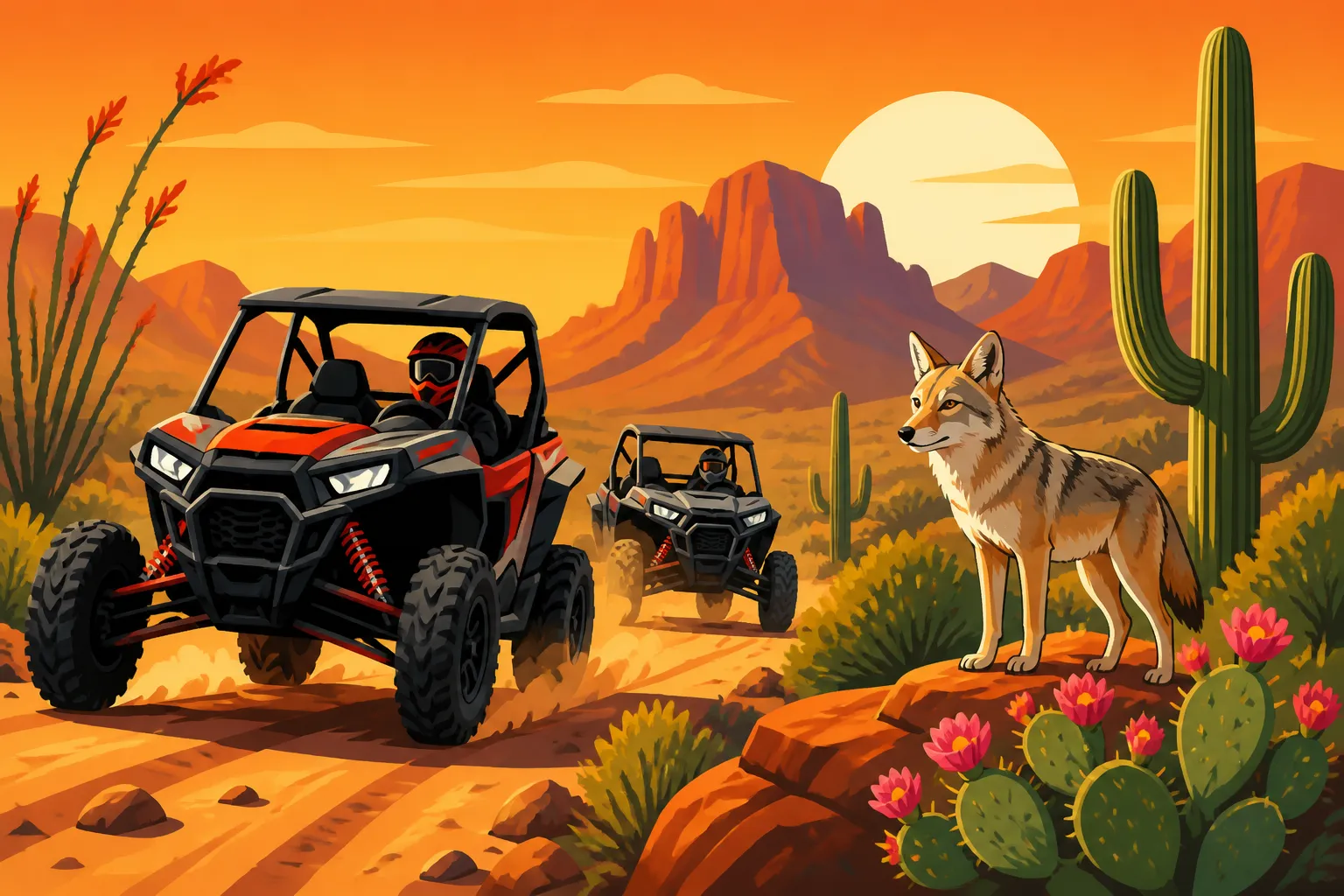
On low-elevation trails, riders may spot javelinas, mule deer, coyotes, rabbits, quail, hawks, and reptiles. Javelinas often travel in groups and may emerge from brush or cross a wash unexpectedly. They are wild animals, not tame pigs; give them room, avoid trying to herd or photograph them at close range, and wait for them to move away before continuing.
Desert reptiles deserve particular care. Rattlesnakes may rest on warm ground, near rocks, or in the shade beside vegetation. Gila monsters are slow-moving but venomous, and desert tortoises are protected wildlife. Do not touch, pick up, move, or crowd an animal to get a better view. If it is on the route, stop well back and give it time and space to leave. If the trail is narrow or the animal does not move, turn around rather than trying to pass close by.
Birds can be easy to overlook because riders are often watching the ground and the next turn. Quail may flush suddenly, and hawks or other raptors may be feeding near a carcass. Slow down when visibility is limited, especially near brush, water, or a wash. For more trip-planning context, Where to Ride an OHV in Arizona can help you think through the different kinds of landscapes you may encounter.
Wildlife in higher elevations and near water
As elevation rises, the mix changes. Forested routes around Flagstaff, the Mogollon Rim, and parts of the Prescott area may have elk, mule deer, black bears, coyotes, and many bird species. Elk can be especially startling because they are large and may appear around a bend or near a meadow. Give a herd a wide berth, do not drive between animals, and avoid lingering if they seem alert or unsettled.
Near lakes, rivers, and desert springs, expect more bird activity and potentially more animals using the same narrow access points as people. Bighorn sheep are associated with rugged terrain in parts of the state, while wild burros are familiar sights around some western Arizona routes and communities. Burros can stand or move unpredictably, so do not honk, chase, or attempt to squeeze past a group. Stop and wait for a safe opening.
If you are planning a route in unfamiliar terrain, use current land and route information rather than assuming an old track is still open. A mapped route in onX Offroad can help you understand where the road or trail goes, but it does not replace posted closures, signs, or instructions from the land manager. For a broader trip-planning checklist, see Planning an Arizona Riding Trip.
How to Respond When Wildlife Is on the Trail
A good response is usually simple: reduce risk, give the animal room, and avoid turning a brief encounter into a pursuit. The pressure of a group ride can make people feel they need to keep moving, but waiting or rerouting is often the safest choice.
Stop early and give animals room to leave
When you see an animal ahead, slow down in a controlled way and stop where you have a clear view. Avoid sudden swerves, hard acceleration, or revving the engine to make the animal move. Those reactions can startle wildlife, kick up dust, or put your machine into loose gravel, soft sand, or a wash edge.
If you are riding with a group, signal the riders behind you to stop too. Leave space between machines rather than crowding the animal from both sides. Keep passengers seated and quiet, and do not surround the animal for photos. Once it has moved away and the route is clear, continue slowly while watching for young animals or others following behind.
Some animals may not move right away. A snake may remain on a warm trail, a burro may pause in the road, or a deer may hesitate before crossing. Do not prod or drive toward it. If waiting does not create a safe passage, retreat along the route you came from or choose another legal route.
Keep encounters calm and predictable
Never feed wildlife, even if an animal approaches a vehicle or looks accustomed to people. Food can change animal behavior and draw wildlife toward roads, camps, and staging areas. Keep snacks and garbage secured, and do not leave food scraps behind at a trailhead or campsite.
Avoid following animals to get a closer look. A vehicle can make an animal feel trapped, particularly on a narrow route with steep banks or dense brush. Keep your machine on the established route, and do not cut a new line around an animal or drive off-trail to bypass a blockage. Route boundaries and closures matter as much as the immediate encounter; Arizona Wilderness Boundaries and Machines explains why riders need to pay attention to areas where motorized travel is not allowed.
| What you see | A safer response | Avoid |
|---|---|---|
| Javelinas or deer crossing | Stop, leave room, and wait for the group to clear | Driving between animals or accelerating toward them |
| Snake on the route | Stop well back and wait, or turn around if passage is unsafe | Touching, moving, or riding over it |
| Burros near the road | Pause and let them move without pressure | Honking, chasing, or squeezing past |
| Bird or small animal near brush | Slow down and scan ahead before proceeding | Rushing through vegetation or a blind corner |
| Large animal that seems distressed | Increase distance and leave the area calmly | Approaching for a photo or blocking its escape |
Plan Your Ride Around Wildlife and Trail Conditions
Wildlife awareness starts before you unload your ATV or UTV. Route choice, timing, group size, and riding pace all affect how prepared you are to respond when an animal appears.
Choose routes carefully and stay on designated trails
Before leaving, check that your intended route is open to motorized travel and suitable for your machine. Trail conditions and access rules can differ between public lands, state trust land, and private property. A line visible on a screen does not automatically mean it is an authorized route. Arizona Trails on State Trust Land is useful background if your ride may cross trust land, while Arizona Trail Difficulty Ratings can help you consider terrain and rider capability.
onX Offroad can be useful for reviewing route lines and terrain before a ride, especially when you are trying to understand how a route connects to staging areas or other roads. Use it as one planning aid, not as permission to ride wherever a line appears. Compare your plan with current official maps and on-the-ground signs. Keep the group on the established route, particularly when going around a wildlife sighting; creating a bypass can damage habitat and may take riders into a closed or unauthorized area.
Also think about visibility. Narrow trails, blind bends, tall brush, and washes can hide animals until you are close. Choose a pace that lets you stop within the distance you can see, and avoid bunching up so tightly that the rider behind you has no time to react.
Pick timing and pace with wildlife in mind
Wildlife can be active at different times of day, and conditions change with season, temperature, and water availability. Dawn and dusk can offer comfortable riding temperatures, but lower light makes it harder to see animals, obstacles, and other riders. If you ride during those hours, use the required lighting for your machine and reduce speed where visibility is poor.
In hot weather, animals and riders may both seek shade or water. A wash or spring can attract wildlife, but it can also be an area where footing is uncertain and sightlines are limited. Approach slowly, avoid crowding water sources, and never assume a dry-looking wash is safe to cross. Weather can change far beyond the immediate trail; Arizona Monsoon Season and Flash Flooding covers why desert routes need extra caution during storm periods.
A steady, moderate pace gives you more time to spot movement and react without startling an animal. It also helps prevent dust clouds that reduce visibility for your group. If the route is busy, keep a safe gap between vehicles and stop in a place where you are not blocking the trail.
Prepare for a Wildlife Encounter Before You Ride
Even experienced riders can be surprised by an animal appearing close to the trail. A little preparation helps the group respond without confusion, especially when riders have different experience levels or are traveling somewhere unfamiliar.
Set expectations with your riding group
Before starting, agree on how riders will signal a stop and how the group will regroup after an encounter. A simple verbal call or hand signal is easier to follow than several riders reacting independently. Keep children and less-experienced riders close enough to receive instructions, but leave enough space between machines for safe stopping.
Talk through a few common situations: what the group will do if a snake is on the trail, if a herd blocks the route, or if a rider spots an animal near a blind turn. Make clear that nobody should leave the route, chase wildlife, or get out of a vehicle to approach an animal. A group that has discussed the basics is less likely to turn a quiet sighting into a noisy crowd.
Carry the essentials for the landscape and the length of your ride. Water, a charged phone or communication device, and a route plan are important in remote areas, where help and cell coverage may be limited. Cell Service in the Arizona Backcountry and Water Planning for an Arizona Trail Day can help you prepare for those practical concerns.
Know when to leave an area or seek help
Leave calmly if an animal appears injured, trapped, unusually aggressive, or unable to move off the route. Do not attempt to rescue or handle it yourself. Back away, keep people and pets away, and contact the appropriate land manager or wildlife authority when you can do so safely. If an animal creates an immediate danger to people, move the group to a safer location first.
After an encounter, check that every rider is accounted for before continuing. Dust, a sudden stop, or a quick turn can separate a group, particularly on a network of branching desert tracks. Use your planned route to regroup at a safe pullout rather than stopping in a blind corner or narrow passage.
Respectful riding does not mean wildlife sightings are rare or unwelcome. It means making room for animals to behave naturally, keeping machines on authorized routes, and accepting that sometimes the best route forward is the one you do not take. With a calm group, a sensible pace, and a plan for changing course, an encounter can remain a memorable part of the ride rather than becoming a hazard.
Disclaimer
This article is for general informational purposes only and does not constitute professional advice. Laws, prices and regulations vary by location and change over time. Consult a qualified professional for guidance on your specific situation.