Arizona Trailhead Parking for a Toy Hauler
A toy hauler makes it easy to bring your ATV or UTV to Arizona’s trails, but the last few miles can be the hardest part of the trip. A narrow approach, soft sand, a crowded staging area, or a parking rule you didn’t expect can turn arrival into a stressful maneuver. This guide explains how to choose a suitable trailhead, check access, and park with room to ride.
Choose a trailhead that can handle your whole rig
Check the complete rig, not just the trailer
A trailhead may look spacious in a photo and still be a poor fit for a truck towing a long toy hauler. Think of your setup as one combined vehicle: tow vehicle, trailer, loaded gear, and the turning space needed to get in and back out. A spot that fits the trailer alone may not provide enough room to turn around or line up with the exit.
Before leaving home, write down the approximate overall length and width of your rig, along with its height and loaded weight if available. Include anything that changes the footprint, such as a rear-mounted spare tire, a hitch extension, or equipment carried on the truck. Use those measurements when reviewing maps, trailhead descriptions, and access roads.
Pay particular attention to the final approach. A steep grade, tight bend, narrow bridge, soft shoulder, or wash crossing can matter more than the parking area itself. If you’re unsure whether a road is suitable, don’t treat a route line on a map as proof that a large trailer can safely use it. Check the relevant land manager’s information and look for recent reports where available. Arizona Trailhead Parking and Staging can help you think through the difference between reaching a trail and having a safe place to unload.
Look for room to turn around and unload
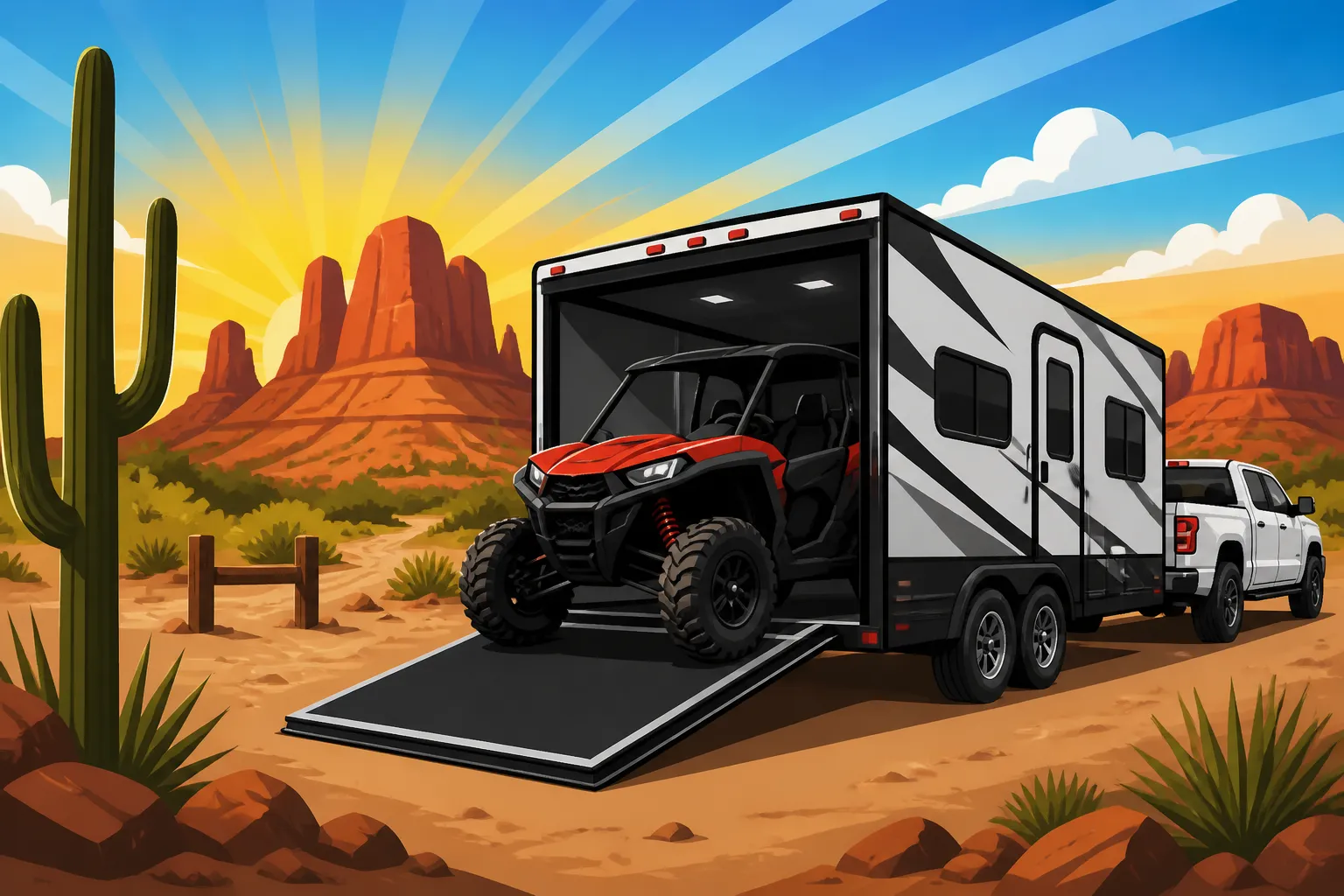
A good staging area needs to work for more than parking. You may need room to open the toy hauler ramp, lower stabilizers, unload machines, check tire pressure, and organize helmets and water without blocking another vehicle. If you have passengers or children, allow space for them to move around safely away from traffic and moving machines.
Picture your arrival before you commit to a site. If the parking area is already busy, can you pull through, or would you need to reverse a long distance? Is there a place to wait without blocking the access road? Can you unload without positioning the ramp toward another parked vehicle? These practical questions help distinguish a genuinely workable trailhead from one that merely appears open on a map.
For a first visit, a spacious, clearly designated staging area is generally a less stressful choice than a small roadside pullout. Conditions and access can vary, though, so confirm that the area is open to your intended use and that trailer parking is allowed. Don’t assume that an unmarked patch beside a road is a permitted parking or staging area.
Compare trailhead conditions before choosing your route
Arizona riding areas can differ sharply in terrain and access. A trailhead near the Phoenix metro area may have a different approach and parking layout from one in the red-rock country around Sedona, the forest roads near Flagstaff, or a desert route outside Lake Havasu City. Even within one riding area, the main staging point may be much easier to reach with a trailer than a smaller secondary access point.
Use a current travel management map to identify roads and designated access points, then check the trail system’s official information for closures or restrictions. Finding the Right Travel Management Map is useful when you need to distinguish an authorized motorized route from a road that only looks convenient. Tools such as onX Offroad can help you plan and review route options, but a map app should supplement—not replace—posted signs and land-manager guidance.
| What to check | Why it matters with a toy hauler | What to do before you go |
|---|---|---|
| Road width and turns | A long trailer needs more clearance and turning room | Review the approach and ask the land manager if the road is uncertain |
| Surface and grade | Loose sand, steep sections, or washouts can complicate towing | Look for current conditions and avoid committing to an unsuitable route |
| Parking layout | Angled or crowded spaces can make backing difficult | Identify a larger staging area and arrive with a backup option |
| Ramp and unloading space | Unloading may require room beyond the trailer’s footprint | Plan where the ramp will extend and keep access lanes clear |
| Overnight rules | Parking permission does not always mean camping is permitted | Confirm the specific rules for the land and location |
| Cell coverage | A dead zone can make last-minute coordination difficult | Save maps and essential details before leaving service |
Plan the approach before towing into the desert
Check access, closures, and surface conditions
A trailhead access road can change after rain, fire restrictions, maintenance, or other temporary conditions. An approach that was manageable on a dry day may become muddy, rutted, or unsafe after a storm. A closure may also apply to the access road, staging area, or a specific trail rather than the entire riding region.
Check for updates close to departure, then check again before turning onto a remote access road. Checking Arizona Trail Status Before You Drive offers a useful reminder that trip planning includes confirming what is open, not just selecting a destination. If your route depends on an unpaved road, consider whether you can turn around safely if conditions have changed.
Do not let a navigation app persuade you to continue down a questionable road just because it shows a shorter route. If a sign indicates a restriction or the road becomes narrower and rougher than expected, stop somewhere safe and reassess. A few extra miles to a suitable staging area are usually preferable to trying to reverse a large trailer through a tight wash or crowded entrance.
Confirm parking, camping, and land access separately
Parking a trailer to unload for the day is not automatically the same as camping or staying overnight. Rules can differ by land manager and location. A designated staging area may allow day use while prohibiting overnight stays; another area may have separate camping rules or designated sites. Ask about the exact activity you plan to do rather than relying on a general assumption that public land is open for every use.
This distinction matters around Arizona State Trust Land as well as federal, state, and local lands. A permit or access authorization may be required for some activities or locations, and permission to ride does not necessarily grant permission to camp or leave a trailer overnight. Review Staging a Trailer on Trust Land and Arizona Recreational Permits for Individuals when your plans involve State Trust Land. When in doubt, contact the responsible land office or agency before you tow in.
If you want to stay near the riding area, look for a designated campground or a location where overnight use is clearly allowed. Camping Beside Arizona OHV Trails and Dispersed Camping Near Arizona Trailheads can help you compare the kinds of options to investigate. Keep the distinction clear: a trailhead is not automatically a campsite, and an open-looking parking area is not an invitation to spend the night.
Have a backup staging area
A backup plan is especially valuable during busy riding periods, when a trailhead can fill before you arrive. Identify a second authorized staging option before the trip, and note how far it is from the route you want to ride. If your first choice is full, closed, or unsuitable for the trailer, you can change plans without searching from the driver’s seat.
Save the location and directions offline if you’ll be traveling beyond reliable cell service. onX Offroad can be helpful for preparing route options in advance, especially when you want to compare nearby access points. Still, keep agency maps and posted signs in the decision-making process: digital route information can’t tell you whether the actual parking area is full or whether a temporary restriction has been posted at the entrance.
A backup plan should include a stopping point where you can safely reassess—not just another trailhead pin. If the road narrows or the trailer is no longer comfortable on the surface, don’t continue on the assumption that the next turn will be better. Turn around only where you can do so safely and legally.
Park, unload, and stage without creating problems
Arrive with a parking plan
When you reach the staging area, take a moment to look around before committing to a space. Check for signs, marked boundaries, other trailers, uneven ground, and the direction of traffic. If there are designated trailer spaces, use them. Avoid blocking gates, road entrances, turnaround areas, access lanes, or the space another vehicle needs to launch or retrieve a machine.
Whenever possible, choose a position that lets you leave without a complicated reverse maneuver. If you must back in, use a spotter who can see the trailer’s corners and nearby obstacles. Agree on simple hand signals before moving, keep the spotter visible, and stop immediately if you lose sight of them. Small rocks, drainage edges, and low posts can be difficult to see from the driver’s seat.
Set up so that unloading does not spill into the travel lane. Keep the ramp, machines, tools, and gear within your usable space. If another vehicle arrives while you’re unloading, pause and make room rather than forcing them to wait beside an active ramp or a moving ATV.
Unload with the site in mind
Before lowering the ramp, check the ground where it will rest. Loose gravel, a slope, or an uneven surface can make loading and unloading less stable. Follow the toy hauler and machine manufacturers’ instructions for safe loading, and use the designated tie-down points and equipment intended for your setup.
Organize gear so that essentials are easy to reach without blocking other users. Keep helmets, eye protection, water, and first-aid supplies together. If you’re riding with children or people unfamiliar with the area, set a clear boundary for where they can stand while machines are being moved. Don’t let anyone walk behind a vehicle that is reversing or beneath a ramp while a machine is being loaded.
Leave room for other trail users to access the staging area. A group that spreads out across several spaces can make a busy trailhead feel full even when parking remains available. Pack up loose trash and secure equipment before heading out. If your return route could involve darkness or changing weather, know how you’ll reload and exit before you begin the ride.
Keep parking separate from trail and land permissions
A permitted parking spot does not necessarily mean every nearby road or trail is open to your machine. Confirm the approved riding routes for your vehicle, observe signs and barriers, and avoid creating a new path around a closed section. Parking on land where you are not authorized to stage can create problems even if the adjacent trail is open.
This is where Planning an Arizona Riding Trip helps connect the practical pieces: route access, land rules, staging, and what you need to carry. If your route crosses multiple land types, check each one rather than assuming the same rules apply throughout the ride. Keep any required permits or documents accessible, and make sure everyone in the group knows where the permitted routes begin.
Match your parking plan to the riding area
Sedona and the red-rock country
Around Sedona, trail access and parking can be affected by narrow roads, crowded destinations, and designated routes. Do not assume a popular trail name points to a large trailer-friendly staging area. Review the specific access point and road approach, and consider whether another authorized staging location would make the day easier.
A toy hauler can be inconvenient in a compact or busy area, even when the trail itself is suitable for your machine. If there is limited space to turn or unload, choose a larger staging area and ride to the route if access rules allow. Check the relevant land-manager information before traveling, especially if your plan involves a particular trailhead or a route near residential areas.
Phoenix-area desert and northern Arizona
Near Phoenix, including areas such as Table Mesa and Bulldog Canyon, access conditions and staging arrangements can vary by location. Some entrances may have gates, permits, or other requirements, while parking availability may be different on a weekend than on a quieter weekday. Confirm the rules for the specific site rather than treating all nearby desert access points as interchangeable.
Northern Arizona brings a different set of considerations. Around Flagstaff and Cinder Hills, forest roads and changing weather can affect the approach, and a route that works for a truck alone may feel very different with a loaded trailer. Check road and trail status before departure, and identify where you can turn around if conditions are not suitable. An offline route plan in onX Offroad may help you keep alternatives available, but follow official closures and on-site instructions.
Build a realistic arrival and departure plan
Estimate more than driving time. Allow time to find a suitable space, position the trailer, unload safely, and get everyone ready before riding. A tight schedule can tempt you to use a questionable pullout or rush a backing maneuver. Leaving earlier may provide more parking options and a calmer start, particularly when your preferred area is known to attract other riders.
Think through departure as carefully as arrival. Will the ramp and machines be ready to load if the ground is busy? Is there enough room to reposition the trailer without blocking others? Could heat, wind, dust, or a late return affect your plan? Arizona conditions can change the comfort and safety of a long day outdoors, so carry water and avoid relying on a last-minute stop for supplies.
If the staging area proves unsuitable, be willing to change the ride. A shorter trip from a better location is a sensible trade for avoiding a risky turn, unauthorized parking, or damage to the trailer. Before the next outing, record what worked: the approach, the parking layout, where you unloaded, and any restrictions you encountered. That small note can save a frustrating search on your next Arizona trail day.
Disclaimer
This article is for general informational purposes only and does not constitute professional advice. Laws, prices and regulations vary by location and change over time. Consult a qualified professional for guidance on your specific situation.