Riding Bulldog Canyon After Rain
Rain can make Bulldog Canyon’s sandy washes look firm while hiding slick clay, soft shoulders, and fast-changing water levels. This guide explains how to judge conditions, check access before leaving the Phoenix area, prepare your ATV or UTV, and decide when turning around is safer than pressing on. A permit or gate code is not a guarantee that a route is safe after a storm.
What rain changes at Bulldog Canyon
Bulldog Canyon lies in the Tonto National Forest northeast of the Phoenix metro area, where desert terrain can shift quickly from dry and firm to muddy, rutted, or flooded. A shower nearby does not always mean the same conditions across the whole area: rain falling miles away can drain into a wash you are about to cross.
That uncertainty is the main challenge. A route may look passable from the entrance, then become much harder after a low spot or shaded stretch. Give yourself permission to change plans—even if the sky is clearing and you have driven a long way to get there.
Washes can flood well beyond the storm
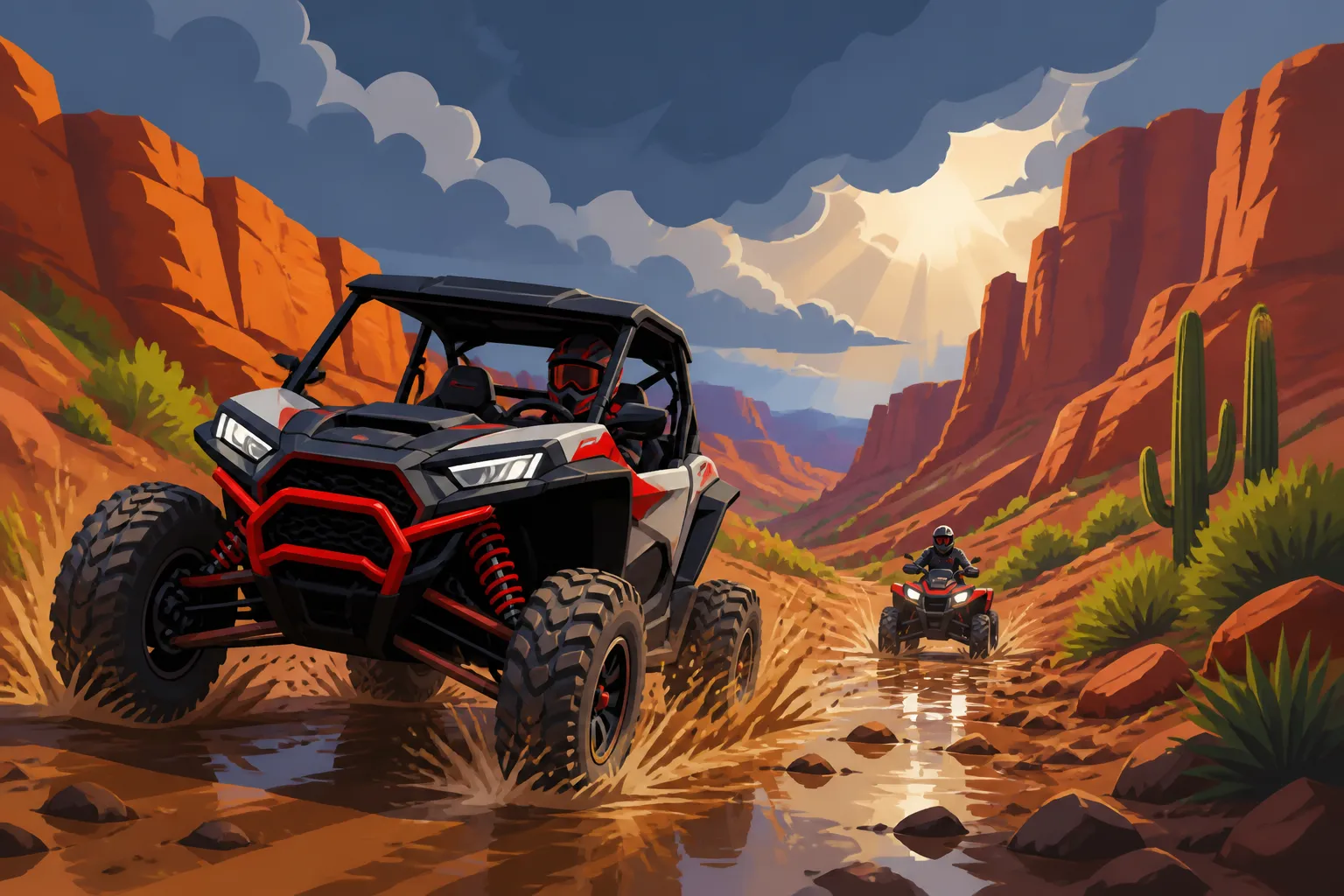
A wash may carry water from a storm that passed elsewhere in the surrounding watershed. That means blue sky overhead is not proof that a crossing is safe. Water can also rise or fall while you are riding, and desert channels can carry debris that is difficult to see from the trail.
Never drive into flowing water when you cannot confidently judge its depth, bottom, and current. If water is moving, muddy, rising, or covering the channel so you cannot see what lies beneath, stop well back from the edge and choose a safe alternative—or turn around. Do not follow another vehicle into a crossing just because it made it through; its machine, line, and timing may be different from yours.
The danger is not limited to dramatic, fast-moving floods. A shallow-looking crossing can conceal a soft bottom, a rut, rocks, or a sudden drop. An ATV or UTV can lose traction, stall, or be pushed off line. If you are unsure, treat the crossing as impassable. For a closer look at the broader hazard, read [Rain 20 Miles Away and a Flooded Canyon] and [Flash Flooding in a Desert Wash].
Mud and ruts can damage trails and machines
Some desert ground drains quickly; other patches stay slick or soft after the rain has stopped. Tires can lose grip on wet rock, while mud can cling to tires and underbody parts. A track that was straightforward in dry conditions may suddenly require more throttle or steering input—and that can make a small mistake harder to correct.
Riding through soft ground can also deepen ruts and widen a trail as drivers try to find a firmer line. Avoid making a new route around a muddy patch, and do not spin the tires to force your way through. If the trail is holding water or your machine is cutting deep grooves, turn back rather than making the damage worse. The same restraint applies to apparently dry margins: going around a puddle can crush vegetation and create a second track.
After wet riding, inspect the machine when it is safe to do so. Check tires for packed mud, look for debris around moving parts, and pay attention to changes in braking, steering, or engine temperature. If you have been through water, do not assume the machine is fine just because it restarted.
Conditions vary from one section to another
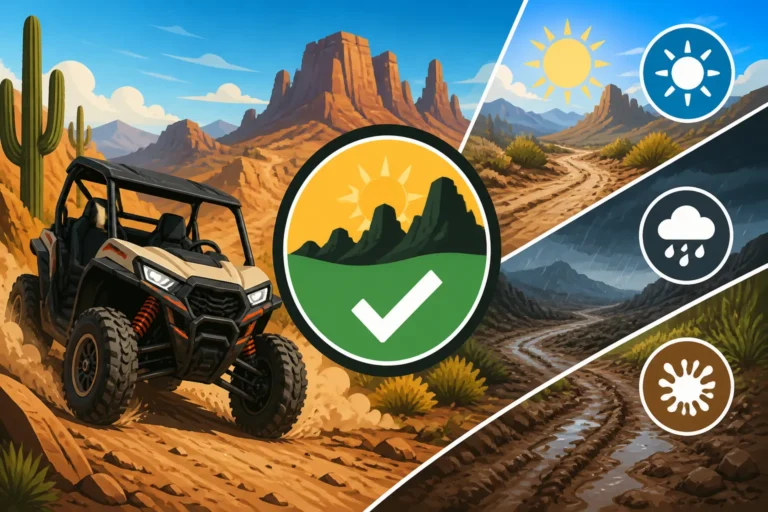
A storm can leave a short stretch of the route muddy while nearby rocky ground stays mostly firm. North-facing slopes, shaded areas, low spots, and drainage crossings may remain damp longer than exposed ground. Conditions can also change between the access point and the route you had planned to ride.
That variation makes a simple “it rained” or “it did not rain” forecast less useful than checking the route area and recent conditions as specifically as you can. A report from a rider who visited before the storm may not tell you much about today’s wash crossings. Even a report from the same day is only a snapshot: rain upstream or another burst of weather can alter conditions afterward.
How to check access and conditions before you go
A good trip plan starts before you load the machine. Confirm that the area is open, make sure you understand the permit and gate-access requirements, and build a backup plan in case rain makes the route unsuitable. Do not count on a permit, a gate code, or an app map to tell you that a trail is safe at the moment you arrive.
Confirm the permit, gate access, and area status
Bulldog Canyon access is managed, so check the current permit and gate requirements before traveling. Make sure your group understands which access point it is using and how the entry procedure works. Keep any required permit information available, and avoid sharing access details in a way that could compromise managed entry.
Then check for applicable closures or restrictions through the relevant land-management information before driving out. A trail or access point may be unavailable for reasons unrelated to rain, and conditions can prompt changes after you have planned your trip. The guide [Bulldog Canyon Permit and Gate Codes] covers the access question; for day-of planning, also use [Checking Arizona Trail Status Before You Drive].
An open gate does not mean every trail beyond it is passable. Likewise, being allowed to enter does not mean it is sensible to ride through a wash or muddy section. Treat access status and trail condition as two separate checks.
Use maps for orientation, not as a live safety report
An offline map can help you understand where you are, follow a planned route, and avoid getting turned around when cell service is unreliable. onX Offroad can be useful for reviewing mapped routes before leaving and keeping map information available offline. It should not be treated as a live report of flooding, mud, closures, or the condition of a particular crossing.
Before the trip, download the map area you expect to use and make sure everyone in the group knows how to read it. Look for a practical way back to your starting point, identify places where you could turn around, and share your intended route with someone who is not riding with you. A map is most useful when the group has already discussed what it will do if the planned line is blocked.
For a route with unsigned or confusing junctions, [Navigating an Unsigned Desert Two-Track] offers useful preparation advice. Keep in mind that mapped lines may not show every current obstacle, and a route displayed on a device is not automatically open or appropriate for your machine. Use onX Offroad as a navigation aid alongside current access information, not as a substitute for it.
Make a go-or-no-go decision before the drive
Before leaving, ask whether recent rain could affect the area, whether the forecast suggests more storms, and whether your group has the skill and equipment for wet conditions. If the weather is unsettled, consider choosing a different activity or postponing the ride rather than turning the outing into a test of judgment at the edge of a wash.
Use a simple decision guide:
| What you find | Sensible choice |
|---|---|
| No apparent recent rain, access confirmed, and routes appear firm | Ride cautiously, keep checking conditions, and stay on established routes |
| Recent rain but no obvious flooding, with uncertain trail reports | Shorten the plan, avoid washes and soft-looking sections, and be ready to turn back |
| Flowing water, rising water, deep mud, closed access, or active storm risk | Do not enter the affected route; postpone or choose another plan |
The table is a planning aid, not a guarantee. A condition can change while you are at the trailhead. If you cannot get a reliable picture of the area and the weather is questionable, the conservative choice is to wait. [Arizona Monsoon Season and Flash Flooding] explains why local-looking weather can still create hazards farther down a drainage.
How to ride more cautiously after rain
If you decide to ride, keep the first part of the outing conservative. The goal is not to prove that a route is passable; it is to gather enough information to make a sound decision while you still have an easy way back.
Start slowly and reassess at every low point
Ease into the ride instead of accelerating as though the surface were dry. Wet rock, loose soil, and slick patches can affect steering and braking differently from the terrain you know. Leave more space between machines so the rider ahead has room to slow down, stop, or choose another line without being pressured from behind.
At each drainage, dip, muddy patch, or change in surface, stop at a safe distance and look carefully. Check for water flow, hidden edges, deep tire cuts, and signs that the ground is giving way. Do not stand in a channel to inspect it if water could arrive from upstream. If a section does not look clearly manageable, turn back before the group commits to it.
Keep your group together, but do not crowd one another through an obstacle. A rider who hesitates should not be hurried by a line of machines behind them. If someone gets stuck, first check that the area is safe to approach and that helping will not put another person in a wash or unstable mud. [Recovery Gear for Deep Sand] can help with general recovery preparation, but recovery equipment does not make floodwater or an unsafe crossing suitable to attempt.
Stay on established routes and respect wet ground
Wet trails are especially vulnerable to damage. Avoid spinning tires, cutting around muddy spots, or creating a new track to bypass an obstacle. If the established route is too soft to ride without carving deep ruts, the responsible choice is to stop and return the way you came if that route remains safe.
A detour is not always a harmless workaround. It may cross private land, sensitive terrain, a closed route, or ground that is even less stable than the trail. Keep to routes you are permitted to use and follow closures or posted directions. If a section is blocked, do not assume that an unmarked gap nearby is an approved alternative.
Take note of how the machine is handling. If steering feels unpredictable, tires are packed with mud, or the trail surface is deteriorating, pause and reassess rather than adding speed. Your ability to reverse course is part of the plan, not a failure of the ride.
Carry essentials and plan for weak cell service
Do not rely on being able to call for help from every part of the area. Tell someone your route and expected return, carry enough water for the group, and bring basic first-aid and recovery supplies suited to your machines. Keep navigation available offline, and make sure riders know where the group is headed if devices lose signal or batteries run down.
A useful plan also covers the possibility of a delay. If a machine becomes stuck, the group may need to wait while assessing the situation, or travel slowly back to the access point. Carrying extra water and allowing more time can prevent a manageable setback from becoming a stressful one. See [Water Planning for an Arizona Trail Day] and [Cell Dead Zones in the Arizona Backcountry] for more on preparing for desert travel.
Do not attempt a risky recovery simply to keep the schedule. If the machine is in or near a wash, or the weather is changing, move people to a safe location before deciding what to do next. If you cannot recover safely, seek appropriate assistance rather than putting another rider in danger.
What to do if rain catches you on the route
Rain during the ride is a reason to stop and reassess, not a cue to hurry through low ground. Storms can build quickly in Arizona, and the safest response depends on where you are, what the terrain is doing, and whether water is moving toward your route.
Leave washes and low ground when storms threaten
If you hear thunder, see a storm approaching, or notice water beginning to flow, move away from washes and low-lying channels as safely as possible. Do not wait in a drainage to see whether the water rises. Avoid trying to cross a flowing channel, even if it appears shallow or another vehicle has passed through.
Choose stable ground away from the channel, and do not park where runoff could collect. If you are unsure which direction offers safer ground, consult your map and use the route you already identified during planning. Be especially cautious about entering a narrow canyon or low area while a storm is active anywhere upstream.
Never assume that the quickest route back is the safest. A short cut across a wash can turn a manageable delay into a dangerous situation. The guidance in [Arizona Monsoon Season and Flash Flooding] and [Flash Flooding in a Desert Wash] is useful to review before a ride, not just after the weather changes.
Turn around early rather than waiting for proof
Riders sometimes keep going because the rain has stopped, the trail is familiar, or the group has already invested time in getting there. Those reasons do not make a wet crossing safe. Turn around when conditions become uncertain—not only when they become obviously dangerous.
If you have a safe, established route back and it is not threatened by water or deteriorating terrain, retrace it carefully. If the return route is also unsafe, move to stable ground away from washes and follow your group’s emergency plan. Do not split up to search for a better way out without communication and a clear plan.
After the ride, share accurate observations with your group, especially if a crossing or access route was affected. Avoid presenting a brief personal observation as proof that the area is safe for everyone; rain, machine type, route choice, and timing all matter. A helpful report describes what you encountered and when, while encouraging the next rider to check current conditions independently.
Planning a Bulldog Canyon ride after rain
The most reliable approach is to separate three questions: Is access allowed? Is the route open? Are conditions safe for your group today? Check each one, prepare an offline route and turnaround plan, and be willing to cancel or shorten the ride. onX Offroad can support navigation planning, but your on-the-ground judgment and current land-management information must guide the final decision.
After rain, avoid flowing water, deep mud, and any route that would require damaging the trail to get through. Take extra care in washes, keep the group together, and turn around early when the conditions are uncertain. A missed ride is disappointing; being stranded in a flooded or unstable desert drainage is far worse.
Disclaimer
This article is for general informational purposes only and does not constitute professional advice. Laws, prices and regulations vary by location and change over time. Consult a qualified professional for guidance on your specific situation.