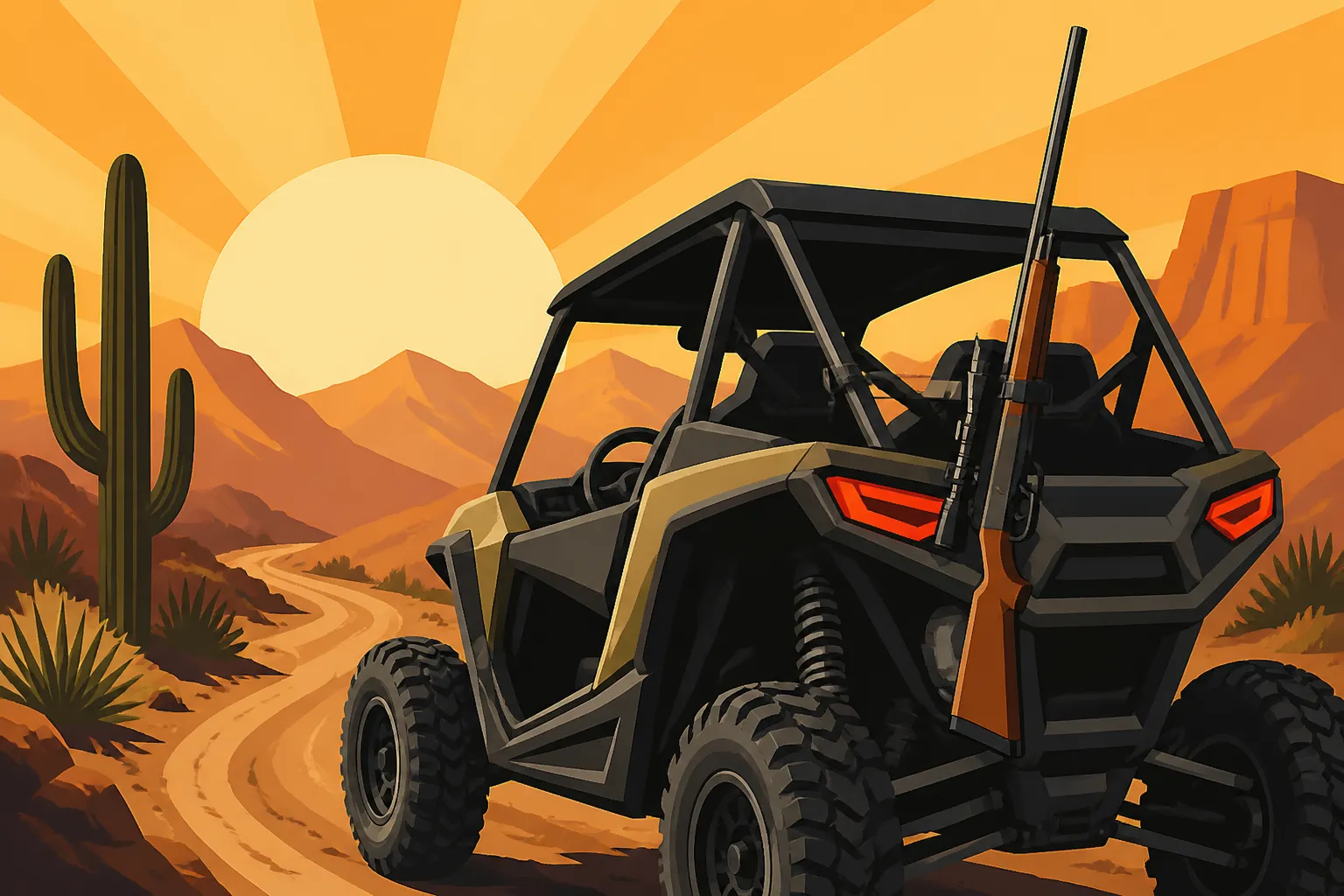
Carrying a Rifle on an OHV in Arizona
Riding the vast and diverse landscapes of Arizona on your ATV or UTV is an incredible experience, but for many enthusiasts, it's also a chance to combine their love for off-roading with other outdoor pursuits, like hunting or target shooting. One question that comes up a lot for Arizona riders is about the legality and best practices for carrying a rifle on an off-highway vehicle. It's not as simple as just tossing it in the bed of your side-by-side, and misunderstanding the rules can lead to serious trouble. This guide will walk you through the nuances of Arizona law, safety considerations, and common-sense approaches to carrying a rifle on your OHV, ensuring you stay legal and safe on your desert adventures.
The Basics of Carrying Firearms on OHVs in Arizona
Arizona is well-known for its strong Second Amendment protections and relatively permissive firearm laws. This generally extends to carrying firearms in the backcountry, including on or in your off-highway vehicle. However, "permissive" doesn't mean "anything goes." There are still important distinctions to understand, especially concerning different land jurisdictions and how your OHV is viewed under the law.
Understanding Arizona's Open Carry Laws for Firearms
Arizona is an "open carry" state, meaning that individuals 18 years or older who are not prohibited from possessing a firearm can generally carry a handgun or long gun openly without a permit. This applies broadly across the state, and for many, an OHV is seen as an extension of their person or vehicle when it comes to open carry. You're simply using your machine to traverse the landscape while exercising your right to carry. So, if you're on public lands and legally allowed to possess a firearm, you can typically have your rifle with you, openly displayed on your OHV.
However, it's crucial to remember that this general rule has exceptions. For instance, carrying a firearm, even openly, is restricted in certain places like federal buildings, polling places, schools, and within the secured areas of airports. While you're unlikely to encounter many of these directly on the trail, it's important to be aware of how close you might be to certain "no-go" zones, especially if your ride takes you near the edge of a small desert town or a populated recreation area. Always assume that city limits or specifically designated park areas might have more restrictive local ordinances, so check before you venture into those spaces with a visible firearm.
Federal vs. State Land Rules
One of the biggest areas of confusion for many riders is the patchwork of land ownership and management in Arizona. We have vast tracts of Bureau of Land Management (BLM) land, U.S. Forest Service (USFS) property, Arizona State Trust Land, and private holdings, not to mention tribal lands. The good news is that for the most part, Arizona's firearm laws apply consistently across most federal and state-managed public lands. This means if you're riding on [Arizona Rules on Forest Service Roads] or [Arizona Rules on BLM Roads], the general open-carry provisions apply.
However, specific federal agencies might have their own regulations regarding target shooting or discharge of firearms, even if carrying them is allowed. For example, some areas might be designated "no shooting" zones due to proximity to campgrounds, residences, or sensitive wildlife habitats. It's always a good idea to check local regulations for target shooting if that's your intent. For simply transporting a rifle on your OHV while traversing these lands, Arizona state law generally governs. State Trust Land is a bit different; while carrying a firearm is generally allowed, you must have an Arizona State Trust Land recreational permit to recreate on these lands, which covers activities like OHV riding, hiking, and yes, even carrying a firearm while you're there. Always know what kind of land you're on to avoid unintended violations.
Specific Considerations for Rifles on OHVs
While the legality of carrying a rifle on an OHV in Arizona is generally straightforward, the practicalities of doing so safely and responsibly require careful thought. Your machine is going to shake, rattle, and roll, and your rifle needs to be protected, both for its longevity and your safety.
Safety and Securing Your Rifle on an OHV
The absolute top priority when carrying any firearm on an OHV is safety. This means ensuring the rifle is unloaded, the chamber is clear, and the safety is engaged before you even think about mounting it to your machine or placing it in a scabbard. Loose ammunition should be stored separately, ideally in a secure container away from the firearm itself. The desert can be rough, and an unsecured or improperly handled loaded firearm is a recipe for disaster, not adventure.
Beyond the "ready-to-fire" state, you need to consider how your rifle will be physically secured. Bouncing over washes, traversing rocky trails, and even leaning into turns can send unsecured items flying. This isn't just a risk to your expensive rifle; it's a hazard to you and anyone riding with you. Invest in quality gun scabbards, hard cases, or specialized mounts designed for OHVs. Companies like SuperATV offer a range of robust rifle and gun mounts that integrate seamlessly into many UTV roll cages and ATV racks. These mounts are designed to hold your rifle firmly, protecting it from impacts and keeping it from shifting or falling out. A well-designed scabbard also protects your rifle from the harsh desert environment – dust, dirt, moisture from unexpected rain showers, and abrasive branches are all hazards that can damage your firearm if it's left exposed. Think about protecting your optics, too, as a bump could knock your scope out of zero.
Loaded vs. Unloaded: What Arizona Law Says (and Implies for OHVs)
Arizona law generally allows you to carry a loaded firearm in your vehicle, including a passenger car. The critical question often arises about whether an OHV is considered a "vehicle" in the same way, especially when you're out on the trails. For general transportation on public land, carrying a loaded, openly visible rifle on your OHV is typically permissible under Arizona's open carry statutes. However, this is where discretion and common sense come into play, particularly if you are in transit to or from a specific hunting area.
While state law generally permits a loaded firearm in a vehicle, many hunters still choose to transport their rifles unloaded and cased until they reach their designated hunting spot. This isn't necessarily a legal requirement for general OHV travel, but it is a widely accepted practice for safety and to avoid any perception of "hunting from a vehicle" which is illegal (more on that in the next section). When passing through campgrounds, staging areas, or near other groups of riders, having a rifle visibly unloaded in a secure mount or case can also help de-escalate any potential concerns from others who might not be as familiar with firearm laws. Always be mindful of the context and environment you're in. For detailed hunting-specific rules, especially regarding loaded magazines, you'll want to review the Arizona Game and Fish Department regulations, which we'll touch on next. [Arizona OHV Rules During Deer Season] will give you a good start.
Hunting-Specific Regulations and Carrying a Rifle
For many, the primary reason to carry a rifle on an OHV is for hunting. Arizona offers incredible hunting opportunities, but combining hunting with OHV use comes with very specific and critical regulations you absolutely cannot ignore.
Hunting from an OHV: A Big No-No
Let's be crystal clear about this: it is strictly illegal to shoot at or attempt to take any wildlife from a motorized vehicle, including an OHV, in Arizona. This isn't just about shooting while driving; it also applies if the engine is running or even if you're merely resting against the vehicle. The intent of the law is to ensure fair chase and prevent unethical hunting practices. An OHV is meant for transportation to your hunting area, not as a mobile hunting blind or shooting platform.
This rule means you cannot spot game from your side-by-side and then immediately grab your rifle and shoot from it. You must dismount, move a reasonable distance away from the vehicle, and ensure the engine is off before you shoulder your rifle and take a shot. The definition of "reasonable distance" can sometimes be debated, but the spirit of the law is to separate the act of hunting from the use of the vehicle. Game wardens take this rule very seriously, and violations can result in hefty fines, license revocation, and seizure of your equipment, including your rifle and even your OHV. So, use your machine to get to your prime hunting location, then become a hunter on foot.
Transporting a Rifle During Hunting Season
When you're out during hunting season, the focus shifts slightly from general open carry to the specific requirements for transporting a hunting weapon. While a rifle can generally be carried openly on an OHV, many hunters choose to transport their rifles unloaded and cased, especially when traveling on roads, near developed areas, or when the hunt is not actively underway. This provides an additional layer of safety and avoids any potential misinterpretation by others or law enforcement that you might be hunting from your vehicle.
Arizona Game and Fish regulations typically require that when transporting a firearm in a vehicle (which includes OHVs) on a public highway, road, or open public land for hunting purposes, the firearm must be unloaded. "Unloaded" generally means no round in the chamber and no magazine attached to the firearm with rounds in it, although a loaded magazine can be carried separately. Many hunters opt for a hard case or a soft scabbard mounted securely to their UTV or ATV. This protects the rifle from the elements and the rigors of the trail while clearly signaling that it's being transported, not actively used for hunting. When you finally reach your hunting camp, you'll want to set up your gear and get ready for the stalk. [Riding to a Hunting Camp in Arizona] can be part of that plan. Always have your hunting license, tags, and any necessary permits readily accessible.
Common Pitfalls and Best Practices
Navigating the rules for carrying a rifle on your OHV in Arizona means being aware of the less common, but equally important, situations that can trip you up. A little foresight can prevent a lot of headaches.
Tribal Lands and Private Property: Unique Rules
Arizona is home to numerous Native American tribal nations, and their lands are sovereign territories. This means that tribal laws, not Arizona state laws, govern what you can and cannot do on their land. Never assume that Arizona's open carry or OHV rules apply on tribal lands. Access to tribal lands for recreation, including OHV riding or carrying firearms, often requires explicit permission, special permits, and adherence to their specific regulations. Violating tribal laws can lead to severe penalties, including fines, impoundment of your vehicle, and even arrest by tribal law enforcement. Always research and contact the specific tribe's game and fish department or land management office before you even consider entering their territory with an OHV or firearm. [Arizona Rules on Tribal Land] are distinct and must be respected.
Similarly, even if you have permission to ride on private property, the landowner's rules are paramount. While [Do You Need a Decal on Private Arizona Land?] is a different question, the landowner sets the rules for firearms. Some landowners may prohibit firearms entirely, or have specific rules about how they can be carried or discharged. Always ask for clarification from the property owner before bringing a rifle onto private land, even if you're just passing through.
Encountering Law Enforcement with a Rifle on Your OHV
It's a common scenario: you're out on the trail, enjoying your ride, and you come across a game warden, a county sheriff's deputy, or a Forest Service ranger. If you're carrying a rifle on your OHV, your interaction with them should be handled with respect and transparency. The moment you are stopped or hailed by law enforcement, keep your hands visible and calmly inform the officer that you have a firearm on your machine. Tell them where it is located. Do not reach for your firearm or make any sudden movements. Simply state, "Officer, I have a rifle secured on my side-by-side," or "My rifle is in the scabbard on my ATV."
Cooperate fully with any instructions they give you. They may ask you to step off your machine, or they might ask to inspect the rifle to ensure it's unloaded if you're in a hunting area. Be polite, answer their questions truthfully, and provide any requested documentation, such as your OHV registration, driver's license, and if applicable, your hunting license and tags. This courteous and direct approach will go a long way in ensuring a smooth and uneventful encounter. Remember, their job is to enforce the law and ensure public safety, and your calm demeanor helps them do that. Knowing [What an Arizona Ranger Asks a Rider For] in advance can make these interactions much easier.
Remember, responsible OHV riding in Arizona includes knowing the laws surrounding firearms. A bit of preparation, the right gear (like a good SuperATV gun mount), and a respectful attitude can ensure your adventures are both thrilling and within legal bounds.
Disclaimer
This article is for general informational purposes only and does not constitute professional advice. Laws, prices and regulations vary by location and change over time. Consult a qualified professional for guidance on your specific situation.