The Horn Arizona Wants Audible at 200 Feet
Hitting Arizona's incredible trails with your ATV or UTV is an experience like no other, but what happens when the trail ends, and you need to connect to another section via a paved road? Many riders feel a real headache trying to decipher the often-confusing rules about making their off-highway vehicle street-legal in Arizona, especially when it comes to specific requirements like the horn. This comprehensive guide is here to cut through the noise, explaining exactly what Arizona expects for your OHV to legally share the road, with a special focus on that all-important horn.
Understanding Arizona's Street-Legal OHV Requirements
The dream of seamlessly transitioning from a dusty desert trail to a paved county road, or even just popping into town for a quick bite, is a strong one for many Arizona OHV enthusiasts. But the reality of achieving "street legal" status for your ATV or UTV can feel like navigating a maze of regulations. It's not just about slapping a license plate on your machine; it's about making sure it meets a specific set of safety and equipment standards set forth by the state. This means a significant difference in how your machine is equipped compared to one used exclusively on trails or private property.
Why Street Legal? The Benefits and Frustrations
The advantages of having a street-legal OHV are clear. Imagine riding from your campsite directly to the trailhead, or using paved connectors to link up different trail systems without having to load your machine onto a trailer every time. It opens up a whole new world of adventure and convenience, reducing the logistical headaches that often accompany off-road trips. You gain immense flexibility, allowing you to explore areas that might otherwise be inaccessible without a tow rig. This freedom is a huge draw, transforming your OHV from a weekend-only toy into a more versatile utility vehicle.
However, the path to street legality isn't always smooth. The initial investment in parts and labor can be substantial, and the process of ensuring every component meets Arizona's precise specifications can be frustrating. Many riders express exasperation with the technicalities, like figuring out the exact decibel level for a horn or the specific placement of mirrors. It often feels like you're jumping through hoops, trying to guess what will pass inspection. The worry of spending money on modifications only to find they don't quite meet the mark is a common concern, leading to a lot of research and sometimes, trial and error.
Arizona MVD's Definition of a Street-Legal Machine
For your ATV or UTV to be considered street-legal in Arizona, it must meet specific criteria defined by the Arizona Motor Vehicle Division (MVD). This isn't just a suggestion; it's a legal requirement that carries consequences if ignored. Essentially, the MVD wants to ensure that an OHV operating on public roads can do so safely and predictably, just like any other motor vehicle. This means equipping it with components that allow it to signal, illuminate, and be seen and heard by other drivers, as well as providing adequate safety for its occupants.
The core idea is that your OHV must be comparable in function and safety features to a standard passenger car or motorcycle when on the pavement. This involves everything from proper lighting and signaling to braking and, crucially, a horn. The state's regulations are designed to minimize risks for both the OHV operator and other motorists on shared roadways. Neglecting any of these requirements can lead to citations, fines, and even the immediate cessation of your ride, effectively derailing your day in the desert. You can dive deeper into the full list of requirements in our guide on [What Arizona Requires on a Street-Legal Machine].
The All-Important Horn: What Arizona Demands
When it comes to making your OHV street legal, many riders initially focus on headlights, taillights, and turn signals. While these are certainly crucial, the horn often gets overlooked or underestimated. Yet, Arizona law is quite specific about this vital safety device, and for good reason. On a busy road, your horn is often your primary way to alert other drivers to your presence or to a potential hazard, especially given the smaller profile of many ATVs and UTVs compared to cars and trucks. It's not just a courtesy; it's a critical piece of defensive driving equipment.
Audibility from 200 Feet: What This Actually Means on a UTV
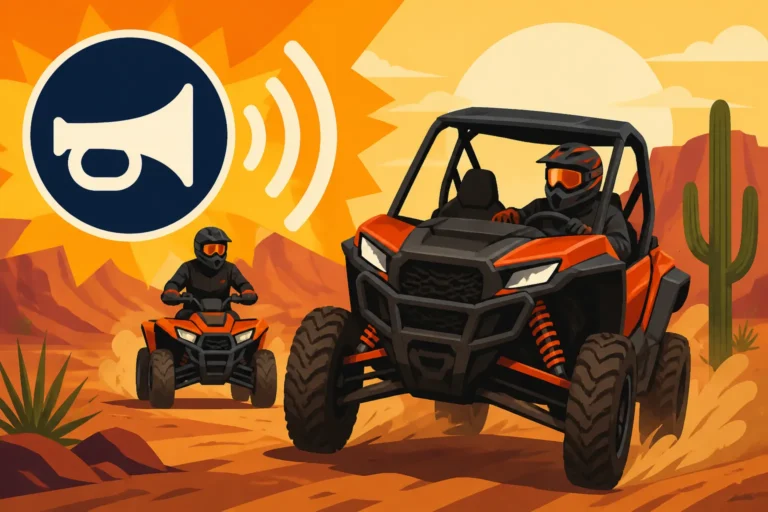
Arizona Revised Statutes clearly state that a motor vehicle horn "shall be capable of emitting sound audible under normal conditions from a distance of not less than 200 feet." This isn't just a suggestion; it's a measurable standard. For many stock ATVs and UTVs, the factory horn, if present at all, might be a small, unassuming beep more suited for warning a squirrel than a full-sized truck. The challenge for OHV owners is to upgrade to a horn that genuinely projects its sound effectively over a significant distance, even with ambient road noise, wind, and the sound of your own engine.
What does "audible under normal conditions" really mean? It implies that on an average day, with typical traffic sounds and no extreme weather interfering, a person standing 200 feet away should clearly hear your horn when activated. This isn't about being ear-splittingly loud, but about having enough clear projection to cut through typical background noise. It's often where many aftermarket horns fall short, despite claims of high decibels. A horn with a higher frequency and clear tone often performs better at distance than one that is simply very loud but muffled. This requirement highlights the need for a dedicated, robust horn system, not just a novelty item.
Choosing the Right Horn for Your OHV
Selecting a horn that meets Arizona's 200-foot audibility requirement requires a bit of thought beyond just grabbing the first one you see. You'll want something durable enough to withstand the elements – dust, mud, water, and vibration – that come with off-road use, but also powerful enough for road safety. Many riders opt for aftermarket automotive horns, which are designed for road use and generally meet or exceed the audibility standard. Air horns are another popular choice, offering a distinct and powerful sound that easily meets the requirement, though they do require an air compressor and reservoir, adding to complexity.
When you're shopping, look for horn kits specifically designed for UTVs and ATVs, as these often come with all the necessary wiring, switches, and mounting hardware, simplifying installation. Companies like SuperATV offer universal horn kits that are designed with OHV riders in mind, ensuring they can stand up to harsh conditions while still providing the necessary volume. It's also wise to check reviews and even listen to sound clips if possible to get a sense of the horn's projection and tone. Remember, a cheap, flimsy horn might save you a few dollars upfront, but it could lead to a costly citation if it doesn't meet the legal requirement, or worse, compromise your safety on the road.
Beyond the Horn: Other Mandatory Street-Legal Components
While the horn is non-negotiable, it's just one piece of the street-legal puzzle. Arizona's MVD has a comprehensive list of equipment that must be present and fully functional on your OHV before it can legally cruise on public roads. These requirements are all about enhancing safety, visibility, and communication with other road users. It's about transforming your off-road beast into a polite, predictable, and safe vehicle for shared spaces. Getting caught without any of these crucial elements can not only result in fines but also pose a significant risk to you and others.
Lighting Up the Road: Headlights, Taillights, Brake Lights, and License Plate Illumination
Proper lighting is paramount for any vehicle sharing the road, and your street-legal OHV is no exception. You'll need at least one, but preferably two, functioning headlights that illuminate the road ahead. Arizona specifically requires headlights to be visible from 500 feet, which is covered in more detail in [Arizona's 500 Foot Headlight Rule]. These can't just be any old work lights; they need to be properly aimed and provide sufficient illumination without blinding oncoming traffic. Many stock UTVs come with adequate headlights, but ATVs might require an upgrade.
Equally important are the rear lights. Your OHV must have at least one taillight, visible from 500 feet to the rear, and dedicated brake lights that illuminate when the brakes are applied. For nighttime driving, a white light must illuminate your license plate, making it visible from 50 feet. And, of course, turn signals on both the front and rear are essential for communicating your intentions to other drivers. These need to be clearly visible from both sides, day or night. All these lighting components work together to ensure your machine is seen and understood by everyone else on the road, dramatically reducing the risk of collisions. Many riders find that aftermarket LED kits offer excellent brightness and durability for all these lighting needs.
Visibility and Safety: Mirrors, Windshields, and Reflectors
Being seen isn't enough; you also need to see what's around you. Arizona requires at least one rearview mirror, mounted to allow the driver to see a minimum distance of 200 feet to the rear. Most street-legal conversion kits include a robust rearview mirror, and many riders opt for two side mirrors for enhanced visibility, much like a car. These mirrors need to be securely mounted and not vibrate excessively, especially on rougher roads. You can find more specific guidance in [Mirror Placement on a Street-Legal UTV].
While not always explicitly required for all OHVs (depending on the type and original design), a windshield is highly recommended for street use to protect against debris, wind, and insects, much like a motorcycle would require eye protection. For machines not originally equipped with a full windshield, or if you prefer an open-air experience, adequate eye protection (goggles or a face shield) is mandatory. Additionally, the machine should have red reflectors visible to the rear, and often amber reflectors on the sides, to further increase its passive visibility to other drivers, especially at dusk or dawn. These small, often overlooked details are crucial for comprehensive road safety.
Mufflers, Spark Arrestors, and Emissions: Environmental and Noise Considerations
Arizona takes noise pollution and environmental concerns seriously, which extends to street-legal OHVs. Your machine must be equipped with a muffler that is in good working order and effectively prevents "excessive or unusual noise." This means no ridiculously loud, straight-piped exhausts that can disturb communities and wildlife. While specific decibel limits can vary slightly, the general rule is that your OHV should not be louder than a typical passenger vehicle. Aftermarket exhaust systems designed for performance might need to be checked to ensure they still comply with noise regulations. Our article on [Arizona Muffler and Noise Limits] has more details.
Furthermore, a USDA-approved spark arrestor is a mandatory component for any OHV operating on public or state trust lands in Arizona, regardless of street-legal status. This device prevents hot carbon particles from escaping the exhaust and potentially igniting wildfires, which are a major concern in Arizona's arid environment. For those making their machine street-legal, an emissions test may also be required, particularly if you're in the Phoenix or Tucson metro areas. This ensures your OHV isn't contributing excessive pollutants to the air, aligning with the state's clean air initiatives. This is a crucial step that often catches riders by surprise, but you can learn more about it in [Emissions Testing and Street-Legal Machines].
Seats, Seatbelts, and Roll Cages: Passenger Safety
Finally, passenger safety is paramount. If your OHV is designed to carry passengers, it must have adequate seating for each occupant. Each seat must be equipped with a functional seatbelt. This is non-negotiable. Many UTVs come standard with multiple seats and seatbelts, but some ATVs or modified machines might need additions to legally carry passengers on the street.
Additionally, most UTVs come from the factory with a robust roll cage. While Arizona law doesn't always explicitly mandate a roll cage for all street-legal OHVs in the same way it does for a car, having one is a critical safety feature that significantly reduces the risk of serious injury in the event of a rollover. For machines that are built to be street-legal, ensuring the integrity and proper attachment of any roll-over protective structures (ROPS) is a wise and often necessary step for safe road use. It's all about providing the same level of occupant protection you'd expect in any other vehicle on the road.
Registering and Insuring Your Street-Legal OHV in Arizona
Once your ATV or UTV is properly outfitted with all the required street-legal components, the next hurdle is the paperwork. This involves navigating the Arizona MVD system to officially register your machine for road use and secure the necessary insurance. This administrative phase is just as critical as the mechanical modifications, as even a perfectly equipped OHV can't legally hit the pavement without the right documentation. It's often where the real patience of OHV owners is tested, as MVD processes can sometimes feel a bit cumbersome.
Getting Your MC Plate
The biggest indicator that your OHV is street-legal in Arizona is the issuance of an "MC" (motorcycle) license plate. Unlike the standard "RV" (recreational vehicle) plate that many off-highway-only machines receive, the MC plate signifies that your ATV or UTV meets all the criteria to be operated on public roads. To obtain this, you'll need to submit an application to the Arizona MVD, often after a visual inspection to confirm all required street-legal equipment is present and functional. This inspection can be performed by an MVD agent or a certified third-party provider.
The process typically involves presenting your vehicle's title, proof of insurance (which we'll discuss next), and payment for registration and plate fees. It's crucial that your vehicle's documentation, particularly the Certificate of Title, accurately reflects the vehicle's information. Any discrepancies could delay the process. Once issued, your MC plate must be securely attached to the rear of your OHV, clearly visible, and illuminated at night. Getting this plate is the culmination of all your hard work in modifying your machine, giving you the green light to explore more of Arizona's diverse landscape. You can learn more about this in [Getting an MC Plate for a Side-by-Side].
Insurance Requirements for Road Use
Just like any other vehicle on Arizona's public roads, your street-legal ATV or UTV must be properly insured. This isn't just a recommendation; it's a mandatory legal requirement. The state of Arizona mandates minimum liability insurance coverage to protect other drivers and their property in the event you are at fault in an accident. These minimums are often referred to as 25/50/15, which translates to:
- $25,000 for bodily injury liability per person
- $50,000 for bodily injury liability per accident
- $15,000 for property damage liability per accident
These are minimums, and many riders choose to carry higher limits for greater protection, considering the potential costs associated with accidents. It's important to note that your existing car insurance policy typically will not cover your OHV for street use. You'll need a specific ATV/UTV insurance policy, often from a specialized provider. Shop around and compare quotes, ensuring your chosen policy meets Arizona's minimums and provides the coverage you need. Without valid proof of insurance, your application for an MC plate will be denied, and operating your street-legal OHV on public roads could lead to significant fines and penalties. More information on this can be found in [Arizona Insurance Minimums for Road Riding].
Here's a quick overview of essential street-legal components for Arizona:
| Component | Arizona Requirement | Common OHV Stock Situation |
|---|---|---|
| Horn | Audible from at least 200 feet | Often weak or non-existent |
| Headlights | At least one, visible from 500 feet, properly aimed | Usually present, but check aiming |
| Taillights & Brake Lights | At least one taillight visible from 500 feet, dedicated brake lights | Often combined, need to ensure clear brake light function |
| Turn Signals | Front and rear, clearly visible | Rarely stock, requires aftermarket kit |
| License Plate Light | Illuminates license plate from 50 feet | Requires aftermarket wiring |
| Rearview Mirror | At least one, view 200 feet to rear | Often absent or too small |
| Muffler | Prevents excessive/unusual noise | Check noise output of stock/aftermarket |
| Spark Arrestor | USDA-approved (for all public land riding) | Usually stock, but verify |
| Seatbelts | For all occupants | Standard on UTVs, rarely on ATVs |
| Eye Protection | Mandatory for driver/passengers if no windshield | Essential for open cabins |
| Reflectors | Red to rear, amber to sides (recommended) | Often minimal, add more for visibility |
| Tires | DOT-approved (required for street-legal) | Many stock tires are not DOT |
Where You Can (and Can't) Ride Your Street-Legal OHV in Arizona
So, you've done all the hard work: your machine is decked out with every necessary component, you've got your MC plate, and your insurance is squared away. Now for the exciting part – hitting the road! However, "street-legal" doesn't necessarily mean "any-road-legal." Arizona has specific rules governing where even a fully compliant OHV can and cannot operate. Understanding these nuances is critical to avoid fines, ensure your safety, and respect local ordinances. It's not a free pass to drive everywhere; it's a privilege with specific boundaries.
City and County Road Access: Understanding Local Ordinances
The good news is that generally, a properly registered street-legal OHV can operate on most county roads and city streets in Arizona. This is a huge benefit, allowing you to connect trails, access services, or simply enjoy a scenic drive through a town. However, there's a significant caveat: local municipalities (cities and towns) retain the authority to restrict or prohibit OHV use on specific streets or within certain areas. This means that while the state may deem your machine street-legal, a local ordinance could still limit where you can ride within their jurisdiction.
It's absolutely vital to check with the specific city or town you plan to ride through. Many towns, especially those with residential areas, may have stricter rules about noise, speed, or even outright prohibitions on certain streets. For instance, a historic downtown area might be off-limits, or there might be specific hours of operation for OHVs on paved roads. Always look for posted signs, or better yet, check the local city's official website or call their municipal offices. Failing to do so could lead to an unexpected citation, even if you genuinely believed you were compliant. Our article [Which Arizona Roads Are Open to OHVs] provides a broader overview of access.
Highway Crossings and Interstates: Strict Limitations
Here's where the "street-legal" designation hits its biggest limitations. Even with an MC plate, you absolutely cannot operate your ATV or UTV on interstate highways (like I-10, I-17, or I-40) or on any state highway where the posted speed limit is greater than 45 miles per hour, unless specifically authorized. These high-speed, multi-lane roads are simply not designed for the characteristics of an OHV, and mixing them with fast-moving traffic is incredibly dangerous.
However, you can cross most highways at an intersection, provided the crossing is made in a safe and direct manner. You can also ride on the shoulder of a highway for short distances to access a trail or another road, but this should be done with extreme caution and only when absolutely necessary. The rule of thumb for highways is generally: if it's high speed, stay off it. Always err on the side of caution and look for alternative routes or trail connectors that avoid major highways. Our guide on [Crossing an Arizona Highway on a Machine] delves into the specifics of these rules.
Common Misconceptions and Pitfalls
One of the biggest pitfalls for riders with newly street-legal OHVs is assuming that because they have an MC plate, they can now treat their machine exactly like a car or motorcycle. This isn't true. As discussed, local ordinances and highway restrictions still apply. Another common misconception is about speed limits; while your OHV might be capable of higher speeds, you must adhere to the posted speed limits for the road you are on. In some areas, county roads might have lower default speed limits for OHVs.
Another area of confusion often revolves around passengers, especially children. While your machine might have seats and seatbelts for multiple occupants, all passengers must still comply with Arizona's age and helmet laws, particularly for those under 18. [Arizona Helmet Rules for Riders Under 18] outlines these requirements clearly. Also, remember that even if your machine is street-legal, you'll still need to carry your registration, proof of insurance, and your driver's license with you, just as you would in any other vehicle. Don't let your excitement overshadow your diligence in understanding and following all the rules.
Disclaimer
This article is for general informational purposes only and does not constitute professional advice. Laws, prices and regulations vary by location and change over time. Consult a qualified professional for guidance on your specific situation.