Do You Carry Papers on an Arizona Trail?
There's nothing quite like hitting the Arizona trails, feeling the sun on your face and the rumble of your ATV or UTV beneath you. But that blissful feeling can vanish in a heartbeat if a ranger or sheriff pulls you over and asks for your paperwork, only for you to realize you've left it all back in the truck. This guide is here to walk you through exactly which documents you should have with you when you're out riding, why they're important, and how to keep them safe on the trail, helping you avoid unnecessary stress and potential fines.
Why Carrying Your OHV Papers on the Trail Is Crucial
It might seem like a hassle to carry documents when all you want to do is escape into the desert, but trust me, it’s a non-negotiable part of responsible riding in Arizona. Think of it less as a burden and more as your riding insurance for peace of mind. Without the right papers, a simple trail stop can turn into a major headache, spoiling your whole day and potentially costing you money.
Legal Requirements and Ranger Stops
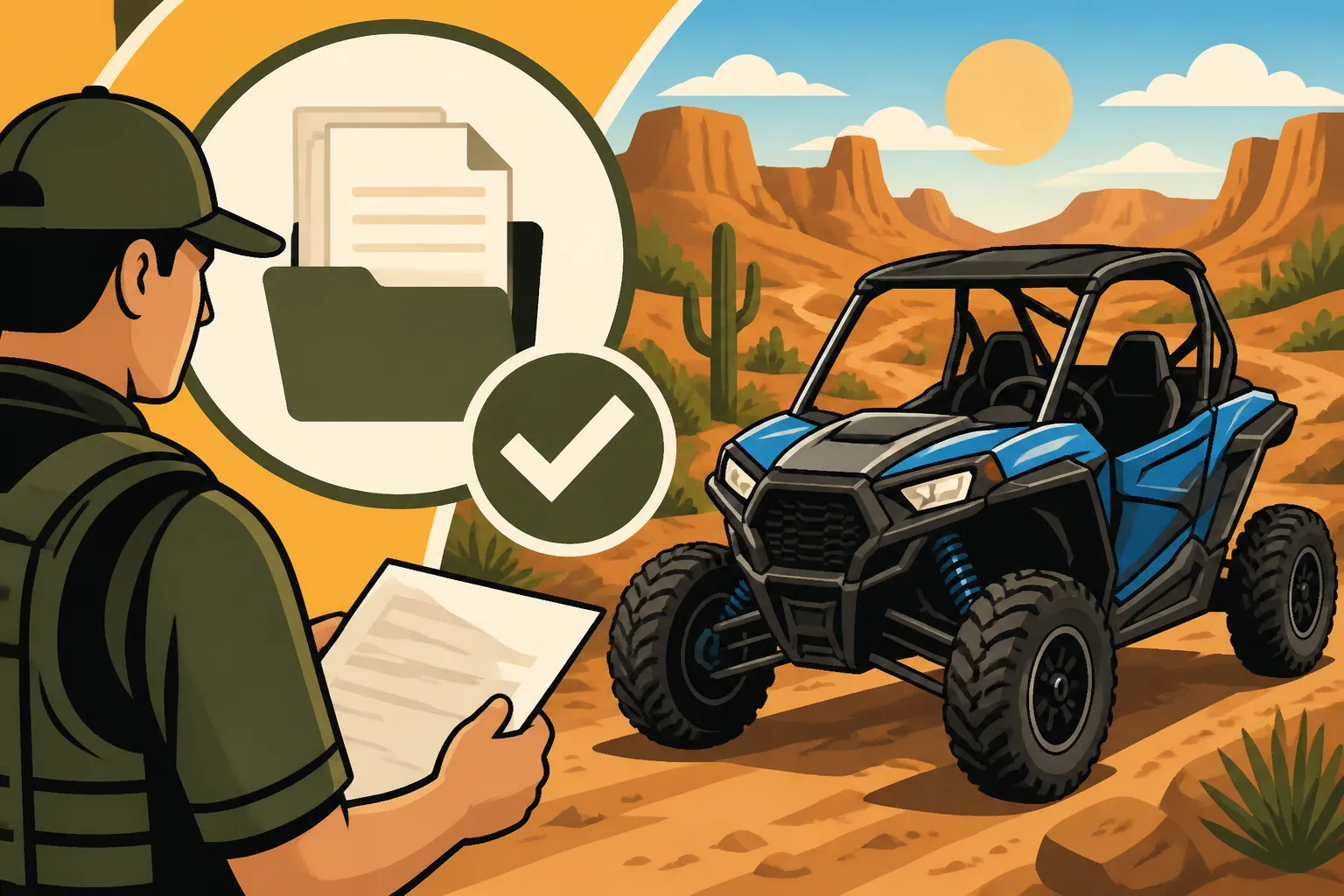
Arizona law is pretty clear about what you need to have when operating an off-highway vehicle on public land. These requirements aren't just suggestions; they're enforceable regulations designed to ensure that vehicles are properly registered, titled, and that operators are legitimate. If you're stopped by a Game and Fish officer, a Forest Service ranger, or a county sheriff's deputy, one of the first things they'll ask for is proof that you're operating your machine legally. This includes validating that your machine is properly registered and that you, as the operator, are authorized to be riding it. Imagine being out deep in the backcountry, enjoying a fantastic ride, only to be stopped, and then having to explain why you don't have your registration or decal information readily available. It's a situation you definitely want to avoid. You can learn more about specific requirements by reading [What an Arizona Ranger Asks a Rider For].
Protecting Your Investment and Proving Ownership
Beyond legal compliance, carrying certain documents also serves as crucial protection for your valuable investment. ATVs and UTVs aren't cheap, and unfortunately, theft is a reality. If your machine were to be stolen while you were out on the trail, or even just parked at a remote trailhead, having immediate access to your proof of ownership, like your title information, can significantly aid law enforcement in recovering it. It helps establish your legitimate claim to the vehicle right away, rather than having to wait for records checks back at the station. Similarly, in the event of an accident or an unexpected breakdown that requires towing or a salvage operation, readily available proof of ownership can simplify the process with tow truck operators or insurance adjusters.
Essential Documents to Have On Hand
Knowing what to carry is just as important as carrying it. While some documents are legally required, others are simply smart to have for your own benefit. Let's break down the absolute must-haves and a few highly recommended additions.
Your Driver's License or State ID
This might seem obvious, but it's often overlooked when people are thinking about vehicle-specific papers. As the operator of an OHV on public roads or trails where a license is required, you must have a valid form of identification. This typically means your state-issued driver's license. If you're a younger rider operating a machine under specific youth rules, or if you're not required to have a driver's license for the specific type of riding you're doing, another form of valid state identification might suffice. Always confirm the specific age and license requirements for the areas you plan to ride, especially if you're on public roads or crossing paved sections.
OHV Decal and Registration Proof
This is perhaps the most critical item for any OHV rider in Arizona. Almost all off-highway vehicles operating on public lands in Arizona are required to display an OHV decal and have current registration. Your actual decal should be affixed to your license plate, but carrying proof of registration is still wise. This could be the physical registration card issued by the Arizona Motor Vehicle Division (MVD) or a third-party provider. The registration card contains vital information about your machine and its legal status. Without it, you could be cited for operating an unregistered or undecaled vehicle. Make sure you understand [Arizona's Annual OHV Decal Explained] and keep your registration current. You can even renew your decal online with ease.
Proof of Ownership or Bill of Sale
While not always a legal requirement to carry on your person on the trail, having proof of ownership is incredibly important. This means your Certificate of Title or a valid Bill of Sale. Imagine you're riding a machine you just bought from a private seller, and you haven't had a chance to transfer the title yet. In such a scenario, a well-executed Bill of Sale is your best immediate proof that the machine is legitimately yours. This is especially true if you encounter any disputes about ownership or in the unfortunate event of theft. A service like LawDepot can provide templates for creating a robust Bill of sale, ensuring all the necessary details are included to protect both buyer and seller. Even if you've owned the machine for years and have the title at home, a copy or clear photo on your phone can be a lifesaver. For more details, refer to [What an Arizona Bill of Sale Should Carry].
Proof of Insurance (if Street Legal)
If your ATV or UTV is street legal and you're operating it on paved roads or highways, then carrying proof of insurance is absolutely mandatory, just as it would be for any other vehicle. Arizona requires minimum liability coverage for street-legal vehicles. While many OHVs are not street legal, if yours is, you need to be prepared to show proof of that insurance policy. Even if your machine isn't street legal, some riders choose to carry off-road insurance for collision, theft, or damage, and having that policy information handy can expedite claims if something goes wrong. Understanding [Insuring an ATV in Arizona] is important for every rider.
Special Permits (e.g., State Trust Land Permit)
Arizona offers vast riding opportunities, but not all land is open to unrestricted public access. If you plan to ride on Arizona State Trust Land, for example, you're required to purchase and carry a State Trust Land Recreational Permit. These permits are separate from your OHV decal and grant you permission to recreate on those specific lands. Many riders use apps to show their permit, but a physical copy or a clear screenshot on your phone is always a good idea. Riding on State Trust Land without the proper permit can lead to fines, so always know whose land you're on and what permits are required.
Here's a quick reference table for what to carry:
| Document Type | Legally Required on Trail | Highly Recommended to Carry | Why It Matters |
|---|---|---|---|
| Driver's License/ID | Yes | Yes | Operator identification, age verification |
| OHV Registration Card | Yes | Yes | Proof of current registration; legal operation |
| OHV Decal | Yes (affixed to plate) | N/A | Visible proof of compliance; checked by law enforcement |
| Vehicle Title/Proof of Ownership | No (typically) | Yes | Proves legal ownership; crucial for theft, accidents, or sales |
| Bill of Sale (recent purchase) | No (typically) | Yes | Interim proof of ownership before title transfer; essential for new purchases |
| Proof of Insurance (street legal) | Yes (if street legal) | Yes | Mandatory for road use; smart for all machines for claims |
| State Trust Land Permit | Yes (if on trust land) | Yes | Required for access to specific public lands |
| Emergency Contact Info | No | Yes | Critical for medical emergencies |
Protecting Your Documents on the Trail
So, you know what to carry, but how do you keep it safe and legible when you're out bouncing through washes and kicking up dust? The desert environment is tough on paper, and losing or damaging critical documents can be just as bad as not having them at all.
Waterproof and Dustproof Storage
The Arizona desert is a master of extreme conditions. You'll encounter dust that gets into everything, sudden monsoon downpours, and even stream crossings that can soak gear if you're not careful. Investing in a good waterproof and dustproof document pouch or case is essential. These come in various sizes and can be easily stowed in a glove box, a sealed storage compartment on your machine, or even a waterproof backpack. Look for cases with robust seals or roll-top closures. A simple Ziploc bag might work in a pinch, but for long-term protection and reliability, a purpose-built dry bag or hard case is a much better investment.
Digital Copies as Backup
In today's digital age, your smartphone can be an incredibly valuable tool for document backup. Take clear, well-lit photos of all your essential documents: your driver's license, registration card, title, insurance card, and any permits. Store these images in a dedicated folder on your phone, or better yet, upload them to a secure cloud storage service that you can access even if you lose your phone or it gets damaged. It's also a good idea to email them to yourself or a trusted contact. While a digital copy might not always be accepted as primary proof by an officer, it can certainly help verify your claims and often satisfy their immediate needs until physical documents can be produced. Just remember that cell service isn't always reliable in remote desert areas, so don't rely solely on cloud access.
Secure Storage on Your Machine
Where you store your documents matters. You want them to be accessible but also secure. Avoid loose papers in open pockets that could fly out. Many UTVs have glove compartments or under-seat storage that can be fitted with a small, secure, waterproof box. For ATVs, a small, lockable cargo box or a sturdy tank bag can work. The key is to keep them protected from vibration, impacts, and the elements. Some riders even keep a small, laminated card with key information (VIN, plate number, owner contact) tethered to their machine for quick reference, in addition to carrying their full documents.
What Happens If You're Caught Without Your Papers?
Riding without the necessary paperwork isn't just an inconvenience; it can lead to tangible penalties that can seriously dampen your riding experience and hit your wallet. Knowing the potential consequences can be a strong motivator to always double-check your documents before heading out.
Fines and Citations
The most immediate consequence of being caught without your required papers is a citation and a fine. Operating an OHV without a valid decal, for instance, can result in a significant penalty. The amount of the fine can vary depending on the specific violation and the discretion of the issuing officer. These aren't just slaps on the wrist; they can be substantial and easily avoidable. For example, if you're riding on State Trust Land without a permit, you'll likely face a fine for trespass. You can research [What Riding Arizona Undecaled Costs You] for specific penalty details.
Delays and Impoundment Risks
Beyond fines, a lack of proper documentation can lead to significant delays in your ride. If an officer cannot verify your registration or ownership, they may hold you and your machine while they conduct records checks. This can take a considerable amount of time, turning a fun outing into hours of waiting. In more serious cases, or if there's suspicion of theft or illegal operation, your machine could even be impounded. Having your OHV impounded means not only the inconvenience of recovering it but also facing impound fees, which can quickly add up. This is where having a physical bill of sale, especially if you've recently purchased the machine, can be incredibly helpful to avoid suspicion. Even if you're borrowing a machine from a friend, a written permission slip (which you could easily draft using a template from a service like LawDepot) stating you have permission to operate it, along with a copy of their registration and insurance, can make a huge difference in avoiding issues.
Difficulty Proving Ownership in Case of Theft
As mentioned earlier, readily available proof of ownership is your first line of defense against theft. If your machine is stolen and you don't have immediate access to your title or bill of sale, it can complicate the process of reporting the theft and proving to law enforcement and your insurance company that the machine is indeed yours. This delay can cost precious time, which is critical in recovering stolen property. While police can eventually verify ownership through VIN checks, having your documents accelerates the process. Making sure your ownership is clear and documented, and carrying a copy of it, is a simple step to protect yourself from a nightmare scenario. For further reading, look into [Proof of Ownership for an Arizona Title].
Remember, a little preparation goes a long way in ensuring your Arizona OHV adventures are safe, legal, and most importantly, fun. Don't let a simple paperwork oversight spoil your day in the beautiful desert!
Disclaimer
This article is for general informational purposes only and does not constitute professional advice. Laws, prices and regulations vary by location and change over time. Consult a qualified professional for guidance on your specific situation.