Weight Limits That Decide What Your Decal Covers
Let's talk about something that trips up so many riders hitting Arizona's incredible trails: the mystery of OHV decals and how your machine's weight plays a starring role. It's not just about getting a decal; it's about getting the right decal that matches your ride, and failing to understand the critical weight limits can lead to frustrating fines and confusion. This guide will cut through the red tape, helping you understand precisely how your quad or side-by-side's weight dictates its decal and registration needs in the Grand Canyon State.
Understanding Arizona's OHV Definition and Weight Classes
Arizona's OHV laws, while designed to keep our trails funded and safe, can feel like a maze sometimes. One of the biggest points of confusion often revolves around what actually counts as an off-highway vehicle in the eyes of the law, and more importantly, how your machine's weight class impacts its registration and decal requirements. It's not as simple as "if it rides off-road, it needs a decal." The details really matter here.
What Exactly is an "Off-Highway Vehicle" in Arizona?
When we talk about an Off-Highway Vehicle, or OHV, in Arizona, we're not just casually referring to anything with knobby tires. The Arizona Revised Statutes have a very specific definition that includes things like ATVs, UTVs (side-by-sides), dirt bikes, sand rails, and even certain types of golf carts or modified vehicles, if they are designed primarily for off-highway travel. The key here is "primarily designed for off-highway travel," distinguishing them from regular cars or trucks that might occasionally drive on a dirt road. This definition sets the stage for everything that follows, including how your machine needs to be titled and registered.
It's easy to assume your powerful new side-by-side or even that vintage quad you restored clearly falls under the OHV umbrella. And in most cases, you'd be right. However, the nuances come into play when you start considering vehicles that blur the lines, perhaps a street-legal conversion or a utility vehicle primarily used on private property. The state's definition is broad enough to encompass most recreational off-road machines, ensuring that the vast majority of our desert explorers contribute to the OHV fund through their decal purchases. This clear understanding is the first step toward avoiding any misunderstandings with law enforcement out on the trails.
The Critical 1,800-Pound Threshold
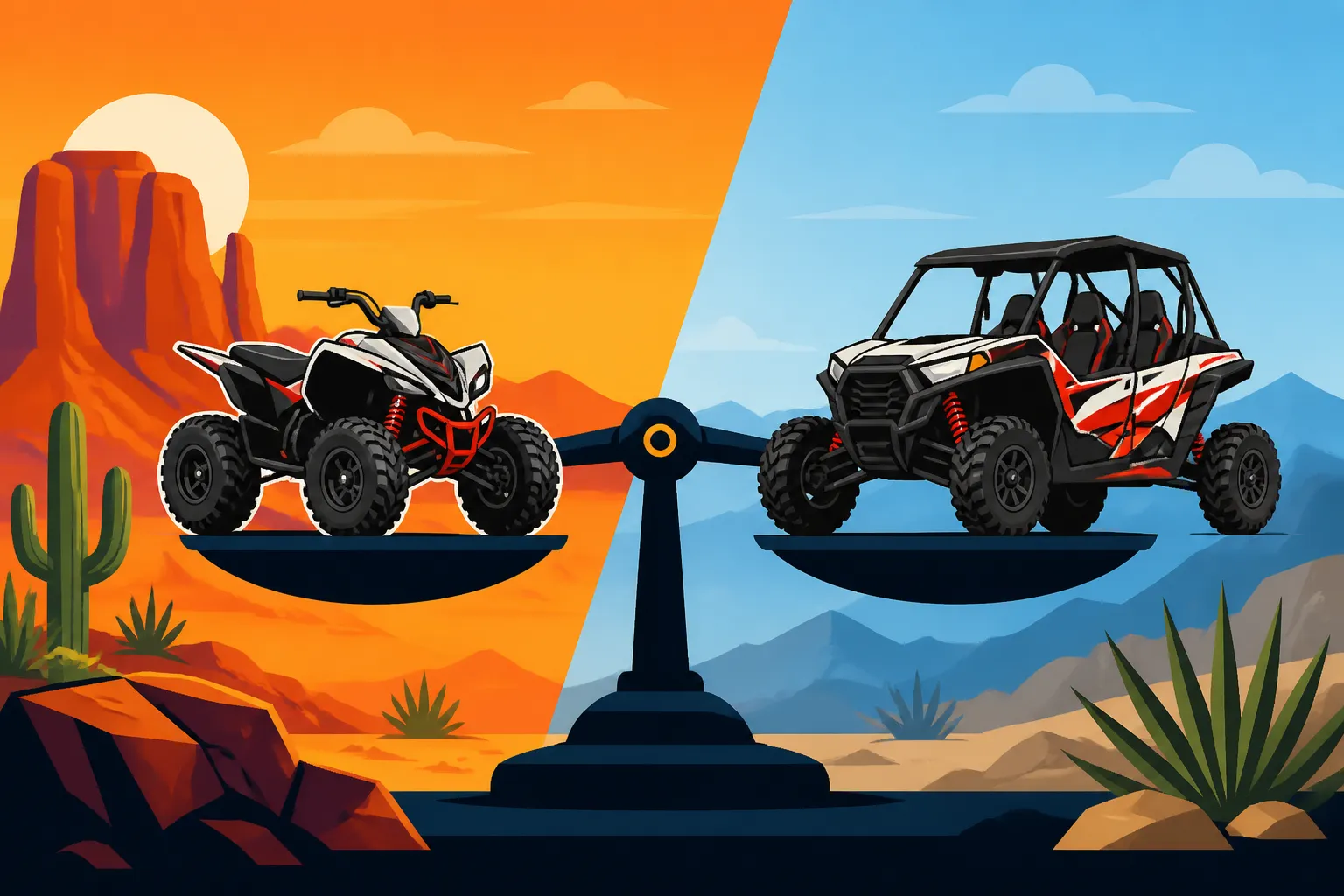
Now, here's where the rubber meets the trail, so to speak. Arizona law introduces a critical weight distinction: 1,800 pounds. This figure isn't arbitrary; it's a foundational element in determining how your off-highway vehicle is registered and, consequently, what kind of decal or plate it will carry. For many riders, especially those with smaller ATVs or dirt bikes, this might seem like an irrelevant detail. However, if you're rocking a larger side-by-side, a modified sand rail, or even some of the heavier utility quads, this weight limit becomes incredibly important to understand.
Machines that weigh less than 1,800 pounds typically fall into one category, while those weighing more than 1,800 pounds can sometimes have different registration paths, particularly if you're aiming for street legality. This weight difference often dictates whether your machine is considered purely an "off-highway vehicle" with just an OHV decal and an "RV" plate, or if it might be eligible for an "MC" plate if converted to be street legal, bringing with it additional requirements like insurance and emissions testing. It’s a fine line that can significantly alter your paperwork and the places you’re legally allowed to ride.
How to Determine Your Machine's Weight
So, how do you figure out where your pride and joy lands on the weight scale? The easiest and most common way is to consult your machine's manufacturer specifications. This information is usually found in the owner's manual, on the manufacturer's website, or sometimes even on a decal or plate affixed directly to the vehicle itself, often near the VIN. For brand-new machines, the dealer will provide this information, and it will be clearly noted on your bill of sale and title application.
If you have an older machine, a custom build, or if you've added significant accessories like a full roll cage, heavy-duty bumpers, winches, or oversized tires, the manufacturer's "dry weight" might no longer be accurate. In such cases, you might need to have your vehicle actually weighed. Some commercial scales, like those found at truck stops or even certain recycling centers, can provide an official weight slip. Remember, for registration purposes, you're looking for the unladen weight – meaning without passengers, fuel, or cargo. Having proof of this weight, especially if it's close to that 1,800-pound threshold, can save you a lot of headache when dealing with the MVD or a third-party provider.
Decal Requirements for Machines Under 1,800 Pounds
For the vast majority of ATV and dirt bike enthusiasts in Arizona, the machines they ride will fall squarely under that 1,800-pound mark. This category includes everything from nimble sport quads to many utility ATVs, and of course, all your standard dirt bikes. Understanding the decal requirements for these lighter machines is crucial for legal trail riding, as this is where the standard Arizona OHV decal truly shines as the primary identifier and funding source for our amazing trail systems.
The Standard Arizona OHV Decal
If your off-highway vehicle weighs less than 1,800 pounds, and you plan to ride it on public lands, then the annual Arizona OHV Decal is absolutely essential. This decal is required for any OHV that will be operated on state trust land, Bureau of Land Management (BLM) land, U.S. Forest Service roads, or any other public land open to motorized vehicles. It's not just a sticker; it's your ticket to the trails, and the funds generated from its sale go directly back into maintaining, improving, and managing Arizona's expansive [Arizona's 40,000 Miles of OHV Trail]. [Arizona's Annual OHV Decal Explained] in detail covers what this decal entails.
The decal itself is a small, colorful sticker that you affix to the upper-left corner of your machine's license plate. It must be renewed annually and is generally valid for one year from the date of purchase. Without it, even if your machine is titled and registered, you're risking a citation if caught riding on public lands. Think of it as your annual contribution to the OHV fund, which is vital for search and rescue operations, law enforcement, and critical trail maintenance. It's a small price to pay for the incredible access we have to Arizona's diverse and beautiful backcountry.
Exemptions and Special Cases for Lighter Machines
While the general rule is "if you ride it off-highway, get a decal," there are a few important exemptions and special cases, even for machines under 1,800 pounds. One of the most common questions riders have is about private land. If you strictly operate your ATV or dirt bike only on your own deeded private property, or on land where you have explicit permission from the landowner and it's entirely closed off from public access, you generally do not need an OHV decal. This often applies to riding in your backyard, on a friend's private ranch, or at a dedicated closed-course facility for racing.
However, it’s critical to understand that "private land" must be truly private and inaccessible to the public. If you need to cross any public land, even for a short distance, to reach your private riding area, your machine needs a decal. Another significant exemption often applies to ranch and farm machines, which might be exempt if used solely for agricultural purposes on private property. [Arizona Exemptions for Ranch Machines] provides more context on this. Always err on the side of caution and get the decal if there's any chance you'll even briefly touch public land, because ignorance of the law is rarely an acceptable excuse when facing a ranger.
Machines Over 1,800 Pounds and Their Unique Decal Situations
The 1,800-pound mark is truly a dividing line in Arizona's OHV world. While lighter machines largely fall into a straightforward decal-and-go category, those robust side-by-sides, heavier utility vehicles, and custom builds that tip the scales beyond this weight introduce a few more layers of complexity to the registration and decal process. It's not necessarily harder, but it requires a keen understanding of the specific requirements to ensure you're compliant, especially if you have aspirations of making your machine street legal.
When a Heavier Machine Still Needs an OHV Decal
Let's be clear: just because a machine weighs over 1,800 pounds doesn't automatically mean it doesn't need an OHV decal. In fact, most large side-by-sides, like many Polaris RZRs, Can-Am Mavericks, or Honda Talons, definitely fall into this heavier category, and if they are primarily used off-highway, they absolutely require an annual Arizona OHV Decal. The weight threshold primarily influences the type of plate you might get and the potential for street-legal conversion, but the fundamental requirement for an OHV decal for public land use remains.
Essentially, if your machine, regardless of weight, is designed for and operated off-highway on Arizona's public lands, that yellow or red decal needs to be prominently displayed on your license plate. The purpose of the decal—funding trail maintenance and safety—applies equally to a lightweight dirt bike and a heavy-duty six-seater side-by-side. The state wants to ensure that all users of our public trails contribute their fair share, and the decal is the mechanism for that. [What the OHV Decal Buys an Arizona Rider] further illustrates why these decals are so important.
The "MC" Plate vs. "RV" Plate Distinction
Here's where the 1,800-pound weight limit really starts to play a significant role, particularly for side-by-sides. Machines weighing less than 1,800 pounds, when registered for off-highway use only, typically receive an "RV" (Recreational Vehicle) designation on their license plate. These are your standard plates for OHVs that aren't street legal. The OHV decal then goes on this RV plate. However, if your machine weighs more than 1,800 pounds and you choose to make it street legal, you might be eligible for an "MC" (Motorcycle) designated plate.
Getting an "MC" plate for a side-by-side, which is often colloquially referred to as "street legalizing" your UTV, comes with a whole host of additional requirements. Beyond the weight, you'll need things like turn signals, a horn, mirrors, proper lighting, a windshield, and most importantly, proof of liability insurance, just like a regular car or motorcycle. The advantage of an MC plate is the ability to drive on most paved roads to get to trailheads or even cruise through certain towns. This allows for greater flexibility. [MC Plates and Street-Legal Machines] delves into the details of making your machine road-ready, while [RV Plates and Off-Highway Only Machines] clarifies the typical off-highway designation. It's a significant decision, and the weight of your machine often determines which path is even possible.
Commercial or Utility Vehicles and Their Registration
The 1,800-pound threshold also has implications for machines used in a commercial or utility capacity, such as those on large ranches, construction sites, or in other industrial settings. While some of these heavier utility vehicles might technically fit the definition of an OHV, their primary purpose and location of use can sometimes lead to different registration requirements or exemptions. For example, a heavy-duty utility UTV used exclusively for maintaining a vast private property or ranch might not need an OHV decal if it never leaves that property.
However, if that same heavy-duty utility vehicle is occasionally driven on public roads (even county dirt roads) to move equipment between different parts of a ranch, or if it's used by a commercial outfitter on public land, then it absolutely needs to be properly registered and decaled. In some commercial scenarios, depending on the specific use and weight, these vehicles might even fall under different commercial vehicle classifications with the MVD, which have their own set of rules entirely. It’s a niche area, but one where knowing your machine’s weight and intended use is paramount.
The Importance of Correct Registration and Decal Placement
You’ve got your machine, you’ve sorted out its weight, and now you know if it needs a decal or a specific plate. Fantastic! But the journey isn’t over. Proper registration and, crucially, correct decal placement are the final pieces of the puzzle that ensure you avoid any hassle with law enforcement. It's not just about having the decal; it's about having it visible and legible according to Arizona law. Overlooking these seemingly minor details can lead to unexpected fines, dampening an otherwise perfect day on the trails.
Penalties for Incorrectly Decaled or Undecaled Machines
Riding an off-highway vehicle on public land in Arizona without a current and properly displayed OHV decal is a clear violation of state law. The penalties for an undecaled machine can range from a warning for a first-time offense to a significant fine, which can easily be several hundred dollars. Law enforcement officers, including county sheriffs, Arizona Game and Fish Department officers, and Forest Service rangers, routinely patrol popular OHV areas and conduct checkpoints. They are well-versed in the regulations, and they will check for valid decals.
Beyond the initial fine, persistent violations or riding on restricted lands without a decal can lead to more severe consequences, including impoundment of your vehicle in some cases. It's a risk that simply isn't worth taking, especially when the cost of an annual decal is relatively low compared to the potential fines. An undecaled machine also indicates that you haven't contributed to the OHV fund, which is essential for maintaining the very trails you're enjoying. [Penalties for an Undecaled Machine in Arizona] offers a deeper dive into what you could face.
Where to Affix Your Decal Based on Machine Type
Proper decal placement is just as important as having the decal itself. For all OHVs, the Arizona OHV Decal must be affixed to the upper-left corner of the license plate. This applies whether you have an "RV" plate for an off-highway only machine or an "MC" plate for a street-legal side-by-side. The key is visibility; the decal needs to be clearly readable and unobstructed. Don't put it on your fender, your helmet, or tucked away in your glove box—it needs to be on that plate.
For dirt bikes, which often have smaller, vertical plates, the rule still stands: upper-left corner. If your plate is mounted in a way that makes the upper-left corner difficult, ensure the decal is as close to that position as possible and remains fully visible. The desert sun can be harsh, so make sure the surface is clean and dry before applying the decal for maximum adhesion and longevity. [Where the Arizona OHV Decal Goes on the Plate] provides visual guidance for proper placement, ensuring your decal is right where it needs to be.
Navigating the Registration Process with Weight in Mind
So, you've identified your machine's weight class and understand the decal requirements. Now comes the actual registration process. This step is where all that knowledge about weight limits, plate types, and decals comes together. Whether you're registering a brand-new side-by-side or a used ATV, approaching the MVD or a third-party provider with a clear understanding of your vehicle's specific needs based on its weight will make the process much smoother. It also ensures you walk away with the correct registration for your machine.
Documents Needed to Prove Machine Weight
When you head to the Arizona MVD or an authorized third-party provider to register your OHV, especially if it's a heavier machine close to or over the 1,800-pound threshold, you might be asked for documentation related to its weight. For new machines, the manufacturer's Certificate of Origin (MCO) or Certificate of Title (COT) will list the vehicle's unladen weight, and this is generally sufficient. The dealership will usually handle this paperwork for you, ensuring the correct weight is submitted.
For used machines, especially older ones, the weight might be less clearly documented. Your existing title or previous registration might list it, or you may need to consult the owner's manual. If you have a highly modified machine or one without clear documentation, a weight slip from a certified scale could be requested. It’s always best to be prepared with any documentation that verifies your machine's weight, as this information guides the MVD in issuing the correct plate type (RV vs. MC) and ensures your OHV decal is appropriately assigned. You might even find templates for a bill of sale or other necessary forms through services like LawDepot, which can help ensure you have all your ducks in a row for proving ownership and machine details. [Documents an Arizona MVD Office Wants] outlines a comprehensive list of what to bring.
Registering Through MVD or a Third-Party Provider
In Arizona, you have a couple of options for getting your OHV registered and decaled. You can visit a traditional Arizona Motor Vehicle Division (MVD) office, or you can utilize one of the many authorized third-party MVD providers scattered across the state. Both options will get the job done, but there are differences in convenience and experience. Many riders prefer third-party providers because they often have shorter wait times and more personalized service.
Regardless of whether you choose the MVD or a third-party, make sure you clearly communicate your machine's weight, its intended use (off-highway only vs. street-legal aspirations), and any modifications that might affect its classification. They will guide you through the specific paperwork, fees, and requirements, ensuring your machine receives the correct title, registration, and OHV decal. Always double-check all documents before leaving the office to ensure your machine's weight is correctly noted and you have the appropriate plate and decal for your riding plans. [Arizona MVD OHV Registration Explained] and [Registering Through Arizona MVD or a Third Party] offer detailed guidance on both options.
Common Weight-Related Scenarios and Misconceptions
The world of OHV registration and decals, particularly concerning weight, is ripe with "what-if" scenarios and common misunderstandings. Riders often ask about the impact of modifications, or how specific types of vehicles like golf carts fit into the OHV framework. Clarifying these points can save a lot of headaches and ensure you’re always riding legally and responsibly on Arizona's beautiful trails.
Modified Machines and Their New Weight
It's a common story: you buy a stock side-by-side, but over time, you add a bigger cage, heavy-duty bumpers, a winch, rock sliders, a roof rack, and a spare tire. All these fantastic upgrades make your machine more capable and enjoyable, but they also add significant weight. If your machine was originally under 1,800 pounds but your modifications have pushed it over that threshold, what happens to your registration and decal? This is a crucial question to consider.
Legally, if your machine's weight changes enough to cross the 1,800-pound boundary, its classification for certain purposes, particularly street-legal conversion, could change. While the basic OHV decal requirement for public land use usually remains, if you're attempting to get an "MC" plate for a machine that was previously "RV" because of its original lighter weight, you might need to prove the new, heavier weight. This could involve getting an updated weight slip. Always review your vehicle's specifications after major modifications, and if you're unsure, a quick call to the MVD or a trusted third-party provider can help clarify if any updates to your registration are needed.
Low-Speed Vehicles LSVs vs. OHVs
Another area of frequent confusion involves golf carts and other low-speed vehicles (LSVs). Many people wonder if their golf cart needs an OHV decal, especially if they drive it around their community or on unpaved roads within a development. The distinction here is crucial: a standard golf cart, or an LSV, is generally not considered an OHV in the traditional sense, and therefore does not require an Arizona OHV decal. LSVs have their own separate registration and equipment requirements, designed for slower speeds on specific public roads.
However, some golf carts are heavily modified for off-road use, effectively becoming "converted" OHVs. If your golf cart is explicitly designed or modified for off-highway travel, has a suspension system for rugged terrain, and is primarily used on trails rather than paved streets, it might indeed fall under the OHV definition and require a decal. The key difference lies in its primary design and intended use. If it's a typical golf cart used in a retirement community, refer to [Arizona Rules for a Golf Cart in a Community]. But if it’s a lifted, knobby-tired monster designed for the desert, then the OHV rules, including the weight limits, very much apply.
Table: Key Differences in OHV Registration by Weight in Arizona
To help visualize these distinctions, here's a table summarizing how the 1,800-pound weight threshold impacts common OHV registration scenarios in Arizona.
| Feature | Machine Under 1,800 lbs (Typical ATV/Dirt Bike) | Machine Over 1,800 lbs (Typical Side-by-Side) |
|---|---|---|
| OHV Decal | Required for public land use | Required for public land use |
| Plate Type (Off-Highway Use) | Generally "RV" plate (Recreational Vehicle) | Generally "RV" plate (Recreational Vehicle) |
| Plate Type (Street-Legal Conversion) | Generally not eligible for "MC" plate (except for specific dirt bike conversions with additional requirements) | Can be eligible for "MC" plate (Motorcycle) with additional requirements |
| Street-Legal Requirements | Difficult/rare due to size/equipment limitations | More common and feasible with required equipment (lights, mirrors, etc.) |
| Insurance for Public Roads | Not required for off-highway use only; specific street-legal insurance if converted | Not required for off-highway use only; Required for "MC" plate/street-legal use |
| Emissions Testing (if Street-Legal) | N/A (generally not street-legal) | Required in specific counties (e.g., Phoenix, Tucson) for "MC" plate |
| Typical Machines | Most ATVs, dirt bikes, smaller UTVs | Most UTVs (side-by-sides), sand rails, larger specialty OHVs |
Disclaimer
This article is for general informational purposes only and does not constitute professional advice. Laws, prices and regulations vary by location and change over time. Consult a qualified professional for guidance on your specific situation.