Finding the VIN on a Desert-Worn Machine
There’s almost nothing more frustrating than trying to track down a crucial piece of information on a machine that has lived a hard life under the Arizona sun and across its dusty trails. You're trying to register your beloved ATV or UTV, sell it, or perhaps even recover it after a theft, only to find the Vehicle Identification Number (VIN) is faded, mud-caked, or simply a mystery. This guide is all about helping you dig up that essential VIN, even when your desert-worn machine seems determined to keep its secrets.
Why That Dusty VIN Matters More Than You Think
It’s easy to think of the VIN as just a random string of characters, especially when you’re elbow-deep in a carburetor or replacing a worn belt. But that 17-character code is the unique fingerprint of your off-highway vehicle (OHV), and it plays a critical role in almost every interaction you’ll have with your machine, from ownership to trail riding. Ignoring a faded VIN can lead to a heap of headaches down the line.
Legal Requirements for OHV Ownership
In Arizona, having a verifiable VIN is fundamental to legal ownership and operation. Without it, you can’t get a [Arizona Certificate of Title for an Off-Highway Vehicle] or an [Arizona's Annual OHV Decal Explained]. Imagine you're at the MVD or a third-party office, excited to finalize the registration, and they ask for the VIN. If it’s unclear, you're stuck. That number proves your machine is legitimate, wasn't stolen, and can be properly tracked by the state. This isn't just bureaucratic red tape; it's a layer of protection for you and other riders. Trying to buy or sell a machine with an ambiguous VIN can raise serious red flags, making the transaction incredibly difficult, if not impossible.
Proving Ownership and Preventing Theft
Your VIN is the ultimate proof of ownership. If your machine is ever stolen, that VIN is what law enforcement uses to identify and return it to you. Without a clear VIN, recovering a stolen ATV or UTV becomes a significantly harder task, almost like trying to find a needle in a haystack of similar-looking machines. When you’re dealing with insurance claims after an incident, they'll always ask for the VIN to verify the specific vehicle involved. Even if you have a bill of sale, the VIN is the connecting thread between that document and the physical machine. Think about it: a well-crafted [What an Arizona Bill of Sale Should Carry] will always include the VIN for both buyer and seller protection.
Verifying a Machine's History Before You Buy
Before you hand over your hard-earned cash for a used machine, checking the VIN is non-negotiable. That 17-character code can unlock a wealth of information about its past, including accident history, previous owners, and any liens. For example, a quick VIN check can tell you if the machine has ever been reported stolen or if it has a [Liens on an Arizona OHV Title] still active. You can verify its make, model, and year against what the seller is telling you. This due diligence can save you from buying a lemon or, worse, a stolen machine. Services exist that can provide a detailed report, but first, you need to actually find and read the VIN.
Common Hiding Spots for the VIN on Desert Machines
The VIN isn't usually prominently displayed like a license plate. Manufacturers place them in specific, often hard-to-reach spots to protect them from damage and tampering. However, after years of sun, sand, and mud, even these protected areas can become a challenge. Knowing where to look is the first step in your VIN detective work.
ATV Frame and Engine Locations
On most ATVs, the VIN is typically stamped directly into the frame. A common location is on the lower left side of the frame, often near the footpeg or just below the handlebars, where the frame tubes come together. Another spot could be on the front of the frame, behind the bumper, which can get easily caked with mud and sand from desert riding. Sometimes, manufacturers will also stamp a VIN or a portion of it on the engine casing, though the primary VIN is almost always on the frame.
- Real-life scenario: Imagine you’ve got an older Honda Foreman that’s seen countless miles on the trails around Lake Havasu. You crawl underneath, flashlight in hand, and find a thick layer of dried mud and desert varnish where the frame tube should be. You'll need some elbow grease to reveal the numbers. Always check both sides of the frame, following the tubes from front to back, especially in areas that might be less exposed to direct impact or friction. Sometimes it's on a small metal plate riveted to the frame, which can unfortunately fall off over time if the rivets rust through.
UTV Chassis and Firewall Placement
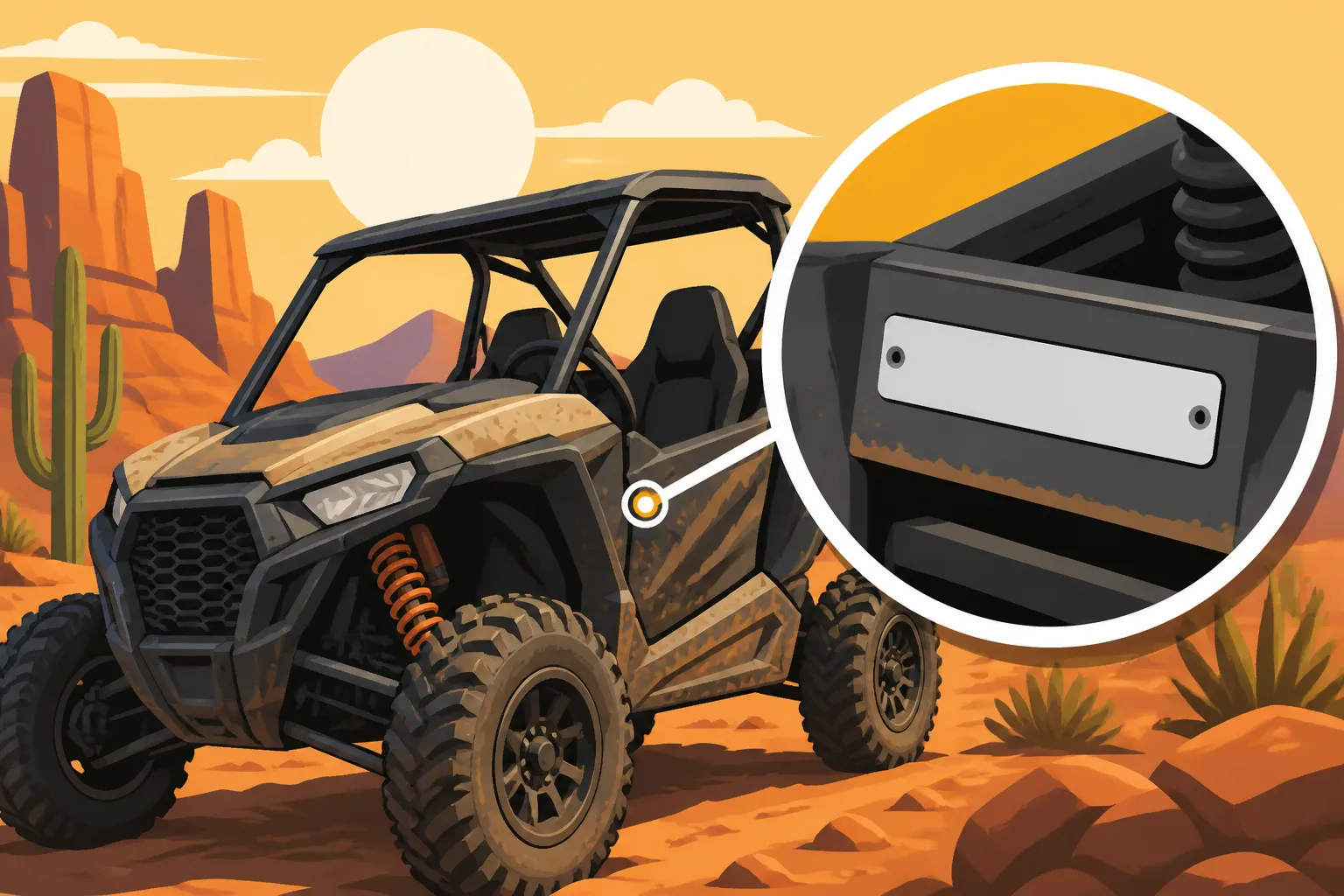
UTVs, with their larger frames and enclosed cabs, offer a few more potential VIN locations. The most common spot for a UTV VIN is on the driver's side frame rail, often visible when you open the driver's door or remove a plastic body panel. Many Polaris RZRs, for instance, have their VIN stamped on the frame rail just behind the left front wheel. Another frequent location is on the firewall of the cab, either etched directly into the metal or on a sticker. These stickers can fade or peel over time due to sun exposure or pressure washing.
- Real-life scenario: Your Polaris RZR has spent years tearing up the Cinder Hills. You lift the hood, expecting to see it on the firewall, but it's just a blank space. Then you remember hearing about other locations. You look on the frame under the driver's door and sure enough, beneath a coating of red dust, you start to make out the faint outlines of numbers. The challenge here is often access – sometimes you have to remove seat cushions, floor mats, or even small access panels to get a clear view. Don't forget to check under the passenger seat too; some manufacturers place it there or on the cross-member beneath. [Where a Polaris RZR Carries Its VIN] can give you even more specific guidance.
Lesser-Known and Secondary Locations
Beyond the main frame and firewall, there are a few other places a VIN might be found, especially on older or less common machines. Sometimes it’s on the swingarm, near the rear axle, or even on a plate attached to the steering column. Some manufacturers also use a smaller, less prominent secondary VIN sticker or etching in a more hidden spot, acting as a backup. These secondary locations are usually for factory reference but can be a lifesaver if the primary VIN is completely obliterated.
- Real-life scenario: You've just inherited an older Kawasaki KFX ATV that's been sitting out in a field near Kingman for years. The main frame VIN is rusted beyond recognition. After searching the usual spots, you decide to check the swingarm and discover a small, almost invisible stamp near the pivot point. It’s barely legible, but with a wire brush and good lighting, you can eventually make out enough characters to begin your MVD process. Remember that the VIN is usually unique across the entire machine, so finding any part of it is better than nothing, as it can help narrow down the possibilities.
Tools and Techniques for Uncovering a Faded VIN
Finding a VIN that’s been exposed to the Arizona elements for years is less about brute force and more about patience, meticulous cleaning, and using the right tools. It's not always going to jump out at you, so get ready for some detective work.
Cleaning the Area Thoroughly
Before you even think about magnification or tracing, you need to clean the area where the VIN is suspected to be. Desert dust, dried mud, paint overspray, or even rust can completely obscure the numbers. Start with a soft brush to remove loose debris, then move to a more abrasive tool if needed.
- Materials: A stiff-bristled brush, wire brush (use gently, especially on softer metals or stamped plates), degreaser, WD-40 or a similar rust penetrant, and plenty of rags.
- Process: Spray the area with degreaser and let it sit for a few minutes to loosen grime. Use the brush to scrub away dirt. For rust, a little WD-40 or rust penetrant can work wonders, allowing you to gently rub away superficial rust without damaging the underlying metal. Be careful not to scrub so aggressively that you further wear down the stamped numbers. The goal is to reveal, not remove. Once clean, wipe the area dry to get a clear view.
- Real-life scenario: You're looking at a used Suzuki KingQuad, the seller assures you it's got a clean title, but the VIN is caked in what looks like five years of Sedona red dirt. You grab a can of engine degreaser, spray the suspected frame area, let it sit, and then use a stiff nylon brush. Slowly, the grime starts to lift, revealing the faint indentations of the VIN beneath. It's tedious, but absolutely necessary.
Using Light, Magnification, and Digital Aids
Once clean, you might still struggle to read the faint impressions. This is where good lighting and magnification become your best friends. The way light hits the stamped numbers can make them appear or disappear.
- Materials: A bright LED flashlight (preferably one with a narrow beam), a headlamp (frees up your hands), a magnifying glass, and your smartphone camera.
- Process: Shine the flashlight at various angles across the VIN. Sometimes, sidelighting will create shadows that make the numbers pop out. A headlamp is excellent for getting light exactly where you need it. Use the magnifying glass to scrutinize each character. If you're still struggling, take high-resolution photos with your smartphone. Adjust the angle of the phone, use the flash, and then zoom in on the photos. Sometimes, seeing it on a larger screen or being able to digitally enhance the contrast can make all the difference.
- Real-life scenario: On a dusty day in Prescott, you're trying to read a VIN on a Yamaha Raptor, but the desert sun is reflecting off the metal, making it impossible. You pull out your phone, activate the flashlight, and angle it just right, casting slight shadows in the stamped numbers. You then snap a few pictures, zoom in, and finally confirm the elusive ninth digit.
Rubbings, Tracings, and Specialized Techniques
When cleaning and lighting aren't enough, you can try more advanced physical methods to capture the VIN. These techniques aim to transfer the raised or recessed numbers onto another medium.
- Materials: Paper (thin printer paper or tracing paper works best), a pencil (soft lead like a 2B or 4B is ideal), a crayon, or a piece of chalk.
- Process for Rubbings: Place the paper over the VIN. Gently but firmly rub the side of the pencil or crayon across the paper, making sure to cover the entire VIN area. The raised or recessed numbers will create a visible impression on the paper. This is similar to how people used to make gravestone rubbings. Take several rubbings, trying different pressures and angles.
- Process for Tracings: If the VIN is somewhat visible but hard to photograph, place a piece of clear packing tape over the VIN, then carefully trace the numbers onto the tape with a fine-point permanent marker. Peel the tape off and stick it onto a piece of white paper.
- Specialized Techniques: For extremely stubborn or rusted-over VINs, some professionals use chemical etches or even light grinding with a Dremel tool to reveal numbers hidden under layers of rust. However, these methods should only be attempted by experienced individuals or professionals, as improper use can permanently damage the VIN. You certainly don’t want to accidentally erase the very thing you’re trying to find!
- Real-life scenario: You've got an old sand rail whose VIN is practically invisible on the frame tube near the suspension. It's been sandblasted over years of dune riding. After trying cleaning and flashlights, you carefully place a thin piece of paper over the area and gently rub with the side of a pencil. Lo and behold, faint but discernible numbers begin to emerge on the paper. You quickly make a few more copies, just to be sure, and use these rubbings to fill out the [Proof of Ownership for an Arizona Title] forms.
| Technique | Best Use Case | Pros | Cons |
|---|---|---|---|
| Cleaning | Removing dirt, mud, paint, light rust | Simple, non-destructive, often sufficient | Can require elbow grease, not effective for deep corrosion |
| Light & Magnification | Faint, hard-to-read numbers | Reveals subtle impressions, enhances visibility | Requires good equipment, can be affected by reflections |
| Photography | Sharing VIN, digital enhancement | Easy to share, zoom, adjust contrast | Quality depends on phone camera, lighting can be tricky |
| Rubbings/Tracings | Very faded, embossed, or recessed numbers | Provides a physical record, can be very effective | Requires patience, careful execution, can smudge if not dry |
| Chemical/Grinding | Severely rusted, obliterated VINs (PRO ONLY) | Last resort for deeply obscured VINs | HIGH risk of permanent damage, requires expertise, not DIY |
What to Do When the VIN is Truly Illegible or Missing
Sometimes, despite your best efforts, the VIN remains a mystery. Whether it's been completely ground off, rusted beyond recognition, or was never properly stamped, a truly illegible or missing VIN presents a unique set of challenges in Arizona. But don't despair – there are official channels and solutions, even if they require more legwork.
Dealing with Arizona MVD for Unreadable VINs
If you cannot read the VIN after thorough cleaning and using various techniques, you'll need to involve the Arizona Motor Vehicle Division (MVD) or a certified third-party provider. They have specific procedures for cases like yours. Typically, you’ll need to schedule an appointment for a VIN inspection. An MVD agent or a law enforcement officer (like a Sheriff’s Deputy) will physically inspect your machine, often using their own specialized tools and knowledge to try and locate or verify the VIN.
- Process: Contact your local MVD office or a [Third-Party MVD Providers That Register OHVs] to inquire about VIN inspection requirements. You’ll usually need to bring your proof of purchase (even if it's just a [What an Arizona Bill of Sale Should Carry] with an unreadable VIN) and any other ownership documents you have. The inspector will attempt to find the VIN and, if successful, will complete a form that can then be used for registration and titling.
- Real-life scenario: You're trying to title an older dune buggy for riding near Glamis, but the previous owner had welded over the frame VIN when doing a modification. You bring the buggy to an MVD office, explain the situation, and an inspector comes out. After a thorough search, they might locate a hidden secondary VIN or, failing that, proceed with a "special constructed vehicle" process or advise on a bonded title. This process is how you'd get a [Arizona Certificate of Title for an Off-Highway Vehicle] for something that doesn't fit the usual mold.
The Bonded Title Process for No Ownership History
When a VIN is completely missing, defaced, or you lack sufficient ownership documentation, Arizona offers a bonded title process. This is essentially a way to establish legal ownership when the standard title chain is broken. It involves purchasing a surety bond, which protects the state and any previous unknown owners against potential claims of ownership.
- Process: You'll typically need to apply for a bonded title through the MVD. This usually involves submitting an affidavit of ownership, any available proof of purchase (even if it’s incomplete), and undergoing a thorough VIN inspection by law enforcement. If no VIN can be found, or if it’s determined to be tampered with, they might issue a new VIN. You then purchase a surety bond for a value typically related to the machine's estimated worth. After a waiting period (often three years), if no one else claims the vehicle, you can apply for a clear title. This process is outlined on the MVD website and forms can often be found there.
- Real-life scenario: You bought an older Yamaha Grizzly from a friend of a friend years ago, and never got proper paperwork. Now you want to sell it, but the VIN is too worn to read, and you never got a title in your name. You check with MVD and they tell you that a bonded title is your best route. You gather all the informal documents you have, get a law enforcement VIN inspection, and then work with a surety company to get the bond. This might seem like a lot of steps, but it's the legitimate way to establish clear ownership and protect yourself from future disputes. You can often find affidavit forms or templates for personal use on legal document sites like LawDepot to help organize your claim.
Law Enforcement Involvement and Potential Issues
In cases where a VIN is severely defaced, appears to have been altered, or is completely missing, law enforcement may become involved. This isn't always a bad thing; their primary goal is to ensure the machine isn't stolen. However, it's a serious matter, and you should be prepared to explain the situation clearly and honestly.
- Potential Red Flags: A VIN that has clearly been ground off, cut out, or replaced raises immediate red flags for law enforcement. This is often an indication of a stolen vehicle. If an officer encounters a machine with a suspicious VIN, they may impound it for further investigation.
- What to Expect: If you suspect your machine's VIN might be compromised in this way, it's best to contact your local Sheriff's office or police department proactively before attempting to register it. They can perform an inspection and advise you on the proper legal steps. They might look for secondary VINs or conduct forensic analysis if necessary. Always cooperate fully and provide any documentation you have, even if it's informal. If you've used a platform like LawDepot to create a detailed bill of sale for a previous transaction, having that record can be incredibly helpful in these situations, showing good faith and intent.
- Real-life scenario: You found a really cheap side-by-side at a swap meet, but the VIN plate looked a little off. You buy it, get it home, and realize the VIN is barely legible and seems inconsistent. You decide to be proactive and call the local Pinal County Sheriff's office. An officer comes out, inspects the machine, and after a thorough check, determines that while the primary VIN is suspicious, a hidden secondary VIN confirms the machine is legitimate. This avoids a lot of potential legal trouble down the road and allows you to move forward with proper registration.
Protecting Your VIN from Future Desert Wear
Once you've gone through the trouble of finding or establishing your VIN, the last thing you want is to repeat the process a few years down the line. The Arizona desert is relentless, but there are steps you can take to protect your VIN from fading, rust, and abrasion.
VIN Protection Products and Coatings
Just as you protect your paint and engine, you can protect your VIN. There are several products on the market designed to safeguard metal stamps and labels from the elements.
- Clear Coatings/Sealants: After thoroughly cleaning the VIN area, apply a clear protective coating. This could be a clear spray lacquer, a clear coat designed for automotive use, or even a heavy-duty marine sealant. These products create a barrier against UV rays, moisture, and abrasive sand. Make sure the area is completely dry before application.
- Frame Protectors/Guards: For VINs located on exposed frame rails, consider adding a frame protector or plastic guard. Many aftermarket companies offer these, especially for popular ATV/UTV models. They shield the VIN area from direct impacts and friction.
- Vinyl Decals/Overlays: While not a permanent solution, a clear, heavy-duty vinyl decal placed over a clearly visible VIN can offer a layer of protection against light abrasion and UV. Ensure the VIN is perfectly legible before applying, and make sure the decal doesn't obscure any important details or appear to be an attempt at tampering.
- Real-life scenario: You just got a new [Arizona's Annual OHV Decal Explained] for your Can-Am Maverick, and you remember the hassle of finding the VIN last year. This time, after cleaning the frame VIN, you apply a couple of coats of clear spray enamel. Then, for added protection against trail debris, you install a small aftermarket frame guard that covers the area, ensuring the VIN stays legible for years to come.
Regular Cleaning and Inspection Habits
The simplest and often most effective method of VIN preservation is regular attention. Incorporating VIN checks into your routine maintenance can prevent major headaches later.
- Post-Ride Cleaning: After every dusty or muddy ride, make it a point to clean the VIN area. Use a hose to rinse off loose dirt, then a brush and soap to remove caked-on grime. This prevents accumulation that can trap moisture and accelerate rust or make the VIN unreadable.
- Scheduled Inspections: Make it a habit to visually inspect the VIN area every few months, or at least annually. Check for any signs of fading, rust, or damage. If you notice any issues, address them promptly. A little touch-up with a clear coat or rust converter can go a long way.
- Documentation: Keep a clear photograph of your VIN on file, both digitally and perhaps a printed copy with your vehicle's other important documents. This serves as a backup in case the physical VIN becomes completely unreadable. You can store this with your [Proof of Ownership for an Arizona Title] or even upload it to your Arizona Game and Fish Portal account.
- Real-life scenario: Before storing your quad for the summer in Arizona’s scorching heat, you give it a thorough wash. As you’re cleaning, you notice a patch of surface rust starting to form directly over the VIN on your Suzuki. You quickly grab some fine-grit sandpaper, gently clean off the rust, and apply a rust-inhibiting primer followed by a clear coat. This small effort saves you from a major problem next time you need to register or sell the machine.
Conclusion: Your VIN is Your Machine's Identity
Whether you're hitting the trails near [Sedona's Red Rock Trails] or exploring the vast [Sonoran Desert Near Phoenix], your machine's VIN is more than just a number; it’s its legal identity. From verifying ownership to protecting against theft, that 17-character code is indispensable. The Arizona desert, with its harsh sun, abrasive sand, and occasional mud, can make finding and reading that VIN a real challenge.
But by understanding where manufacturers place them, employing careful cleaning and magnification techniques, and knowing the official channels for when a VIN is truly lost or illegible, you can overcome these obstacles. And once you've successfully identified your machine's unique fingerprint, taking proactive steps to protect it will ensure you avoid similar headaches in the future. Don't let a faded VIN be the reason your next adventure hits a bureaucratic roadblock!
Disclaimer
This article is for general informational purposes only and does not constitute professional advice. Laws, prices and regulations vary by location and change over time. Consult a qualified professional for guidance on your specific situation.