Liens on an Arizona OHV Title
Buying or selling an off-highway vehicle (OHV) in Arizona can be a thrilling experience, whether it's the excitement of getting a new side-by-side or the satisfaction of selling your old ATV to a new enthusiast. However, a common source of anxiety and confusion for many riders, both buyers and sellers, revolves around something called a "lien" on the vehicle's title. This guide is here to untangle the complexities of liens on an Arizona OHV title, explaining what they are, how they get there, and most importantly, how to deal with them cleanly and correctly to avoid future headaches.
What Exactly is a Lien on Your Arizona OHV Title?
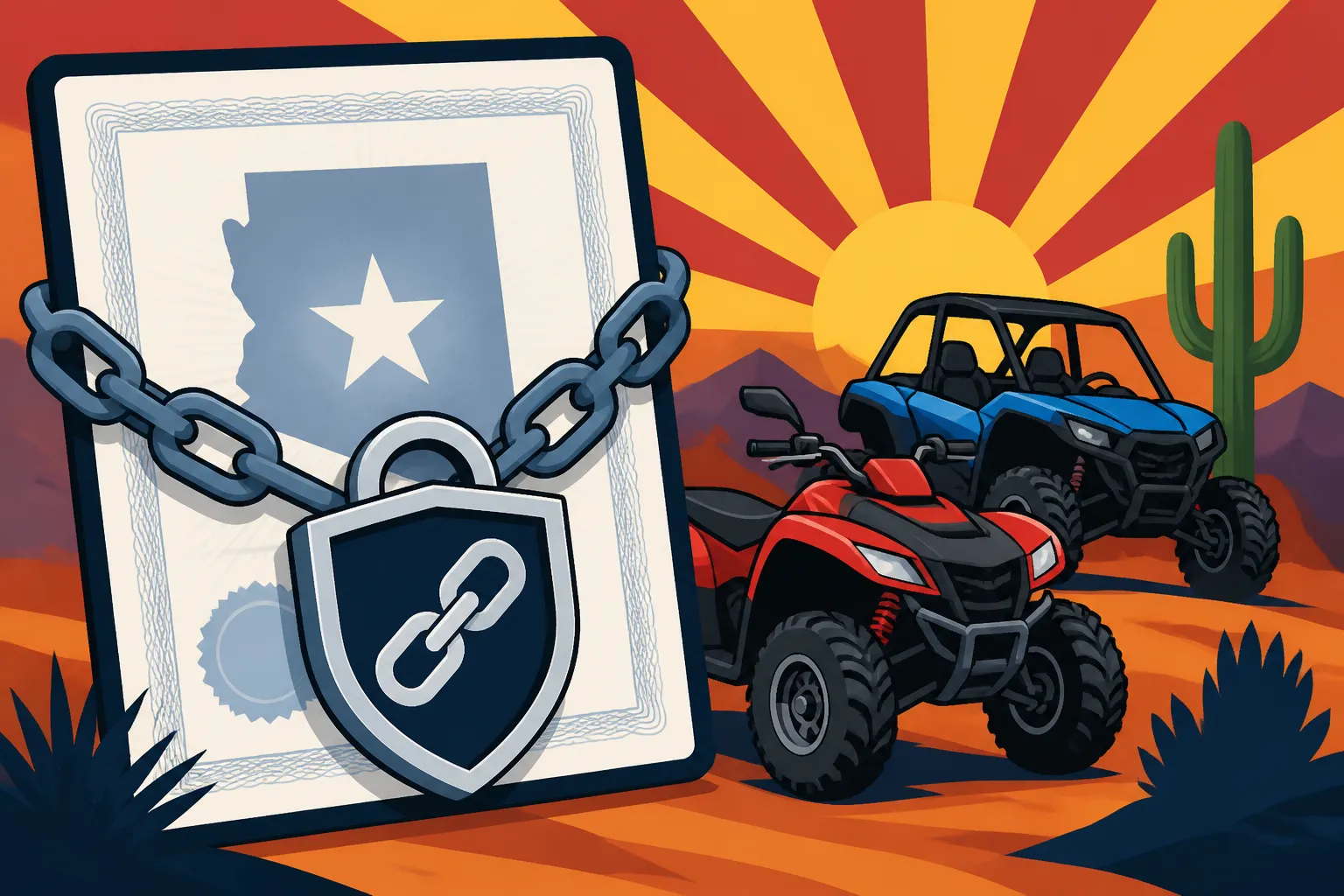
Think of your OHV's title as the official document proving who owns the machine. It's like the deed to your house, but for your quad or side-by-side. Now, imagine you buy that machine, but you don't pay for it all upfront with cash. Most of us don't have that kind of money just sitting around, right? So, you get a loan from a bank, a credit union, or even the dealership itself. This is where a lien comes into play. It's essentially a legal claim against your OHV that ensures the lender gets their money back.
The Basics of Secured Debt and Your Machine
When you take out a loan for a substantial purchase like an OHV, that loan is almost always "secured." What does "secured" mean? It means there's collateral involved – something the lender can take back if you don't keep up your end of the deal and make your payments. In the case of your ATV or UTV, the machine itself is the collateral. The lien is the formal mechanism that attaches this collateral to your loan. It's recorded on your vehicle's certificate of title by the Arizona Motor Vehicle Division (MVD), making it a public record that this specific OHV has outstanding debt tied to it. This legal tie prevents you from selling or transferring full ownership of the machine until that debt is settled.
It's a really important distinction because it means you don't truly have "clear" ownership until the lien is satisfied. While you might be riding it every weekend, maintaining it, and loving it like it's completely yours, the reality is that the bank still has a vested interest in it. This setup is standard practice across the country for vehicles, houses, and other big-ticket items. It minimizes the risk for the lender, allowing them to offer financing in the first place, which is a good thing for most buyers who need that financial assistance.
Who Holds the Lien and What It Means for You
The "lienholder" is the entity that holds the lien – almost always the bank, credit union, or financial institution that provided your loan. If you financed your machine directly through the dealership, they might be the initial lienholder, or they might have immediately sold the loan to a larger bank. When you get your Arizona Certificate of Title for a Quad or side-by-side, you'll see your name listed as the owner, but there will also be a section clearly stating the name of the lienholder. This is the official notification that someone else has a financial claim on your machine.
For you, as the owner-in-possession, this means a few things. First, you're obligated to make your payments as agreed. Second, you generally can't just up and sell the machine without involving the lienholder, because the title isn't "clean." If you tried to sell it, a smart buyer performing a title check would immediately see the lien and likely walk away, or demand a very specific process to ensure the lien is removed as part of the sale. It also means if you were to default on your loan, the lienholder has the legal right to repossess the OHV to recover their losses, even if it's parked in your garage in Phoenix or out at your cabin in Prescott.
How a Lien Protects the Lender (and Complicates Your Life)
From the lender's perspective, a lien is their primary form of protection. It ensures that if you stop making payments, they have a legal avenue to reclaim the collateral (your OHV) and mitigate their financial loss. Without liens, banks would be far less willing to lend money for vehicles, making it much harder for average folks to afford a new side-by-side or ATV. The system is designed to create a secure lending environment.
However, for you, the borrower, a lien can definitely complicate things. Imagine you're ready to upgrade to a newer model or you're moving out of state and want to sell your current OHV. If there's an active lien on the title, you can't just sign the title over to a new owner and be done with it. The process becomes a bit more involved, requiring the lien to be satisfied and released before a clean title can be issued to the new owner. This is where many private sales run into trouble, especially if either party isn't fully aware of the steps involved in [Lien Release Once the Loan Clears]. It’s not an insurmountable hurdle, but it requires careful attention to detail and good communication with your lender and the MVD.
How Liens Get Placed on an Arizona OHV Title
Understanding how a lien actually gets recorded on your title can help prevent surprises down the road. It’s usually a pretty straightforward process, often handled by the dealership, but it’s always good to know the mechanics yourself.
Buying from a Dealership with Financing
The most common way a lien ends up on your Arizona OHV title is when you purchase a new or used machine from a dealership and finance it. When you sit down in the finance office, you'll sign a stack of papers, including a loan agreement that specifies the terms of your financing. As part of this process, the dealership handles all the initial paperwork for titling and registration with the Arizona MVD. They will submit an application for an Arizona Certificate of Title for an Off-Highway Vehicle, naming you as the owner and your lender as the lienholder.
The MVD then processes this application, and when the title is issued, it will physically show the lienholder's name and address. In most cases, the physical title document is actually sent directly to the lienholder, not to you. This might come as a surprise to some first-time buyers! You'll typically only receive a copy or a notice that the title has been issued. This practice further protects the lender, ensuring they maintain control of the critical proof of ownership until the loan is fully paid off. It's a seamless process for the buyer at the time of purchase, but it's important to be aware of how that title is being handled.
Private Loans and Recorded Liens
While less common for individual buyers, it is possible to secure a private loan for an OHV, perhaps from a smaller bank or even a family member. If you go this route, it's crucial that any lender who wants to protect their interest formally records their lien with the Arizona MVD. Unlike a dealership that handles this routinely, if you get a private loan, you or your lender would need to proactively file the necessary paperwork with the MVD to ensure the lien is properly noted on the title.
This usually involves filling out specific MVD forms that detail the lienholder's information and attaching them to your title application or an existing title. If the lien isn't officially recorded, the lender has significantly less protection. For example, if you were to sell the machine to an unsuspecting buyer who checked the title and found no lien, that buyer would likely receive a clean title, and the original private lender would have a much harder time recovering their funds if you defaulted. This is why official recording is so important for both parties in a private loan arrangement, and why utilizing something like a formal loan agreement from a service like LawDepot can be critical to ensure all parties are protected and clear on their obligations. [What a Lender Wants for a UTV Loan] can shed more light on these requirements.
When a Lien Appears Unexpectedly (and What to Do)
Sometimes, a lien can appear on an OHV title unexpectedly, causing a lot of stress. This often happens to buyers of used machines if the seller wasn't entirely forthcoming or if there was a mix-up in the title transfer process. You might think you've bought a machine with a clean title, only to find out later that a previous lien was never properly released. Discovering a lien on your OHV that you didn't know about can be a real punch to the gut.
If this happens, your first step is to gather all your paperwork, including your bill of sale and any communication with the seller. Then, you'll need to contact the Arizona MVD to understand the details of the lien – who placed it, and when. You may also want to reach out to the stated lienholder directly. In some cases, it could be an old loan that was paid off but the release paperwork was never filed. In other, more complex situations, it could be a sign of a fraudulent sale. This is why verifying [Arizona Records and a Machine's Ownership History] is crucial before completing any purchase. If you find yourself in this predicament, getting legal advice might be necessary to help you navigate the process of clearing the title or seeking recourse against the seller. It can be a lengthy and frustrating process, but not one you should ignore.
The Critical Process of Releasing a Lien in Arizona
Okay, so you've diligently made all your payments, and you've finally paid off your OHV loan! Congratulations, that's a huge milestone. But the job isn't quite done. You still need to ensure that the lien is officially removed from your Arizona title. This isn't just a formality; it's a crucial step to truly owning your machine free and clear.
Paying Off Your Loan: The First Step
The moment of truth arrives when you make that final payment. However, it's essential to understand that simply paying off the loan doesn't automatically erase the lien from the MVD's records. While your financial obligation to the lender is fulfilled, the lien is a separate legal record that needs to be actively removed. It's like having a mortgage on your house; even after the last payment, you still need to get a "reconveyance" document to clear the public record.
Once your final payment has cleared, give your lender a few business days to process everything on their end. It's a good idea to contact them directly and confirm that the loan has been paid in full and inquire about their process for releasing the lien. Some lenders are very proactive, while others might require a nudge. Don't assume they'll just handle everything automatically and swiftly. Be persistent, but polite, and keep a record of all your communications, including dates, times, and who you spoke with. This documentation can be invaluable if any issues arise later.
Getting the Lien Release Document from Your Lender
This is arguably the most critical step in clearing your title. After you've paid off your loan, your lienholder is legally obligated to provide you with a "lien release" document. This document, often a stamped and signed paper, formally states that their claim on your OHV has been satisfied. It's their way of telling the Arizona MVD, "We no longer have an interest in this vehicle."
The format of this release can vary. Sometimes it's a separate letter, sometimes it's a signed-off section on the original title certificate (if they held it), or it could even be an electronic notification sent directly to the MVD by larger financial institutions. Make sure whatever you receive is an original document, or a verifiable electronic confirmation. A photocopy typically won't cut it. If the lienholder sent the original title to you after the payoff, ensure the lien section has been clearly marked as released and signed by an authorized representative. If they held the title, they should send it to you with the lien released. If you don't receive this within a reasonable timeframe (usually a few weeks after payoff), follow up immediately. This document is your golden ticket to a clean title. You can read more about this specific process in [Lien Release Once the Loan Clears].
How Arizona MVD Handles Lien Releases and New Titles
Once you have that official lien release in hand, you're ready for the final step with the Arizona MVD. You'll need to take this document to an MVD office or authorized third-party provider to have the lien formally removed from your OHV's record and to receive a clear title in your name. You can often do this at a local MVD office or one of the many approved third-party MVD providers around the state. [Titling an ATV at an Arizona MVD Office] covers these options.
You'll typically need to bring:
- The original lien release document.
- Your existing OHV title (if you had it, or a clear explanation if the lienholder sent it directly to MVD).
- Your photo ID.
- Payment for any nominal title update fees.
The MVD will review your documents, verify the lien release, and then update their system. They will then issue you a brand-new certificate of title for your OHV, this time with no lienholder listed. This new title is the official proof that your machine is truly yours, free and clear of any financial encumbrances. Don't skip this step! Until you have that clean title, the MVD's records will still show a lien, which can cause significant problems if you try to sell or transfer the OHV later.
Buying or Selling an OHV with an Existing Lien in Arizona
Navigating an OHV transaction where a lien is involved, either as a buyer or a seller, requires extra diligence. It’s definitely not as straightforward as a cash sale with a clean title, but it's a common scenario that can be managed successfully with the right approach.
As a Buyer: The Risks and What to Look For
When you're looking to buy a used ATV or UTV in Arizona, and the seller mentions there's still a lien on the title, your antennae should immediately go up. This doesn't necessarily mean it's a bad deal, but it does mean you need to be extra cautious. The biggest risk for a buyer is paying the seller for the OHV, only for the seller not to use that money to pay off their loan, leaving the lien intact. You'd be stuck with a machine that legally belongs to the bank, and the seller might be long gone with your cash.
Before you hand over any money, always, always, always verify the lien directly with the Arizona MVD. You can do this by requesting a vehicle record search to check for [Arizona Records and a Machine's Ownership History]. This will confirm who the lienholder is. Then, ideally, you want to involve the lienholder in the transaction. A safe way to proceed is to meet at the lienholder's bank or a third-party MVD office. You would pay the outstanding loan amount directly to the bank, and any remaining balance of the sale price would go to the seller. This ensures the lien is satisfied on the spot, and you can immediately begin the process of transferring the title to your name. Never just trust a seller's word that they "will pay it off" after you give them the full amount.
As a Seller: Your Responsibilities and Best Practices
If you're selling an OHV that still has an active lien, your primary responsibility is transparency. Be upfront with potential buyers about the lien. Trying to hide it will only lead to trouble and could even land you in legal hot water. Your goal is to facilitate a smooth transaction where the buyer feels secure that the lien will be properly released.
The best practice is to arrange for the buyer to pay the lienholder directly. If your asking price is higher than the outstanding loan balance, the buyer would pay the lienholder the amount needed to clear the loan, and then pay you the difference. This protects both you and the buyer. It's also wise to have a clear, written bill of sale that outlines all the terms of the sale, including how the lien will be handled. A service like LawDepot can provide customizable bill of sale templates that clearly state the sales price, the outstanding lien amount, and how the funds are to be disbursed. This ensures everything is documented and agreed upon. This detailed approach is also covered in [What an Arizona Bill of Sale Should Carry].
Private Sales and the Role of a Bill of Sale
In Arizona private sales, a well-drafted bill of sale is your best friend, especially when a lien is involved. It acts as a contract between the buyer and seller, documenting the terms of the transaction. For an OHV with a lien, the bill of sale should explicitly state:
- The full purchase price.
- The current lienholder's name and the outstanding loan amount.
- How the payment will be divided (e.g., X amount to the lienholder, Y amount to the seller).
- A clear statement that the seller guarantees a clean title will be provided once the lien is satisfied.
- The date by which the lien release document will be obtained.
Using a reputable template from a service like LawDepot can help ensure you don't miss any critical details. While a bill of sale isn't a substitute for the MVD title transfer, it provides crucial legal protection for both parties and minimizes misunderstandings. Without this level of detail, [Buying a Used Side-by-Side in Arizona: The Paperwork] can become a true nightmare. Remember, documentation is key to a secure and drama-free private sale, especially when dealing with financial encumbrances.
What Happens if a Lien Isn't Properly Released?
Let's imagine a scenario where the loan is paid off, but for some reason, the lien release paperwork never makes it to the Arizona MVD, or it gets lost in the shuffle. This happens more often than you'd think, and it can create a mountain of problems down the road. Ignoring the proper release process can turn a paid-off machine into a never-ending source of frustration.
The Headaches for the New Owner
If you've bought an OHV that had an existing lien, and that lien was never officially released and removed from the MVD's records, you, the new owner, are in for a serious headache. The MVD will refuse to issue you a clean title in your name because their records still show the machine as belonging, in part, to a lienholder. This means you don't truly have full, clear ownership. You might be able to ride it with temporary registration, but you won't be able to properly register it long-term or transfer legal ownership.
Even if you have a bill of sale proving you paid for it, if the lien is still active on the title, the lienholder technically still has a claim. In extreme cases, if the original borrower (the seller) defaulted on other loans with that same bank, the bank could potentially try to repossess the OHV, even though you paid for it! It's a messy legal situation, and you'd have to prove your case, which could involve legal fees and a lot of stress. This scenario underscores why checking for liens and ensuring a proper release at the time of sale is non-negotiable.
Difficulties with Future Sales or Trades
Fast forward a few years: you want to sell that OHV or trade it in for an upgrade. If the lien from the original loan (which you thought was paid off) is still lingering on the MVD records, you're going to hit a brick wall. Any potential buyer or dealership will immediately see the unreleased lien when they perform a title search. They won't touch the machine with a ten-foot pole, or they'll offer you a drastically reduced price to account for the risk and the hassle of clearing the title themselves.
You'll then have to scramble to find the original lienholder (who might have merged with another bank, or gone out of business), dig up old loan records, and try to get that release document, which could be a monumental task years after the fact. This can easily turn a quick sale into months of bureaucratic nightmares. The problem is compounded if the original seller is no longer reachable. This is why getting that lien formally removed from the MVD records after payoff is just as important as making the final payment.
Legal Recourse and Clearing a "Ghost" Lien
If you find yourself with an unreleased lien on your OHV's title, and you've exhausted all avenues trying to get the original lienholder to provide the release, you might need to pursue legal recourse to clear what's sometimes called a "ghost" lien. This typically involves petitioning the Arizona courts. You would need to present proof that the loan was satisfied (bank statements, cancelled checks, payment histories, the bill of sale from when you bought it, etc.) and demonstrate that you've made a good-faith effort to obtain the release from the lienholder.
In some situations, if the lienholder is defunct or completely unreachable, the MVD may have specific procedures for handling these types of situations, possibly involving a bonded title application as described in [Bonded Title for a Quad in Arizona]. This is not a quick fix; it's a process that can be time-consuming and potentially expensive, requiring legal assistance. It's a stark reminder of why preventing this situation in the first place, through careful attention to detail during the purchase and lien release process, is always the best course of action.
Protecting Yourself: Best Practices for Arizona OHV Owners
As an Arizona OHV enthusiast, you want to spend your time on the trails, not wrestling with paperwork and title issues. Adopting a few best practices can save you immense frustration and potential financial loss when it comes to liens on your machine.
Checking for Liens Before You Buy
This cannot be stressed enough: always check for existing liens before you buy a used OHV in Arizona. This simple step can prevent countless headaches. The Arizona MVD offers services that allow you to check the title status of a vehicle, including any recorded liens. You'll typically need the vehicle identification number (VIN) of the OHV.
Here’s how you might approach it:
- Get the VIN: Ask the seller for the VIN. Make sure it matches the physical VIN on the machine itself (usually on the frame, near the engine, or on a sticker). [Finding the VIN on a Desert-Worn Machine] can help if it's hard to locate.
- MVD Record Request: Visit an Arizona MVD office or authorized third-party provider and request a vehicle record search using the VIN. There's usually a small fee for this. This search will tell you if there are any active liens recorded against the title, and who the lienholder is.
- Cross-Reference: Compare the information from the MVD search with what the seller tells you. If they say the machine is clear but the MVD shows a lien, that's a red flag. If they admit to a lien, you can verify the lienholder and the approximate payoff amount.
By doing this due diligence, you can ensure that the OHV you're eyeing doesn't come with any hidden financial surprises. [Arizona Records and a Machine's Ownership History] is an invaluable resource for this process.
Keeping Meticulous Records of Your Loan and Payments
Whether you're the one with the loan or you've bought an OHV that you're waiting for a lien release on, keeping meticulous records is your absolute best defense against future problems. Treat all paperwork related to your OHV loan and title as extremely important documents.
Here's what to keep:
- Loan Agreement: The original contract from your lender.
- Payment History: Statements or online records showing all your payments, especially the final payoff.
- Lien Release Document: The official paper or electronic confirmation from your lender stating the lien is satisfied. This is the most crucial piece of paper!
- Communication Records: Dates, times, names of people you spoke with at the bank or MVD, and summaries of conversations.
- Bill of Sale: If you bought the OHV privately, ensure you have a detailed [What an Arizona Bill of Sale Should Carry].
Store these documents in a safe, accessible place – a dedicated folder, a fireproof safe, or even digital copies backed up securely. This way, if any questions about the lien arise months or years down the line, you have all the proof you need right at your fingertips.
Utilizing Resources for Secure Transactions
When buying or selling, especially privately, leverage available resources to make the transaction as secure as possible. This includes services that help with legal documents and understanding proper procedures.
- Arizona MVD and Third-Party Providers: Don't hesitate to use these resources for title checks, transfers, and questions about liens. They are the official source of truth for vehicle records.
- Reputable Legal Document Services: For private sales, creating a formal bill of sale and even a simple loan agreement (if you're a private lender) can provide clarity and legal protection. Services like LawDepot offer templates for these kinds of documents, ensuring they cover all necessary legal points for your specific state and situation. Having a professionally drafted document can prevent ambiguities that lead to disputes.
- Bank or Attorney Assistance: For complex transactions involving large sums or existing liens, consider involving your bank or even an attorney to facilitate the transfer of funds and ensure all legalities are met. While there might be a small fee, the peace of mind and protection against future issues can be priceless. Remember, a clean title is key to [Getting an Arizona Certificate of Title for a Quad] in your name.
Disclaimer
This article is for general informational purposes only and does not constitute professional advice. Laws, prices and regulations vary by location and change over time. Consult a qualified professional for guidance on your specific situation.